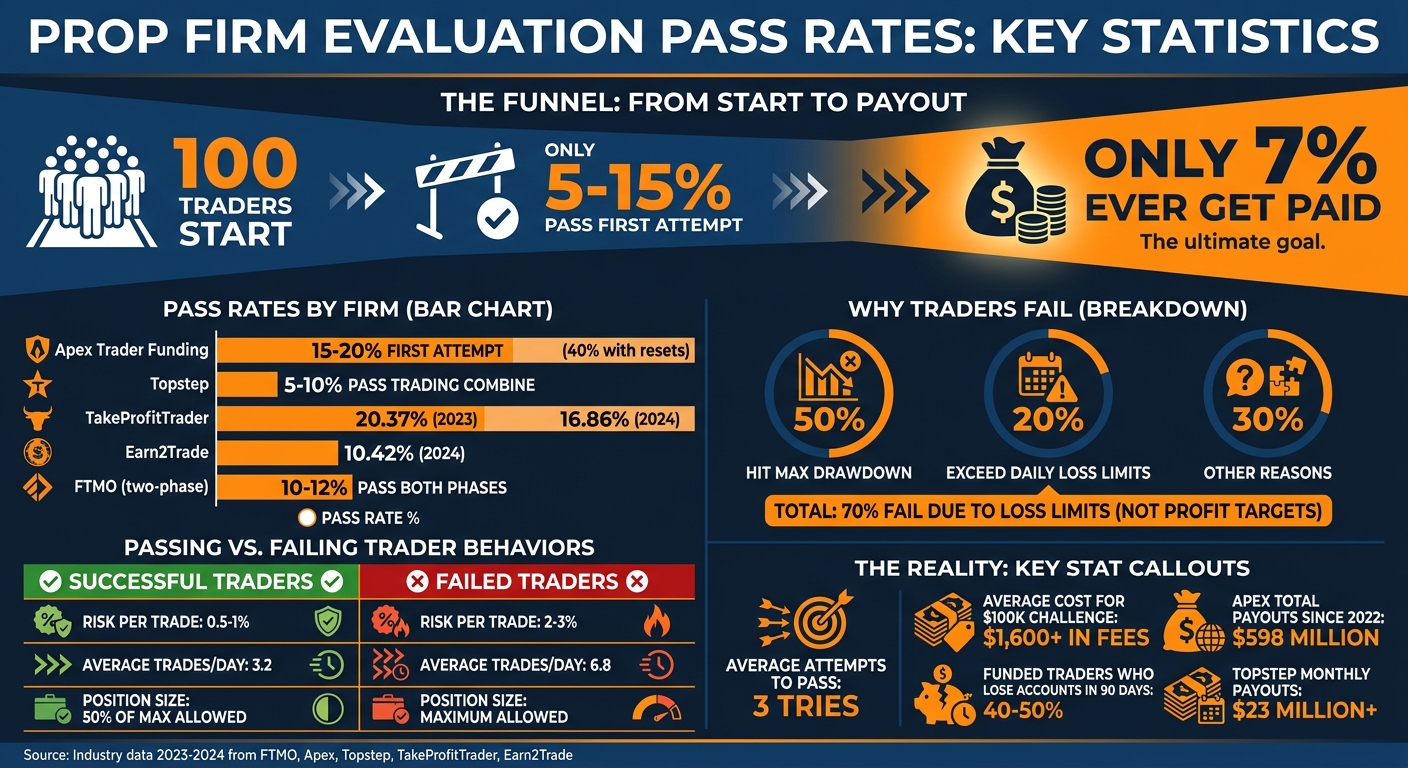
Only 5% to 15% of traders pass their prop firm evaluations on the first try. Even fewer – just 7% – ever see a payout. These numbers are brutal, but they’re not random. Most traders fail because they hit loss limits, not because their strategies don’t work. If you’ve been burning cash on retries, you’re not alone. The average trader needs three attempts to pass, racking up over $1,600 in fees for a $100k challenge.
This article breaks down the real pass rates at firms like Apex, FTMO, and Topstep, why traders fail, and what you can do to improve your odds. Whether you’re frustrated with trailing drawdowns or struggling with consistency rules, we’ll show you how to avoid the traps that kill most accounts. Let’s get into it.
Prop Firm Evaluation Pass Rates and Trader Success Statistics
Industry-Wide Pass Rate Data
Average Pass Rates Across All Firms
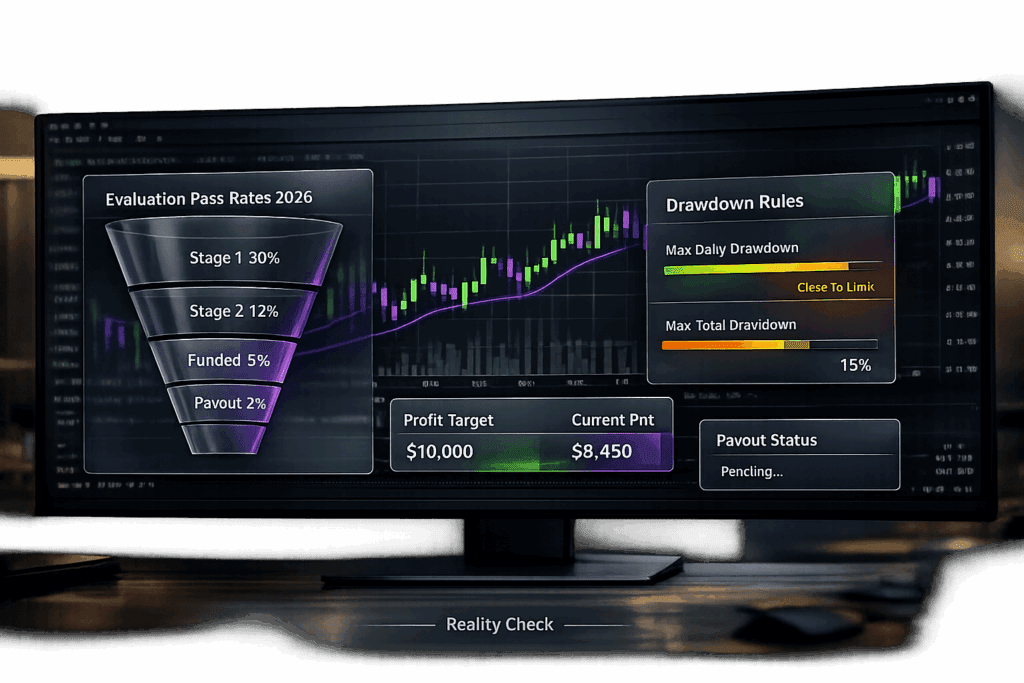
The stats across the prop trading world are tough to swallow: only 5% to 10% of traders pass their first evaluation attempt [2][5]. These evaluations are designed to test more than just profitability; they focus on consistency and strict risk management [2]. That means 85% to 95% of traders fail on their first try, and most need three attempts to finally succeed [3].
Single-phase evaluations tend to give traders slightly better chances. For example, firms like Topstep and Apex report first-attempt pass rates of 15% to 20%, while two-phase challenges, such as those from FTMO, see pass rates closer to 10% to 12% [3]. Between January and August 2023, Take Profit Trader recorded a 20.37% pass rate for its one-step evaluation process [5]. Meanwhile, in 2024, Earn2Trade reported a verified pass rate of 10.42% across its Trader Career Path and Gauntlet Mini evaluations [5].
Here’s the kicker: most traders don’t fail because they can’t hit profit targets. Instead, 70% fail due to loss limits – with 50% blowing their max drawdown and 20% hitting daily loss caps [3]. Gary M., founder of Trader’s Second Brain, put it bluntly:
Prop firms don’t publish pass rates because the numbers are sobering… Most people fail, but the reasons are fixable
[3].
But passing the evaluation is just the first hurdle. Turning that success into a payout is an entirely different challenge.
How Many Traders Actually Get Paid
Passing an evaluation is one thing, but only about 7% of traders who start an evaluation ever make it to their first payout [2][5]. The drop-off happens because many traders change their approach after getting funded. Some become too cautious, while others abandon the strategies that got them funded in the first place [3].
For two-phase firms like FTMO, the numbers tell a familiar story. Roughly 25% pass Phase 1, but only 10% to 12% clear both phases, and just 7% to 9% ever make a withdrawal [3]. Even after funding, the odds remain stacked against traders – about 50% lose their accounts within 90 days. Strict rules, like minimum trading days (8–10 days) and consistency requirements, often delay or prevent first withdrawals [3][5][7].
The payout data paints a clear picture of how challenging it is to succeed long-term. For example, Topstep paid out over $23 million in one recent month, but that came from a small group of traders who managed to pass and keep their accounts [5]. Apex Trader Funding, after introducing their "Apex 3.0" update, distributed $56 million in payouts over 90 days leading up to 2026. This update removed rigid payout windows and reportedly boosted pass rates by 10% to 15% [5].
FunderPro sums it up well:
Verified public sources consistently show low pass rates. Roughly 5 to 10% pass evaluations, and a smaller share maintain accounts long enough to withdraw profits
[5].
sbb-itb-46ae61d
How to Pass a Prop Firm Challenge in 2025 | 6 Proven Tips to Follow
Pass Rates by Firm
Here’s a breakdown of pass rates from some of the top futures prop firms. These numbers vary quite a bit, and knowing the odds upfront can save you a ton of money on repeated evaluation fees.
Apex Trader Funding Pass Rates
Apex claims first-attempt pass rates of 15% to 20% [5]. If traders use account resets, that number jumps to 40% [5]. Since 2022, the firm has paid out over $598 million [5].
One thing to watch out for is Apex’s intraday trailing drawdown. It’s different from the end-of-day drawdown some traders might be used to. If you don’t factor this in, your odds of failing on the first try could hit 85%. This shows how much the evaluation rules can affect your chances of success.
Topstep Pass Rates
Topstep’s pass rates are lower. Only 5% to 10% of traders pass their Trading Combine [5]. It gets even tougher after that – just 7% of those who pass end up making a withdrawal [5]. To put that into perspective, out of 100 traders starting the Combine, maybe 5 to 10 will pass, and fewer than one will actually cash out.
Even with these stats, Topstep has a solid reputation. They’ve earned a 4.6/5 rating on Trustpilot [5] and are known for their payout policy, which is considered the best in the industry [5]. Weekly payouts and no consistency rules make the funded phase easier once you’re in [8].
TakeProfitTrader Pass Rates
TakeProfitTrader takes a different approach with a one-step evaluation process, leading to higher pass rates. From January to August 2023, 20.37% of traders passed their Trading Test [5]. By 2024, that number dropped slightly to 16.86% for those advancing to PRO accounts [5].
This simpler structure helps with pass rates, and TakeProfitTrader also lets you withdraw profits right away on PRO+ accounts [5]. They’ve earned a 4.4/5 rating on Trustpilot from 7,773 reviews [5]. While their process is more accessible, it’s worth noting that around 80% of traders still don’t make it through.
What Actually Affects Pass Rates
Most traders fail evaluations because of their own actions and a lack of understanding about the rules firms set. Roughly 50% of failures are tied to hitting max drawdowns, while another 20% result from exceeding daily loss limits [3].
Consistency Rules and Drawdown Limits
Firm-specific rules like consistency checks and drawdown limits often trip traders up. Consistency rules are designed to ensure that traders aren’t relying on one big winning day to meet profit targets while lacking steady performance overall. Typically, firms won’t allow a single day’s profit to make up more than 30% to 50% of your total profit at payout [6][5]. Apex, for example, enforces this 30%-50% rule [4][5]. So, if you make $3,000 in profit but $2,000 of that comes from one day, you’ll likely fail the consistency check – even if you hit the profit target.
Then there are drawdown rules, which vary widely and can heavily influence your outcome. Firms generally use one of three types:
- Static Drawdown: A fixed level that never changes.
- End-of-Day (EOD) Trailing Drawdown: Adjusts at the end of the trading day based on your account balance.
- Intraday Trailing Drawdown: Adjusts during the session based on your peak unrealized profits [4][6].
Apex uses an intraday trailing drawdown [4][9], which is tough. Here’s why: if you’re up $500 during a trade and it pulls back, that $500 still raises your drawdown floor, possibly causing you to fail even though the trade ended in profit. Topstep, on the other hand, uses a static end-of-day drawdown [9], which is more forgiving since unrealized intraday gains don’t affect your failure threshold.
Trader Mistakes and Risk Management
Rules aside, how traders approach the evaluation process often determines success or failure. Position sizing and trade frequency are two big factors. Data shows that traders who pass evaluations average 3.2 trades per day, while those who fail average 6.8 trades per day [3]. Successful traders also risk less per trade – usually 0.5% to 1% of the account balance – compared to 2% to 3% for those who fail [3]. Gary M., founder of TradersSecondBrain, explains it well:
Passers average 3.2 trades per day vs 6.8 for failures. Higher trade frequency exposes traders to increased commissions, decision fatigue, and emotional trading [3].
Another common pitfall is trading at the maximum position size allowed. For example, on a $50,000 account, using 10 mini ES contracts means a 20-tick move could wipe out your entire drawdown [7]. To avoid this, try cutting your position size to half of the max allowed [3]. Adding a personal daily loss limit – like stopping at 50% of the firm’s threshold – can also help you avoid emotional or revenge trading [3][7].
How to Improve Your Pass Rate
Since 70% of failures come from hitting loss limits, tweaking your approach can make a big difference in improving your pass rate [3].
Use Low-Risk, Consistent Trading Methods
The numbers don’t lie: traders who pass evaluations typically risk only 0.5% to 1% of their account per trade. On the flip side, those risking 2% to 3% are the ones who usually fail [3][12]. For example, on a $50,000 account with a $2,500 drawdown, sticking to a 1% risk per trade gives you room for 5 to 10 losing trades before you’re in trouble [12].
Cut your position size to half of what the firm allows [3]. If the rules let you trade 10 mini ES contracts, stick to 5. Even better, try Micro E-mini contracts (MES/MNQ), which give you finer control over your risk – especially useful for smaller accounts [7][12].
Set your own daily loss limit at 50% of what the firm allows [3][7]. For instance, if the firm’s daily limit is $1,000, stop yourself at $500. This keeps you from falling into revenge trading, which can quickly wreck your evaluation.
Practice with Demo Accounts and Calculators
Before diving into a paid evaluation, test everything in a demo account. Make sure your strategy works under the exact conditions of the firm you’re targeting. This means following their rules to the letter – like closing trades by 3:50 PM CT or accounting for trailing drawdowns. Practicing this way builds habits and confidence without risking your money [5][1].
Use the firm’s calculators to stress-test your strategy. Plug in your win rate and risk-to-reward ratio to see if you can realistically hit the profit target without breaking the firm’s 5% daily or 10% total drawdown caps [3]. If your numbers don’t hold up over three separate 30-day periods, don’t waste your money on the challenge [11].
Also, check if your profits are consistent enough. Some firms have rules that no single day can account for more than 30% to 50% of your total profit [5][10]. If you rely on occasional big wins, those days could disqualify you from payouts – even if you hit the profit target.
Choose Firms That Fit Your Trading Style
Refining your strategy is only half the battle. Picking a firm that aligns with your trading style is just as important. As Gary M., founder of Trader’s Second Brain, says:
Prop firm selection is a matching problem, not a quality ranking
[11]. For example, if you have big single-day losses, avoid firms like Topstep with their strict 2% daily loss limit [11].
If you’re a swing trader who holds positions overnight, go for firms like FTMO or The5ers that allow it. Futures-focused firms like Apex and Topstep often require you to close trades before the session ends [11][6][7].
The type of drawdown matters too. Static drawdowns (used by FTMO and FundedNext) are based on your starting balance, making them easier to manage during losing streaks [11][6]. Trailing drawdowns, like those used by Apex and Topstep, track your peak equity, which can hurt traders with high intraday volatility or those who let profits run [11][6][7]. Apex does offer an end-of-day (EOD) drawdown option now, meaning your drawdown is only updated at market close. This is a better fit for intraday traders who don’t want unrealized gains messing with their drawdown floor [7][13].
Finally, keep an eye on time limits. Some firms still force you to hit targets in 30 days, while others like Apex, Topstep, and E8 Markets give you unlimited time. If you’re the kind of trader who waits for A+ setups, having no time limit is a must [11][1][13].
Conclusion
Prop firm evaluations are all about testing discipline, not just profitability. Industry stats show pass rates usually sit between 5% and 15%, with around 70% of failures coming from hitting loss limits – not missing profit targets[3].
This flips the focus: it’s less about chasing big wins and more about managing losses. Traders who pass typically risk only 0.5% to 1% of their account per trade, take an average of 3.2 trades daily, and use 60%-80% of the evaluation period. On the other hand, those who fail often risk 2%-3% per trade, average 6.8 trades a day, and rush to hit profit targets early on[3].
But passing is just step one. Around 40%-50% of funded traders lose their accounts within 90 days, and only about 7% of funded accounts ever see a payout[3]. Most traders need three tries to pass, so planning for multiple evaluation fees is smart.
The key here? Adapt your strategy to the firm’s rules. For instance, if you’re a swing trader with a 15% success rate at a firm like FTMO or Phidias Prop Firm (with static drawdowns), that rate might drop to 5% at a firm like Topstep, which uses trailing drawdowns[6]. Match your approach to the firm’s risk and drawdown rules. To up your odds, cut position sizes to about 50% of the max allowed, set tighter daily loss limits, and practice on demo accounts until you’ve nailed compliance with their rules[3][7].
Think of the evaluation as a test of risk management, not luck. These stats aren’t here to discourage you – they’re a roadmap to avoid common mistakes. Use them to fine-tune your strategy and improve your chances at every stage of the process.
FAQs
What pass rate should I realistically expect for my first evaluation attempt?
Realistically, your chances of passing a prop firm evaluation on the first try are about 10-20%. Most firms report pass rates in the 5-20% range. For example, Topstep estimates theirs at 15-20%, while Apex falls between 12-18%. Your success hinges on factors like how well you handle consistency rules and trailing drawdowns. The better prepared you are, the better your odds.
Which rule causes the most failures – daily loss limit, max drawdown, or consistency?
The maximum drawdown rule is hands-down the top reason traders fail prop firm evaluations. This rule, which sets strict overall loss limits, is often the hardest to work around. If you exceed it, you’re out. While daily loss limits and consistency rules also trip traders up, max drawdown is the biggest culprit. Why? Most of the time, it comes down to poor risk management during the evaluation period.
How can I improve my odds without buying multiple resets or retries?
To pass prop firm evaluations without burning money on resets, you’ve got to stick to disciplined trading and really know the firm’s rules inside and out. Focus on risk management, stay within drawdown limits, and aim for steady performance. Pick a firm whose rules match how you trade, and make sure you’re ready to meet things like minimum trading days. Matching your strategy to what the firm expects can make a huge difference in getting that funded account.