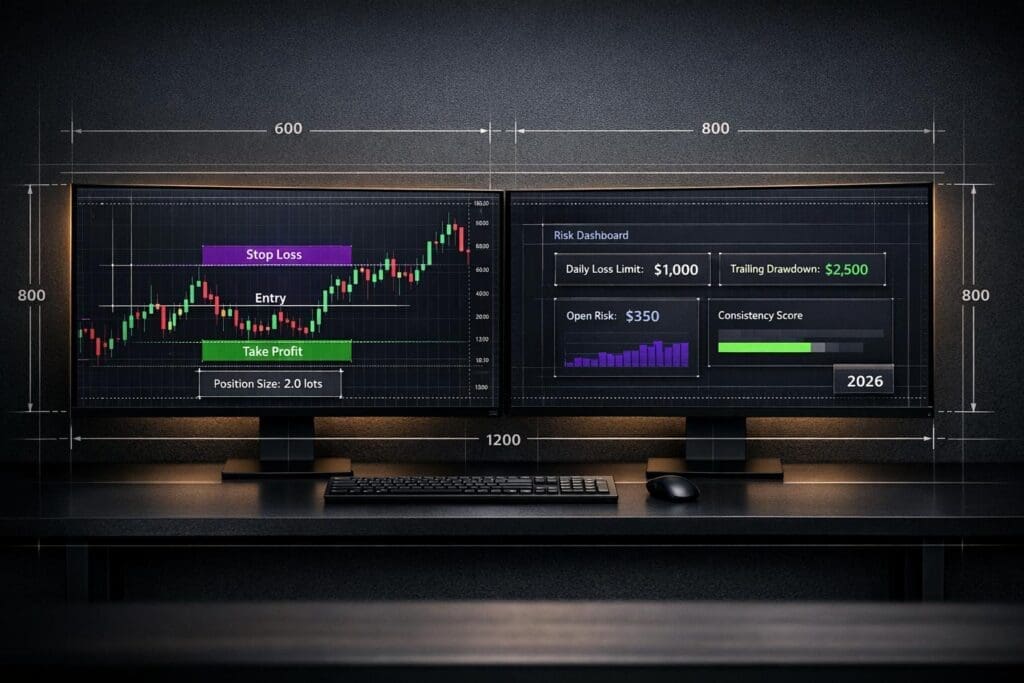
If you’ve ever blown up a prop account, you know the pain. One bad trade, and you’re done – no warnings, no second chances. Prop firms don’t care about your strategy or potential; they care about one thing: sticking to their risk rules. Whether it’s daily loss limits, unrealized trailing drawdowns, or consistency rules, crossing the line means game over.
This guide breaks down how to stay within those strict boundaries so you can actually keep your funded account and get paid. From position sizing to daily trade plans and avoiding consistency rule violations, I’ll show you how to trade smart within the firm’s limits. Let’s get into it.
STOP Blowing Prop Firm Accounts
sbb-itb-46ae61d
Know Your Prop Firm’s Risk Rules
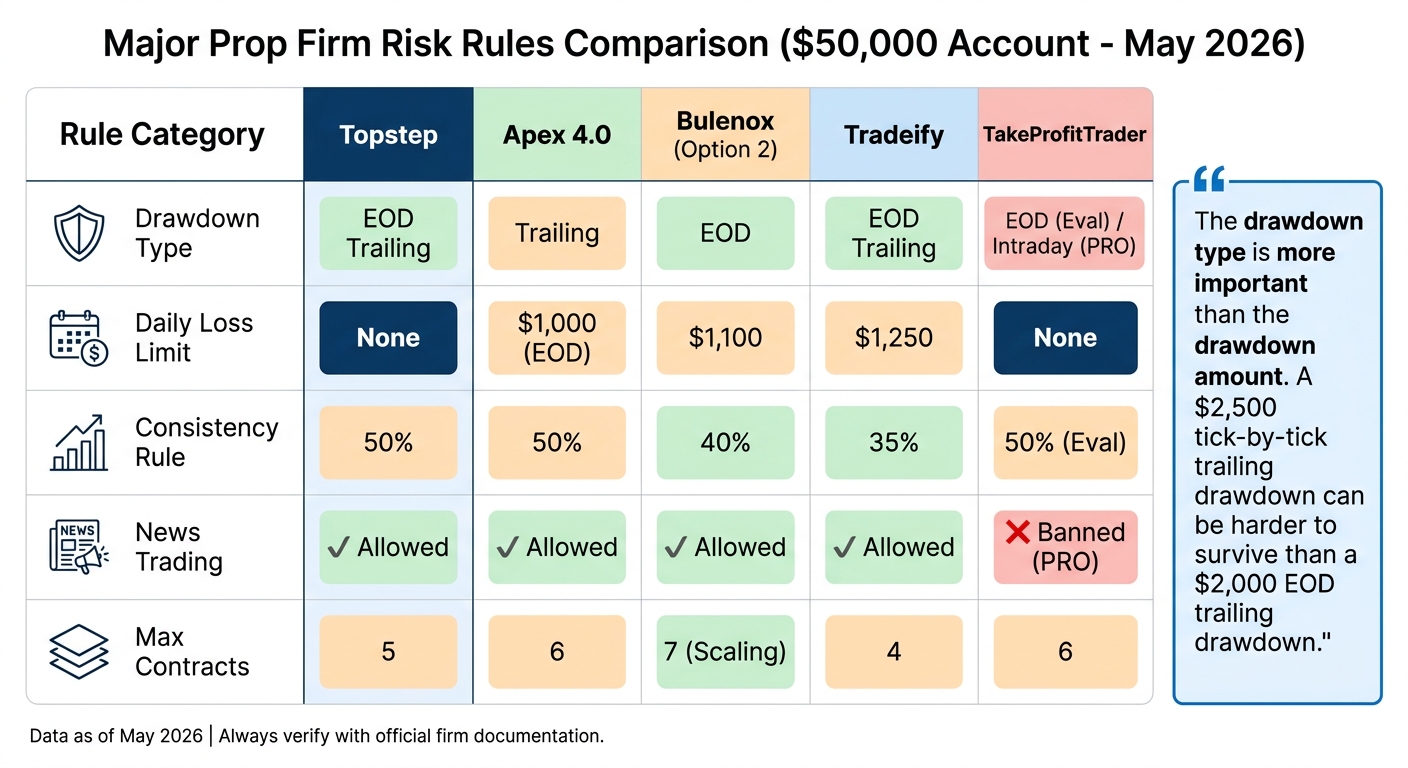
Prop Firm Risk Rules Comparison for $50K Futures Accounts (2026)
Before you start trading, make sure you know the rules. Every prop firm has its own risk parameters, and they can differ significantly. What might be fine at Apex Trader Funding could get your account terminated at Topstep. The difference between keeping your funded account and blowing it often comes down to understanding these rules. Let’s break them down so you can plan your trades wisely.
Main Risk Rules You Need to Track
There are three major rules you need to keep an eye on: drawdown type, daily loss limits, and consistency rules. These aren’t guidelines – they’re hard limits that can shut your account down if you cross them.
Drawdown type is a big one. It determines how your risk buffer adjusts during the day. Real-time (intraday) trailing drawdowns move tick-by-tick as your profits increase, meaning your drawdown floor rises with every unrealized gain. On the other hand, end-of-day (EOD) trailing drawdowns only update based on your account balance at the close of the trading day, giving you more breathing room during volatile swings. Some firms stick to EOD drawdowns, while others, like DayTraders, use a static drawdown that stays fixed throughout the session.
When it comes to daily loss limits, firms like Topstep enforce strict caps on evaluation accounts, while others rely on overall drawdown limits. To protect yourself, it’s smart to set personal loss limits below the firm’s cap – around 80% is a good rule of thumb. This way, you can account for slippage in fast-moving markets.
Consistency rules are designed to prevent you from relying on one big trading day to hit your profit target. As of May 2026, Apex Trader Funding enforces a 50% consistency rule (up from 30% in March 2026), meaning no single day can make up more than half of your total profits when you request a payout. Accounts purchased before March 2026 still follow the old 30% rule. Other firms set their thresholds between 35% and 50%.
Here’s a quick comparison of the major firms’ rules for a $50,000 account as of May 2026:
| Rule | Topstep | Apex 4.0 | Bulenox (Opt 2) | Tradeify | TakeProfitTrader |
|---|---|---|---|---|---|
| Drawdown Type | EOD Trailing | Trailing | EOD | EOD Trailing | EOD (Eval)/Intraday (PRO) |
| Daily Loss Limit | None | $1,000 (EOD) | $1,100 | $1,250 | None |
| Consistency Rule | 50% | 50% | 40% | 35% | 50% (Eval) |
| News Trading | Allowed | Allowed | Allowed | Allowed | Banned (PRO) |
| Max Contracts | 5 | 6 | 7 (Scaling) | 4 | 6 |
"The drawdown type is more important than the drawdown amount. A $2,500 tick-by-tick trailing drawdown can be harder to survive than a $2,000 EOD trailing drawdown."
Real-time trailing drawdowns require you to lock in profits quickly and manage tight stops, as giving back unrealized gains immediately reduces your risk buffer. Meanwhile, EOD structures let you ride out intraday volatility more comfortably.
Recent Rule Changes
Keeping up with rule changes is just as important as knowing the current ones. Prop firms update their rules frequently – usually every 3-6 months – so relying on outdated info can cost you. Here are some key updates as of May 2026:
- Apex raised its consistency rule from 30% to 50% in March 2026 (legacy accounts stay at 30%).
- Topstep introduced No Activation Fee Trading Combines in November 2025.
- Topstep updated its Express Funded Accounts (XFA) payout rules in December 2025.
- TakeProfitTrader changes drawdown rules when you move from evaluation to funded status. They use an EOD trailing drawdown during evaluation but switch to stricter intraday monitoring for PRO accounts. This can make trading live significantly harder than during evaluation.
Why You Should Check Official Documentation
Here’s a sobering stat: 93% of prop firm traders never get a payout, and the main reason is drawdown violations – not bad strategies[1]. Most of these violations happen because traders rely on outdated or incomplete rule info.
Don’t trust marketing pages or third-party reviews to give you the full picture – they often miss critical details in the fine print. To avoid surprises, always check the firm’s official documentation. For example:
- Apex Trader Funding: support.apextraderfunding.com
- Topstep: help.topstep.com
For other firms, visit their help centers or FAQs. Don’t depend on blogs or YouTube videos – the rules they reference might already be outdated.
On our individual prop firm reviews, we include "as of [Month Year]" notes for every rule and link directly to the official documentation so you can verify it yourself. We update our content regularly, but it’s always smart to double-check with the firm before funding an account. Knowing these rules is the first step to building a solid trade plan.
Calculate Position Sizes Based on Drawdown Limits
Now that you’ve got the rules down, let’s figure out how many contracts you can trade without blowing your account’s drawdown. A lot of traders mess this up by risking too much on each trade.
How to Calculate Position Sizes
The formula is simple: Number of Contracts = (Risk Amount) / (Stop Loss Distance × Point Value). But here’s the trick – don’t base your risk amount on the total account balance. Instead, use 1% of your drawdown buffer.
For example, if you’ve got a $100,000 account with a $3,500 drawdown, risking 1% of your balance ($1,000) means you’re actually risking 28.5% of your account’s life[2]. That’s a fast track to disaster. Instead, risk 1% of the $3,500 drawdown buffer – just $35. This keeps you within the firm’s limits and protects your account.
Let’s break it down further. Say you’re trading ES (E-mini S&P 500) with an 8-point stop loss. Each point is worth $50, so your risk per contract is $400. If your risk cap is $35 per trade, one ES contract blows right through that limit. Instead, trade MES (Micro E-mini S&P 500), where an 8-point stop equals $40. With MES, you can trade one micro contract and stay within your $35 risk limit.
Here’s a quick cheat sheet for common futures contracts:
| Contract | Symbol | Point Value | Tick Value | Notional Value (at 5,000 Index) |
|---|---|---|---|---|
| S&P 500 E-mini | ES | $50 | $12.50 | $250,000 |
| S&P 500 Micro | MES | $5 | $1.25 | $25,000 |
| Nasdaq 100 E-mini | NQ | $20 | $5.00 | $400,000 (at 20k) |
| Nasdaq 100 Micro | MNQ | $2 | $0.50 | $40,000 (at 20k) |
If the Average True Range (ATR) doubles, cut your position size in half to keep your dollar risk steady[2]. For example, trading one NQ contract on a 250-point ATR day is way riskier than on a 150-point day. Always adjust your stop loss and position size based on market conditions.
Examples of Risk Per Trade
Here are a few scenarios to show how position sizing changes based on your drawdown buffer and stop loss. These examples assume an 8-point stop ($400 risk per contract) for ES.
| Account Size | Typical Drawdown | 1% of Drawdown (Max Risk) | ES Contracts (8-pt stop) |
|---|---|---|---|
| $25,000 | $1,500 | $15 | 1 micro (MES) |
| $50,000 | $2,500 | $25 | 1 micro (MES) |
| $100,000 | $3,500 | $35 | 1 micro (MES) |
| $150,000 | $5,000 | $50 | 1 mini (ES) |
| $50K (with $3K profit) | $3,000 cushion | $30 | 1 micro (MES) |
Even with a $150,000 account, you’re only trading one mini ES contract if you’re playing it safe. As Brett Simba from Tradeify puts it:
"The only capital that truly matters is the distance between the current balance and the Trailing Maximum Drawdown floor"[2].
Don’t forget to account for slippage. A 10-pip slippage over five trades on a 2-standard lot position can eat up $1,000 – 20% of a $5,000 daily drawdown limit[3]. Always leave a buffer, especially during high-volatility events[3].
Calculators That Make This Easier
To simplify all this math, use a calculator. We’ve built a Prop Firm Position Sizer tool on DamnPropFirms that lets you plug in your account size, drawdown buffer, and stop loss distance. It calculates how many contracts you can trade for ES, NQ, MES, MNQ, and other futures.
If you’re on TradingView, there’s a “Prop Firm Position Sizer” indicator that automates these calculations right on your chart. You just input your account size and risk percentage[2]. Platforms like x-trade.ai even enforce daily loss limits and adjust for volatility automatically, so you don’t accidentally overtrade[1].
Build a Daily Trade Plan
Once your position sizes are dialed in, the next step is creating a disciplined daily trade plan. Most traders don’t blow up their accounts because their strategy is bad – it’s usually because they’re winging it without a solid plan. A clear daily plan keeps you grounded and helps you avoid emotional trades when the market gets wild. Let’s break it down.
Set Risk Per Trade and Loss Limits
Start by defining your max risk per trade and your daily stop-loss. A good rule of thumb is the 1% drawdown rule. For example, if your drawdown buffer is $2,500, you’d risk about $25 per trade. On top of that, set a personal daily loss limit at 25–30% of your total drawdown buffer. Using the same $2,500 buffer, your daily stop should land somewhere between $625 and $750. This gives you a cushion before hitting the firm’s hard limits.
Here’s a cheat sheet for common account sizes:
| Account Size | Typical Drawdown | Max Risk/Trade (1% of DD) | Daily Loss Limit (25–30% of DD) |
|---|---|---|---|
| $25,000 | $1,500 | $15 | $375 – $450 |
| $50,000 | $2,500 | $25 | $625 – $750 |
| $100,000 | $3,500 | $35 | $875 – $1,050 |
| $150,000 | $5,000 | $50 | $1,250 – $1,500 |
Another rule to stick to is the three-strike rule: if you lose three trades in a row, stop trading for the day. This isn’t just about money – it’s about recognizing when your market read is off or you’re trading emotionally. To make things easier, automate your daily loss limit at 80% of the firm’s official limit. That way, the platform shuts you down before emotions take over.
Plan Your Entry and Exit Points
Before the bell rings, pick 1–2 instruments (like ES and NQ) and stick to trading during high-volatility sessions – 9:30 to 11:00 AM ET is a solid window. Limit yourself to three trades per day, and always use a stop-loss with your orders. No mental stops allowed. For ES, that means setting stops at 8–12 ticks.
Your profit target should be at least 1.5× your risk. If you’re risking $25, aim for $37.50 or more in profit. Also, use “time stops.” If a trade isn’t moving your way within 15–20 minutes, close it and save your capital for a better setup.
Here’s an example of what a trade plan might look like:
| Component | Rule/Parameter | Example (50K Account) |
|---|---|---|
| Markets | Stick to 1–2 instruments | ES, NQ only |
| Session Window | Focus on high-volatility hours | 9:30–11:00 AM ET |
| Max Trades/Day | Limit entries to this number | 3 trades max |
| Risk Per Trade | 1% of drawdown buffer | $25 per trade |
| Daily Stop-Loss | 25–30% of drawdown buffer | $625–$750 |
| Stop-Loss Type | Always use hard stops | 8–12 ticks on ES |
| Profit Target | Minimum reward-to-risk ratio | 1.5× risk |
The key is sticking to these rules, no matter what the market throws at you.
Adjust for Market Conditions
Markets don’t stay the same every day, so your plan shouldn’t either. On days with high volatility (like when NQ’s ATR spikes from 150 to 250 points), reduce your contract size to keep your dollar risk consistent. Before major news releases like CPI, FOMC, or NFP, either sit out entirely or cut your position size in half to avoid slippage that could blow through your stops.
If you’re within 30% of your drawdown limit, tighten up your risk per trade to 0.25–0.5%. And if you’ve burned through 60% of your weekly drawdown buffer by midweek, slash your position sizes by 50% for the rest of the week. On the flip side, after a big profit day, scaling down your next session can help lock in consistency. You can also use a consistency calculator to ensure your profits stay within firm-specific payout rules. Remember, 93% of prop traders don’t get paid – not because they lack skill, but because they bust their drawdown limits[1].
Lastly, check the economic calendar every morning. If there’s high-impact news on the schedule, make sure your drawdown buffer is solid and set a hard cap on your trade count for the day. This quick pre-session routine can save you from impulsive trades when the market gets tricky. Combining precise position sizing with a solid daily plan is your best defense against blowing up your account.
Follow Consistency Rules in Your Trade Planning
Consistency rules are a common stumbling block for prop traders. Even if your drawdown management is flawless, it won’t matter if one trading day accounts for too much of your total profit. Firms like Apex Trader Funding (which bumped its rule from 30% to 50% in March 2026 – legacy accounts before that date still follow the 30% rule) and Topstep use these rules to filter out traders who might get lucky on a single day but can’t consistently replicate their results. The reasoning is straightforward: firms are looking for traders with a repeatable edge, not one-hit wonders.
What Consistency Rules Mean
A consistency rule limits how much of your total profit can come from a single day. For example, if Apex enforces a 50% rule and you earn $1,000 during your evaluation, no single day’s profit can exceed $500. If one day does surpass that limit – even if you hit the profit target – you could still fail the evaluation. As x-trade.ai puts it:
"Don’t just hit the profit target. Make sure your daily P&L distribution is compatible with the firm’s consistency requirement"[1].
Each firm sets its own threshold, so it’s essential to review the rules before you start trading.
| Firm | Consistency Rule (%) | Min. Trading Days |
|---|---|---|
| Tradeify | 35% | 1 (Eval) |
| Bulenox | 40% | 10 |
| Topstep | 50% | – |
| Apex 4.0 | 50% | 5 (for payout) |
| TakeProfitTrader | 50% (Eval) | 5 |
Adjust Trade Sizes and Frequency
If you have a big winning day early in your evaluation, don’t panic. It doesn’t mean you’re automatically disqualified. You can balance out that day’s impact by trading more and spreading your profits across additional days. For example, if you made $600 on Day 1 under a 50% rule, you’d need to earn at least another $600 over the next few days to bring your total profit to $1,200. That way, your big day accounts for exactly 50% of your total profit.
Keep an eye on your "Best Day" metric by comparing your highest single-day profit to your cumulative total. If that ratio starts creeping too close to the firm’s limit, shift your focus to smaller, consistent wins to dilute the impact of that big day[1]. Regularly updating your records will help you stay on track and make any necessary adjustments to your trading plan.
Track Your Consistency Metrics
Use a simple spreadsheet or the Consistency Rule Calculator on Damn Prop Firms to monitor your daily profit and loss. Update your records after every session, and set alerts when any day’s profit reaches 40% of your total. This gives you a buffer to stay under the firm’s limit. Incorporate these checks into your daily routine to ensure your performance stays balanced and aligned with the firm’s requirements.
Set Trading Rules and Review Your Performance Weekly
Once you’ve nailed down your daily trade plan, the next step is sticking to it with strict rules and weekly check-ins. A solid plan can still fall apart if emotions get the better of you, so setting up your own guardrails is essential to keep you from hitting the firm’s limits. Brett Simba from Tradeify sums it up perfectly:
"Overtrading is the moment when a disciplined sniper turns into a machine gunner, triggering impulsive, unfocused trades."[5]
Rules to Keep Overtrading in Check
These rules are like an extra layer of protection on top of your trade plan. One of the best tools I’ve seen is the 15-Minute Rule: if you lose two trades in a row, step away from your screen for 15 minutes. This short break can clear your head and stop you from spiraling into emotional decision-making.[5]
Another handy rule is the 10-Second Rule. If you can’t commit to holding a trade for at least 10 seconds, it’s probably not a well-thought-out setup – just a knee-jerk reaction.[5]
Limit yourself to three high-quality setups per day. If you hit that number, any trades beyond that are likely overtrading. Remember, your firm’s Daily Loss Limit is there as a last line of defense. If you hit it, your account will pause until the next session, giving you time to reflect on any emotional trading habits.[5]
Make Weekly Trade Reviews a Habit
Set aside 30–60 minutes every week – on the same day if possible – to go over your trades. Start by calculating your best single day as a percentage of your total weekly profits. This tells you how consistent you are. For example, if you’re trading with Apex or Topstep, that percentage should stay below 50%.[1]
Next, check if you followed your rules. Did you close all your positions before the session ended? Did you let your trailing drawdown creep up during a winning streak, only to get burned on a pullback? These reviews are your chance to spot where you strayed from your risk management plan.
Also, track your emotions during trades. Look for patterns like FOMO or revenge trading – maybe you’re overtrading on Fridays or chasing setups after missing one earlier in the day.[4][5] Catching these tendencies early can save you from costly mistakes down the line.
Tap Into Trading Communities for Feedback
Trading doesn’t have to be a solo grind. Join a group like the DGT Discord, where over 3,000 active futures traders hang out. Share your weekly reviews, ask questions about setups, and get advice from traders who’ve already passed the firms you’re aiming for. Sometimes, someone else might notice a pattern you’ve overlooked – like overtrading in the first hour of the session or getting too aggressive after a win streak. A good community keeps you accountable and helps you stick to your plan. Combining this feedback with your weekly reviews will strengthen your discipline and improve your overall trading game.
FAQs
How do I calculate my risk buffer with a trailing drawdown?
Your risk buffer is the gap between your peak account equity and the trailing drawdown limit. This limit moves based on your highest equity. For instance, if your peak equity hits $10,000 and the trailing drawdown is 5%, your buffer is $500. Keep an eye on your peak equity and make sure your trades stay within this range to avoid resets or losing your account.
When should I switch from minis to micros to stay safe?
Switch to micro contracts when your trade size gets close to your prop firm’s risk limits, like drawdown or daily loss caps. This simple adjustment can help you stay within the rules and avoid costly resets.
If your current trade size risks too much compared to your account balance – or you’re flirting with a 2-3% daily loss cap – scaling down to micros can give you tighter control over your exposure while keeping your risk in check.
How can I avoid breaking the 50% consistency rule after a big win day?
To stick to the 50% consistency rule, spread your wins across multiple days instead of banking on one massive trade. Most firms cap daily profits at 20–50% of your total, and going over that limit can mess with payouts or trigger compliance headaches. Keep an eye on your daily profit percentages and use tracking tools to make sure your gains are steady over time. This approach keeps you within the rule and avoids unnecessary delays.