When choosing between Apex Trader Funding and Lucid Trading, it comes down to your trading style and priorities. Apex, established in 2021, offers high funding limits, multi-account management (up to 20 accounts), and a 100% profit split for the first $25,000. However, it uses an intraday trailing drawdown and processes payouts bi-weekly. On the other hand, Lucid Trading, founded in 2025, focuses on end-of-day drawdowns, faster payouts (15 minutes), and no recurring fees for most accounts. But it limits traders to managing 5 accounts with a maximum funding cap of ~$750,000.
Key Points:
- Apex: $3M funding cap, intraday trailing drawdown, bi-weekly payouts, $85 monthly fee for funded accounts.
- Lucid: $750K funding cap, end-of-day drawdown, 15-minute payouts, one-time account fees.
Quick Comparison:
| Feature | Apex Trader Funding | Lucid Trading |
|---|---|---|
| Drawdown Type | Intraday Trailing | End-of-Day |
| Payout Speed | Bi-weekly (8+ days) | ~15 Minutes |
| Profit Split | 100% (First $25K), then 90% | 90% |
| Max Accounts | 20 | 5 |
| Max Funding | $3,000,000 | ~$750,000 |
| Fees | $85/month (funded accounts) | One-time fee (most accounts) |
If you’re a high-volume trader managing multiple accounts, Apex might suit you. If flexibility during volatile sessions and fast payouts matter more, Lucid is the better option. Choose based on what aligns with your trading strategy.
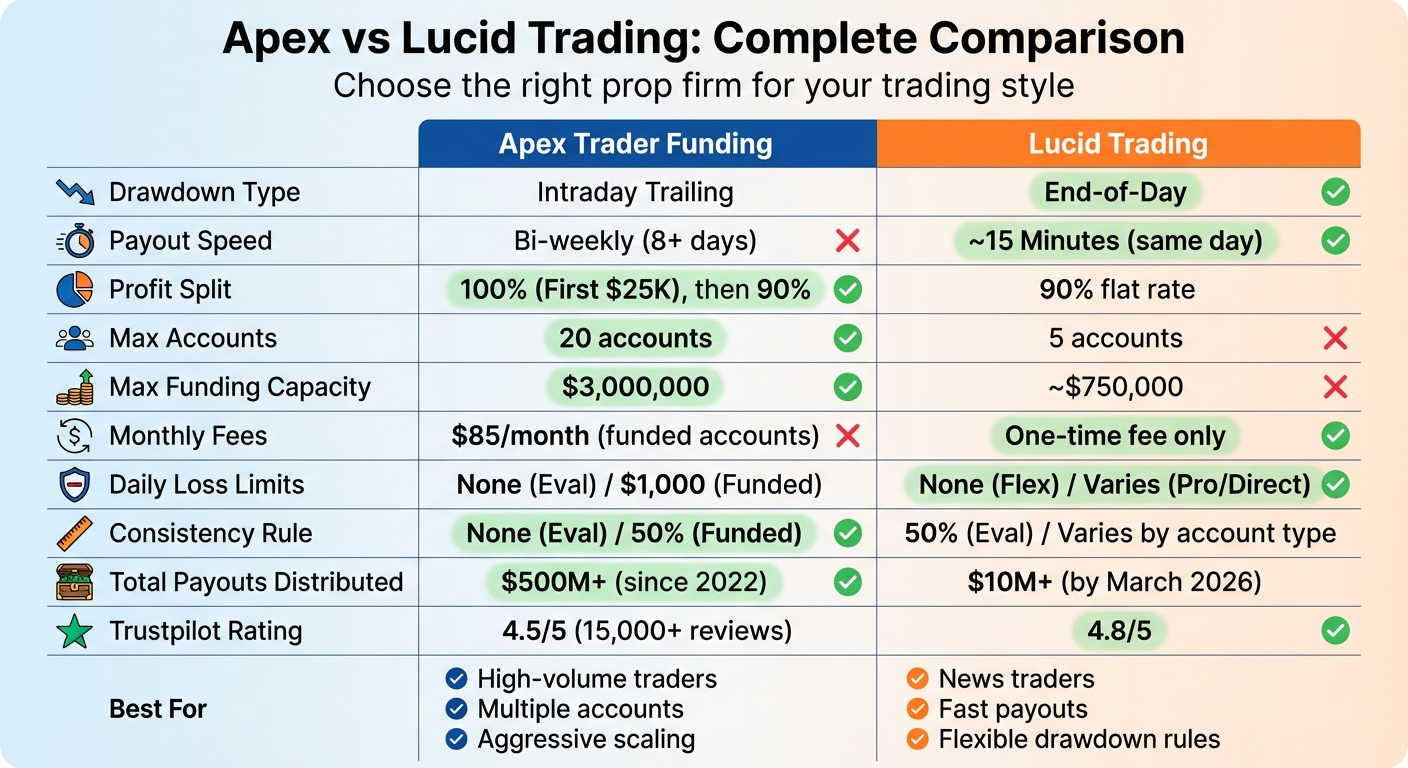
Apex vs Lucid Trading: Complete Feature Comparison Chart
Lucid Black vs Lucid Pro Apex Laughs with 20 Accounts Who Wins in 2026
sbb-itb-46ae61d
Apex Trader Funding: Account Features and Rules

These features highlight Apex’s focus on offering flexibility and performance, laying the groundwork for later comparisons.
Account Sizes and Evaluation Requirements
Apex provides evaluation accounts ranging from $25,000 to $300,000, catering to traders at any skill level. For instance, a $100,000 account costs $207 per month, requires a $6,000 profit target, and includes a $3,000 trailing drawdown [7]. A $50,000 account is priced at $167 monthly with a $3,000 profit target, while the $300,000 account comes with a $20,000 profit target and a $677 monthly fee [7].
Most accounts feature an intraday trailing drawdown, which locks in once the balance reaches the initial deposit plus $100 [9, 12]. However, the $100,000 Static account operates differently, using a fixed $625 drawdown and requiring a $2,000 profit target [8].
Apex also enforces a 30% consistency rule during the funded phase. This means no single trading day can contribute over 30% of the total profits in a payout cycle [10, 11, 12]. Additionally, all positions must be closed by 4:59 PM ET daily, and traders must complete a minimum of 7 trading days during the evaluation phase [9, 12]. Promotional discounts can significantly lower costs – for example, reducing a $50,000 evaluation fee to as little as $33 [12, 15].
Let’s now explore Apex’s payout structure and account scaling options.
Payout Process and Account Scaling
Apex allows traders to keep 100% of their first $25,000 in profits, after which they move to a 90/10 profit split [9, 10, 12]. Payouts are processed either every 8 trading days or twice monthly [9, 12]. Since 2022, Apex has distributed over $500 million in payouts, with the largest single payout reaching $2.5 million [8].
Traders can manage up to 20 performance accounts simultaneously, with copy trading available to streamline operations [9, 10, 12]. This setup enables skilled traders to potentially withdraw up to $70,000 within their first 8 days by scaling multiple accounts [8]. Activation fees for accounts range from $85 to $145 [8].
Next, let’s look at how Apex enhances the trading experience through its platform options and community feedback.
Trading Platforms and Community
Apex supports a variety of trading platforms, including NinjaTrader 8, Tradovate, Rithmic, WealthCharts, and TradingView [9, 10, 12]. NinjaTrader 8 stands out with its advanced charting tools and strategy automation, offering funded traders a free license key. Tradovate provides browser-based access across web, desktop, and mobile devices, making it convenient for traders on the go [9].
Apex has earned a 4.5/5 rating on Trustpilot from over 15,000 reviews [10, 12]. Many traders appreciate the fast payouts and frequent promotional discounts, though some mention that the real-time trailing drawdown can be challenging for those used to end-of-day calculations [10, 12].
Lucid Trading: Account Features and Rules
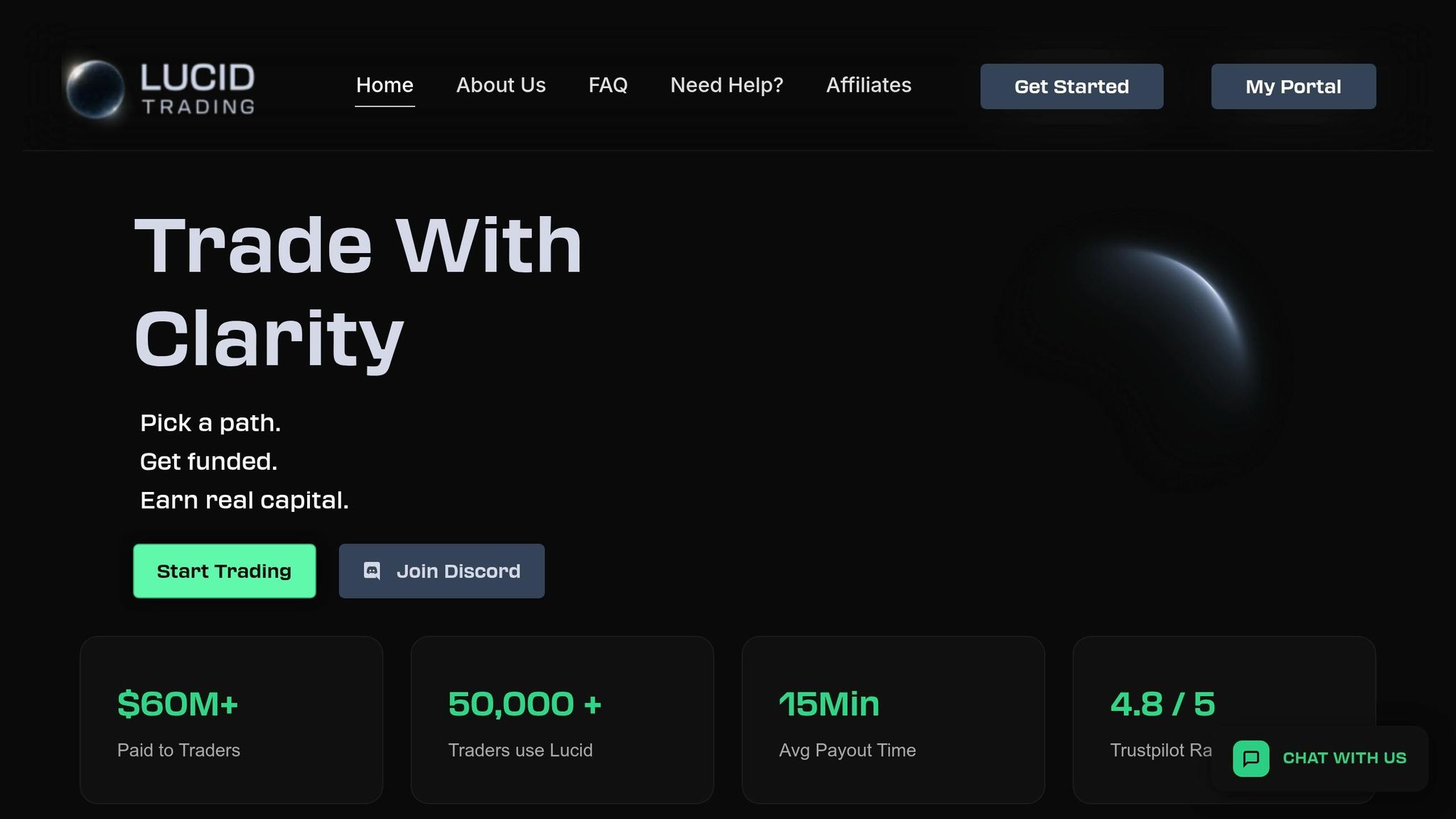
Lucid Trading stands out with its one-time evaluation fees and an end-of-day drawdown system, which gives traders more flexibility during volatile trading sessions. By March 2026, the firm had paid out over $10 million to more than 14,000 traders and earned a 4.8/5 rating on Trustpilot [4].
The platform’s account structure is designed to cater to a variety of trading styles, offering models that suit both aggressive scalpers and news traders.
Account Types and Evaluation Requirements
Lucid Trading provides four main account options: LucidFlex, LucidPro, LucidDirect, and the exclusive LucidMaxx.
- LucidFlex: Ideal for traders who value freedom, this account removes daily loss limits and post-funding consistency rules. For instance, a $100,000 LucidFlex account costs $295 as a one-time fee, requires a $6,000 profit target, and includes a $3,000 end-of-day trailing drawdown. A $50,000 account option is available for $175 with a $3,000 profit target [10].
- LucidPro: Updated in February 2026, this account is tailored for aggressive traders. It allows traders to pass the one-phase evaluation in a single day and withdraw profits every three days. A $100,000 LucidPro account is priced at $199.50, with a $6,000 profit target, a daily loss limit, and a 40% consistency rule during the funded phase [10].
- LucidDirect: This option skips the evaluation process entirely, offering instant funding. Pricing depends on the chosen account size [10].
- LucidMaxx: An invite-only account available to select traders.
All account types use an end-of-day trailing drawdown, which calculates drawdown based on the closing balance rather than intraday fluctuations. As one trader noted:
"The end-of-day trailing drawdown offers a forgiving structure by safeguarding against temporary intraday fluctuations."
Traders must close all positions by 4:45 PM EST daily, and there are no time limits for completing evaluations.
This diverse account lineup supports Lucid Trading’s reputation for fast payouts and scalable accounts.
Payout Speed and Account Scaling
Lucid Trading’s payout system is among the fastest in the industry. Payouts are processed within 1 to 15 minutes, with funds typically arriving the same day via Plaid. This outpaces the standard processing time of 1–3 business days. Traders keep 90% of their profits across all plans, and LucidPro and LucidDirect accounts allow traders to keep 100% of their first $10,000 in payouts.
Payout frequency depends on the account type. LucidFlex requires five profitable trading days per cycle, while LucidPro allows withdrawals every three days. Traders can manage up to five funded accounts at once. After four to six payouts, accounts transition to LucidLive, a live trading environment with an 80/20 profit split [10].
Trading Platforms and Community
Lucid Trading supports a variety of platforms, including NinjaTrader 8, Tradovate, TradingView (via Tradovate), MotiveWave, Quantower, and Sierra Chart. News trading is fully permitted, even during high-impact events like FOMC, NFP, and CPI releases.
The firm’s 4.8/5 Trustpilot rating reflects strong trader satisfaction. Users frequently highlight the 15-minute payout approval process and the absence of daily loss limits on Flex accounts as major advantages. However, some traders have mentioned that the $500 minimum withdrawal is higher than competitors, and the 80/20 profit split on LucidLive is less appealing compared to the 90/10 split offered on simulated accounts.
Lucid Trading’s wide range of account options, fast payouts, and support for different trading styles make it a strong choice for traders, standing alongside the best futures prop firms like Apex in offering tailored solutions.
Apex vs Lucid: Direct Comparison
Looking at the core features and rules outlined earlier, this section dives into the key differences between Apex Trader Funding and Lucid Trading. Your choice between these two firms depends on how their rules, payout systems, and account structures align with your trading preferences. While both firms share features like one-step evaluations and support for news trading, their approaches to drawdowns, profit splits, and account management differ in ways that could significantly impact your strategy.
Evaluation Rules
Apex uses an intraday trailing drawdown, which updates in real time based on unrealized profits. This means a position that temporarily moves against you could trigger a violation, even if it eventually closes in profit. By contrast, Lucid calculates drawdowns at the end of the trading day, giving traders more flexibility during volatile sessions – a useful feature for those navigating unpredictable intraday swings. Other firms, such as TradeDay, also offer EOD drawdown options to help manage this risk.
Daily loss limits also vary. Apex imposes no daily loss limits during evaluations but sets a $1,000 daily limit for funded $50,000 accounts. Lucid’s LucidFlex account eliminates daily loss limits entirely, while LucidPro and LucidDirect accounts do include restrictions.
| Feature | Apex Trader Funding | Lucid Trading |
|---|---|---|
| Drawdown Type | Intraday Trailing | End-of-Day |
| Daily Loss Limit | No limit (Eval) / $1,000 (Funded) | No limit (Flex) / Varies (Pro/Direct) |
| Consistency Rule | None (Eval) / 50% (Funded) | 50% (Eval) / Varies (Funded) |
| Min. Trading Days | 1–7 Days | 1–3 Days |
| Max Accounts | 20 | 5 |
The prop firm consistency rule is another point of distinction. Apex does not enforce consistency during evaluations but applies a 50% rule once funded. Lucid, on the other hand, requires 50% consistency during evaluations for Flex and Pro accounts. Once funded, this requirement varies: Flex accounts have no consistency rule, Pro accounts apply 40%, and Direct accounts apply 20% [1].
These evaluation differences are just the beginning. Payout systems and account scaling options further highlight how these firms cater to different trader needs.
Payouts and Scaling
Lucid stands out with its rapid payout processing. Withdrawals are approved within about 15 minutes via Plaid or cryptocurrency, allowing same-day access to funds [5]. Apex, however, processes payouts on a bi-weekly schedule, with withdrawals handled on the 1st and 15th of each month [6]. For traders who prioritize quick access to profits, Lucid’s system offers a clear advantage.
Profit-sharing models also differ. Apex provides a 100% profit split on the first $25,000 earned, which then shifts to a 90/10 split. Lucid maintains a flat 90/10 split across all accounts. In terms of funding capacity, Apex supports up to 20 funded accounts with a combined cap of $3,000,000, while Lucid limits traders to 5 funded accounts with a maximum range of $750,000–$800,000 [1][3].
| Feature | Apex Trader Funding | Lucid Trading |
|---|---|---|
| Profit Sharing | 100% (First $25K), then 90% | 90% |
| Payout Frequency | Bi-weekly / Every 5–10 days | On-Demand / Same-Day |
| Withdrawal Approval Time | 8+ Days | ~15 Minutes |
| Account Setup Fee | ~$79–$85 | $0 (most accounts) |
| Max Funding | $3,000,000 | ~$750,000–$800,000 |
| Multi-Account Support | Yes (up to 20) | Yes (up to 5) |
Apex charges a recurring $85/month Performance Account fee, while Lucid operates with a one-time fee structure, eliminating monthly costs. Additionally, Lucid allows unlimited withdrawals on both simulated and live funded accounts. Apex, on the other hand, caps live account withdrawals at $25,000 per day [3].
For more details, check out our in-depth reviews of Apex Trader Funding and Lucid Trading.
Which Firm Fits Your Trading Style
Finding the right firm for your trading style means weighing account features, drawdown policies, and payout systems.
If you’re a high-volume trader who thrives on aggressive scaling, Apex Trader Funding might be your ideal match. They allow you to manage up to 20 accounts with a combined funding capacity of $3,000,000. Plus, they offer a 100% profit split on the first $25,000 for each account. However, keep in mind that Apex enforces stricter intraday drawdown rules, which require careful risk management[11].
For news traders or those just starting out, Lucid’s LucidFlex account provides more breathing room. Its End-of-Day trailing drawdown feature helps you avoid stop-outs during high-volatility events like NFP or FOMC announcements. Additionally, LucidFlex eliminates daily loss limits and funded consistency rules, making it a forgiving option for newer traders. As Paul from PropTradingVibes puts it:
"LucidFlex is the forgiving option. No daily loss limit. No funded consistency rule… Most traders should start here."[2]
Payout speed is another key factor. Lucid stands out with lightning-fast withdrawals, often processing them in about 15 minutes via Plaid ACH, meaning you could see your funds the same day[2]. On the other hand, Apex follows a bi-weekly payout schedule, typically on the 1st and 15th of each month. This could mean waiting over a week to access your earnings[3].
Fee structures also vary significantly. Apex charges an $85 monthly Performance Account fee once you’re funded[3]. Lucid, however, uses a one-time fee model with no recurring costs. For example, a 50K LucidFlex account costs $175, while a 50K LucidPro account is priced at $129.50[2].
Ultimately, the choice depends on your trading priorities. If you excel at intraday trading across multiple accounts and can handle tighter risk controls, Apex’s model might suit you. But if you value flexibility during volatile markets and faster payouts, Lucid’s approach could be a better fit. Carefully consider what matters most – whether it’s payout speed, cost structure, or risk management – before making your decision.
FAQs
How does intraday trailing drawdown change my risk management?
Intraday trailing drawdown plays a key role in risk management by introducing a dynamic limit that moves with your trading performance throughout the day. Unlike a fixed end-of-day limit, this approach adapts in real time, giving traders a chance to manage risk more effectively during periods of market volatility. It minimizes the risk of sudden disqualification due to temporary losses while encouraging discipline. By aligning with your trading strategies and the market’s behavior, it allows for greater control over daily risk exposure.
Which account type is best for news trading and volatile sessions?
When it comes to news trading and navigating volatile sessions, the ideal account type should allow for news trading, scalping, flexible drawdown rules, and fast payouts.
For this, Lucid Trading stands out as a top choice. Their key accounts come with no trailing or daily loss limits, making them perfect for traders who need flexibility. Plus, they offer payouts in as little as 15 minutes – a huge advantage for those who prioritize quick access to their funds.
Apex is another solid option, supporting both news trading and scalping while also eliminating daily loss limits. However, their bi-weekly payout schedule makes Lucid Trading a better fit for traders who need faster withdrawals.
What fees will I pay after I get funded?
After securing funding, fees vary based on the firm and the type of account. Lucid Trading stands out by charging a one-time evaluation fee, with no recurring costs once funding is secured. Similarly, Apex Trader Funding emphasizes affordability, often providing discounts and not listing any monthly fees after funding. Both firms prioritize keeping initial fees low, with post-funding costs typically limited to small transaction or withdrawal fees, depending on the payment method.