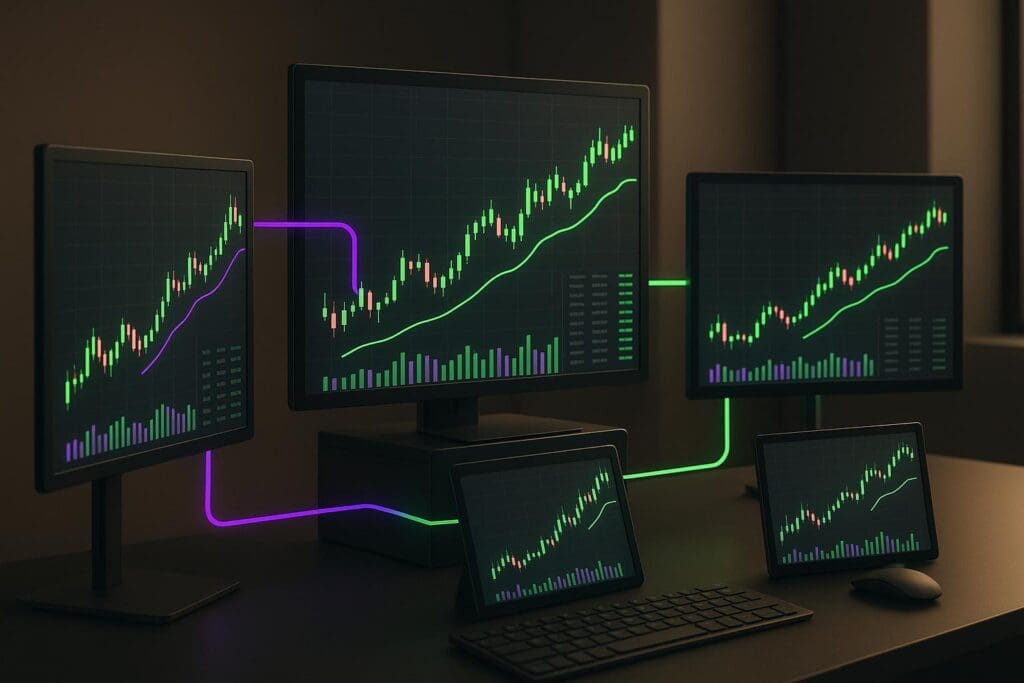
Trade copying in futures prop trading is an automated process where trades from a master account are mirrored across multiple follower accounts in real-time. This eliminates the need for manual trade replication, saving time and reducing errors. By using software like TradeSyncer, traders can execute strategies across several funded accounts simultaneously, maintaining consistent execution and risk management.
Key Takeaways:
- How It Works: Trades (entry, size, stop loss, etc.) are copied instantly – often in under 100 milliseconds – via APIs or cloud-based tools.
- Who Uses It: Futures prop traders managing multiple funded accounts, typically 5–20 or more, to scale strategies efficiently.
- Benefits: Simplifies managing multiple accounts, ensures consistent trade execution, and reduces errors.
- Challenges: Amplifies both profits and losses across accounts; requires strict risk management to avoid significant drawdowns.
- Tools: Platforms like TradeSyncer support seamless trade copying across prop firms like Apex Trader Funding, TickTickTrader, and Phidias Prop Firm.
Trade copying streamlines scaling profitable strategies but comes with risks, making disciplined risk management critical for success.
Setting Up to Copy Trade PROP FIRMS and ProjectX in TradersPost

How Trade Copying Works in Futures Markets
Trade copying uses specialized software to link your trading accounts, ensuring every action in your master account is mirrored across your follower accounts. Let’s break down how this process works and explore the tools and features that make it possible.
The Trade Copying Process
Trade copying unfolds in a rapid, automated sequence, typically completed in milliseconds. Here’s how it works:
- When you execute a trade in your master account, the software immediately detects the new position and logs all essential details, such as entry price, trade size, stop loss, and take profit levels. This real-time monitoring ensures there’s no lag between your original trade and its replication.
- Next, the software applies any pre-set rules, like scaling positions, enforcing risk limits, or restricting certain instruments to comply with prop firm guidelines.
- The prepared trade is then executed across all linked follower accounts, often in under 100 milliseconds. This speed is critical in the fast-moving futures market, where even small delays can lead to slippage.
- Finally, the system continuously tracks all accounts. Any updates – whether it’s a stop-loss adjustment, partial profit-taking, or closing a position – are instantly mirrored in the follower accounts to maintain alignment.
Software and Tools for Trade Copying
Trade copying tools rely on APIs or direct platform integrations to connect your master and follower accounts. This setup allows the software to read trade data and execute commands without manual input, streamlining the entire process.
A popular example is Tradesyncer, a cloud-based trade copier tailored for futures prop trading. It synchronizes trades from one master account to multiple follower accounts and supports platforms like Tradovate, Rithmic, DxFeed, TradingView, and ProjectX. This versatility ensures compatibility with a wide range of prop firms.
"At Damn Good Trading, we rely on the most advanced cloud-based trade copier for futures trading every single day. This powerful software allows us to instantly synchronize trades from one master account to 40+ follower accounts across multiple prop firms like Tradeify, Apex Trader Funding, Take Profit Trader, Lucid Trading, and FundedNext, all at the same time."
Since the system operates on a cloud-based infrastructure, trades are replicated around the clock, even if your computer is offline. This reliability is especially valuable when managing accounts across firms like Apex Trader Funding, Take Profit Trader, Tradeify, Lucid Trading, and FundedNext Futures. The system’s dependable performance ensures seamless trade execution, even during periods of high trading volume.
Key Features of Trade Copying Systems
The best trade copying systems go beyond basic replication, offering features that enhance risk management and precision:
- Blazing-fast synchronization: Leading platforms can replicate trades in under 100 milliseconds, ensuring all accounts enter and exit positions simultaneously.
- Smart position sizing: Automatically adjusts trade sizes based on account equity, ensuring proportional risk across accounts. For instance, a $50,000 account won’t take the same position size as a $100,000 account, maintaining consistent risk percentages.
- Stop-loss and take-profit replication: Risk management settings from the master account are mirrored across all follower accounts, helping traders stay within drawdown limits and meet prop firm rules.
- Risk filters and instrument restrictions: These tools enforce specific trading rules, such as limiting exposure to certain instruments or maintaining predefined risk levels.
- Real-time monitoring: Any changes to trades – like modifying a stop loss or closing a position early – are instantly applied across all accounts.
Some advanced systems also offer performance tracking tools, like journaling and analytics, to consolidate data from multiple accounts. This transparency helps traders review their strategies and maintain accountability when managing several accounts at once.
Why Traders Use Trade Copying in Futures Prop Trading
Trade copying simplifies the trading process while maintaining strict risk controls, making it an essential tool for futures prop traders. It addresses practical challenges that would otherwise make managing multiple funded accounts a logistical nightmare.
Managing Multiple Accounts Without the Hassle
Handling multiple funded accounts manually is a tedious process. You’d need to enter trades repeatedly, which not only eats up time but also increases the risk of delays and missed opportunities. This inefficiency can cost traders valuable entry points.
Trade copying software solves this problem by replicating trades from your master account across all connected follower accounts in milliseconds. So, when you make a move in your master account, it’s instantly mirrored in 10, 20, or even 40+ accounts, depending on your setup.
The time saved here is massive. Instead of spending minutes – or even longer – manually inputting trades across different platforms, you can focus on analyzing market trends and making strategic decisions. The software takes care of the repetitive tasks, allowing you to dedicate your energy to what truly matters.
For traders working with firms like Apex Trader Funding, Take Profit Trader, Tradeify, FundedNext Futures, and Lucid Trading, this centralized approach transforms what could be chaos into a streamlined and efficient process. Automation not only saves time but also makes scaling your strategies far more achievable.
Scaling Strategies Across Multiple Accounts
Once you’ve developed a profitable trading strategy, the next logical step is to scale it. Trade copying allows you to do just that, multiplying your strategy’s impact across numerous accounts without requiring additional effort.
By leveraging trade copying, you can amplify your returns while keeping your workload the same. Many prop firms actively support this approach. For example, Apex Trader Funding lets traders manage up to 20 accounts, TickTickTrader supports up to 10 accounts, and Phidias Prop Firm allows for 15 accounts. These limits provide traders with the opportunity to significantly increase their earning potential.
Trade copying also acts as a real-time testing ground. By executing the same strategy across multiple accounts, you can quickly gauge its performance under identical conditions. This immediate feedback helps you spot inconsistencies or anomalies, ensuring your strategy is as effective as it appears.
Additionally, this automation safeguards your operations by minimizing the chance of execution errors.
Cutting Down on Errors and Stress
Manually managing trades across multiple accounts is a recipe for mistakes. Delayed entries, incorrect position sizes, and forgotten accounts are just some of the errors that can occur. Trade copying eliminates these risks entirely.
The software ensures that all follower accounts replicate the exact position size and trade details from your master account. This means no more sizing errors, no missed accounts, and no incomplete orders. Every trade is executed flawlessly, every time.
But the benefits go beyond just reducing errors. Trade copying also lightens the mental load of managing multiple accounts. Decision fatigue is a real issue – when you’re juggling five, ten, or more accounts, the sheer number of repetitive decisions can drain your energy and lower the quality of your trading.
By automating the execution process, you free up your mental bandwidth for the tasks that matter most: analyzing the market, spotting opportunities, and refining your strategy. This sharper focus leads to more disciplined and consistent trading across all accounts.
The psychological relief extends to risk management as well. When trades are entered manually, the pressure to keep multiple accounts aligned can lead to rushed decisions that undermine risk controls. With trade copying, your stop-loss levels, take-profit targets, and position sizes are applied consistently across all accounts, no matter how volatile the market gets. This ensures that your risk management rules are followed to the letter, every single time.
sbb-itb-46ae61d
Risk Management and Challenges in Trade Copying
Trade copying can be a powerful tool, but it comes with its own set of risks. These risks, if not managed carefully, can lead to amplified losses across multiple accounts. To succeed in this space, it’s essential to understand these challenges and implement strong risk controls.
Multiplied Risks Across Accounts
While trade copying can multiply profits, it can just as easily magnify losses. When a trade is executed in the master account, it’s instantly mirrored across all connected follower accounts. This increases the total market exposure by the number of accounts involved.
For instance, if you place a $1,000 trade in a master account and it’s copied to three follower accounts, the total exposure jumps to $4,000. A 2% market movement will then result in a combined gain or loss of $80 across all accounts. Now, imagine managing five prop firm accounts at once – this could mean equity swings five times greater than trading a single account. That’s why proper position sizing is absolutely crucial to avoid depleting accounts too quickly.
Here’s where things get even trickier: if your strategy experiences a 5% drawdown in one account, the same loss will reflect in every copied account. To mitigate this, traders often scale down their risk. For example, if you normally risk 1–2% per trade on a single account, you might reduce that to 0.2–0.4% per account when managing multiple accounts.
Modern trade copying platforms are impressively fast, replicating trades in under 100 milliseconds – a critical feature in fast-moving markets like futures. However, this speed also means that any error or misstep is instantly duplicated across all accounts.
Prop Firm Rules and Monitoring
Prop firms don’t offer unlimited flexibility when it comes to trade copying. They enforce strict rules and monitor trading activity to ensure compliance with their risk management protocols.
Many firms have consistency rules that pose unique challenges for traders using copy trading. For example, some firms require that your largest winning day doesn’t disproportionately outweigh your overall profits or that your winning days remain within a specific percentage of your total trading days. Managing multiple accounts while adhering to these rules demands meticulous oversight.
Some firms, such as Take Profit Trader, TickTickTrader, FundingTicks, and TradeDay, simplify things by offering funded accounts without consistency rules. On the other hand, firms like Tradeify have "Dynamic Consistency Rules In Instant Funding", where requirements can shift based on factors like account type or performance.
Account limits also vary. For instance, Apex Trader Funding allows up to 20 accounts, TickTickTrader supports 10 accounts, and Phidias Prop Firm permits 15 accounts. Violating these rules can lead to severe consequences, including account termination, forfeiture of profits, or even permanent bans.
These restrictions make disciplined risk management even more essential for successful trade copying.
Best Practices for Risk Management
To navigate the amplified risks of trade copying, traders need a disciplined and proactive approach. Here are some key strategies:
- Use stop-loss orders: Set strict stop-loss levels to limit losses during volatile market conditions.
- Adjust position sizes: Scale your position sizes to reflect the total exposure across all accounts. Many trade copying platforms include tools to set position scaling rules, drawdown limits, and instrument filters – configure these before trading.
- Monitor system alerts: Keep an eye on alerts and verify that trades are syncing correctly across all accounts. Regularly review performance as market conditions evolve.
- Set portfolio-wide drawdown limits: Establish an aggregate drawdown limit that accounts for the multiplied impact of trade copying. For instance, if each account has a 5% drawdown limit, ensure your total exposure stays within that boundary. Some platforms even offer automated trade halts when limits are breached.
- Minimize technical risks: Rely on professional-grade trade copying services that use robust, cloud-based infrastructure with 24/7 availability and redundancy. This reduces the likelihood of issues like execution delays or API failures.
- Stay adaptable: Be ready to adjust or pause trade copying if market conditions shift or your strategy underperforms.
The secret to successful trade copying isn’t just in replicating trades – it’s in replicating disciplined, well-managed trades. Without strong safeguards, the same system that can amplify your profits can just as easily magnify your losses.
Trade Copying Solutions and Resources for Futures Prop Trading
Once you’re familiar with the risks and challenges of trade copying, the next step is figuring out how to implement it effectively. Today, trade copying software has come a long way, offering specialized tools tailored for traders managing multiple funded accounts.
Trade Copying Tools and Software
When choosing a trade copier, focus on three key factors: execution speed, reliability, and compatibility with the platforms used by prop firms.
One standout option is TradeSyncer, a cloud-based trade copier designed specifically for futures prop trading. In November 2025, DamnPropFirms named TradeSyncer the "#1 Best Trade Copier For Futures Prop Firms". This platform can replicate trades in under 100 milliseconds using its cloud infrastructure, ensuring seamless execution around the clock. It also supports cross-prop firm trading by integrating with platforms like Tradovate, Rithmic, DxFeed, TradingView, and ProjectX. On top of that, it offers advanced journaling and analytics with auto-sync features, making it easier to track performance across all connected accounts.
When evaluating trade copiers, prioritize speed, cloud reliability, platform compatibility, and built-in risk management tools. Once you’ve chosen a copier, the next step is finding prop firms that support this technology.
Finding Prop Firms That Support Trade Copying
Not every prop firm allows trade copying, and some impose strict limits on how many accounts you can manage at once. To succeed, you’ll need to find firms that explicitly support multi-account trading.
DamnPropFirms is a valuable resource for researching and comparing prop firms based on their policies regarding trade copying. This platform offers verified reviews, monthly rankings, payout speed ratings, and detailed risk signals for futures prop firms – all thoroughly vetted by their research team. This helps you avoid firms that might penalize or terminate accounts for using trade copiers, even if such rules aren’t clearly stated.
Here are a few top-rated firms that support trade copying, each with different account limits:
- Apex Trader Funding: Allows up to 20 accounts, making it a great choice for traders looking to scale.
- TickTickTrader: Supports copy trading for up to 10 S2F+ accounts, with no evaluation phase required.
- Phidias Prop Firm: Permits copy trading for up to 15 accounts.
When researching firms, pay close attention to their consistency rules. Some firms, like Take Profit Trader, FundingTicks, and TickTickTrader, offer funded accounts without consistency rules, which simplifies managing multiple accounts. Others, such as Tradeify, may have dynamic consistency rules that vary based on account performance or type.
DamnPropFirms also provides tools like the Consistency Rule Calculator, helping you navigate specific firm requirements. Additionally, the platform offers verified discounts (ranging from 10% to 90%) on prop firm challenges using the code DGT, reducing your upfront costs when scaling across multiple accounts. Their Discord community, with over 3,000 active prop firm traders, is another great resource for real-world insights into which firms genuinely support trade copying.
Once you’ve secured the right trade copier and firm, the next step is focusing on how to maximize your earnings.
Maximizing Payouts With Trade Copying
The main goal of trade copying is to boost your earning potential without requiring additional time or effort. Start by perfecting a proven strategy on a single account, and only scale once you’ve achieved consistent profitability.
Proper position sizing is critical. Configure your trade copier to maintain consistent risk management across all accounts. For example, if you typically risk 1–2% per trade on a single account, adjust this to 0.2–0.4% per account when managing multiple accounts. This ensures that a single loss doesn’t have an outsized impact on your overall portfolio.
Choosing the right prop firms is equally important. Look for firms with favorable profit-sharing arrangements, lower fees, and faster payout processes to improve cash flow and reinvest profits efficiently. Using TradeSyncer’s cross-prop firm trading capabilities can also help you spread your capital across multiple firms, minimizing the risk of policy changes or operational issues affecting your bottom line.
Finally, ongoing monitoring and adjustments are essential. Take advantage of advanced journaling and analytics tools to track performance across all accounts. Regularly review this data to identify which strategies work best under different market conditions. This disciplined approach ensures that your scaling efforts lead to sustained profitability.
Conclusion
Trade copying has changed the game for futures prop traders managing multiple funded accounts. With automated software capable of replicating trades in under 100 milliseconds, you can scale a single winning strategy across numerous accounts while maintaining consistent execution and risk management standards.
The key benefit is simple: you increase earning potential without adding to your workload. By placing a trade in your master account, the software instantly mirrors it across all connected accounts. This automation frees up your time to focus on refining strategies and analyzing the markets instead of handling repetitive execution tasks. However, it’s important to remember that this efficiency comes with increased risks.
Trade copying amplifies both profits and losses across all accounts. To safeguard your capital during volatile market conditions, it’s essential to use position sizing rules, maximum drawdown limits, and stop-loss orders. Automated systems help streamline execution and risk controls, but they don’t eliminate the need for active monitoring. Past performance isn’t a guarantee of future success, so staying vigilant is still crucial.
Reliable infrastructure is another cornerstone of effective trade copying. Cloud-based trade copiers ensure 24/7 availability and smooth operation. For instance, TradeSyncer, recognized as the "#1 Best Trade Copier For Futures Prop Firms" by DamnPropFirms, supports platforms like Tradovate, Rithmic, DxFeed, TradingView, and ProjectX, making it a standout choice for traders.
Equally important is finding prop firms that support trade copying. Not all firms allow multi-account trading, and some enforce strict limitations. Platforms like DamnPropFirms offer verified reviews, rankings, and risk insights to help you identify firms such as Apex Trader Funding (up to 20 accounts), TickTickTrader (up to 10 accounts), and Phidias Prop Firm (up to 15 accounts) that are trade-copying-friendly. With tools like the Consistency Rule Calculator and discounts ranging from 10% to 90% (using code DGT), they make scaling your trading operation more accessible.
The true potential of trade copying lies in turning a single successful strategy into multiple revenue streams. Instead of being confined by the capital of one account, you can leverage funding from multiple prop firms while maintaining consistent execution. For traders who prioritize disciplined risk management and continuous oversight, this scalability offers a clear edge in today’s competitive trading environment.
Start by perfecting your strategy on one account, apply disciplined risk controls across all accounts, and use resources like DamnPropFirms to find the best tools and prop firms to support your goals.
FAQs
How does trade copying affect risk management in futures prop trading?
Trade copying in futures prop trading offers a practical way for traders to manage risk by mirroring the strategies of seasoned professionals. For those who are newer to trading, this approach provides a chance to lean on established methods rather than starting from square one with untested strategies.
That said, trade copying isn’t a free pass to avoid risk. Traders still need to stay actively involved – keeping an eye on their accounts, fine-tuning position sizes, and ensuring the strategies they’re copying align with their own risk tolerance and financial objectives. Evaluating the lead trader’s track record and consistency is a key step to help reduce potential losses.
What challenges can arise when using trade copying software like TradeSyncer?
Using trade copying software like TradeSyncer comes with its own set of challenges. One major issue is latency – delays in executing trades can cause differences between the original and copied trades, which might impact overall profitability. Even a slight delay can make a big difference in fast-moving markets.
Another common problem is technical glitches. Software malfunctions can interrupt the copying process, leading to missed opportunities or, worse, incorrect trades. These technical hiccups can be frustrating and potentially costly.
Additionally, there’s the challenge of aligning the copied strategy with your own risk tolerance and trading goals. Simply mimicking another trader’s moves without fully understanding their approach can lead to unexpected losses. Regularly reviewing the copied trades and ensuring they align with your financial objectives is crucial to avoid unpleasant surprises.
How can traders select the best prop firms that support trade copying?
To find the best prop firm for trade copying, it’s crucial to focus on firms that provide dependable trade copying services and match your trading objectives. Prioritize firms with clear policies, strong platforms, and features like instant funding or scaling options to help you grow.
DamnPropFirms makes this easier by offering verified reviews, practical tools, and detailed insights into leading futures prop firms. This allows traders to compare and select firms that support effective trade copying and cater to their unique requirements.