Practicing futures trading without risking money is possible with built-in simulators. These platforms replicate live market conditions, allowing traders to test strategies, learn contract mechanics, and prepare for evaluations like those required by prop firms. Here’s a quick overview of the top platforms discussed:
- NinjaTrader: Offers realistic market replay and advanced tools for strategy testing. Great for serious traders but has a steep learning curve.
- thinkorswim: Features $100,000 in virtual funds and supports options on futures. Ideal for multi-asset trading but may experience execution lags.
- Tradovate: Cloud-based with mobile access and TPO charts. Perfect for traders on the go but has limited historical data.
- Webull: Simple interface with live-stream data. Good for beginners but lacks replay features.
- TradeStation: Focused on automation and backtesting with advanced tools, but requires an active account for full features.
Quick Comparison
| Platform | Key Features | Ideal For | Limitations |
|---|---|---|---|
| NinjaTrader | Market Replay, Full Automation | Advanced traders | Steep learning curve |
| thinkorswim | Options on Futures, Institutional Tools | Multi-asset traders | Execution lags in simulation |
| Tradovate | Cloud-based, TPO Charts | Mobile traders | Limited historical chart data |
| Webull | Live-stream data, Community tools | Beginners | No replay feature |
| TradeStation | Automation, Advanced Backtesting | Algorithmic traders | Requires active account |
These simulators are valuable for testing strategies, learning futures mechanics, and preparing for evaluations with proven challenge strategies. Choose the one that aligns with your trading goals and experience level.
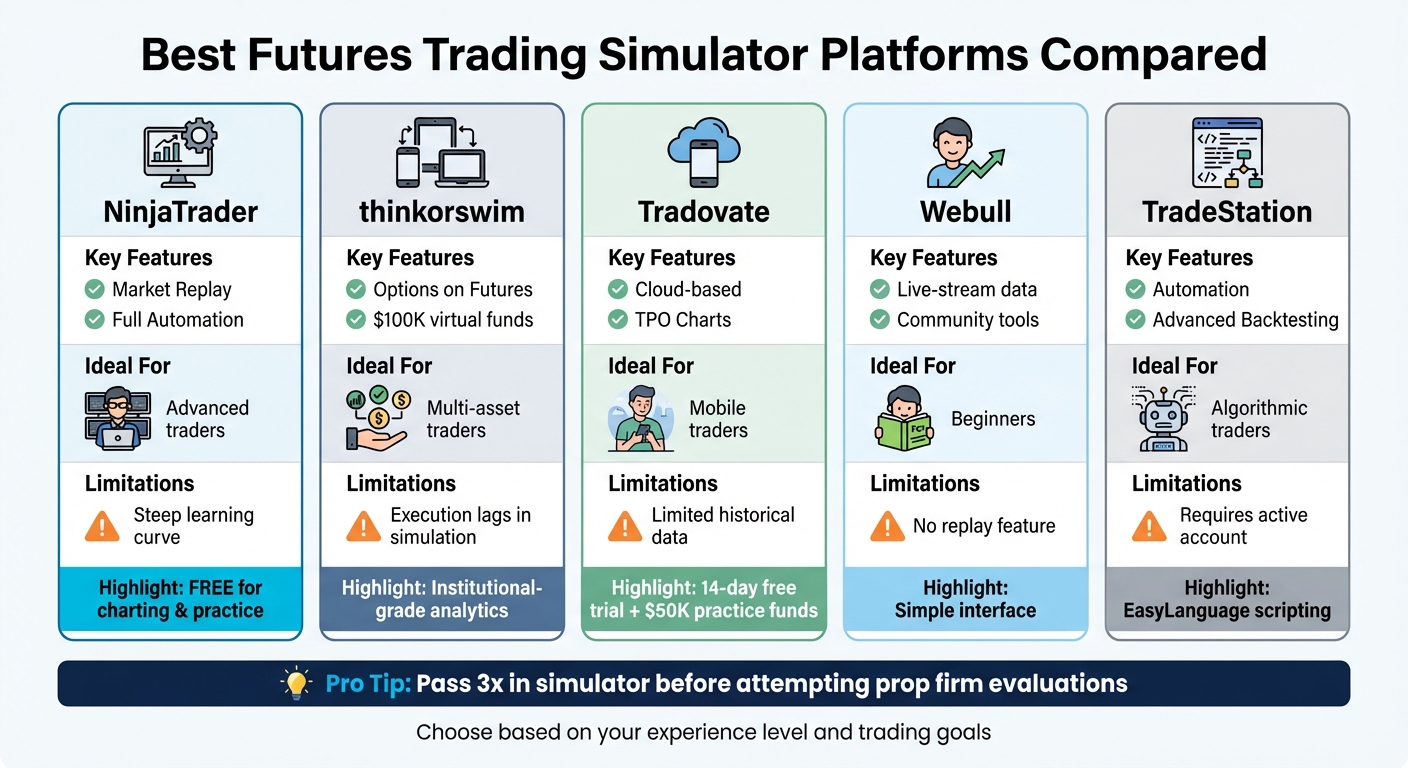
Futures Trading Simulator Platform Comparison Chart
Best Platforms with Built-in Futures Simulators
NinjaTrader
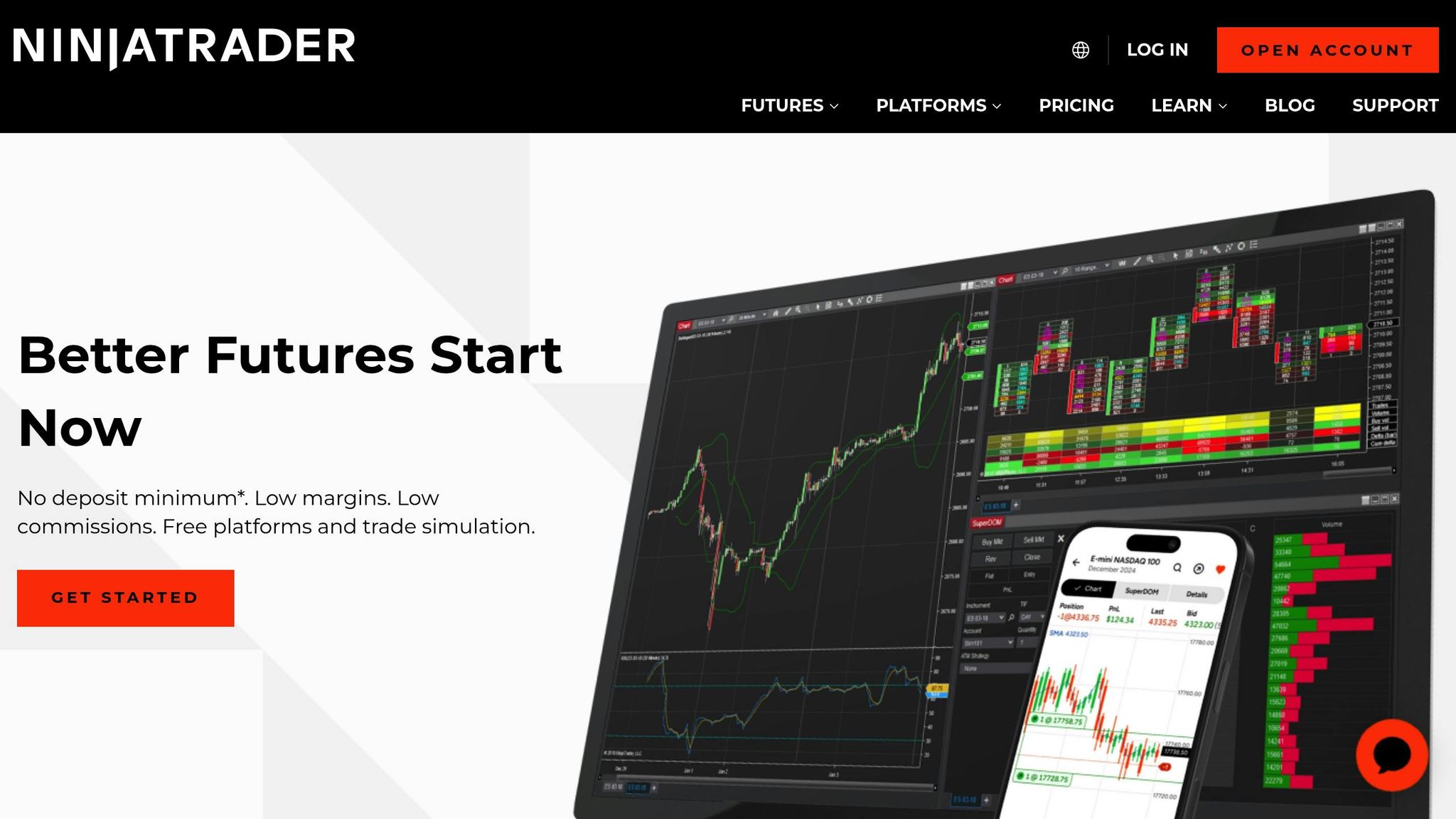
NinjaTrader stands out with its advanced tools and a practice environment that feels incredibly lifelike. Its Market Replay feature lets you revisit historical market data, tick-by-tick, so you can pause, rewind, or replay volatile events like Fed announcements. This is perfect for honing your skills in high-pressure scenarios. This is a critical step for anyone serious about day trading futures. The Simulated Data Feed also allows you to create custom market movements – ideal for testing automated strategies. Plus, the platform supports advanced order types like OCO (Order Cancels Order) and ATM (Advanced Trade Management) strategies, making it a great choice for mastering complex execution techniques. Best of all, the simulator is free for charting, backtesting, and practice, and comes with a 14-day trial of live market data.
"Paper trading lets you flex your futures muscles without having any actual skin in the game." – NinjaTrader
That said, the platform does come with a steep learning curve. Its interface might take some time to get used to, but for traders aiming to develop professional-level skills, the effort pays off.
thinkorswim by Charles Schwab
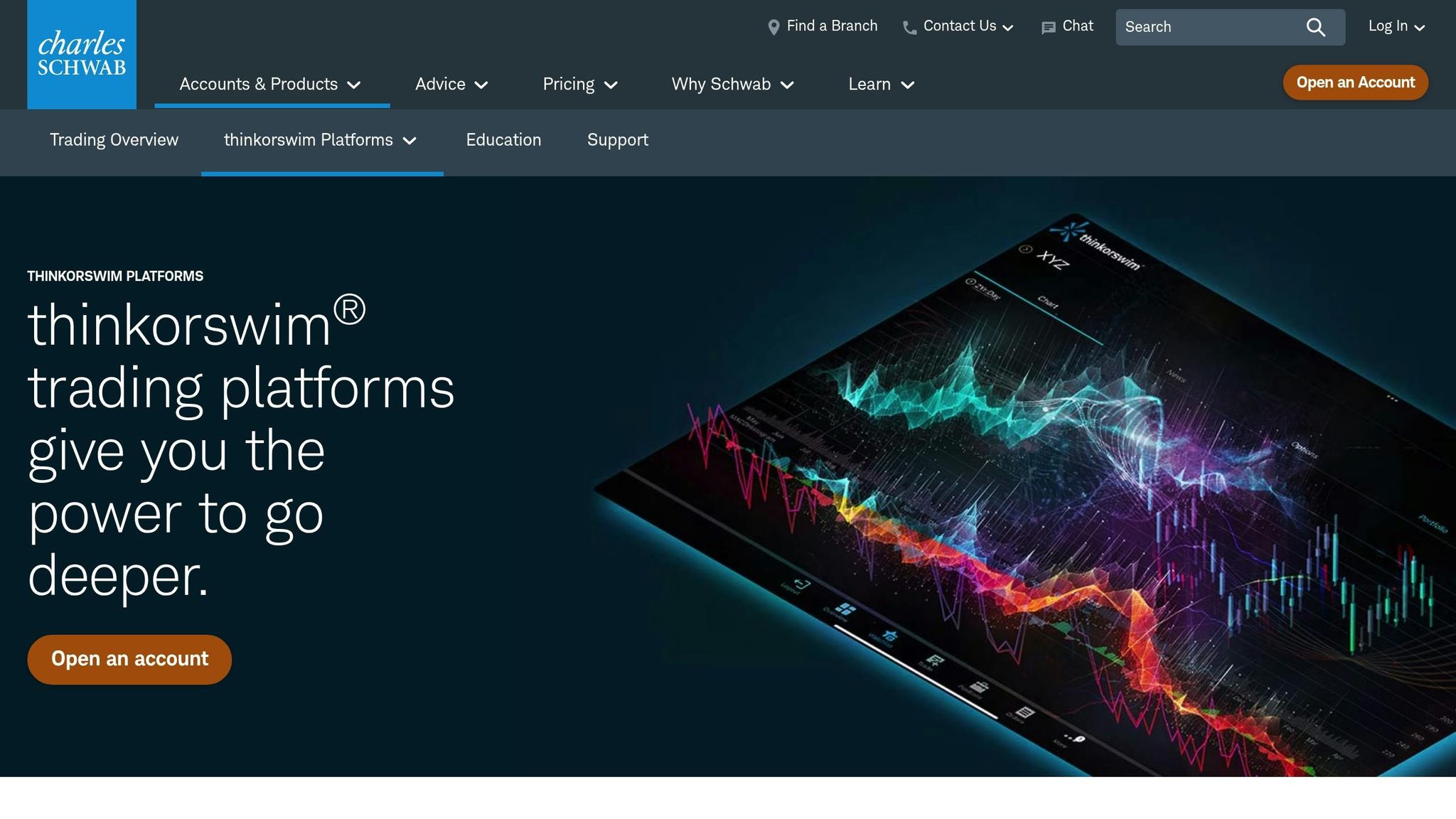
Another strong contender is thinkorswim by Charles Schwab. Its paperMoney feature provides $100,000 in virtual funds, paired with institutional-grade analytics. It also supports options on futures, making it a solid choice for practicing more advanced strategies. A big plus is its consistent interface – what you see in the demo mode is what you’ll use in live trading. If you’re already a Charles Schwab client, access is free. Non-clients can still check it out with a Guest Pass.
"Use paper trading to define, test, and evaluate your strategies, including setting rules for your trades, practicing risk management, and testing across market conditions." – Charles Schwab
One downside? Execution speeds in the simulator might lag compared to live trading, meaning fill prices and speeds may differ when you switch to real money.
Tradovate
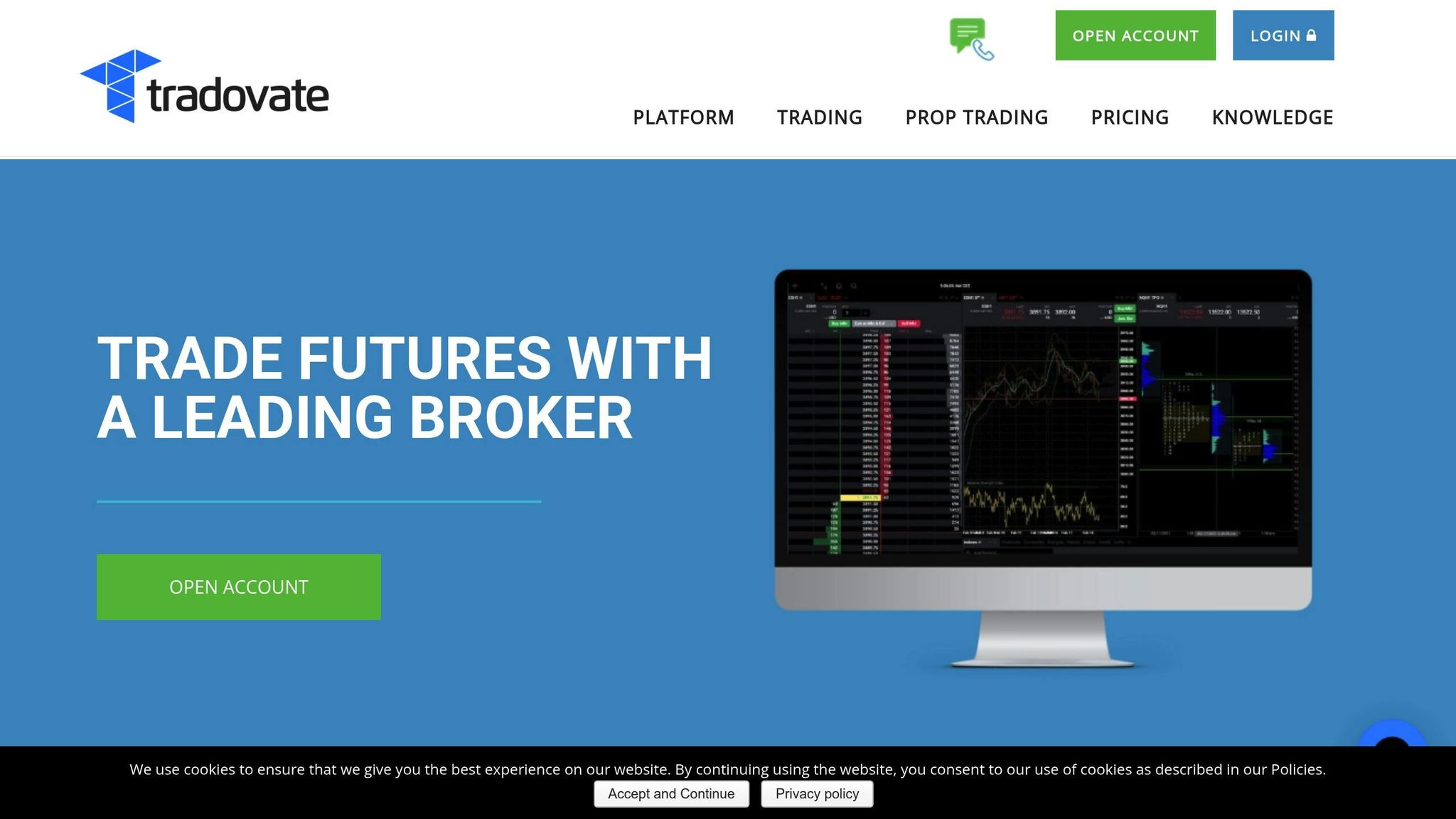
For traders who value flexibility, Tradovate delivers a cloud-based platform that works seamlessly across devices. Start on your computer, switch to your phone, and pick up right where you left off. It offers a 14-day free trial with $50,000 in practice funds. After the trial, you can opt for a SIM-only subscription at $12.95 per month, with no need for a full brokerage account.
Tradovate also includes handy tools like a DOM (Depth of Market) module for fast order placement and TPO Profile charts to help pinpoint opportunities based on time, price, and volume. You can even set your simulated balance to match your intended account size for a more realistic experience. However, keep in mind that its analytics aren’t as detailed as what you’d find on NinjaTrader or thinkorswim.
Webull

Webull’s simulator offers something a little different. Instead of market replay, it relies exclusively on live-stream data. The platform also features a trader community and sentiment tracking tools, giving you a glimpse into ongoing market discussions. It supports real-time practice for popular futures like the ES (S&P 500) and NQ (Nasdaq 100). However, one limitation is the lack of a replay feature, which means you’ll need to practice in real-time without the ability to skip slower market periods. This approach could be particularly useful for traders who want to focus on real-time sentiment and decision-making in fast-moving markets.
sbb-itb-46ae61d
Platform Comparison
Key Features Comparison Table
Finding the right trading platform depends on your goals and preferences. Some platforms excel in automation and backtesting, while others focus on ease of use and accessibility. The table below breaks down how each platform stacks up in key areas.
| Platform | Access Methods | Market Data | Key Tools | Limitations |
|---|---|---|---|---|
| NinjaTrader | Desktop, Web | Real-time | Market Replay, Full Automation (C#/NinjaScript), SuperDOM | Steep learning curve for beginners |
| thinkorswim | Desktop, Web, Mobile | Real-time | Options on Futures, Institutional Analytics | Execution can lag; OnDemand feature may underperform |
| TradeStation | Desktop, Web | Real-time | EasyLanguage Automation, Advanced Backtesting, Slippage Modeling | Advanced features require an active account |
| tastytrade | Desktop, Web, Mobile | Real-time | Options-focused tools, Risk Analysis | – |
| Tradovate | Web, Mobile, Desktop | Real-time | Cloud Replay (4x speed), DOM, TPO Profile Charts | Limited historical chart data |
| Webull | Mobile, Web, Desktop | Delayed (15 min)* | User-friendly interface, Community sentiment | No stop-loss/take-profit orders in simulator |
| Power E*TRADE | Desktop, Web, Mobile | Delayed | Multi-platform access, Basic order management | Requires a funded live account; no slippage simulation |
*Note: Real-time data on Webull requires an OPRA subscription; otherwise, quotes are delayed by 15 minutes.
This table highlights how differences in features, data accuracy, and automation options can impact your trading simulation experience.
Platforms like NinjaTrader and TradeStation are perfect for traders who want deep control over automation and strategy development. If you’re comfortable with coding and need precise backtesting tools, these platforms are worth exploring. On the other hand, thinkorswim and Tradovate offer robust tools that don’t require coding knowledge, though they may not offer the same level of customization.
When it comes to data realism, some platforms rely on delayed data, which is fine for learning the basics but less effective for simulating real-world trading conditions. NinjaTrader, Tradovate, and TradeStation stand out by offering real-time feeds, which provide a more accurate feel for order execution during volatile periods. As trading expert Thomas Vasilyev explains:
"Simulated trading often lacks the emotional intensity of live trading, which can lead to overconfidence when transitioning to real accounts."
This underscores the importance of testing slippage and partial fills in your simulator before diving into live trading.
For traders preparing for prop firm evaluations, NinjaTrader and Tradovate offer Market Replay features that compress historical data into fast-paced sessions. This can closely mimic the conditions of strict evaluations. If you’re looking for detailed reviews and insights into prop firm evaluations, check out DamnPropFirms for more information.
How Simulators Help with Futures Prop Firm Preparation
Testing Prop Firm Rules with Simulators
Prop firm evaluations come with strict rules – daily loss limits, trailing drawdowns, and profit targets – that can end your evaluation instantly if breached. Simulators offer a safe way to practice these constraints without risking real money. Many advanced platforms allow you to set custom starting balances, drawdown limits, and position sizes to replicate prop firm rules exactly.
Using market replay tools, you can compress historical data into shorter sessions, letting you repeatedly practice navigating high-volatility events – like an 8:30 AM EST CPI release. This kind of repetition helps you build the necessary muscle memory to handle slippage and execute trades effectively during chaotic market conditions.
John McDowell, a writer for Tradingsim, emphasizes the importance of preparation:
"Do not pay for a Topstep combine until you have passed it 3 times in a row on Tradingsim. This discipline alone will save you thousands of dollars in reset fees."
This advice is crucial, as fewer than 1% of participants typically advance to the live-capital stage with prop firms. Adopting a "3x Rule" in simulation can help you avoid unnecessary expenses and improve your chances of success before committing to evaluation fees.
To make the simulation experience more realistic, consider adding tangible consequences for breaking rules. This helps mimic the psychological pressure of live trading, bridging the gap between practice and real-world scenarios.
These disciplined simulation practices naturally prepare you for platforms used in actual prop firm evaluations.
Using Platforms with Prop Firms
Once you’ve honed your skills in a simulator, transitioning to prop firm evaluations becomes much smoother. Many top evaluations rely on platforms like NinjaTrader, Tradovate, and TradeStation, which provide live-like trading environments. Evaluation fees can range from $49 to several hundred dollars, but some firms offer instant funding futures prop firms, skipping the evaluation process entirely. If you’re already familiar with NinjaTrader’s simulator, moving to a Topstep evaluation becomes straightforward, as there’s no need to learn a new platform.
For those eager to access capital more quickly, firms like Lucid Trading and Tradeify provide instant funding options. For instance, Lucid Trading processes 92% of withdrawal requests on the same business day, making it a popular choice for traders who have proven their consistency through simulation.
To align your simulator practice with the right prop firm, resources like DamnPropFirms offer detailed reviews and comparison tools. Their Consistency Rule Calculator is particularly helpful in determining if your simulated trading patterns meet the specific requirements of various firms before you commit to an evaluation.
Conclusion
Platform Summary
NinjaTrader stands out as the go-to choice for serious futures traders, offering a unique Market Replay feature that condenses years of historical data into weekend practice sessions. This capability has earned it the title of #1 Futures Broker for 2026. thinkorswim by Charles Schwab shines for multi-asset traders, providing institutional-grade analytics and options on futures practice. For traders who value convenience, Tradovate offers cloud-based access with no downloads required, making it an excellent choice for beginners and those who trade on the move. Meanwhile, TradeStation caters to algorithmic traders with its proprietary EasyLanguage scripting, and Webull provides a straightforward, mobile-friendly platform suited for basic practice.
NinjaTrader also boasts a robust ecosystem with over 1,000 third-party apps, allowing for extensive customization. These platforms equip traders to meet the stringent rules of proprietary (prop) firm evaluations, where fewer than 1% of participants typically advance to live-capital stages. By honing skills with these simulators, traders can better prepare for the challenges of prop firm evaluations.
Next Steps for Traders
The first step is choosing a simulator that aligns with your trading style. For advanced automation and precise market replay, download NinjaTrader. If you prefer an easy, cloud-based solution without software installations, open a Tradovate account. To further refine your skills, apply the "3x Rule": pass a mock evaluation three times in a row on your chosen simulator before taking on an actual prop firm challenge.
Once you’ve achieved consistency through disciplined practice, explore potential prop firms using DamnPropFirms, a platform offering verified reviews of firms like Apex Trader Funding, Take Profit Trader, and FundedNext Futures. Their Consistency Rule Calculator can help ensure your simulated trading habits align with specific firm requirements, saving you from unnecessary evaluation fees. For those seeking quicker access to capital, firms such as Lucid Trading and Tradeify provide instant funding options that bypass traditional evaluations.
Simulator practice is a critical differentiator between traders who lose their capital within 90 days and those who build long-term careers. Treat your simulator account as seriously as a live account: journal every trade, study contract mechanics, and develop a disciplined approach before risking real money.
How to Trade Futures for Beginners Using the thinkorswim® Platform
FAQs
Which futures simulator is closest to real fills and slippage?
TradingSim delivers a highly realistic futures trading simulator, complete with real market data and tools like full market session replay. These features allow traders to experience authentic fills and slippage, creating a practical environment for honing their skills.
Can I practice prop firm rules like trailing drawdown in a simulator?
Many trading simulators are designed to let you practice following prop firm rules, such as trailing drawdowns, profit targets, and risk management protocols. They offer a risk-free way to develop discipline and get familiar with the criteria set by prop firms before transitioning to live trading. Simulators also give traders a chance to test and fine-tune their strategies while adhering to the specific guidelines required for funded accounts.
Do I need real-time market data for effective futures paper trading?
Real-time market data plays a key role in futures paper trading. It lets you simulate live trading conditions with precision, giving you the chance to test strategies in scenarios that mirror actual market behavior. Without access to real-time data, your practice sessions might fall short of replicating the true dynamics of the market, making them far less effective.