
If you’re deciding between prop firms, Funded Futures Family, Apex Trader Funding, and Topstep each offer distinct benefits and challenges. Here’s the quick takeaway:
- Funded Futures Family: Affordable plans starting at $54/month, clear payout rules, and no activation fees. However, it requires seven $200+ profit days before withdrawal and enforces a 40% consistency rule for early payouts.
- Apex Trader Funding: Known for its frequent discounts and 100% profit split on early payouts. Offers up to $3M scaling potential but has stricter drawdown rules and activation fees.
- Topstep: Simple structure with no consistency rules, a 90% profit split, and support for automated trading. Slightly higher fees but fewer restrictions.
Quick Comparison:
| Feature | Funded Futures Family | Apex Trader Funding | Topstep |
|---|---|---|---|
| Evaluation Fee ($50K) | $79-$108 | Varies (discounts) | $109 |
| Activation Fee | $0 | $119 | $0 |
| Profit Split | 90% (after $10K) | 100% (early payouts) | 90% |
| Consistency Rule | Yes (40%) | Yes (50%) | None |
| Max Scaling | 4 accounts | $3,000,000 | $750,000 |
| User Rating | 4.7/5 | 3.8/5 | 4.5/5 |
Each firm caters to different trading styles. Funded Futures Family works well for consistent traders, Apex suits those seeking high scaling potential, and Topstep offers flexibility with fewer restrictions. Choose based on your trading habits and goals.
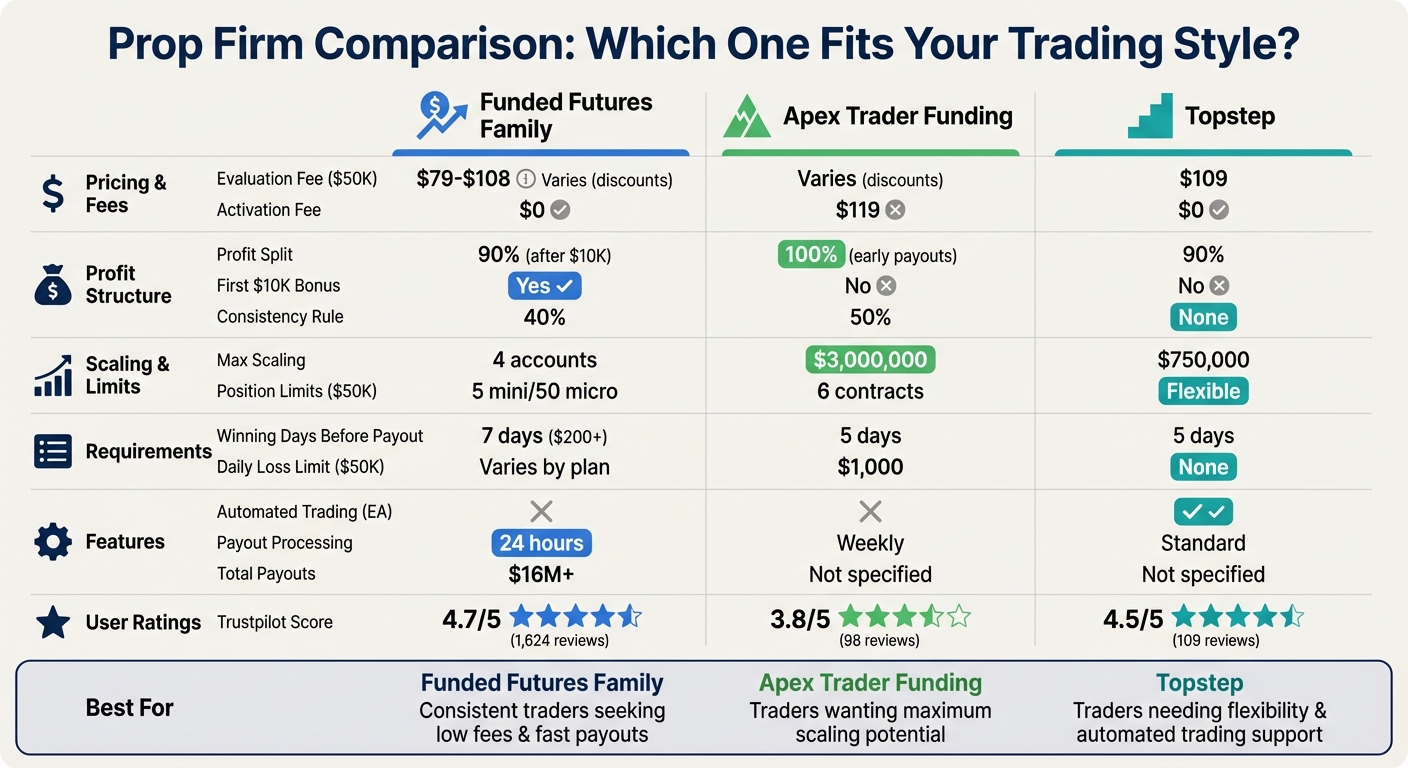
Funded Futures Family vs Apex Trader Funding vs Topstep Comparison Chart
$2,000 Payout Proof – Funded Futures Family Review #shorts
sbb-itb-46ae61d
1. Funded Futures Family
Funded Futures Family stands out with its range of account options, clear payout rules, robust risk management, and a strong emphasis on transparency – all designed to meet traders’ needs effectively.
Account Options
Funded Futures Family offers six distinct account types, catering to different trading preferences and strategies:
- The Elite Evaluation Plan starts at $54/month for a $25,000 account and uses an intraday trailing drawdown that adjusts in real-time based on peak account value.
- The Classic Evaluation Plan ($72/month) and Premier Evaluation Plan ($78/month) rely on an End-of-Day (EOD) drawdown, which updates only at the close of the trading session.
- The Straight to Funded (S2F) plan skips the evaluation process entirely, offering immediate funded access for a one-time fee of $399–$699. However, it comes with a 25% consistency rule.
- For high-frequency traders, the Velocity Plan allows payouts every three trading days for just $16/month.
- The Evaluation to Live (E2L) plan transitions traders from simulated accounts to live brokerage accounts with real capital and daily payouts.
Account sizes range from $25,000 to $150,000, providing flexibility in buying power.
Payout Rules
The payout structure is designed to reward consistent and disciplined trading. Before their first withdrawal, traders must meet the requirement of seven winning days – defined as earning at least $200 in profit per day. Early payouts are subject to a consistency rule: traders keep 40% of profits for the first three payouts, increasing to 45% for the next two, and 50% from the sixth payout onward.
Once approved, payouts are processed within 24 hours if submitted by 5:00 PM EST on weekdays. Traders retain 90% of their profits, and the first $10,000 in total payouts is entirely theirs with no profit split. After reaching three approved payouts or $10,000 in earnings, traders may qualify for the Professional Stage Account (PSA), which offers daily withdrawals and no payout caps. To date, the firm has paid out over $16 million, with the largest individual payout reaching $117,450.00.
Risk Management
Funded Futures Family employs strict risk controls to promote disciplined trading. Two types of drawdowns are available:
- EOD drawdown (used in the Premier and Classic plans) updates only at the end of the trading session, ignoring intraday fluctuations.
- Intraday trailing drawdown (used in the Elite and Velocity plans) adjusts throughout the day based on peak account value.
Position limits are also enforced, with a $50,000 account capped at 5 mini contracts or 50 micro contracts. To discourage excessive short-term trading, trades must remain open for a minimum of 20 seconds and contribute at least 50% of total profits.
If account rules are breached, traders can reset their funded accounts up to three times, with reset fees ranging from $649 to $1,499 depending on account size. A dedicated risk management team monitors simulated accounts to ensure compliance and promote responsible trading.
Transparency
Funded Futures Family prioritizes clarity and fairness in its policies. The firm promotes a "No Hidden Rules" policy, clearly defining terms like "winning day" and "qualifying trading day" upfront. There are no activation fees across any plans. With a 4.7/5 rating on Trustpilot from 1,624 reviews, traders often highlight the fast payout process and straightforward guidelines.
As trader Miguel Santos shared:
FFF guidelines fit and empower traders to trade without worries and know they will get paid when it’s time with NO EXCUSES!
While the firm receives praise for its transparency, some traders have noted challenges with the consistency rule and occasional technical issues on platforms like WealthCharts. Despite this, Funded Futures Family maintains a strong reputation for supporting disciplined traders through its well-defined policies and reliable systems.
2. Apex Trader Funding

Apex Trader Funding revamped its program on March 1, 2026, introducing two key account types: EOD (End of Day) Trailing Drawdown and Intraday Trailing Drawdown. Traders can select from four account sizes – $25,000, $50,000, $100,000, and $150,000 – and manage up to 20 active Performance Accounts (PAs) at once, which is notably higher than what most firms offer. Let’s break down the account options and features.
Account Options
Evaluations can be completed in as little as one day if traders hit profit targets without breaching drawdown limits. For example, a $50,000 evaluation costs about $35 with a 90% discount code, plus a $119 activation fee upon passing. The EOD model calculates drawdown at the end of each trading day, while the Intraday model adjusts dynamically based on peak balance, including unrealized gains. This real-time adjustment can be tricky for those unfamiliar with how open profits impact their drawdown threshold.
Payout Rules
Apex stands out by offering a 100% profit split on approved payouts, exceeding the typical 80%-90% range in the industry. To request a payout, traders must complete five qualifying trading days (not necessarily consecutive) and maintain a minimum balance of $500. A 50% consistency rule applies, meaning no single day can account for more than half of the total net profit since the last payout.
For the first three payouts, traders need to reach a "Safety Net" level – the drawdown limit plus $100 – if they want to withdraw more than the $500 minimum. The firm uses a 6-step payout ladder with maximum caps per payout. For instance, on a $50,000 account, the first payout is capped at $1,500, while the sixth payout maxes out at $3,000.
Risk Management
Apex incorporates strict risk controls into its structure. For EOD accounts, the Daily Loss Limit (DLL) is $1,000 on a $50,000 account, pausing trading for the day if breached. Position limits are based on account size: a $50,000 account allows up to 6 contracts, while a $150,000 account permits 12 contracts. Intraday Performance Accounts require traders to log at least one $150 net profit day within 150 consecutive calendar days to keep their account active.
Transparency
Apex prioritizes clear policies and quick payouts, earning a 4.4/5 rating on Trustpilot from over 17,669 reviews. The company has eliminated its old "payout windows", now allowing weekly payout requests once eligibility criteria are met. However, the Intraday Trailing Drawdown model continues to be a pain point for some traders, particularly due to its handling of unrealized gains.
For more details on Apex Trader Funding’s rules and features, check out our full review on our Apex Trader Funding review page.
3. Topstep

Topstep provides a straightforward setup with a $50,000 challenge account priced at $109, and there’s no activation fee. While this fee is about $30 higher than some competitors, the platform offers a generous 90% profit split – meaning traders keep $900 out of every $1,000 they earn. Here’s a closer look at Topstep’s account features, payout process, risk management, and overall structure.
Account Options
To pass the evaluation, traders must complete at least 2 trading days, achieve a $3,000 profit target, and stay within a $2,000 drawdown on the $50,000 account. One standout feature is the lack of a daily loss limit, giving traders more flexibility during volatile market conditions. Topstep also supports automated trading through Expert Advisors (EAs) and provides access to platforms like Project X and Plus 500. For those looking to grow their accounts, the firm offers scaling opportunities up to a maximum live balance of $750,000.
Payout Rules
Traders can request their first payout after completing 5 trading days, with payments processed via Wise. Unlike Funded Futures Family, which enforces a 40% consistency rule, Topstep does not impose consistency requirements. This makes the payout process more accessible and less restrictive.
Risk Management
Topstep’s risk management approach includes clear guidelines like the $2,000 maximum drawdown for the $50,000 account. The evaluation process requires traders to stay active for at least 2 trading days, while payouts necessitate 5 active days. These measures encourage consistent participation without being overly restrictive, allowing traders to focus on discipline and strategy.
Transparency
Topstep stands out for its clear and straightforward policies. The absence of consistency rules and a simple fee structure make it easier for traders to focus on profitability. Features like the 90% profit split and support for automated trading systems offer flexibility, appealing to traders who value fewer restrictions on their trading style – even if it comes at a slightly higher cost.
Pros and Cons
Here’s a breakdown of the strengths and weaknesses for each firm, based on our thorough review. This summary pulls together insights from earlier sections to help you compare.
Funded Futures Family has some standout benefits, including $0 activation fees on many plans and quick daily payout reviews. Payouts are processed Monday through Friday, with same-day approval for requests submitted before 5:00 PM EST. The firm has already distributed over $16 million in payouts, with an average payout of $3,067 per account. However, there are a few downsides. It enforces a "Winning Day" requirement, meaning a qualifying day must generate at least $200 in profit, similar to the Alpha Futures consistency rule, and its platform restrictions might feel limiting for some traders. On the plus side, users often commend its fast customer support, though a small number of traders have reported unexpected charges during rebilling.
Apex Trader Funding shines with the highest scaling potential, offering a maximum allocation of $3,000,000, and frequent promotional discounts – sometimes as high as 90% off. Despite these perks, its user satisfaction rating is lower, sitting at 3.8/5 compared to Funded Futures Family’s 4.7/5 and Topstep’s 4.5/5.
Topstep appeals to traders looking for fewer restrictions, with no consistency rules and support for automated trading via Expert Advisors. The firm also has a strong reputation, with over 10 years in operation. However, it does come with slightly higher fees and requires a minimum of five trading days before payouts can be processed.
The comparison table below highlights the key features and differences:
| Feature | Funded Futures Family | Apex Trader Funding | Topstep |
|---|---|---|---|
| $50K Eval Fee | $79 – $108 | Varies (often discounted) | $109 |
| Activation Fee | $0 on many plans | Typically required | $0 on specific plans |
| Consistency Rule | 40% (Classic); None (Premier+) | Varies by plan | None |
| Expert Advisors | Not allowed | Not allowed | Allowed |
| Max Allocation | 4 simulated accounts | $3,000,000 | $750,000 |
| User Rating | 4.7/5 (1,624 reviews) | 3.8/5 (98 reviews) | 4.5/5 (109 reviews) |
- Funded Futures Family: Ideal for traders who value fast support and no activation fees.
- Apex Trader Funding: Best for those seeking maximum scaling potential and promotional pricing.
- Topstep: A great choice for traders who want flexibility with automated trading and no consistency rules.
Conclusion
The suitability of Funded Futures Family depends largely on your trading habits and what you prioritize in a funding firm.
For traders who consistently achieve $200+ profit days, the firm’s low starting cost (from $64 with no activation fee) and quick, transparent payouts are appealing. Its 4.7/5 rating on Trustpilot, based on 1,624 reviews, reflects this appeal. As the company aptly states:
Your best fit is the firm whose rules you can follow on your worst trading week, not your best one.
Experienced traders looking to skip the evaluation process may find the Straight-to-Funded option especially attractive, offering a faster path to funded trading. This aligns with the firm’s commitment to supporting disciplined and consistent traders through scaling funded accounts.
For those with limited capital, Funded Futures Family offers a blend of affordability, straightforward rules, and realistic payout opportunities. Before you start, review our funded account checklist to ensure you’re prepared. With over $16 million distributed and an average payout of $3,067 per account, the firm emphasizes structured rules that align with traders’ strengths, aiming to promote consistent and sustainable performance.
To dive deeper into the details, check out our dedicated reviews: Funded Futures Family, Apex Trader Funding, and Topstep.
FAQs
How hard is it to meet the seven $200+ profit-day requirement?
To meet the seven $200+ profit-day requirement, traders need to achieve at least $200 in profit on five separate qualifying trading days. There’s no need for a buffer, so the focus should be on maintaining consistent daily profits to hit this target.
What does the 40% consistency rule actually limit in my payouts?
The 40% consistency rule limits your maximum daily payout to 40% of your total net profit during the payout period. Essentially, this means that if you want to stay eligible for payouts, your largest single-day profit must not exceed 40% of your overall net profit.
Which Funded Futures Family plan fits my trading style (Elite, Classic, Premier, S2F, Velocity, or E2L)?
Your choice of plan should align with your trading style and how much risk you’re comfortable taking. The Elite plan is tailored for active intraday traders, offering intraday trailing drawdowns. For those who prefer a more traditional approach, Classic and Premier come with end-of-day drawdowns. If you’re looking for a quicker evaluation process, the Velocity plan might be the way to go. Meanwhile, S2F and E2L are designed for traders seeking specific funding paths. Pick the one that best matches your goals and risk management preferences.