Trailing drawdowns can make or break your trading evaluation. They adjust based on your account’s equity peaks, tightening your safety margin as profits grow. However, many traders fail due to common mistakes – like misunderstanding how unrealized gains affect drawdowns or overtrading after resets.
Here’s what you need to know upfront:
- Trailing drawdowns move up with your equity peaks but never back down, even after losses.
- Unrealized profits can tighten your drawdown buffer, risking liquidation if the market reverses.
- Reset rules vary by firm, with intraday and end-of-day (EOD) models affecting how thresholds adjust.
- Overtrading after resets often leads to quick disqualification due to tighter risk margins.
- Funded accounts may lock drawdowns at a fixed level, requiring different risk strategies.
To avoid these pitfalls, monitor your drawdown levels daily, understand your firm’s reset rules, and scale down risk during volatile sessions. The key is disciplined trading and clear awareness of how resets impact your safety net.
Prop Firm End of Day Drawdown vs Trailing Drawdown
sbb-itb-46ae61d
How Trailing Drawdown Resets Work
Trailing Drawdown Models Comparison: Intraday vs EOD vs Static
A trailing drawdown functions like a one-way ratchet, always tracking your account’s highest value. When your account balance or equity hits a new peak, the liquidation threshold adjusts upward to maintain a fixed distance behind that peak. For instance, on a $50,000 account, this distance is typically $2,500 or 5% of the account size. Once the threshold moves up, it never moves back down – even if your account drops after reaching a new high.
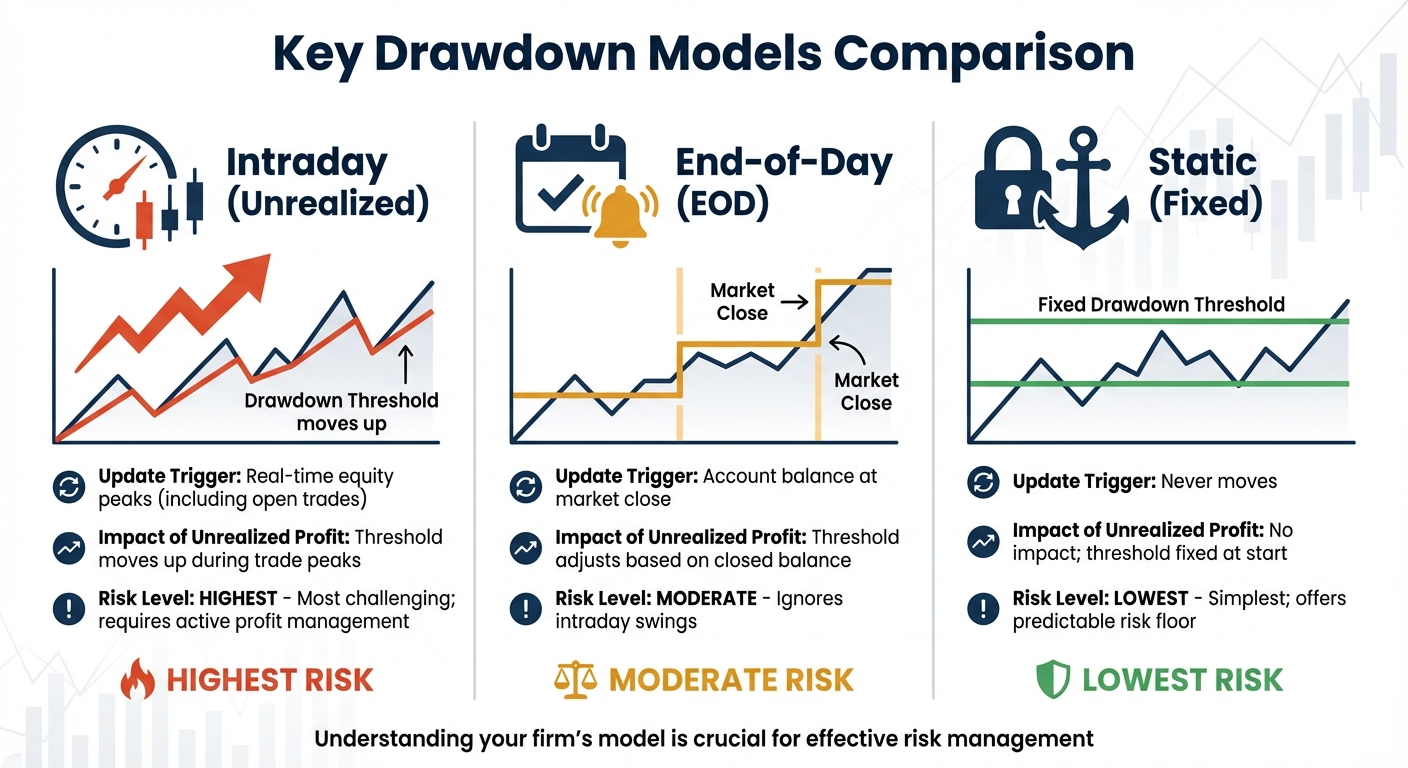
The way this threshold is calculated varies between firms. Some use an intraday model, where the threshold adjusts in real-time based on your open equity peaks. This means that even unrealized gains during a trade can tighten the margin for error. Others use an end-of-day (EOD) model, which only updates the threshold based on your closed balance at the end of the trading day, ignoring any intraday fluctuations. The intraday model can be far more demanding, as it requires constant attention to protect profits, while the EOD model is more forgiving.
Interestingly, many firms introduce a locking mechanism when the threshold reaches your starting balance, often with a small buffer (e.g., $100). At this point, the trailing drawdown stops moving entirely.
"The trailing drawdown will continue moving up until it reaches your starting balance + $100. At that point, it stops trailing forever." – DamnPropFirms
For example, at Apex Trader Funding, a $50,000 Performance Account has its trailing drawdown permanently locked at $50,100. Once locked, the drawdown becomes a static risk floor, meaning additional profits no longer increase your safety buffer. This makes understanding when your drawdown resets or locks crucial for effective risk management.
Key Drawdown Models
| Type | Update Trigger | Impact of Unrealized Profit | Risk Level |
|---|---|---|---|
| Intraday (Unrealized) | Real-time equity peaks (including open trades) | Threshold moves up during trade peaks | Most challenging; requires active profit management |
| End-of-Day (EOD) | Account balance at market close | Threshold adjusts based on closed balance | Moderate; ignores intraday swings |
| Static (Fixed) | Never moves | No impact; threshold fixed at start | Simplest; offers predictable risk floor |
Understanding these models helps you align your trading strategy with the specific rules of your firm. Once the threshold locks, further gains won’t enhance your protection, so adapting your approach is essential for managing risk effectively.
5 Common Trailing Drawdown Reset Mistakes
Managing trailing drawdown resets can catch even seasoned traders off guard. The process might seem simple on paper, but when actual money and fluctuating thresholds come into play, things can get tricky. Here’s a breakdown of five common mistakes that can derail your trading evaluation.
Mistake 1: Ignoring Unrealized Profits in Reset Calculations
One of the biggest pitfalls is assuming that only closed profits impact the drawdown threshold. In reality, firms like Apex Trader Funding and Bulenox calculate the threshold based on your highest intraday equity peak, including open trades.
For example, if your equity peaks at $50,875 on a $50,000 account with a $47,500 threshold, the threshold adjusts upward to $48,375. If you close your position at $50,100, your buffer shrinks to just $1,725. A dip to $48,374 triggers liquidation – even though you’re technically above your starting balance.
"The unrealized trailing drawdown at Apex Trader Funding is the single biggest rule that trips up traders." – Kyle Kozlowski, Editor
This issue is compounded by platforms like Rithmic, where the real-time threshold is hidden in the "Auto Liquidate Threshold" field on RTrader Pro, making it easy to miss critical changes to your safety net.
Mistake 2: Confusing EOD and Intraday Reset Timing
Not all trailing drawdowns work the same way. Some firms, like Topstep, Take Profit Trader, and FundedNext Futures, use end-of-day (EOD) models. These update the threshold based on the final closed balance at the market’s close. For instance, if your account hits $51,500 during the day but closes at $51,000, the threshold adjusts based on $51,000.
In contrast, intraday models like those used by Apex and Bulenox adjust the threshold in real time. If your equity spikes during a news event, that peak permanently raises the threshold, even if your balance later drops.
"Even if your balance closes lower, the trailing drawdown ‘remembers’ your highest unrealized peak." – DamnPropFirms
This distinction is crucial, especially during volatile sessions, where a temporary spike could unexpectedly lock in a higher threshold.
Mistake 3: Expecting Drawdown to Adjust After Losses
Another common misconception is thinking the drawdown threshold will lower after losses. Once the threshold ratchets upward, it stays fixed. For instance, if your account reaches $52,000 and the threshold moves to $49,500, dropping back to $50,000 still leaves you with a much smaller cushion than the original $2,500.
This one-way adjustment can lead to overconfidence, causing traders to take on larger positions without realizing their risk buffer has significantly decreased.
Mistake 4: Overtrading After a Reset Advance
When the threshold increases after a new equity peak, traders often mistakenly believe they have more room to trade. In reality, their safety buffer has tightened. For example, if you start with a $2,500 cushion and the threshold rises by $1,000, you’re left with just $1,500 of protection.
To manage this, experts recommend risking only 0.25% to 0.5% per trade to stay within a 5% trailing drawdown. After a reset advance, it’s better to scale down your position sizes to protect the new threshold.
Mistake 5: Misapplying Reset Rules Across Evaluation and Funded Accounts
The shift from evaluation to a funded account often comes with different reset rules, and failing to adapt can be costly. At Apex Trader Funding, for example, the drawdown trails during evaluation but locks once the account is funded.
For a $50,000 Performance Account, the drawdown stops at $50,100, turning it into a static risk floor. Continuing to manage risk as if the drawdown were still trailing can lead to overtrading or undertrading, increasing the likelihood of violations.
| Mistake | Impact on Performance |
|---|---|
| Ignoring Unrealized P&L | Premature liquidation despite being in an open "profitable" trade |
| Confusing EOD/Intraday | Rule violations during high-volatility events |
| Expecting Downward Adjustment | False sense of security after losses |
| Overtrading After Reset | Greater emotional stress and higher risk of hitting daily loss limits |
| Misapplying Account Rules | Poor strategy adjustments when moving from evaluation to funded accounts |
Prop Firms with Clear Trailing Drawdown Reset Rules
Let’s take a closer look at how some of the best futures prop firms approach trailing drawdown reset rules. These rules can vary significantly, and understanding them is crucial for avoiding unexpected account violations and aligning with a firm that matches your trading style.
Prop firms generally follow one of three approaches to trailing drawdowns: End-of-Day (EOD) models, intraday (unrealized) trailing drawdowns, and static accounts. Each has its own set of advantages and challenges.
- End-of-Day (EOD) models: These are often the most trader-friendly. Here, the drawdown threshold updates only at the market close, based on your final balance. This approach protects traders from intraday fluctuations and provides a buffer during volatile sessions.
- Intraday (unrealized) trailing drawdowns: These are stricter and require constant monitoring. The drawdown level adjusts in real time, making active profit protection essential. While these accounts are usually more affordable, they demand tighter risk management.
- Static accounts: These accounts set a fixed drawdown level, offering predictability at the expense of higher costs or smaller buffers. They’re a good fit for traders who prefer stability and are less comfortable with fluctuating thresholds.
Reset Mechanics Comparison by Firm
Here’s a breakdown of how some of the leading prop firms handle trailing drawdown resets, along with their key benefits:
| Firm | Drawdown Type | Reset/Lock Conditions | Key Benefit |
|---|---|---|---|
| Apex Trader Funding | Intraday Trailing | Locks at Starting Balance + $100 in funded accounts | Offers low-cost entry and static account options |
| Topstep | End-of-Day (EOD) | Updates only after market close | Shields traders from intraday volatility |
| Take Profit Trader | End-of-Day (EOD) | Updates after market close | Provides withdrawals from day one with no activation fees |
| Tradeify | End-of-Day (EOD) | Locks at Starting Balance + $100 in funded accounts | Real-time enforcement with instant funding options |
It’s worth noting that while EOD models update thresholds at the close of the trading day, they are enforced in real time. This means that even a temporary dip during a volatile session could result in liquidation if the drawdown limit is breached.
How to Avoid Trailing Drawdown Reset Errors
Grasping the mechanics of trailing drawdowns is one thing – managing them effectively is another. The key difference between traders who succeed in evaluations and those who don’t often lies in daily discipline and smart risk management. Here’s how you can stay within your drawdown limits.
Monitor Your Reset Thresholds Daily
Begin each trading session by checking your current trailing drawdown level. For Rithmic users, this can be found under "Auto Liquidate Threshold" in RTrader Pro. Tradovate users can locate their unrealized trailing drawdown details in the account dropdown menu.
Set equity alerts at 75%, 50%, and 25% of your buffer. These alerts act as early warnings, allowing you to adjust your trades or exit before hitting liquidation. A manual cushion of $100–$300 above your actual threshold provides extra safety during unpredictable sessions. To stay even more cautious, consider mentally adjusting your threshold closer by $500–$1,000.
Automate your exits with bracket or OCO (One-Cancels-Other) orders to maintain your risk-to-reward ratios. During high-volatility events like CPI or FOMC announcements, reduce your position sizes and use the Average True Range (ATR) to guide your adjustments.
Knowing your current threshold is just the start. You also need to understand the specific reset rules of your prop firm.
Read Your Prop Firm’s Reset Rules
Each prop firm has its own reset policies. For example, Apex Trader Funding uses intraday trailing drawdowns that adjust in real-time with unrealized equity peaks. Meanwhile, firms like Take Profit Trader and Topstep rely on End-of-Day (EOD) calculations, which only update after the market closes. At Apex, an unrealized profit spike can permanently tighten your drawdown cushion, even if the trade later closes with a smaller gain.
Check if your firm offers threshold locking, which freezes the trailing drawdown once it reaches a certain level. To avoid surprises, review your firm’s policies on DamnPropFirms and confirm whether you’re operating under intraday, EOD, or static drawdown conditions. Make it a habit to revisit these rules daily. If your firm enforces profit caps, use a consistency calculator to ensure your winning days don’t inadvertently trigger a violation.
Plan for Market Volatility
With a clear understanding of reset thresholds and rules, you can tailor your strategy to handle market volatility. High volatility can increase your trailing drawdown through unrealized peaks, shrinking your safety buffer when prices reverse. If you’re trading correlated instruments like ES and NQ at the same time, treat them as a single risk unit, especially when using trade copying. A sudden market move could impact multiple positions and potentially violate your threshold across accounts.
Set a daily loss limit that’s 30–50% below your firm’s threshold. For accounts with a 5% trailing drawdown, professional risk managers recommend risking no more than 0.25% of your balance per trade. After a strong session pushes your equity to a new high, reduce your lot sizes – your effective buffer has decreased relative to the new high-water mark. To protect against reversals, lock in partial profits during intraday peaks instead of letting unrealized gains raise your threshold unnecessarily.
Conclusion
Trailing drawdown resets – those subtle shifts in your safety net – are often a major reason traders fail prop firm evaluations. As Fred Harrington, Founder of Vetted Prop Firms, puts it:
"Trailing drawdown may sound like some boring risk management term, but in reality, it’s the silent killer of prop firm evaluations".
Unlike static limits, trailing drawdowns only move upward, shrinking your safety cushion even when you’re making profits.
Grasping how these resets work can reshape your trading habits. It encourages you to actively protect profits while building a foundation for scaling your capital. For example, firms like Apex Trader Funding use trailing drawdowns that lock in unrealized gains, which can permanently reduce your cushion. This means you need to treat unrealized profits as carefully as your starting balance. This shift in mindset often leads to disciplined trading and helps traders move away from risky strategies, setting the stage for larger capital allocations.
Every firm has its own drawdown rules. For instance, Take Profit Trader uses End-of-Day (EOD) calculations, while Topstep offers similar EOD structures. These policies can significantly alter your account’s risk dynamics. To avoid missteps, check out detailed reviews on DamnPropFirms before you trade. These resources explain how unrealized gains are treated, when thresholds lock, and how platforms like Rithmic and Tradovate display account metrics.
Sustaining your account requires consistent discipline. Keep an eye on equity peaks, maintain a $100–$300 buffer above the liquidation threshold, and adjust your position sizes during volatile markets. Successful traders see managing trailing drawdowns as a key skill. By using the strategies discussed here – like understanding reset mechanics and preparing for market fluctuations – you can aim for steady, long-term trading success instead of falling into the trap of repeated resets.
FAQs
How do I know if my firm uses intraday or end-of-day trailing drawdown?
To determine whether your firm uses intraday trailing drawdown or end-of-day trailing drawdown, take a close look at their rules. Here’s the difference:
- End-of-day drawdown is calculated at the end of the trading day, based on your account’s closing balance.
- Intraday trailing drawdown adjusts in real time during the trading day, reflecting your account’s activity moment by moment.
Review your firm’s guidelines carefully to understand how these rules are applied to your trading account.
Where can I see my real-time liquidation threshold on Rithmic or Tradovate?
You can check your real-time liquidation threshold on platforms like Rithmic or Tradovate by monitoring the active trailing drawdown limit. This limit fluctuates based on your highest account value during trading and will disqualify you if exceeded. For a deeper understanding, consult the platform’s FAQ or resources that explain how trailing drawdowns work.
What should I change after my trailing drawdown locks on a funded account?
After your trailing drawdown locks, it’s crucial to fine-tune your approach to avoid any breaches. Start by reducing your position sizes – this helps limit potential losses and keeps your risk manageable. Keep a close eye on unrealized gains to guard against sudden market reversals that could catch you off guard. During volatile periods, steer clear of large trades or excessive leverage, as these can quickly spiral out of control.
Make it a habit to regularly review your equity and unrealized profits. This ensures you remain within the adjusted drawdown limits and stay compliant with account requirements. Staying proactive is key to navigating these restrictions effectively.