Scalping at futures prop firms is a high-speed trading approach targeting small price movements, often just 2-4 ticks per trade. This strategy is ideal for liquid markets like E-mini S&P 500 (ES), Nasdaq-100 (NQ), and Crude Oil (CL), where tight spreads and fast execution are critical. However, it demands discipline, quick decision-making, and a solid understanding of order flow.
Key takeaways:
- Why Scalping Fits Prop Firms: Scalping aligns with prop firm rules, such as closing positions daily and staying within drawdown limits.
- Challenges: Over 90% of traders fail due to rapid equity swings and mental strain. Between Jan 2024 and Jul 2025, only 20.35% passed evaluations at one major firm.
- Tools You Need: Platforms like Rithmic or Tradovate, hotkeys, and tools like Bookmap or TradeSyncer for multi-account management.
- Strategies: Use techniques like Opening Range Breakouts, DOM Order Flow Scalping, and Momentum Fades on tick charts.
- Top Prop Firms: Apex Trader Funding, Take Profit Trader, and FundedNext Futures stand out for scalpers, offering features like trailing drawdowns and fast payouts.
Scalping requires precision and strict risk management. With the right tools, strategies, and firm selection, traders can improve their chances of success.
LIVE Day Trading Futures | Prop Firm Scalping
sbb-itb-46ae61d
What Is Scalping in Futures Prop Trading?
Scalping in futures prop trading is a fast-paced strategy that focuses on capturing small price movements – called ticks – within seconds or minutes by executing multiple trades. Instead of trying to predict long-term market trends, scalpers repeatedly take advantage of short-term market inefficiencies. For instance, in the E-mini S&P 500 (ES), each tick is valued at $12.50. So, gaining 2 ticks on 10 contracts could result in $250 before accounting for commissions. Scalpers typically aim for profits of 1 to 5 ticks per trade and hold positions for very short durations.
This strategy works best in highly liquid markets with tight bid-ask spreads, such as the E-mini S&P 500 (ES), Nasdaq-100 (NQ), and Crude Oil (CL). These conditions allow for quick trade execution with minimal slippage. Tools like tick charts, 1-minute charts, and Level 2 market data are critical for spotting momentum shifts and imbalances in supply and demand. Scalping also aligns with prop firm rules that require traders to close all positions before the trading session ends.
By clearing positions before the market closes, scalpers avoid risks tied to overnight news or price gaps. Additionally, unlike stock markets, futures markets don’t have pattern day trading rules, which gives scalpers more flexibility to enter and exit trades as needed.
That said, scalping requires intense concentration. With such small profit margins, even a single poor trade execution or moment of hesitation can turn a winning day into a losing one. Transaction costs, including commissions and fees, can also eat up 2% to 7% of a scalper’s gross profit. As HighStrike highlights:
The market volatility must remain within manageable levels because it needs to generate trading opportunities yet it should not become so unpredictable that it produces erratic price movements and increased risks.
Tools and Platform Setup for Scalpers
Scalping is all about speed and precision. As DayTraders.com aptly explains: "Your profit target is 2 to 4 ticks. Every millisecond counts". A single hiccup – whether it’s a delayed order or a frozen platform – can wipe out your gains for the day. That’s why having the right tools and setup is just as crucial as your trading strategy.
Trading Platforms for Scalping
When it comes to scalping, Rithmic-based platforms are often considered the go-to choice for tick-by-tick DOM (Depth of Market) trading. Rithmic provides ultra-low-latency direct market access, which is vital for analyzing bid/ask imbalances and absorption patterns in real time. Tools like TradeSea, powered by Rithmic, offer a sleek interface with features like copy trading and account lockouts.
For traders managing multiple prop firm accounts, Tradovate Prop has emerged as a top choice in 2026. This cloud-based platform integrates seamlessly with TradingView and boasts real-time risk dashboards tailored for prop firms. A standout feature introduced in 2026 is the Manual Lockout button, which DamnPropFirms describes as "designed to keep prop traders from blowing an evaluation or funded account in a single bad session". This feature allows traders to set their own daily loss limits, adding an extra layer of discipline.
Meanwhile, ProjectX – now branded as TopstepX – is ideal for those who prefer hard, platform-enforced discipline. However, it’s exclusive to the Topstep ecosystem, making it less versatile for traders working with firms like Apex Trader Funding, Take Profit Trader, or FundedNext Futures. For those firms, Rithmic or Tradovate remains the better option.
Third-party trade copying platforms also play a significant role in scalping setups. Bookmap is widely used for liquidity visualization, while TradeSyncer simplifies multi-account management by syncing trades across more than 40 follower accounts. TradeSyncer is especially handy for traders with multiple funded accounts – Apex, for instance, allows up to 20 Performance Accounts. Rated as the top trade copier for futures prop firms in 2026, TradeSyncer ensures quick and simultaneous execution across platforms like Tradovate and Rithmic.
| Feature | Tradovate Prop | ProjectX / TopstepX | Rithmic + TradeSea / DOM |
|---|---|---|---|
| Primary Use Case | Multi-firm management & TradingView users | Enforced discipline (Topstep) | Advanced scalping & Order Flow |
| Risk Enforcement | User-level Manual Lockout & warnings | Firm-level hard platform lockouts | Platform-level (TradeSea) or trader discipline |
| Execution Speed | High (Cloud-based) | High | Ultra-Low (Native DOM) |
| Multi-Account | Group trading | Limited to Topstep ecosystem | Optimized via Rithmic/TradeSea |
With the right platform in place, the next step is ensuring your hardware and network can keep up with the demands of scalping.
Hardware and Internet Connection Requirements
Scalping relies on split-second execution, so your hardware and internet setup must be up to the task. As MyFundedFutures warns: "Latency kills. A platform freeze or delayed order route can erase a day’s gains instantly. If your setup can’t handle speed, don’t attempt scalping".
To minimize latency, always use a high-speed, wired internet connection instead of Wi-Fi. Avoid using VPNs, proxy services, or TOR, as these are often banned by prop firms and can significantly slow down execution. Your computer should be powerful enough to handle advanced DOM tools and rapid data refreshes, especially if you’re using tick or range charts that update constantly.
Setting up one-click trading and hotkeys is another must. These features eliminate delays caused by mouse clicks and allow you to execute bracket order strategies seamlessly, which is critical during fast-moving market sessions. As DamnPropFirms notes, "for very active scalpers and algos trading the DOM tick-by-tick, Rithmic-based platforms and DOM software remain faster than many web platforms".
For traders managing multiple prop accounts, cloud-based trade copiers are a game-changer. They ensure quick, simultaneous execution across all accounts, eliminating the need for heavy local hardware installations. This setup keeps your execution speed consistent, whether you’re using Tradovate, Rithmic, or other platforms.
Scalping Strategies for Prop Firm Accounts
Once your platform and hardware are in top shape, the next step is crafting strategies that align with the rules of your chosen prop firm. Scalping, in particular, demands sharp precision, unwavering consistency, and strict rule adherence. Below are three strategies that have shown success in funded trading environments, provided they are tailored to meet the specific requirements of each firm.
Opening Range Breakout Strategy
The Opening Range Breakout (ORB) strategy takes advantage of the heightened volatility at the start of the trading session. Here’s how it works: traders identify the high and low prices established during the first 5 to 15 minutes of the market open. A price break above the high signals a long position, while a break below the low indicates a short entry. To manage risk, stops are placed just outside the range.
Timing is key with ORB. Delaying entry until spreads stabilize can help minimize slippage. This strategy is particularly effective with highly liquid instruments like the E-mini S&P 500 (ES) or Nasdaq (NQ), where spreads tend to tighten quickly after the open. Using bracket orders to set both profit targets and stop-loss levels is a smart way to stay prepared.
The main challenge with ORB lies in false breakouts – when price briefly moves beyond the range only to reverse direction, hitting your stop. Some traders mitigate this by waiting for a retest of the breakout level before entering, though this approach may mean missing the initial momentum. It’s crucial to tailor this strategy to the specific evaluation rules of your prop firm.
DOM Order Flow Scalping
DOM (Depth of Market) Order Flow Scalping is a more advanced technique that involves analyzing the price ladder in real time. By monitoring liquidity clusters and order absorption, traders can detect shifts in supply and demand before they appear on standard charts.
For instance, a cluster of persistent buy orders could indicate strong support and signal a potential long entry. On the flip side, if large sell orders are executed without halting a decline, it may point to weakening support.
As MyFundedFutures succinctly puts it:
Scalping is microstructure, not astrology. If you need three indicators to confirm a scalp, you’re too slow for this game.
This method requires intense focus and ultra-low latency, which is why many traders prefer Rithmic-based platforms. Profit targets in DOM scalping are typically small – often just 2 to 4 ticks.
Prop firm traders need to be mindful of specific rules. For example, Tradeify’s microscalping rule mandates that at least 50% of trades and profits come from positions held longer than 10 seconds. If this doesn’t align with your strategy, firms like Apex Trader Funding or Take Profit Trader might be better suited.
Momentum Fade on Tick Charts
The Momentum Fade strategy thrives on tick or range charts, which filter out time-based noise and focus purely on price activity. The idea is simple: when price moves too far from its average, you trade against the momentum, expecting a return to equilibrium. The Volume Weighted Average Price (VWAP) often serves as the reference point.
For example, if the ES extends 10–15 ticks above VWAP on a tick chart, you might enter a short position, anticipating a reversion. A tight stop just above the recent high helps manage risk. Some traders use tools like RSI or Bollinger Bands for additional confirmation, though the danger of entering too early remains.
To reduce the risk of premature entry, focus on the first 90 minutes of the New York session (9:30 AM to 11:00 AM ET), when volatility is higher and mean reversion strategies are more reliable. Avoid trading during midday lulls, as lower volume often leads to sideways market movement. Like other strategies, this one should be adjusted to fit your prop firm’s evaluation criteria.
Key Considerations for Scalping in Prop Firms
Regardless of the strategy you choose, it’s important to account for consistency rules that many prop firms enforce. For instance, firms like Apex and DayTraders.com have a 50% consistency rule, which means no single day can account for more than half of your total profits . As DayTraders.com explains:
The 50% consistency rule during evaluation is actually good practice. If your scalping strategy only works one day a week, it is not consistent enough for funded trading.
To stay compliant, plan your daily profit targets carefully and avoid relying on "home run" trades that could skew your profit distribution.
Best Futures Prop Firms for Scalping
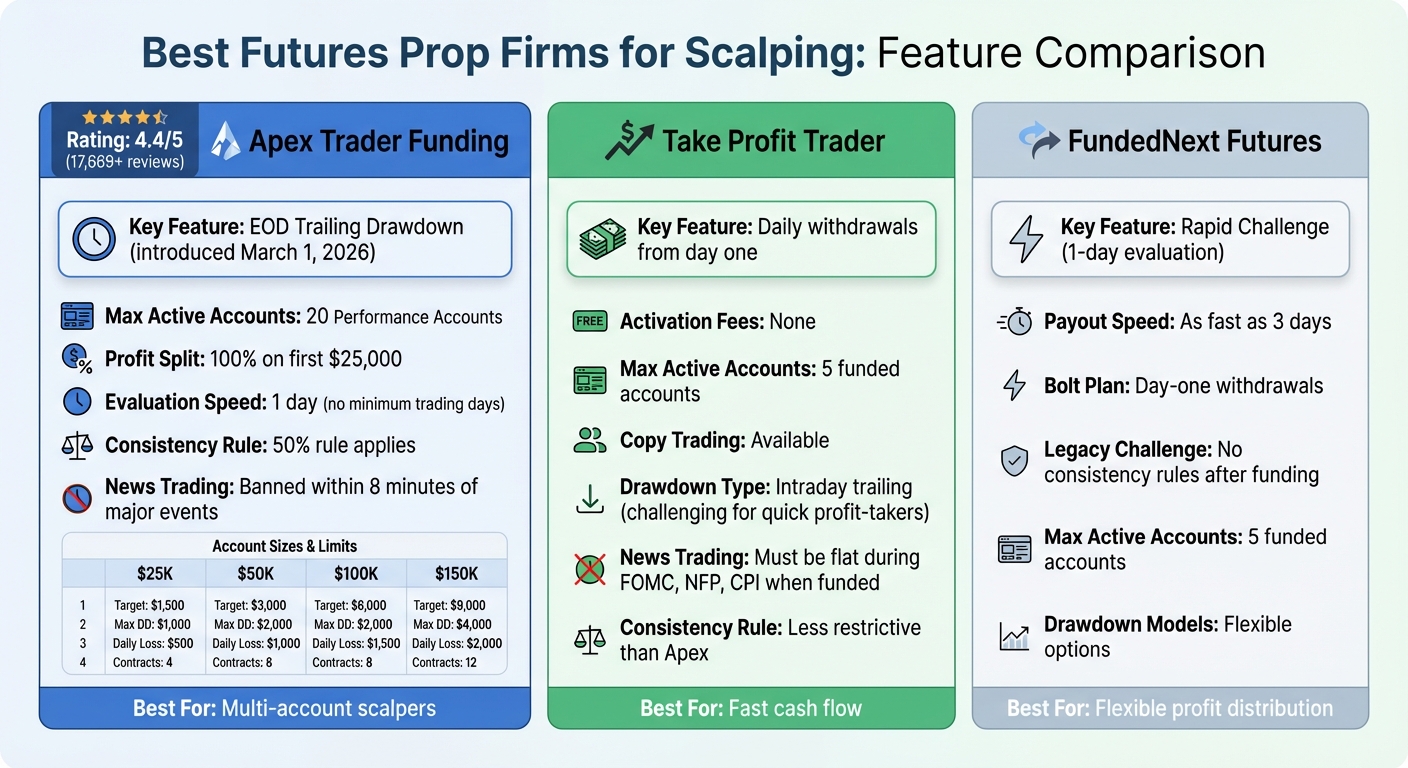
Top 3 Futures Prop Firms for Scalpers: Features and Account Limits Comparison
When it comes to scalping, selecting the right prop firm can make or break your trading success. The best firms for scalping provide tight spreads, fast execution, and rules that align with high-frequency trading. Below are three standout firms, each offering unique benefits tailored to different trading styles and financial needs.
Apex Trader Funding
On March 1, 2026, Apex Trader Funding introduced EOD Trailing Drawdown accounts. Unlike traditional intraday drawdowns, which adjust in real time based on unrealized profits, the EOD model only updates at the end of the trading day. This feature helps avoid the "ratchet effect", where temporary profit spikes tighten your drawdown limit, potentially stopping you out prematurely.
Apex allows traders to manage up to 20 active Performance Accounts simultaneously, making it a great option for those using trade copiers to maximize small gains. Traders enjoy a 100% profit split on the first $25,000, and evaluations can be completed in just one day with no minimum trading days required. However, keep in mind the 50% consistency rule during payouts – no single day can contribute more than half of your total profits. Additionally, the firm enforces a rule against trading within 8 minutes of major news events. With a 4.4/5 rating from over 17,669 reviews, Apex provides a blend of flexibility and scalability for scalpers looking to execute high-frequency strategies.
| Parameter | $25K Account | $50K Account | $100K Account | $150K Account |
|---|---|---|---|---|
| Profit Target | $1,500 | $3,000 | $6,000 | $9,000 |
| Max EOD Drawdown | $1,000 | $2,000 | $3,000 | $4,000 |
| Daily Loss Limit | $500 | $1,000 | $1,500 | $2,000 |
| Max Contracts | 4 | 6 | 8 | 12 |
Take Profit Trader

Take Profit Trader stands out for its daily withdrawals from day one and no activation fees. The firm supports up to 5 live funded accounts, with copy trading available to spread risk. While its consistency rules are less restrictive than Apex’s, traders must remain flat during major news events, such as FOMC, NFP, and CPI, once funded.
One downside is the intraday trailing drawdown, which can be challenging for traders who don’t secure profits quickly. However, the combination of immediate payouts and zero activation fees makes this firm appealing for scalpers who value fast access to earnings. These features align well with the need for speed and risk discipline in scalping.
FundedNext Futures

FundedNext Futures is geared toward scalpers who prioritize speed and flexibility. Its Rapid Challenge allows traders to pass the evaluation in just one day, with payouts available in as little as three days. The Bolt plan offers day-one withdrawals, while the Legacy Challenge eliminates consistency rules after funding – perfect for scalpers with fluctuating daily profits .
Although FundedNext supports up to 5 funded accounts – fewer than Apex’s 20 – it compensates with flexible drawdown models and quick payout options. These features make it a strong choice for traders seeking efficient cash flow and fewer restrictions on daily profit distribution. It’s an excellent fit for scalpers looking to combine speed with effective risk management.
Prop Firm Rules That Impact Scalping
Once you’ve sharpened your scalping strategies, understanding the rules set by prop firms becomes crucial. These rules dictate how you trade, manage risks, and secure payouts. Overlooking even a single rule can result in immediate account failure, so knowing the details is absolutely critical.
Daily loss limits are one of the most important rules to watch. For instance, Apex Trader Funding enforces a $1,000 daily loss limit on a $50,000 account. If you hit this limit, trading stops for the day, though your account isn’t terminated. To avoid this, scalpers often set tight stops – between 2–4 ticks on ES futures – especially during volatile sessions like FOMC announcements.
Drawdown models are another key factor, and they come in two types: intraday trailing and end-of-day (EOD) trailing. Intraday models adjust in real time based on your peak balance, including unrealized gains. For example, if your open trade reaches a $500 profit but then pulls back to $200, the drawdown threshold remains locked at the $500 peak. This "ratchet effect" can shrink your cushion and lead to early stop-outs. On the other hand, EOD models – like the one Apex introduced on March 1, 2026 – only update at the market close (4:59:59 PM ET), offering more flexibility for intraday swings.
Consistency rules are equally important for scalpers. These rules ensure that profits are spread evenly across trading sessions, promoting sustainable growth. Many firms enforce a consistency rule, meaning no single day’s earnings can exceed half of your total profits during a payout period. For instance, if you make $600 in one session, you’ll need at least $1,200 in total profits before withdrawing funds. Tradeify uses a tiered system: 20% for the first payout, 25% for the second, and 30% for the third and beyond. Tools like the Consistency Rule Calculator on DamnPropFirms can help you confirm your eligibility before requesting payouts.
News trading policies also play a significant role in scalping. Restrictions vary by firm and account type. While some firms allow news trading during evaluations, funded accounts often require traders to be flat (no open positions) during major economic events like FOMC, NFP, and CPI. For example, Take Profit Trader enforces strict flat-position rules for funded accounts. Apex takes it a step further, banning trades within 8 minutes of major news events. Violating these rules could result in account forfeiture, so it’s essential to stay informed and track high-impact events on your calendar.
Here’s a quick summary of the key rules and their effects on scalping:
| Rule Type | Impact on Scalpers | Example |
|---|---|---|
| Daily Loss Limit | Caps intraday losses; pauses trading if breached | $1,000 limit on $50K account at Apex |
| Intraday Trailing Drawdown | Adjusts with peak balance; risk of "ratcheting" | Unrealized $500 profit locks threshold |
| EOD Trailing Drawdown | Updates only at market close; more forgiving | Apex’s March 2026 update |
| Consistency Rule | Requires balanced profits; delays payouts | 50% rule: $600 day needs $1,200 total profits |
| News Trading Ban | Flat positions required during major events | FOMC, NFP, CPI restrictions at Take Profit Trader |
Risk Management and Consistency Rules for Scalpers
When it comes to scalping at prop firms, maintaining strict risk discipline is non-negotiable. A good rule of thumb is to risk only 0.5%–1% per trade. For instance, on a $50,000 account, this translates to $250–$500 per setup.
To complement firm rules, you should set your own daily loss cap. While firms like Apex Trader Funding permit up to $1,000 in daily losses on a $50,000 account, many scalpers stick to personal limits of 2%–3% per day. If your equity drops by 5% or more, consider cutting your position size by 50% until you recover. This disciplined approach not only protects your account but also helps you stay consistent with your risk management strategy.
Another key principle is avoiding over-leverage. A safe practice is to trade only 30%–50% of your available contract capacity, leaving room for adjustments. For example, if Take Profit Trader allows you to trade up to 6 contracts on a $50,000 account, you might limit yourself to 2–3 contracts. While prop firms set external risk boundaries, your personal controls are what ensure long-term stability and success.
The importance of these practices is underscored by some sobering statistics:
80% of account violations occur because traders abandon their own rules when emotions take over.
Another critical aspect is the 50% consistency rule, which many firms enforce. This rule ensures that no single day accounts for more than half of your total profits during evaluation. For example, if you earn $800 in one trading session, you’ll need to accumulate at least $1,600 in total profits before you can request a payout. This requirement pushes traders to demonstrate a repeatable edge rather than relying on a single lucky day. Tools like the Consistency Rule Calculator on DamnPropFirms can help you check your eligibility before submitting payout requests.
Successful scalpers typically maintain a win rate of 40%–55%, paired with a risk-reward ratio of 1:2 or better. They also spread their gains across multiple sessions rather than chasing one big win, which helps build a steady and reliable profit curve.
How to Maximize Payouts with Scalping
You can amplify your scalping profits by replicating trades across multiple funded accounts. Instead of simply increasing your contract size on a single account – which raises the risk of hitting your Daily Loss Limit – use cloud-based trade copiers like TradeSyncer. These tools allow you to mirror trades across multiple accounts. For example, Apex Trader Funding supports up to 20 performance accounts, while Take Profit Trader allows copy trading across 5 accounts. With this approach, a single $200 scalp can turn into $4,000 when duplicated across 20 accounts. This strategy pairs perfectly with high-frequency trading methods.
Reducing commission drag is another critical factor in scalping. While Micro contracts like MES and MNQ have lower margin requirements, they often come with higher commission costs relative to their tick value. For instance, two ticks on an E-mini S&P (ES) contract can yield around $50 before commissions, but the same movement on Micros generates a much smaller profit. To keep costs down, avoid trading during the first five minutes after the market opens – spreads are typically wider at this time. Instead, focus on periods with higher trading volume.
Stick to firm-specific rules to ensure successful withdrawals. Tools like the Consistency Rule Calculator on DamnPropFirms can help confirm your eligibility before submitting a payout request. Also, remember to close all positions before requesting a withdrawal – a single open trade, no matter how small, can void your request. At Apex Trader Funding, for example, you need to exceed your drawdown limit by at least $100 to access payouts above the $500 minimum. On a $50,000 account, this means achieving a balance of $52,100. After a streak of wins, consider scaling back your position size to protect your buffer, as trailing drawdowns increase with equity but don’t decrease.
For more flexibility, consider "no consistency" account options like LucidFlex at Lucid Trading, Tradeify Select at Tradeify, or FundedNext Legacy at FundedNext Futures. Pairing these accounts with daily withdrawal options – such as those provided by Take Profit Trader – can help you access funds quickly and reinvest in new evaluations. These choices can greatly enhance your scalping strategy and improve your payout potential.
Conclusion
Scalping isn’t just about reacting quickly – it’s about having a solid plan, the right tools, and a compatible firm to turn those small market moves into steady profits. Fast trading platforms like Rithmic or Tradovate, paired with a low-latency internet connection, are non-negotiable for scalpers. Without these, slippage can eat into your edge before commissions even factor in.
Choosing the right firm is just as important as your strategy. Firms such as Apex Trader Funding (offering 100% of first payouts up to $25,000 and no trailing drawdown on funded accounts), Take Profit Trader (which allows daily withdrawals), and FundedNext Futures (providing instant funding options) cater to different trading styles. Matching your scalping approach with the firm’s drawdown model is essential.
"Most futures traders blow accounts not because their setups are bad, but because they choose a drawdown model that punishes how they manage risk." – Apex Trader Funding
Risk management is another cornerstone of scalping success. Keep risk between 0.5% and 1% per trade, and adhere to consistency rules, such as Apex’s 50% rule, to avoid account violations. Tools like the Consistency Rule Calculator on DamnPropFirms can help you confirm your eligibility before submitting withdrawal requests, especially after the rule updates introduced in March 2026.
FAQs
How do I choose a prop firm drawdown model for scalping?
When selecting a drawdown model for scalping, it’s important to align it with your trading style. Intraday trailing drawdowns adjust in real-time based on your highest equity, making them a good option for traders who execute frequent trades. On the other hand, static drawdowns have fixed loss limits, which can appeal to those who prefer a more conservative approach to risk management. The right choice depends on your risk tolerance and trading strategy, so make sure to carefully review the rules of each firm to determine what works best for you.
What contract size is safest for scalping an evaluation?
The safest contract size for scalping during an evaluation largely hinges on your approach to risk management and the specific rules set by the firm. Opting for smaller contract sizes, such as 1–2 mini or micro contracts, is often a smarter choice. Why? It keeps potential losses in check and ensures risk exposure stays manageable.
Many firms suggest keeping your risk per trade between 0.5% and 1% of your account. On top of that, it’s crucial to stick to the firm’s rules, including daily loss limits and position sizing guidelines. By doing so, you can scale up responsibly while keeping risks under control.
How can I scalp without failing news and consistency rules?
To scalp successfully while steering clear of news-related surprises and consistency rule violations, stick to these key strategies:
- Steer clear of high-impact news events to avoid sudden and unpredictable market swings.
- Trade with smaller contract sizes to ensure you stay within drawdown limits and meet consistency requirements.
- Keep a close eye on your account metrics and follow a structured trading plan with clear targets and stop-loss levels.
Maintaining discipline and staying aware of market conditions can help reduce the chances of breaking the rules.