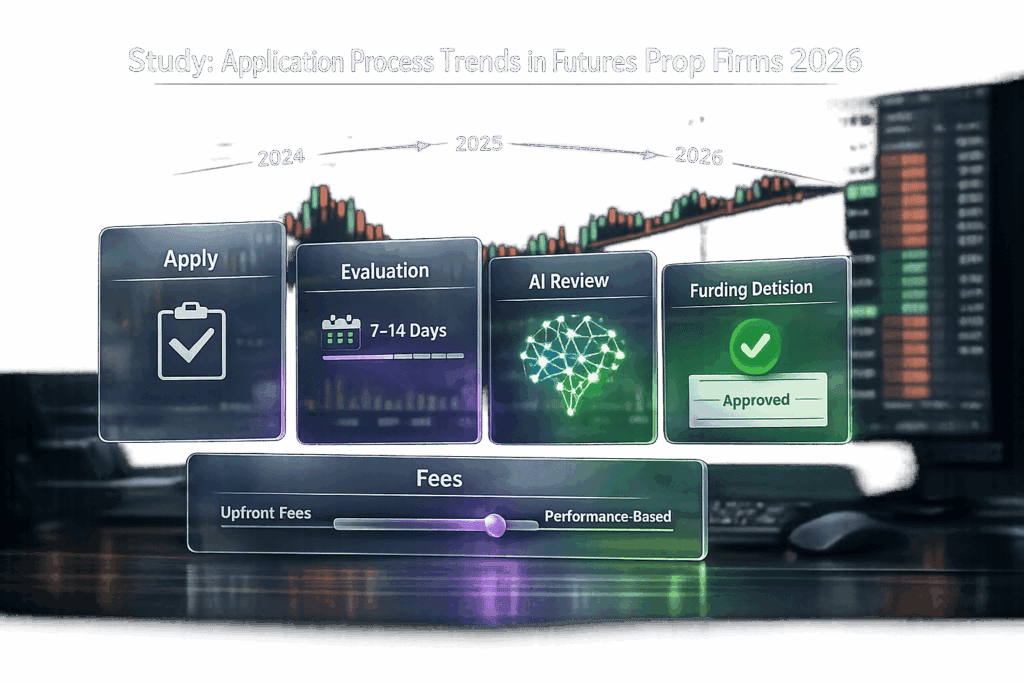
Prop firms in 2026 flipped the script. If you’re tired of drawn-out evaluations, complex rules, or paying monthly fees, this year’s updates are a breath of fresh air. Apex Trader Funding, Topstep, and others are ditching subscriptions for one-time fees, cutting evaluation timelines to as little as one day, and automating payouts with AI. The result? Faster funding, simpler rules, and fewer headaches. But not every change is great – Apex killed reset options, and consistency rules got stricter. Here’s what’s new, what works, and what might trip you up.
Major Changes in Futures Prop Firm Applications in 2026
The futures prop firm world saw some big shifts in 2026. What used to be a drawn-out, weeks-long process has been trimmed down thanks to tech upgrades, making it easier and faster for traders to secure funding. Three big changes stood out: better pass rates at top firms, the rise of one-phase evaluations, and the use of AI to oversee applications. Let’s break these down.
Pass Rates Increased at Top Firms
Top firms like Apex Trader Funding have seen their pass rates jump significantly. Their new one-phase products now boast first-attempt pass rates of 15% to 20%, which is nearly double the old industry average of 5% to 10% [4][7]. If you factor in traders who use resets, Apex’s pass rate climbs to an impressive 40% [7]. Take Profit Trader also reported a 20.37% pass rate for its one-step evaluation between January and August 2023 [7]. Compare that to the old system, where about 94% of traders failed challenges, and only 7% ever reached payouts [7]. The boost in pass rates comes down to simplified rules – no more losing out over small technicalities.
More Firms Using One-Phase Evaluations
Higher pass rates have paved the way for a major industry shift: one-phase evaluations are becoming the norm. Firms are ditching the multi-phase grind in favor of streamlined setups. For example, Apex Trader Funding launched a new evaluation in March 2026 that traders can pass in just one day [1]. Take Profit Trader offers a system where you can qualify in five days, while MyFundedFutures has a "Rapid Plan" that lets you finish in a single session [6]. Even Topstep, the OG firm in the space, has dropped minimum trading day requirements [4]. This shift away from 7–10 day minimums means skilled traders can hit profit targets and get funded without waiting around for arbitrary time limits [1][6].
AI Tools Now Used in Application Reviews
Automation has taken over in a big way, with AI now running the show for application reviews. These tools enforce rules in real time, tracking things like floating losses, leverage use, and exposure concentration. If you break a rule – like hitting a 5% daily drawdown – AI flags it instantly [9]. By 2026, AI was handling 89% of the world’s trading volume [10], and firms are using the same tech to catch behaviors like revenge trading or sudden lot size spikes [9]. Apex Trader Funding has fully automated payouts, cutting out manual reviews and the risk of subjective denials [1]. This automation has slashed admin costs by 30% while tightening up compliance [9], making payouts faster and more reliable for traders.
sbb-itb-46ae61d
How Evaluation Structures Changed
By 2026, the prop trading world saw a major shift in how evaluations worked. The old 30–60-day evaluation periods were replaced with faster, more flexible setups. Many firms now combine live trading with skill assessments to ensure traders show real ability, not just a lucky streak. The focus has shifted to rewarding traders who can deliver results quickly and consistently.
Evaluation Periods Got Shorter
Gone are the days of mandatory minimum trading periods. In March 2026, Apex Trader Funding dropped its minimum trading day requirement to just one day. If you hit your profit target on day one without breaking any rules, you’re instantly funded. Lucid Trading offers a similar one-day option through its LucidPro product. Meanwhile, MyFundedFutures lets traders complete their evaluations in a single session with its Rapid Plan add-on[1][2].
On the flip side, firms like these cap evaluation periods at 30 calendar days, giving traders about 21–22 actual trading days to hit their targets[1]. This shift has simplified the process, ditching the drawn-out evaluations of the past in favor of quicker, performance-driven systems. It’s all about cutting the fluff and focusing on results. This efficiency is a hallmark of TradeDay Prop Firm, which prioritizes fast payouts and streamlined rules.
Combined Trading and Interview Evaluations
Speeding up evaluations isn’t the only change – firms now emphasize consistent skill over one-off wins. For example, Lucid Trading has introduced a "live review pool" for traders who achieve five payouts. This pool evaluates their readiness for live capital[2]. Similarly, Tradeify uses its "Elite Live" program, requiring traders to complete 3–10 payouts before a final review[2].
These new models go beyond a simple pass/fail system. Even if you crush the initial challenge in one day, you’ll need to prove consistent performance – usually through 3–5 payout cycles – before moving from simulation to live trading[2]. It’s a tiered approach that ensures only traders with proven, steady results get access to live markets.
2026 Rule Changes Affecting Applications
The trading landscape saw some big shifts in 2026 with new rules that changed how traders qualify for funding. Major players like Apex Trader Funding and Topstep updated their consistency requirements and payout structures, making it clear that traders need to adapt their strategies to meet these new standards.
Apex Trader Funding Tightened Consistency Rules
Starting March 1, 2026, Apex Trader Funding raised the bar for its consistency rules. The threshold for new Performance Accounts jumped from 30% to 50%. This means no single trading day can make up more than half of your total profit when you’re requesting a payout[1].
Apex also introduced more flexibility by letting traders pick between End-of-Day (EOD) trailing drawdown – where the drawdown resets only at market close – or Intraday trailing drawdown when signing up for an evaluation[1]. On top of that, they scrapped some of the more restrictive rules, like the MAE rule, the 5:1 risk-reward requirement, and the one-direction rule. The result? A more straightforward approach with fewer hoops to jump through.
However, there’s a catch: evaluations now expire after 30 days, giving traders about 21–22 trading days to hit their targets. And resets? They’re no longer an option under this new system[1].
Topstep Introduced a Two-Rule Payout System

Topstep also shook things up, rolling out a two-rule payout structure for its Express Funded Accounts (XFA) in December 2025. By February 2026, they added a Consistency Path option to give traders more flexibility in how they qualify for withdrawals[4].
Here’s how it works:
- Standard Path: Traders need five winning days to qualify for a payout, with a cap of $5,000 per cycle.
- Consistency Path: This option only requires three winning days but enforces a stricter 40% consistency rule (no single day can account for more than 40% of total profit). The payout cap here is higher – up to $6,000 per cycle[4].
For both paths, a winning day means earning at least $150, and the profit split is 90/10 for new traders.
"Topstep has the most predictable payout once you meet the requirements and recently formalized the two-rule structure that adds a ‘remain profitable’ check after the first payout."
These changes also make it easier to manage multiple accounts with trade copying platforms since all follower accounts automatically stick to the same winning day and consistency rules[4].
Application Process Comparison Across Firms
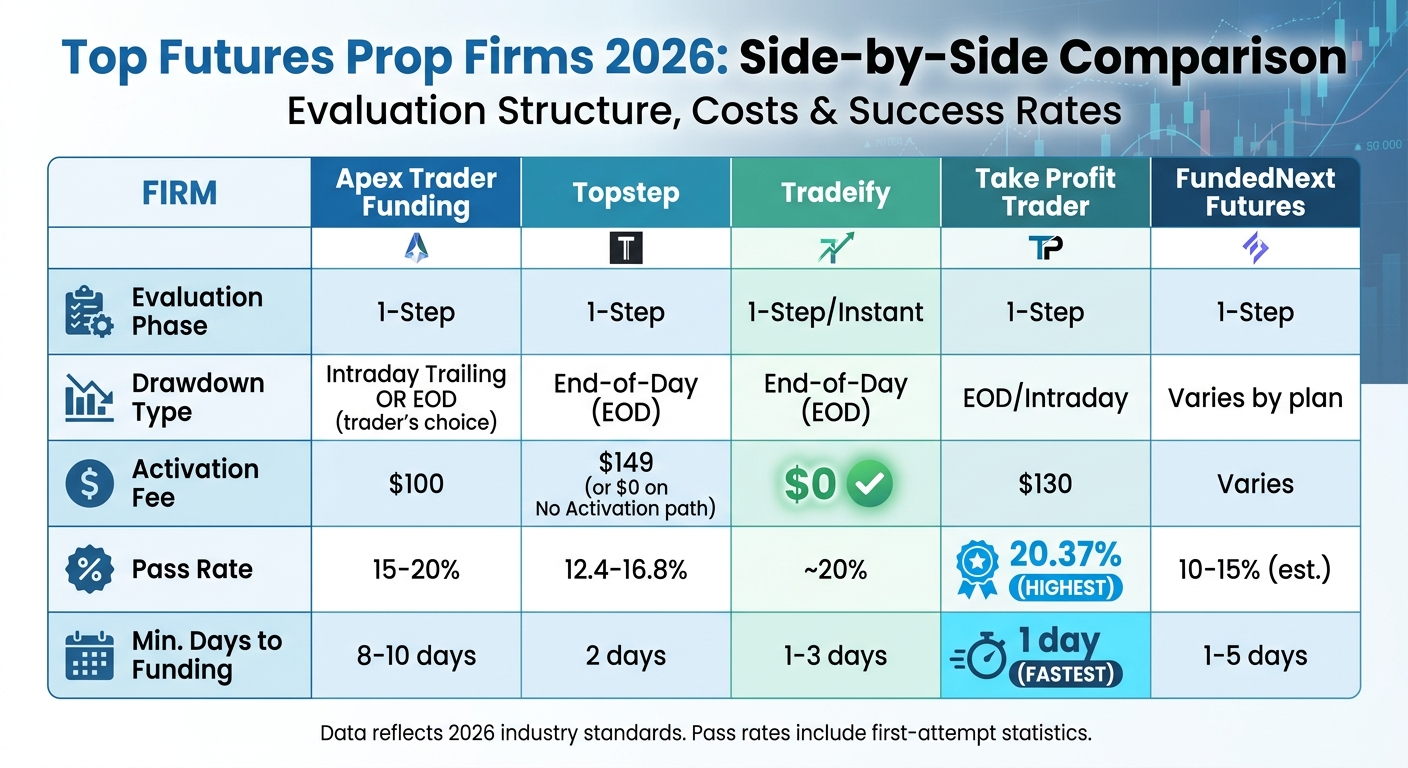
2026 Futures Prop Firms Comparison: Fees, Pass Rates & Funding Timeline
The 2026 rule changes make it crucial to compare the top futures prop firms before applying. You can also compare the best futures prop firms for funding and payout rules. Differences in evaluation structures, fees, and timelines can have a big impact – especially if you’re on a tight budget or need funding quickly. The table below breaks down the key metrics you should focus on.
Comparison Table of Top Firms
Here’s how the leading futures prop firms stack up on the factors that matter most:
| Firm | Evaluation Phase | Drawdown Type | Activation Fee | Pass Rate | Min. Days to Funding |
|---|---|---|---|---|---|
| Apex Trader Funding | 1-Step | Intraday Trailing or EOD (your choice) | $100 | 15-20% [7] | 8-10 days [7][2] |
| Topstep | 1-Step | End-of-Day (EOD) | $149 (or $0 on No Activation path) | 12.4-16.8% [11][7] | 2 days [11][7] |
| Tradeify | 1-Step / Instant funding | End-of-Day (EOD) | $0 | ~20% (Select) [11][12] | 1-3 days [11][2] |
| Take Profit Trader | 1-Step | EOD / Intraday | $130 | 20.37% [11][7] | 1 day (PRO accounts) [2] |
| FundedNext Futures | 1-Step | Varies by plan | Varies | 10-15% (est.) | 1-5 days [2] |
Looking at the table, a few trends stand out. First, End-of-Day (EOD) trailing drawdown is becoming the go-to option for newer traders. It recalculates your max loss at the end of the session, so you’re not knocked out by intraday price swings [2][12]. Firms like Topstep and Tradeify default to EOD, while Apex lets you choose between EOD and Intraday when you sign up [2].
Another shift? Activation fees are dropping fast. Tradeify charges nothing to activate funded accounts, and Topstep now offers a "No Activation Fee" option. You pay a higher monthly fee instead – $209/month for a $150K account – versus the usual $149 activation fee [4][11]. If you’re looking for the cheapest entry, firms like My Funded Futures offer accounts starting at just $77 for $50K, with no activation fee [4].
Passing rates vary widely, but Apex has upped its game. They report 15–20% pass rates on the first attempt, jumping to 40% with resets [7]. Take Profit Trader leads the pack at 20.37% [11][7], while Topstep trails slightly at 12.4–16.8%, depending on the account type [11][7].
What Traders Say About 2026 Application Processes
The updates for 2026 have stirred up plenty of chatter among traders, especially when it comes to evaluation resets, refund programs, and upfront costs. Some of the changes make it easier to get started, but not without trade-offs.
Reset Options and Refund Programs
One of the biggest shake-ups is that Apex Trader Funding has completely done away with reset options in its 2026 lineup. Instead of paying $65 to reset a failed evaluation, you now have to buy a new evaluation outright. Prices start at $17.70 for a 25K account, and each evaluation runs for 30 days[1].
For a 100K account, the cost is now around $29.70 – a massive drop from the old $133.65 subscription model. As DealPropFirm put it:
"The loss of resets is the most impactful for most traders… However, at ~$17.70-$39.70 per evaluation, buying a new eval isn’t dramatically more expensive than a reset."
- DealPropFirm[1]
On the upside, Apex has also removed payout denials and simplified its rules, which many traders feel makes up for the lack of resets. Meanwhile, firms like Bulenox still offer traditional reset options – charging $78 for an immediate retry or providing free resets on the next billing cycle[[13]](https://www.quantvps.com/blog/top futures prop firms).
Refund programs are also becoming more popular. Both Aqua Funded and Blue Guardian now offer full refunds of the evaluation fee after a trader’s fourth payout. That’s a big draw – Aqua Funded boasts a 9.4/10 rating from over 5,000 verified reviews[11]. These policies shift the focus from just passing evaluations to sustaining performance over time.
These reset and refund changes also tie into broader cost-cutting measures, like the elimination of activation fees.
No-Activation-Fee Options
Another major win for traders in 2026 is the removal of activation fees. These fees, which used to range from $100 to $160, were a common hurdle between passing an evaluation and getting funded. Now, firms like Tradeify, My Funded Futures, Phidias, and Topstep have scrapped these fees entirely[5][6].
This change is a big deal, especially for newer traders. On average, traders spend over $400 trying out different firms before finding one that works for them[6]. By cutting activation fees, firms are lowering the overall cost of getting funded.
For example, Tradeify, which has a 4.8/5 rating from 131 verified reviews, gets consistent praise for its $0 activation fee[5]. One funded trader, Chris T., shared his experience:
"My first payout arrived within a week."
- Chris T., Funded Trader[7]
With faster payouts and no activation fees, the path from passing an evaluation to earning profits has become a lot smoother. These updates reduce entry costs and hint at even more changes to come in how prop firms handle evaluations.
What’s Next for Prop Firm Evaluations
Prop firm evaluations are evolving fast, with a growing emphasis on objective metrics that reward consistent performance over initial capital contributions. Automation and skill-based models are driving this shift.
More AI and Automated Risk Controls
AI is becoming a bigger player in how prop firms manage risk. By 2026, its role is expected to expand even more. For example, Fidelcrest introduced AI mentors in early 2026 that gave personalized feedback during evaluation challenges. The result? A 22% drop in account failure rates[8]. On top of that, smarter automated risk controls, like AI-powered drawdown alerts, are helping traders avoid costly mistakes. These alerts have been shown to prevent up to 40% of potential trading losses by pausing trades before a trader hits their daily loss limit[8]. Some firms are even using "soft breaches", which temporarily pause trading instead of shutting down accounts entirely, giving traders a chance to reset.
"The days of manual, subjective evaluations are fading. Digital platforms are now fully automated, providing a fast and objective way to assess a trader’s performance." – BrightFunded[3]
And it’s not just AI. A few firms are dabbling with quantum computing for better market analysis. Lux Trading Firm, for instance, integrated quantum computing into its research tools in 2026, improving market prediction accuracy for funded traders by 55%[8]. These advancements make it clear: the future is all about using tech to reward trading skill.
Skill-Based Access Models
The industry is also moving toward evaluation models that focus purely on trading ability. Firms like Tradeify and Lucid Trading now offer "Instant Funding" accounts. These let skilled traders skip the traditional evaluation process for a one-time fee, usually between $349 and $729[5]. More firms are also ditching monthly subscriptions in favor of these one-time payment models.
"Apex’s move to one-time pricing in March 2026 is the most significant pricing innovation in the industry in years." – Tradecovex[4]
Transparency is another area seeing upgrades. Blockchain-based payout verification is becoming a thing, helping traders trust the process. In late 2025, FTMO updated its Account Management App to include blockchain verification, cutting payout disputes by 60% in just a few months[8]. These changes point to an industry prioritizing fairness and skill over outdated systems.
FAQs
How do one-day evaluations work in 2026?
In 2026, one-day evaluations push traders to hit profit targets and stick to risk rules – all within a single trading day. These tests focus heavily on real-time risk management, with strict guidelines like daily loss limits and set trading hours. Some firms even provide instant funding, letting traders bypass the usual multi-step process and jump straight into funded accounts once they pass.
Should I choose EOD or intraday trailing drawdown?
The decision between EOD (end-of-day) trailing drawdown and intraday trailing drawdown comes down to how you trade and how much risk you’re comfortable with.
EOD drawdown only updates at the end of the trading session, giving you more breathing room to ride out intraday fluctuations. It’s a better fit if you’re holding trades longer or dealing with market swings. On the other hand, intraday drawdown adjusts in real time. This makes it stricter but ideal if you want tighter control over your risk during the trading day.
Pick EOD if you lean toward longer setups, and stick with intraday if you need precise, moment-to-moment risk management.
How can I pass stricter consistency rules and still get paid out?
To stick to stricter rules and actually get paid, aim for steady profits instead of chasing one massive trade. Many prop firms cap how much profit you can make in a single day to keep things balanced. Build a strategy that delivers consistent daily results, manage your risk wisely, and know the specific rules for the firm you’re trading with. Following these steps gives you a much better shot at staying compliant and securing those payouts.