When joining a prop trading firm, fees can significantly impact your profits. Here’s what you need to know:
- Evaluation Fees: These range from $50 to over $1,000, depending on account size. Some firms refund this fee after your first withdrawal.
- Activation Fees: After passing the challenge, expect to pay between $0 and $800 to start trading live.
- Monthly Costs: Professional market data fees (~$130) and platform subscriptions ($50–$100) can add up quickly.
- Per-Trade Costs: Round-trip trades typically cost $6–$8, plus clearing fees.
- Profit Splits: Firms usually take 10%–30% of your earnings, and some impose withdrawal minimums or processing fees.
Key takeaway: Always calculate your total costs, including recurring fees and trade expenses, before committing to a firm. Transparent pricing is crucial for sustainable trading.
Prop Trading Firm Fee Breakdown by Account Size and Type
Common Prop Firm Fees Explained
Evaluation and Challenge Fees
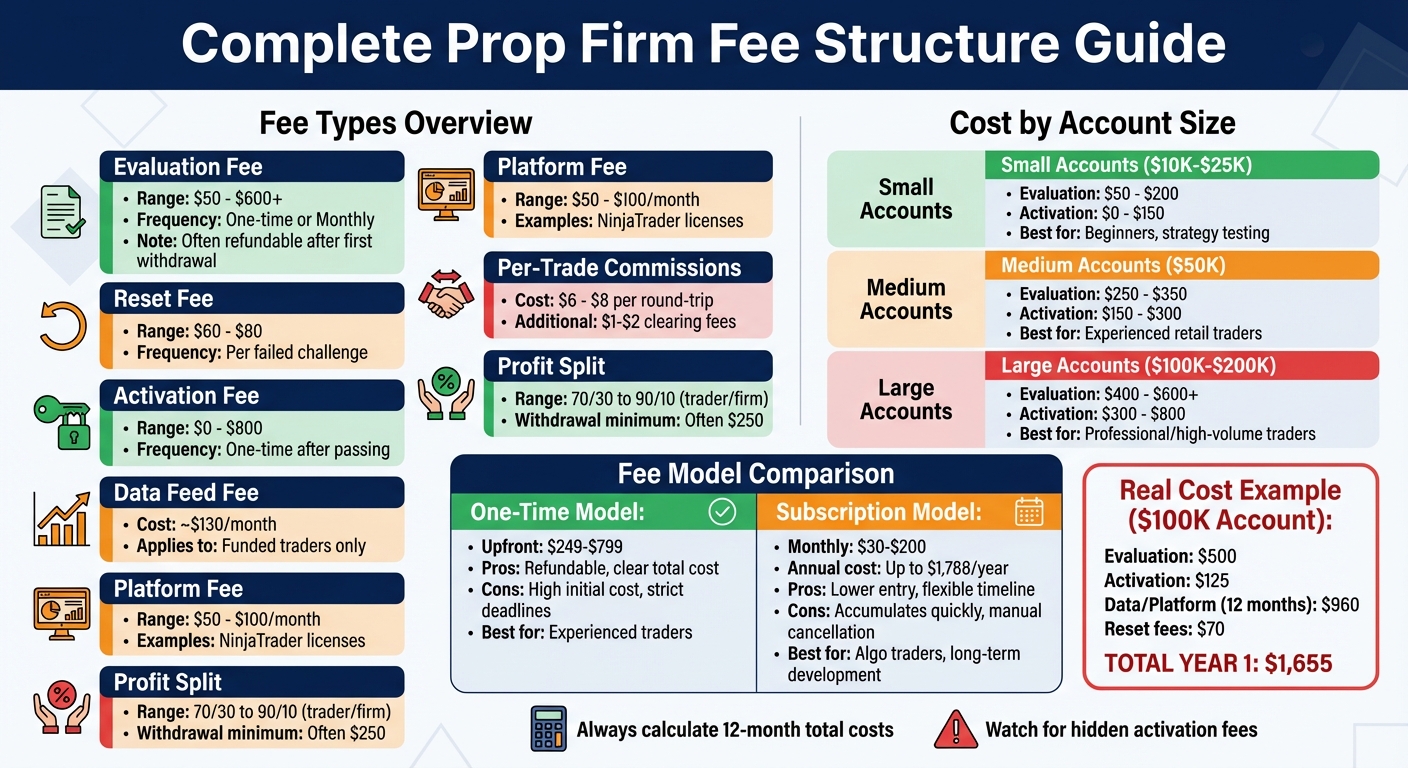
Evaluation fees act as the entry cost for traders looking to join a prop firm. These fees can range anywhere from $50 to over $1,000, depending on the account size. For example, a $10,000 account might cost around $167, while evaluations for $100,000 accounts typically fall between $400 and $600 [6].
Some firms offer one-time fees that allow unlimited attempts until you pass the evaluation, while others use a subscription model. For instance, Topstep charges about $49 per month for a $50,000 account and $99 per month for a $100,000 account. However, subscriptions require manual cancellation to avoid ongoing charges [1].
Interestingly, some firms refund your evaluation fees once you pass and make a withdrawal, essentially returning your initial investment [6]. Beyond these fees, traders should also be aware of potential activation and reset costs, or consider prop firms with instant funding to bypass the evaluation phase entirely.
Account Activation and Reset Fees
Passing an evaluation doesn’t always mean immediate access to live trading. Many firms require an activation fee, which is a final payment before you can start trading with real capital. These fees can range from $0 to as much as $800, with a $100,000 account activation often costing around $125 [3].
"Think of an activation fee as a final ‘unlock’ payment that grants you funded account trading access and the ability to earn real payouts." – SaveOnPropFirms [3]
If you fail a challenge, reset fees allow you to restart right away instead of waiting for the next billing cycle. These fees typically range between $60 and $80 [1].
Platform and Data Feed Costs
During the evaluation phase, most firms provide free access to trading platforms and market data. However, once you’re funded, you may encounter additional costs. Professional market data for exchanges like CME or CBOT costs around $130 per month. Similarly, while platforms like NinjaTrader might be free during the evaluation, you may need to pay for a monthly license – usually between $50 and $100 – once you start trading live [1].
"Data feeds are free during your challenge, but once funded, exchanges like CME, CBOT, or NYMEX charge professional data fees… simply because you’re now seen as a professional trader." – Fred Harrington, Founder of Vetted Prop Firms [1]
Understanding these costs is essential to calculate your total expenses as a funded trader.
Profit Splits and Withdrawal Fees
Prop firms typically take a percentage of your profits to fund their operations. Most firms offer profit splits ranging from 70/30 to 90/10, with some competitive firms even offering splits as high as 90% or 100% to attract skilled traders [2].
In addition, many firms have a minimum profit threshold – often around $250 – before allowing fee-free withdrawals. If your profits fall below this amount, you might face processing fees, which can further reduce your net earnings.
Per-Trade Commissions and Clearing Costs
Trading futures contracts comes with transaction costs. Standard commissions for futures generally range from $3 to $4 per contract per side, meaning a full round-trip trade costs between $6 and $8. On top of that, clearing and regulatory fees add an additional $1 to $2 per contract [1].
These costs can add up quickly. For example, executing ten round-trip trades per day at $8 each totals about $80 daily – or roughly $1,600 per month if trading 20 days.
| Fee Type | Typical Cost | Frequency | Coverage |
|---|---|---|---|
| Evaluation Fee | $50 – $600+ | One-time/Monthly | Entry into the challenge phase |
| Reset Fee | $60 – $80 | Per occurrence | Restarting a failed challenge immediately |
| Activation Fee | $0 – $800 | One-time | Setting up the funded account |
| Data Feed Fee | ~$130 | Monthly | Professional exchange data for funded traders |
| Platform Fee | $50 – $100 | Monthly | Trading software licenses (e.g., NinjaTrader) |
| Commissions | $6 – $8 | Per round-trip | Transaction execution and clearing costs |
sbb-itb-46ae61d
Prop Firms: How They Work & Who They’re For (What I Wish I Knew)
One-Time vs. Recurring Fee Models
When it comes to funded trading, understanding fee structures is essential to grasp the full cost involved – not just the upfront evaluation charges.
One-Time Evaluation Fees
With a one-time evaluation fee, you pay a single upfront amount to enter the challenge. These fees typically range from $249 for a $25,000 account to $799 for a $100,000 account [4]. A major perk? Many firms refund this fee after your first successful payout, essentially turning it into a refundable entry cost [4].
On the flip side, the initial expense can feel steep, and the strict deadlines can add extra pressure. If you don’t pass, you’ll need to pay again to try another challenge [1]. This model is ideal for seasoned traders with a solid strategy who can perform well under tight time constraints [4]. Knowing the exact cost upfront makes it easier to calculate your trading expenses.
Monthly Subscription Models
Subscription models work differently – they charge anywhere from $30 to $200 per month for ongoing platform access and evaluation opportunities [4]. The lower upfront cost makes it more accessible, and the absence of strict deadlines gives you the freedom to refine your trading approach at your own pace [4].
However, these fees can add up fast. For example, a $149 monthly subscription totals $1,788 over a year – much higher than most one-time fees. Plus, you’ll need to manually cancel to stop recurring charges [1]. This model is better suited for traders using algorithmic strategies or those experimenting to develop a long-term edge in a stable, "real-world" trading environment [4].
Combined Fee Structures
Some firms mix things up by combining evaluation fees (either one-time or recurring) with an activation fee once you pass the challenge. Activation fees can range from $0 to $800, with $125 being a common amount for a $100,000 account [3]. A few firms even offer options: pay a larger one-time activation fee for lifetime access or choose a smaller recurring fee to maintain your funded account [3].
"Prop firm fees aren’t just about the sign-up cost. It’s about knowing what you’ll actually pay before, during, and after passing a trading challenge." – Fred Harrington, Founder of Vetted Prop Firms [1]
Before you commit to any model, take the time to calculate your total costs over a 12-month period. Include potential resets, activation fees, and ongoing platform or data charges [2]. This will give you a clear understanding of your overall investment. Evaluating these combined fees alongside your trading goals ensures you make an informed decision.
How to Identify Clear vs. Hidden Fee Structures
When evaluating prop trading firms, the key difference between those that are upfront and those that obscure costs often lies in what they don’t disclose on their checkout pages. Many traders focus solely on the evaluation fee, only to discover additional charges later.
Questions to Ask Before Joining
Before signing up, take the time to understand all potential fees. Reach out to the firm’s support team and ask these specific questions:
- Is there an activation fee after passing the challenge? These fees can vary widely, from nothing to as much as $800 [3].
- What platform and data fees will I face once funded? While some platforms, like NinjaTrader, may be free during the evaluation phase, funded traders could incur $50–$100 in monthly platform fees and around $130 per month for professional exchange data [1].
- Is the evaluation fee refundable? If refunds are offered, confirm the exact timing and conditions for receiving the money back.
- Are there penalties for inactivity or additional monitoring fees? Some firms impose desk fees or penalties if you don’t meet trading volume requirements within a set period, often 14–30 days [7].
Warning Signs in Fee Disclosures
Be wary of firms that don’t clearly display activation fees on their pricing pages. As SaveOnPropFirms explains:
"If the fee isn’t clearly mentioned on the checkout page, it’s likely buried in the fine print" [3].
Additionally, watch out for firms with high minimum withdrawal thresholds (e.g., $250) or hidden processing fees, which may only be mentioned in payout policy documents [1] [8]. Fred Harrington, Founder of Vetted Prop Firms, cautions:
"What looked like a $100 challenge can turn into a multi-hundred-dollar monthly expense" [1].
Understanding these potential pitfalls can help you avoid unexpected costs.
Calculating Total Costs
Once you’ve identified potential fees, use this formula to calculate your actual expenses and compare firms effectively:
(Evaluation Fee) + (Activation Fee) + (12 × Monthly Platform/Data Fees) + (Estimated Reset Fees) + (Withdrawal Fees) [1] [7].
For example, let’s say you’re evaluating a $100,000 account. The evaluation fee might be $500, with an additional $125 activation fee. Add $80 in monthly data costs (totaling $960 annually) and $70 in reset fees, and your total comes to roughly $1,655 before you even see your first payout. Comparing these totals across firms is essential to find the most cost-effective option. Tools like DamnPropFirms can help you analyze costs for the best futures prop firms such as Apex Trader Funding, Take Profit Trader, and Topstep.
How Account Size Changes Fee Structures
Account size plays a big role in shaping your overall cost structure, influencing both initial and ongoing expenses.
For instance, a $10,000 account might cost between $100 and $200 for evaluation, while a $100,000 account could range from $400 to $600 for assessment fees [2]. But these upfront costs are just the beginning – there are additional fees to consider, especially as your account size grows.
Small Account Fees ($25,000 and Below)
Smaller accounts are ideal for traders looking to test the waters without taking on too much financial risk. Evaluation fees for accounts in the $10,000 to $25,000 range typically fall between $50 and $200. During special promotions, you might even snag one for as low as $17 [2]. Activation fees for these accounts are relatively low, ranging from $0 to $150 [1].
Roderick Casilli from Futures Fanatic explains the appeal of starting small:
"Starting with smaller account sizes allows testing a company’s processes before larger commitments. This approach reduces financial risk while building confidence." [2]
A $25,000 account offers a low-risk way to learn a firm’s rules and platform while setting the stage for future growth. Many firms have scaling options, allowing you to transition from managing smaller accounts to significantly larger ones as your performance improves [5]. Firms like Apex Trader Funding, FundedNext Futures, and Tradeify are worth considering for smaller accounts.
Medium and Large Account Fees ($50,000-$100,000+)
As account sizes increase, so do the associated costs. A $50,000 account typically comes with an evaluation fee between $250 and $350, while $100,000 accounts range from $400 to $600 [2]. Activation fees also climb, with medium accounts costing $150 to $300 and large accounts requiring $300 to $800 [1].
Here’s a quick comparison of fees by account tier:
| Account Size | Evaluation Fee Range | Activation Fee Range | Audience |
|---|---|---|---|
| $10,000 – $25,000 | $50 – $200 | $0 – $150 | Beginners, strategy testing |
| $50,000 | $250 – $350 | $150 – $300 | Experienced retail traders |
| $100,000 – $200,000 | $400 – $600+ | $300 – $800 | Professional/high-volume traders |
Larger accounts come with additional recurring costs like monthly platform and data fees, which can add $50 to $100 per month [1]. These ongoing expenses make it crucial to consider the total cost of ownership, not just the initial fees. For instance, a $100,000 account might require an evaluation fee of $500, an activation fee between $300 and $800, and monthly platform fees of $50 to $100. These costs can quickly add up.
If you’re considering a larger account, make sure to weigh the upfront and recurring fees carefully. Take the time to compare costs across the top futures prop firms like Take Profit Trader, Alpha Futures, and Topstep to find the best fit for your trading strategy and budget.
Understanding how account size impacts fees will help you align your trading goals with the right financial commitment.
Conclusion: Choosing the Right Fee Structure
Understanding all costs involved is key to protecting your profits. Beyond the evaluation fee, there are activation costs, monthly subscriptions, data fees, and per-trade commissions – all of which can eat into your earnings.
"When you stack them all together, what looked like a $100 challenge can turn into a multi-hundred-dollar monthly expense." – Fred Harrington, Founder, Vetted Prop Firms [1]
As we’ve covered, transparent fee structures are essential for sustainable trading. Before committing, calculate your 12-month break-even point. This means factoring in all recurring charges over a year to uncover your true costs. Sometimes, a firm with a higher upfront fee but a 90% profit split can yield better long-term returns than one with a lower entry fee but only a 70% profit split [2]. Pay close attention to how fees are disclosed – firms that openly share activation fees, withdrawal rules, and platform costs tend to be more trustworthy. Also, check if the evaluation fee is refundable after your first successful withdrawal, as this can significantly reduce your initial expenses [2][6].
For a side-by-side comparison of fee structures, explore detailed reviews on platforms like DamnPropFirms. They provide insights into top firms such as Apex Trader Funding, Take Profit Trader, and Topstep. Matching fee structures to your account size and trading approach is crucial – not just chasing the lowest advertised price.
FAQs
What fees apply after I pass the evaluation?
After clearing the evaluation, you could encounter activation fees, profit-sharing arrangements, or recurring expenses, depending on how the firm operates. To steer clear of unexpected costs, take the time to thoroughly examine each firm’s payout structure and fee policies. Clarity is essential – make sure you grasp all the terms completely before moving forward.
How do I spot hidden prop firm fees fast?
To spot hidden fees from prop trading firms, take a close look at their fee structures. Watch for recurring costs like account maintenance, platform usage, data feed charges, and withdrawal fees – these can quietly eat into your profits. Also, keep an eye out for activation fees, evaluation fees, or monthly subscriptions that might not be clearly disclosed upfront. Tools like DamnPropFirms can be a helpful resource for finding firms with clear and upfront fee policies, saving you from unexpected expenses.
Which fee model is cheaper over 12 months?
Paying a single upfront fee is often the most cost-effective option over a 12-month period. This approach eliminates ongoing expenses, such as monthly payments or periodic evaluation resets, which can accumulate and increase overall costs.