Apex Trader Funding introduced two new trailing drawdown options on March 1, 2026: End-of-Day (EOD) and Intraday. These changes give traders more control over risk management during evaluations and in funded accounts. Here’s what you need to know:
- EOD Drawdown recalculates daily at market close, ignoring intraday fluctuations. It offers a safety buffer with a Daily Loss Limit but comes with slightly higher fees.
- Intraday Drawdown adjusts in real time, including unrealized gains, locking in equity peaks. It’s cheaper but requires precise risk management to avoid breaches.
Both options have unique benefits and trade-offs, making the choice dependent on your trading style. EOD suits most traders by allowing flexibility for pullbacks, while Intraday is ideal for scalpers comparing prop firms focused on short-term trades.
Quick Comparison:
| Feature | EOD Drawdown | Intraday Drawdown |
|---|---|---|
| Threshold Update | Once daily (market close) | Real-time (includes unrealized gains) |
| Daily Loss Limit | Yes | No |
| Cost | Higher | Lower |
| Best For | Most traders (trend followers) | Scalpers |
Choose the option that aligns with your trading strategy and risk tolerance. Once selected, the drawdown type cannot be changed. For more details, visit Apex Trader Funding Review.
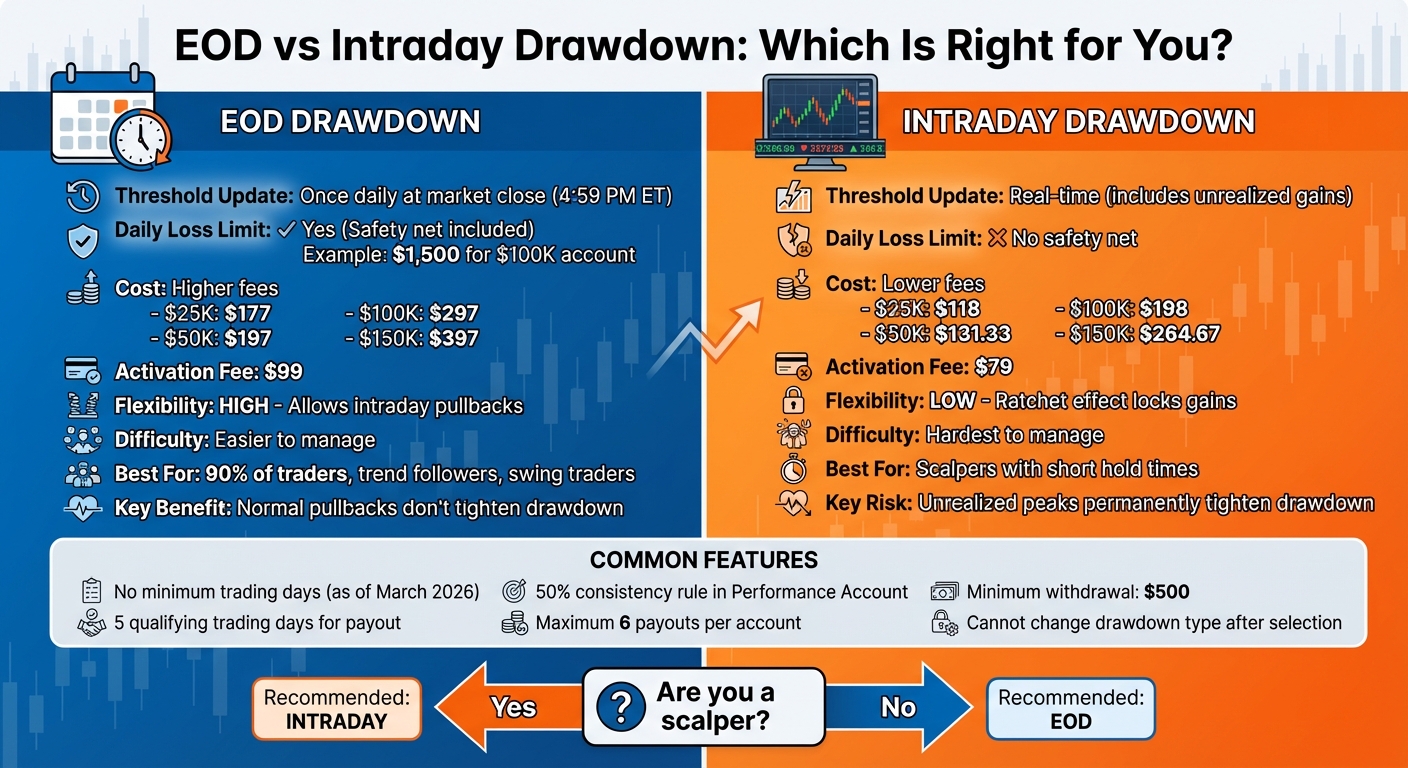
EOD vs Intraday Drawdown Comparison for Apex Trader Funding
1. End-of-Day (EOD) Trail Drawdown
Mechanics
The EOD trailing drawdown recalculates once per day at market close (4:59 PM ET) [2][6]. This means the threshold only updates at the end of the trading day, based on your final balance. Intraday gains don’t affect the drawdown until the market closes [2][6]. This setup allows traders to hold positions through normal pullbacks without the risk of prematurely tightening their margin for error.
The threshold moves up with your highest end-of-day balance and never moves backward. If breached, the account is immediately terminated [2][3]. Unlike older systems, Apex’s trailing drawdown continues to trail even after you transition to the Performance Account phase [2].
EOD accounts include a Daily Loss Limit (DLL), which acts as a safeguard [3][6]. For instance, on a $100,000 account, the DLL is $1,500. If this limit is hit, trading is paused for the rest of the session, but your account remains active [2]. This feature helps prevent significant losses during volatile sessions.
Fees
| Account Size | Evaluation Fee | Max Drawdown | Daily Loss Limit | Profit Target |
|---|---|---|---|---|
| $25,000 | $177 | $1,000 | $500 | $1,500 |
| $50,000 | $197 | $2,000 | $1,000 | $3,000 |
| $100,000 | $297 | $3,000 | $1,500 | $6,000 |
| $150,000 | $397 | $4,000 | $2,000 | $9,000 |
EOD evaluations come with a one-time fee and no recurring monthly charges [6]. The activation fee is $99, slightly higher than the $79 charged for Intraday accounts [9]. However, discounts are available – using a promotional code like "SAVENOW" can lower the $100,000 evaluation fee to about $30 [6]. These fee structures align with the flexibility EOD accounts offer in managing drawdown thresholds.
Flexibility
This system emphasizes Apex Trader Funding’s approach to risk management. For example, a trade that spikes and then pulls back might trigger an Intraday breach but would leave an EOD account unaffected, avoiding the "ratchet effect" [9][1]. Many traders prefer to compare TradingView prop firms to find setups that integrate directly with their charting software.
You can complete an evaluation in just one day, as the minimum trading day requirement was removed in March 2026 [8][9]. However, contract limits often decrease when transitioning from evaluation to a Performance Account. For example, a $100,000 account drops from 8 contracts to 6 [3].
Payout Requirements
The drawdown rules also impact payout conditions. To request a payout, you need 5 qualifying trading days, with at least $50 in profit generated on each day [3]. Additionally, the 50% consistency rule applies during the Performance Account phase: no single day can account for more than half of your total profits at the time of the request [3][4]. This rule does not apply during the evaluation phase, allowing you to hit your profit target in a single trade if desired [3].
After a payout, your account balance must remain above a "safety net" threshold. For a $100,000 account, this threshold is typically $103,100 [3]. The minimum withdrawal amount is $500 per request, and Performance Accounts are limited to a maximum of 6 payouts before the account is closed [9]. These payout rules are designed to ensure account stability and longevity.
sbb-itb-46ae61d
2. Intraday Trail Drawdown
Mechanics
Intraday Trail Drawdown keeps a close watch on every equity movement in real time, including unrealized gains [2][5]. When your account balance hits a new high, the drawdown threshold moves up, locking in that new level. However, it doesn’t adjust downward if your balance drops, creating what traders call the "ratchet effect." This means that even if you’re still net profitable, a sharp pullback after a peak could result in breaching the account limits [1][2][4]. Unlike End-of-Day (EOD) accounts, Intraday accounts don’t have a Daily Loss Limit under the March 2026 rules. If you breach the trailing threshold, your account is terminated immediately [3].
Intraday accounts allow traders to monitor the threshold in real time. You can track it using RTrader Pro (for Rithmic) or through the account dropdown menu in Tradovate, where it’s labeled as the "Auto Liquidate Threshold" [1]. Once you transition to the Performance Account phase, the trailing drawdown stops advancing when it reaches your starting balance plus $100. For instance, in a $100,000 account with a $3,000 drawdown, the threshold locks at $97,100. This real-time adjustment sets the stage for specific payout and account management rules.
Fees
Intraday accounts are the most budget-friendly option at Apex Trader Funding [1]. As of March 2026, the evaluation fees are:
- $118 for a $25,000 account
- $131.33 for a $50,000 account
- $198 for a $100,000 account
- $264.67 for a $150,000 account [9]
The one-time activation fee for Performance Accounts is $79.
| Account Size | Evaluation Fee | Max Drawdown | Profit Target | Max Contracts (Eval) |
|---|---|---|---|---|
| $25,000 | $118 | $1,000 | $1,500 | 4 |
| $50,000 | $131.33 | $2,000 | $3,000 | 6 |
| $100,000 | $198 | $3,000 | $6,000 | 8 |
| $150,000 | $264.67 | $4,000 | $9,000 | 12 |
Flexibility
The mechanics of Intraday Trail Drawdown are designed for precision, and the flexibility rules focus on trade execution and account stability. This system works best for scalpers who prefer short-term trades and avoid holding onto unrealized gains [1][2]. It demands careful risk management, as Gary M., Founder of Trader’s Second Brain, puts it:
"The trailing drawdown punishes unrealized peaks – not just your closed P&L." [4]
As of March 2026, there are no minimum trading days required to pass an evaluation. You can hit your profit target in just one session if you’re able [3][5]. However, contract limits usually decrease when moving to a Performance Account. For instance, a $100,000 evaluation account might allow 8 contracts, but the Performance Account may restrict you to 6. Additionally, mandatory stop-losses are now required for all active trades, and failing to use them leads to immediate disqualification [10].
Payout Requirements
To request a payout, you need at least 5 qualifying trading days [5]. For a $50,000 account, a qualifying day requires a minimum net profit of $200 [9]. While the 50% consistency rule applies during the Performance Account phase, it does not apply during the evaluation period [3][5].
Unlike EOD accounts, Intraday accounts require your balance to stay above the "Safety Net" threshold – your starting balance plus the drawdown amount plus $100. For example, in a $100,000 account, you must maintain at least $103,100 before withdrawing funds [5][7]. The minimum withdrawal amount is $500, and Performance Accounts are capped at 6 payouts before they are closed [9]. Traders can operate up to 20 active Performance Accounts simultaneously. Many use a trade copier to manage multiple accounts efficiently. To keep an account active, you must log at least 2 trading days with $50 or more profit within any rolling 30-day period [5].
For a deeper dive into Apex Trader Funding’s rules and account details, check out the full review at Apex Trader Funding Review.
Explaining the New IMPROVED Apex (Rules, EOD, Payouts, etc.)
Advantages and Disadvantages
When comparing Intraday accounts and End-of-Day (EOD) accounts, each comes with its own set of strengths and challenges. Here’s a closer look at how they stack up.
Intraday accounts are the most budget-friendly option. Thanks to promotional discounts, a $50,000 evaluation can cost as little as $18–$37 per month [4]. Another perk? You can pass the evaluation in just one day, as Apex removed the minimum trading day requirement in March 2026 [3]. However, there’s a major catch: real-time tracking. This feature locks in tighter drawdowns as your unrealized profit peaks, reducing your safety buffer. Kyle Kozlowski, Editor at DamnPropFirms, puts it plainly:
"The trailing drawdown is the single biggest rule that trips up traders. Unlike a static drawdown, it moves up with your account’s highest unrealized gains and never moves back down" [1].
This makes Intraday accounts tricky to manage, making them better suited for scalpers who rely on quick entries and exits.
On the other hand, EOD accounts come with a slightly higher fee but offer more breathing room. The drawdown threshold updates only once daily at 4:59 PM ET, so intraday fluctuations and unrealized gains won’t affect your drawdown during the trading session [2]. Additionally, EOD accounts include a Daily Loss Limit (e.g., $1,500 for a $100,000 account), which temporarily halts trading if exceeded [2]. Paul, an author at PropTradingVibes, highlights the appeal:
"EOD trailing is the better choice for 90% of traders at Apex Trader Funding. The overnight recalculation means normal trade pullbacks don’t permanently tighten your drawdown" [2].
Here’s how they compare to the best futures prop firms:
| Feature | Intraday Trailing Drawdown | End-of-Day (EOD) Drawdown |
|---|---|---|
| Threshold Update | Real-time (includes unrealized gains) | Once per day (at market close) |
| Flexibility | Low; punishes profit give-back | High; allows for intraday pullbacks |
| Daily Loss Limit | None | Yes (acts as a safety net) |
| Cost | Lowest | Moderate |
| Difficulty | Hardest to manage | More trader-friendly |
| Best For | Scalpers with very short hold times | 90% of traders; intraday trend followers |
For high-frequency scalpers who avoid letting unrealized gains build, the cost savings of Intraday accounts can be a solid choice. But if you’re a swing trader, position holder, or anyone who values flexibility for normal market pullbacks, the slightly higher fee of an EOD account is a worthwhile trade-off. Choosing the right option depends on your trading style and risk tolerance.
For more details on Apex’s current rules and account types, check out the Apex Trader Funding Review on DamnPropFirms.
Conclusion
When deciding between EOD and Intraday drawdown accounts, it all comes down to your trading style and how you manage risk. Intraday accounts, priced around $20 during promotions, are popular among scalpers because of their near real-time updates. On the other hand, most traders lean toward EOD accounts. Why? Their once-a-day recalibration at 4:59 PM ET provides a buffer against the usual intraday pullbacks.
EOD accounts also come with a built-in safety net – a Daily Loss Limit (like $1,500 on a $100K account). If you hit this limit, trading is paused to protect your balance. Intraday accounts don’t include this feature. As Paul from PropTradingVibes explains:
"EOD is better for the majority of Apex Trader Funding traders. The overnight recalculation means normal trade pullbacks don’t permanently tighten your drawdown." [11]
The choice ultimately depends on your trading rhythm. Just remember, the drawdown type is locked in when you make your purchase – there’s no switching later. If you’re unsure about your strategy or how to handle the "ratchet effect" of real-time tracking, resources like the Apex Trader Funding Review on DamnPropFirms can help. They provide detailed breakdowns, real-world examples, and tools like the Consistency Rule Calculator to guide your decision.
While EOD accounts cost about $10 more per month, the added flexibility might be worth it. Choose the option that aligns best with your trading approach and goals to keep your path to funding as smooth as possible.
FAQs
How do I choose between EOD and Intraday drawdown?
When choosing between EOD (End of Day) and Intraday drawdown, it’s important to think about how each fits your trading approach.
- EOD drawdown resets at the end of each trading day. This setup can be more lenient, especially if you’re holding positions over multiple days, as your drawdown isn’t recalculated during the day.
- Intraday drawdown, on the other hand, updates in real-time throughout the trading session. This means you’ll need to actively monitor your trades and enforce tighter risk controls.
Your choice ultimately depends on whether you prefer the flexibility of daily resets or the precision of real-time tracking.
What is the “ratchet effect” in Intraday drawdown?
The "ratchet effect" in intraday drawdown refers to a situation where the drawdown threshold is fixed at the highest account equity achieved during the trading day. Once this level is established, it doesn’t move lower, even if the account’s value decreases afterward. This mechanism can heighten the risk of losing the account if it’s not managed with caution.
What happens if I hit the Daily Loss Limit on EOD?
If you reach the Daily Loss Limit with Apex Trader Funding, your trading account will be restricted or closed for the remainder of the day. These rules are designed to help manage risk and safeguard against further losses.