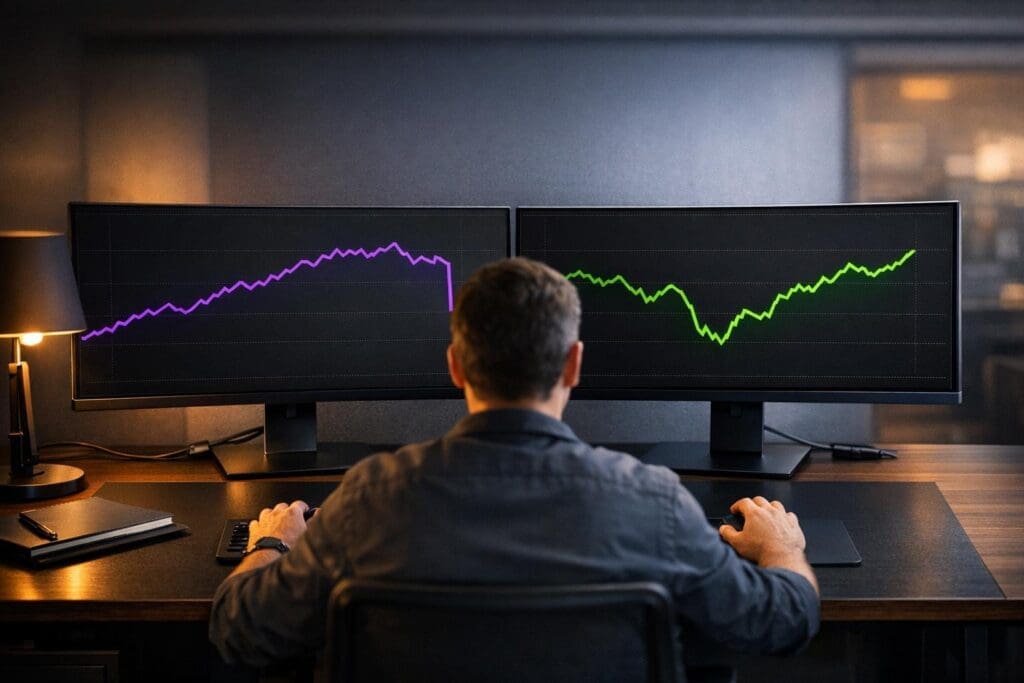
When choosing between End-of-Day (EOD) and Intraday drawdown models in futures prop firms, the key difference lies in how risk thresholds adjust:
- EOD Drawdown: Updates your drawdown floor based on the account balance at the end of each trading day. It ignores intraday fluctuations, allowing more flexibility for swing or longer-term strategies. However, a strong day can raise the floor for the next session, limiting future losses.
- Intraday Drawdown: Tracks your account equity in real time, including unrealized gains. This model is stricter, making it ideal for scalpers and day traders who prioritize quick profit-taking. But it can penalize temporary pullbacks, even if trades are ultimately profitable.
Key takeaway: EOD is better for strategies needing room for market noise, while Intraday suits precise, short-term trading styles. Misunderstanding these rules often leads to evaluation failures. Choose based on your trading approach to avoid setbacks.
Quick Comparison:
| Feature | End-of-Day (EOD) Drawdown | Intraday Drawdown |
|---|---|---|
| Adjustment Timing | End of trading day | Real-time |
| Includes Unrealized Gains | No | Yes |
| Best For | Swing/position traders | Scalpers/day traders |
| Stress Level | Lower | Higher |
| Volatility Tolerance | Higher | Lower |
Understanding these models is crucial for aligning with your strategy and passing prop firm evaluations.
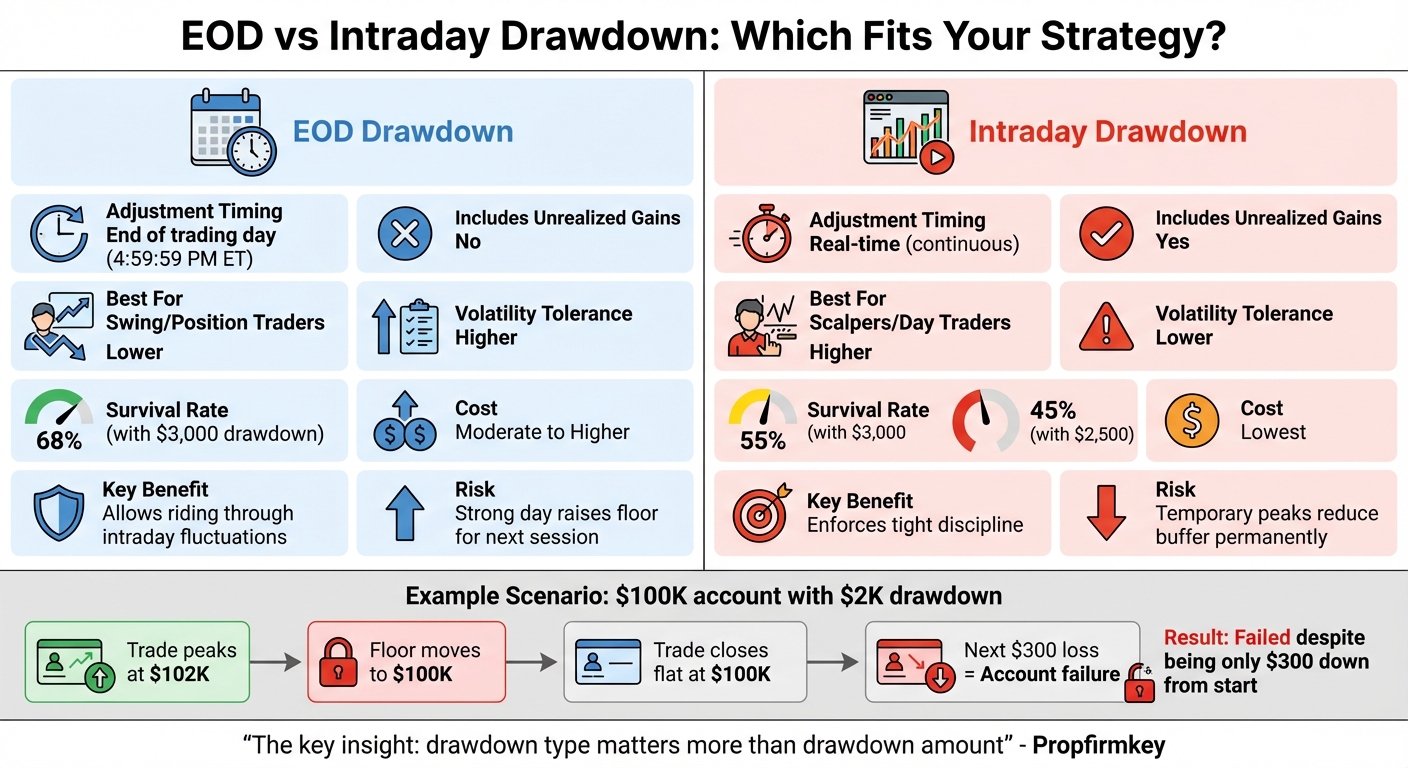
EOD vs Intraday Drawdown Models Comparison for Futures Traders
Understanding Drawdown & Floating PnL: Here’s What You Need to Know!
sbb-itb-46ae61d
What Is End-of-Day (EOD) Drawdown?
End-of-Day (EOD) drawdown is a risk management approach that evaluates your trading account’s performance based on the closing balance at the end of each trading day. Intraday fluctuations are ignored, and only the final balance determines whether the account breaches the drawdown limit. This means your account can dip below the threshold during the day, as long as it recovers by the market close. The drawdown floor remains unchanged unless the closing balance breaches the threshold.
How It Works
At the close of the trading day (4:59:59 PM ET), the proprietary trading firm records your realized account balance. This closing balance is then compared to your highest previous closing balance, also known as the "high-water mark." If the day’s closing balance exceeds the high-water mark, the drawdown floor is adjusted upward. If it doesn’t, the floor remains the same.
It’s important to note that unrealized profits are not considered in this calculation. For example, even if your account equity peaks at $5,000 during the day, only the realized $3,000 closing profit contributes to updating your high-water mark.
While the threshold is set at the end of the day, it is enforced in real time during the next trading session. If your account balance touches the EOD threshold at any point during the day, the account fails.
Example of EOD in Practice
Apex Trader Funding: Imagine a trader with a $50,000 account and a $2,000 EOD drawdown, setting the initial threshold at $48,000. On Day 1, the trader closes the day at $50,800, raising the threshold to $48,800. On Day 2, the closing balance rises to $51,600, moving the threshold to $49,600. On Day 3, the trader ends at $50,900, which doesn’t exceed the previous high, so the threshold stays at $49,600.
Topstep: Consider a trader up $5,000 during the day but experiencing a $2,000 pullback before closing the position. Under an EOD model with a $2,000 drawdown limit, finishing the day up $3,000 keeps the trader in good standing. However, an intraday trailing model would have triggered a breach immediately after the $2,000 pullback.
"End-of-Day Drawdown allows you to play all four quarters. This is how real trading works. You can ride out the ups, downs, and pullbacks as long as you finish the day above your max drawdown limit." – Topstep [4]
Pros and Cons of EOD Drawdown
The EOD drawdown model offers traders flexibility during the trading day. Strategies like swing trading or mean reversion can handle typical market fluctuations without the drawdown floor tightening mid-trade. Traders also avoid the pressure of exiting profitable positions prematurely due to temporary equity peaks.
This model also reduces psychological stress by allowing traders to focus on their end-of-day balance rather than monitoring every market move.
However, there are risks. Traders might hold onto losing positions too long, banking on a recovery that doesn’t happen. Additionally, if the market slips at the end of the session, the closing balance could fall below the threshold. Another drawback is that a highly profitable day raises the drawdown floor for the next session, leaving less room for future losses.
Firms using EOD drawdown include Topstep, Tradeify (on SELECT, Growth, and Lightning plans), MyFundedFutures (Core and Scale plans), and BluSky Trading.
What Is Intraday Drawdown?
Intraday drawdown serves as a real-time tracker, monitoring your account’s equity throughout a trading session. If your equity dips below the trailing threshold, the account is typically terminated on the spot.
How It Works
The drawdown threshold adjusts upward whenever your account hits a new equity high, creating a "ratchet effect" that locks in those gains and never moves backward. Here’s the catch: this includes unrealized profits from open trades. For example, if your trade temporarily gains $500, the drawdown floor rises by that amount. But if the trade reverses and you close it with a $500 loss, you’ve effectively reduced your buffer by $1,000 – $500 from the raised floor and $500 from the actual loss.
This mechanism means you could technically break even or even close trades with a net profit, yet still fail the account. The system doesn’t care about your overall profit or loss; it only tracks whether your equity has dipped below the adjusted threshold. Even temporary equity peaks can shrink your available buffer, making precision and timing critical.
Example of Intraday in Practice
Imagine starting with a $100,000 account and a $2,000 trailing drawdown, which sets your initial threshold at $98,000. During the morning, you open a position that peaks at $102,000 in unrealized equity. The drawdown floor immediately rises to $100,000. If the trade reverses and you close it flat, your account balance returns to $100,000. On the next trade, a $300 loss drops your equity to $99,700 – triggering an immediate failure. Even though you’re only $300 below your starting balance, the adjusted drawdown floor leaves no room for error.
Some firms that use this model include Apex Trader Funding during both evaluation and funded stages, Take Profit Trader for PRO accounts, and MyFundedFutures on their Rapid plan.
Pros and Cons of Intraday Drawdown
Intraday drawdown enforces tight trading discipline, requiring traders to be precise with their entries and exits. It helps prevent situations where winners turn into losers or where traders hold onto losing positions hoping for a turnaround. This model works well for best prop firms for scalpers and high-frequency traders who aim to secure small, consistent gains.
But it comes with challenges. The constant need to monitor every market movement can create significant stress. Even a brief market spike can raise the drawdown floor, leaving traders vulnerable during normal pullbacks. Strategies like swing trading or mean reversion, which often involve holding through intraday fluctuations, are particularly risky under this model. Additionally, high volatility can create large temporary equity spikes, further reducing the risk buffer even when the trading strategy is sound. A hands-off approach can quickly erode the available cushion, making this model tough for traders who prefer less active management.
EOD vs Intraday Drawdown: Side-by-Side Comparison
The key difference between these two models lies in how and when they adjust the drawdown floor. End-of-Day (EOD) models lock in your high-water mark only at the market close, relying on your realized account balance. In contrast, Intraday models update the drawdown floor in real time, factoring in both realized and unrealized profits from open positions. This variation creates distinct trading dynamics.
When it comes to protecting your risk cushion, this distinction is crucial. With an EOD drawdown, you can ride out normal market fluctuations and pullbacks without worrying about the floor shifting during the trading session – it’s only the balance at the close that matters. On the other hand, intraday models adjust the floor immediately as unrealized gains occur. This can shrink your risk buffer if those gains reverse later in the session.
"The key insight: drawdown type matters more than drawdown amount." – Propfirmkey [5]
Simulation data further emphasizes the practical impact of these differences. For example, a $3,000 EOD trailing drawdown shows a 68% survival rate, while the intraday equivalent drops to 55%. A $2,500 real-time trailing drawdown survival rate is even lower at about 45%. Meanwhile, static drawdowns – those unaffected by unrealized gains – offer the highest survival rate, around 75% [5]. The table below highlights these distinctions.
Comparison Table
| Feature | End-of-Day (EOD) Drawdown | Intraday Trailing Drawdown |
|---|---|---|
| Calculation Method | Based on account balance at market close | Updated in real time with realized/unrealized equity |
| Volatility Tolerance | High; ignores mid-session peaks and dips | Low; floor adjusts instantly with equity peaks |
| Stress Level | Lower; forgiving for holding positions | Higher; penalizes temporary profit reversals |
| Best Suited For | Swing, mean-reversion, and position traders | Scalpers and high-frequency traders |
| Risk Flexibility | High; allows trades to "breathe" through noise | Low; requires aggressive profit-taking/scaling |
| Recovery Ability | Can recover from intraday losses if close is positive | Difficult; floor locks in reduced cushion |
| Typical Cost | Moderate | Lowest |
EOD accounts are generally more expensive because of their forgiving nature, while intraday accounts come at a lower cost [6].
How Trailing Drawdown Works in EOD and Intraday Models
A trailing drawdown adjusts as your account grows, tracking its high-water mark. Unlike a static drawdown, which stays fixed, this approach shifts with your performance. The key difference between end-of-day (EOD) and intraday models lies in how and when these adjustments happen.
EOD Trailing Drawdown
In an EOD trailing drawdown, the high-water mark only updates at the end of the trading day, based on your closed account balance. For example, if you’re in a profitable trade at 2:00 PM but exit the day with no gains, the drawdown floor remains unchanged. This setup allows you to ride out typical market fluctuations without worrying about unrealized equity swings.
However, any significant gain at the session’s close will raise the floor for the following day. Let’s say you finish Monday with a $3,000 profit – your drawdown floor adjusts upward for Tuesday. This means a hefty loss the next day could still exceed your limit, even if the prior day’s gains were substantial.
By comparison, intraday trailing drawdown operates on a much tighter leash, adjusting in real time.
Intraday Trailing Drawdown
Intraday trailing drawdown recalculates your risk buffer constantly, tracking the highest equity point reached during the session – even unrealized profits. The moment your equity peaks, the floor moves up, regardless of whether the trade is closed.
"Intraday trailing drawdown… punishes you for having an open profit that you didn’t lock in fast enough." – Copilink [1]
This creates a more unforgiving environment. If a profitable trade reverses to breakeven, your floor has already moved up, leaving no room for error. A subsequent loss could breach your limit and end your account, even if you’re still net positive for the day. As Copilink points out: "You need to treat open profits as a liability until they’re locked in" [1].
To navigate this, traders using intraday models must focus on locking in gains quickly. Moving stop-losses to breakeven and scaling out of positions early can help preserve your risk buffer and prevent account failure.
Choosing between EOD and intraday trailing drawdown models by consulting futures prop firm reviews and guides comes down to your trading style and risk tolerance. Understanding how these systems work is essential for aligning them with your strategy.
Which Drawdown Model Fits Your Trading Style?
Your trading style plays a crucial role in determining the best drawdown model for you. Choosing the wrong one can turn potential profits into evaluation setbacks.
Understanding the differences between EOD and intraday drawdown models can help you preserve your gains and align with your trading approach.
For Swing Traders and Mean-Reversion Strategies
If you focus on swing trading or mean-reversion setups, an EOD drawdown model is likely your best fit. This approach accounts only for your closing balance, allowing you to ride out intraday fluctuations without the fear of mid-session liquidation. In volatile markets, intraday models adjust the drawdown floor with every equity peak, reducing your buffer. EOD rules, on the other hand, ignore these intra-session swings.
"EOD trailing drawdown is objectively more forgiving and gives you a significantly higher probability of completing an evaluation without a technical violation." – Copilink [1]
This model enables you to let trades reach their full potential without constantly worrying about managing your drawdown buffer. However, there’s a tradeoff: a strong session that ends with significant gains will set a higher drawdown floor for the next day. This means a sharp reversal following a big win could still breach your limits. Despite this, the EOD structure is ideal for traders who focus on longer-term positions and need to withstand intraday noise.
Firms that offer EOD drawdown models include Tradeify, Topstep, and BluSky Trading [1].
If your strategy involves quick trades, the intraday model might be worth exploring.
For Scalpers and Risk-Sensitive Day Traders
For scalpers and traders who prioritize tight risk management, an intraday drawdown model is often a better choice. This approach is tailored for high-frequency strategies where trades are opened and closed quickly. By focusing on short-term moves, you can avoid the unrealized equity peaks that can erode your drawdown buffer.
Intraday accounts are typically more affordable [6]. However, they require a disciplined approach: securing partial profits early, moving stops to breakeven, and scaling down during volatile periods are essential practices. These real-time adjustments are critical for scalpers working within tight risk parameters.
Firms offering intraday drawdown models include Apex Trader Funding, Take Profit Trader (PRO accounts), and MyFundedFutures (Rapid) [1].
If your strategy involves holding positions through pullbacks or aiming for larger moves, the cost savings of intraday models may not outweigh the risks. In such cases, an EOD model might be the safer option.
Prop Firm Drawdown Rules: Real Examples
Real examples shed light on how different prop firms implement their drawdown rules, showcasing the practical application of varied models.
Firms Offering EOD Drawdown
Some well-known firms use End-of-Day (EOD) drawdown rules, which only update after the market closes. For instance, Tradeify introduced its SELECT Evaluation program in January 2026, using an EOD model that recalculates drawdown limits at the end of the trading day. Similarly, Topstep applies an EOD approach in its Trading Combine. Here, a trader’s maximum loss limit is adjusted only after the market closes, offering flexibility to handle intraday market swings while maintaining prop firm consistency rules as long as the day’s closing balance meets the required threshold. Other firms like Take Profit Trader, FundedNext, and Lucid Trading also follow this model [6].
"EOD Drawdown typically gives a trader more room to manage volatility inside the trading day." – Tradeify [7]
However, not all firms operate this way. Some adopt real-time drawdown rules, as explained below.
Firms Using Intraday Drawdown
Apex Trader Funding employs an Intraday Trailing Drawdown, where the drawdown floor adjusts in real-time based on unrealized equity. For example, as of January 2026, if a $50,000 account with a $2,000 drawdown reaches an unrealized peak of $51,000, the failure threshold immediately shifts to $49,000. This means even small pullbacks can violate the limit [7][3].
In Apex’s funded stage (Performance Accounts), the trailing drawdown stops once it hits the starting balance plus $100, offering more stability than during the evaluation phase. Apex also provides a $100K Static account, where the drawdown remains fixed. In this setup, the account is liquidated if the balance drops below $99,375. While this fixed model offers greater predictability, it generally comes at a higher cost [6].
"The unrealized trailing drawdown at Apex Trader Funding is the single biggest rule that trips up traders." – DamnPropFirms [6]
Conclusion
Deciding between End-of-Day (EOD) and Intraday drawdown models is a key factor when selecting a futures prop firm. EOD models update at the market close, while Intraday models adjust in real time. This distinction can have a significant impact on your trading outcomes.
For swing traders and mean-reversion strategies, EOD models are often a better fit, as they allow traders to navigate intraday market fluctuations without breaching drawdown limits. On the other hand, scalpers and high-frequency traders might find Intraday models more suitable, provided they secure profits quickly to avoid drawdown violations.
Understanding how each firm’s drawdown rules work is critical. As mentioned earlier, many traders fail prop firm challenges not because their strategies are flawed but because they misinterpret the drawdown mechanics [2]. Before paying an evaluation fee, take the time to thoroughly review the rules. To make an informed choice, visit DamnPropFirms for verified reviews and comparison tools. Research firms like Apex Trader Funding, Tradeify, and Topstep to find the drawdown structure that aligns with your trading approach.
FAQs
How do I calculate my drawdown floor step by step?
To figure out your drawdown floor, follow these steps:
- Start with your initial balance: For example, if you begin with $100,000, that’s your starting equity.
- Decide on the drawdown type: Are you using an intraday trailing method, which updates throughout the trading day, or an end-of-day (EOD) approach, which checks at the market close?
- Determine your maximum allowable loss: Set a specific amount, like $2,000, that you’re willing to risk.
- Monitor your highest equity value: Subtract the maximum loss from your peak equity to calculate your drawdown floor. Keep an eye on this in real-time to ensure you stay within your limits.
Can I fail an intraday drawdown account even if I’m profitable?
Yes, it’s entirely possible to fail an intraday drawdown account even if you’re profitable overall. These rules are based on the largest balance drop within a single trading day. If your account balance falls below the specified limit at any moment during the day, your account could fail – no matter how much profit you make by the end of the day.
Which model is safer for holding trades overnight or through news?
The End-of-Day (EOD) drawdown model offers a more secure option for holding trades overnight or during major news events. This model establishes a threshold based on the account balance or equity at market close, giving traders the flexibility to endure intraday fluctuations without triggering a breach – provided the account remains within the set limits by the day’s end. On the other hand, intraday trailing drawdowns monitor performance in real-time. This means they can trigger immediately if the account dips below the threshold, making them a less forgiving choice for volatile situations.