When deciding between Tradeify and Phidias Prop Firm, the right choice depends on your trading style and priorities. Here’s a quick breakdown:
- Tradeify is best for intraday traders and scalpers. Key features include:
- 90% profit split (100% for the first $15K on specific accounts).
- Positions must close by 4:59 PM ET daily.
- Fast payouts processed within hours (7 days/week).
- Supports Tradovate, NinjaTrader, and TradingView.
- Pricing: $111 for a $50K account (monthly fee).
- Phidias is ideal for swing traders and those needing overnight flexibility:
- Allows holding positions overnight and weekends.
- One-time payment model (e.g., $116 for a $50K account).
- Offers a Static drawdown option for consistent risk limits.
- Supports Rithmic-compatible platforms like Sierra Chart and Quantower.
- Fast funding and payouts – complete evaluations in 1 day, payouts in 48 hours.
Quick Comparison
| Feature | Tradeify | Phidias Prop Firm |
|---|---|---|
| Trading Style | Intraday only | Swing/overnight allowed |
| Profit Split | 90% (100% first $15K) | 75%-90% (starts at 80%) |
| Account Price (50K) | $111 (monthly fee) | $116 (one-time fee) |
| Payout Speed | Hours (7 days/week) | 48 hours |
| Max Allocation | $750,000 | $1,600,000 |
| Platforms | Tradovate, NinjaTrader | Rithmic-compatible |
| Drawdown Type | EOD trailing | Static/EOD options |
If you’re a day trader focused on intraday strategies and fast withdrawals, Tradeify has the edge. For swing traders or those looking for more flexibility and a one-time fee structure, Phidias is the better choice.
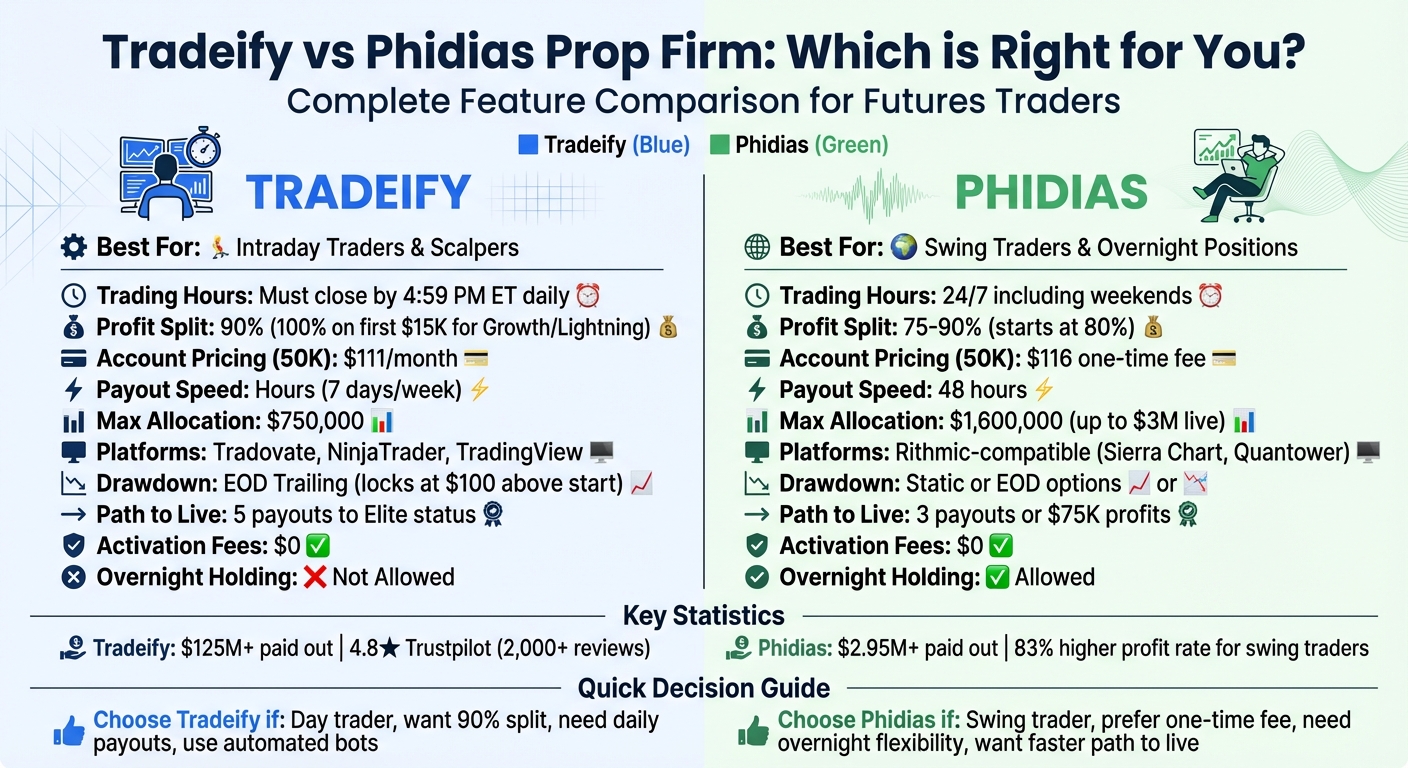
Tradeify vs Phidias Prop Firm: Complete Feature Comparison
Best Prop Firm To Trade! | Tradeify | Day Trade Professor

sbb-itb-46ae61d
Tradeify Overview
Tradeify is a futures prop trading firm tailored for day traders. All trading positions must be closed by 4:59 PM ET daily, ensuring a clean slate for the next session. The firm offers an attractive 90% profit split across all account types. For Growth and Lightning accounts, traders can keep 100% of the first $15,000 in profits before the profit-sharing kicks in [4].
One standout feature is the End-of-Day (EOD) trailing drawdown. This mechanism updates only at the session’s close, based on the highest end-of-day balance. This approach shields traders from intraday market swings. Once your account balance surpasses the starting capital plus the drawdown amount plus $100, the drawdown floor locks permanently, offering a fixed safety margin [6].
Tradeify eliminates activation fees for traders who pass the evaluation, saving between $130 and $160 compared to firms that charge setup costs [4]. Payouts are processed daily, including weekends, with most requests completed within hours [4]. To discourage high-frequency bot trading, the firm enforces a 10-second hold rule, requiring at least 50% of trades or profits to come from positions held longer than 10 seconds [4]. These features make Tradeify an appealing option for traders looking for flexibility and efficiency.
Main Features of Tradeify
Here are some of the key features that define Tradeify’s offerings:
- Select: This plan requires a three-day evaluation with a 40% consistency rule. After passing, traders can choose between:
- Select Flex: No daily loss limit and payouts every five days.
- Select Daily: Daily payout eligibility but with an enforced daily loss limit [3].
- Growth: Offers a one-day evaluation with no consistency requirement during the evaluation phase. Once funded, a 35% consistency rule applies, along with a soft daily loss limit of $1,250 on a $50,000 account [3].
- Lightning: This plan skips the evaluation phase entirely for a one-time fee ($244–$759), granting immediate payout eligibility [3].
After completing five approved payouts, traders qualify for Tradeify Elite. This upgrade transitions accounts from simulation-based trading to live CME exchange routing [6]. Tradeify supports trading through Tradovate, with additional connectivity options for NinjaTrader, TradingView, and Quantower [4]. News trading is unrestricted, even during major Tier 1 events such as FOMC, NFP, and CPI announcements [6].
Best Traders for Tradeify
Tradeify is ideal for day traders and scalpers who need to close all positions by the end of the trading day. The EOD trailing drawdown provides flexibility during volatile sessions. For instance, if a trader experiences a $600 loss but recovers before the session closes at 5:00 PM ET, the drawdown floor remains unaffected [3]. Additionally, the firm’s fast payout system, available seven days a week, appeals to traders who value quick access to their earnings. Most payouts are processed within 2 to 24 hours [4].
For traders seeking daily income, the Select Daily plan offers daily payout eligibility with limits ranging from $1,000 to $2,500. On the other hand, those who prefer less frequent but higher payouts may benefit from Select Flex, which includes 5-day payout cycles with higher caps of $3,000 to $5,000 [6].
As Paul, a professional trader at Prop Trading Vibes, explained, "Tradeify has become one of the most reliable payout machines in the futures prop space, and my $47K+ in personal withdrawals confirms the track record is real" [4].
Experienced traders who want to skip the evaluation can opt for the Lightning plan, while beginners might find the Growth plan appealing due to its low entry cost ($139/month for a $50,000 account) and the chance to pass in just one day. However, funded traders in the Growth plan must adhere to a 35% consistency rule [3].
Phidias Prop Firm Overview
Phidias Prop Firm caters to futures traders who need the ability to hold positions beyond regular trading hours. While many firms require positions to be closed at market close, Phidias offers Swing accounts, enabling traders to hold trades overnight and through weekends. This feature is perfect for those aiming to ride multi-day trends without the pressure of closing out daily.
The firm provides three account types: Static, Fundamental, and Swing. Static accounts feature a fixed drawdown that doesn’t trail, making them a quick route to funding. Fundamental accounts are tailored for day traders, with an End-of-Day (EOD) trailing drawdown that recalculates only at market close, offering some flexibility during volatile periods. Swing accounts combine the EOD trailing drawdown with the ability to hold positions overnight and on weekends, catering to traders focused on longer-term strategies. All account types start with an 80% profit split, increasing to 90% after the first three withdrawals, offering traders a generous share of their earnings.
Phidias supports any Rithmic-compatible trading platform, like Quantower, Sierra Chart, Motivewave, and Bookmap, and allows news trading across all account types.
One of the standout features is Phidias’s One-Time Payment (OTP) model, which eliminates recurring subscription and activation fees. For instance, a 50K Fundamental account costs $116.00 as a one-time payment, making it a budget-friendly option compared to subscription-based alternatives. Traders can manage up to 15 funded accounts simultaneously, with a maximum total allocation of $1.6 million. Upon reaching three successful payouts or $75,000 in cumulative profits, traders graduate to a live funded account with daily withdrawal options [2][7].
Main Features of Phidias Prop Firm
- Static Account (25K):
Offers a fast track to funding, requiring just one trading day with no profit target and a fixed $500 drawdown. Traders can receive their first payout within 48 hours. Costs $55.40 as a one-time payment. - Fundamental Accounts (50K–150K):
Utilizes an EOD trailing drawdown that recalculates at market close. Includes a 30% consistency rule for funded accounts, though this does not apply during the evaluation phase. - Swing Accounts:
Perfect for traders aiming to capture long-term trends, these accounts allow overnight and weekend holds. They require a minimum of three trading days during the evaluation period and also use an EOD trailing drawdown. Swing traders at Phidias have reported profit rates 83% higher compared to day-trading-only strategies [1]. - 10K Drawdown Challenge:
Provides a low-cost entry point with fees between $19.00 and $30.00 per entry. Successful completion awards a $10,000 live account. This challenge uses a static drawdown and allows limited overnight holding.
Best Traders for Phidias Prop Firm
Phidias is a great fit for traders who prioritize the ability to hold positions longer. Swing and position traders benefit from the flexibility to capture multi-day trends without daily closure requirements. The Static account appeals to those looking for a quick path to funding, as it requires just one trading day and no profit target. Cost-conscious traders can also appreciate the OTP model, which eliminates recurring fees. Additionally, news traders can take advantage of market volatility without restrictions, and the EOD drawdown mechanism offers protection from intraday spikes, as it only updates at market close.
In late 2025, Jordan, a U.S.-based trader, successfully withdrew $35,200 from a 50K Fundamental account. The payout was processed and approved in under two hours, showcasing Phidias’s dedication to fast and reliable payouts [2].
Account Types and Funding Options
Tradeify and Phidias take different approaches when it comes to account structures and pricing. Tradeify provides three funding paths: Select, a single-phase evaluation with flexible payout policies; Growth, a quick one-day pass evaluation; and Lightning, which offers instant funding without requiring an evaluation. On the other hand, Phidias presents three account options: Static, which has no profit target and includes a one-day pass; Fundamental, tailored for day traders; and Swing, which supports overnight and weekend positions.
When it comes to pricing, the differences are clear. A $50,000 account is priced at $111 with a discount code at Tradeify, compared to $149 at Phidias. At the $100,000 level, Phidias offers a lower price of $144.60, while Tradeify charges $181. Tradeify’s Lightning option takes a different route, offering instant funding accounts ranging from $329 for $25,000 to $759 for $150,000. These pricing choices reflect the unique funding philosophies of each firm, which also extend to their allocation limits.
Speaking of allocation, Tradeify caps total funding at $750,000, while Phidias allows up to $1,600,000 across a maximum of 15 funded accounts. This makes Phidias particularly appealing for traders aiming to scale up significantly.
Both firms use single-phase evaluations, but the evaluation timelines differ. Tradeify’s Select option requires at least three trading days, while the Growth evaluation can be completed in just one day with no consistency rules during the challenge phase. Phidias’s Static account offers a simple one-day pass, requiring traders to stay above the starting balance while meeting drawdown limits. Meanwhile, the Swing account demands a minimum of 10 trading days during evaluation, making it better suited for longer-term strategies.
Account Comparison Table
| Feature | Tradeify | Phidias Prop Firm |
|---|---|---|
| $50K Account Price | $111 (with discount code) | $149 |
| $100K Account Price | $181 (with discount code) | $144.60 |
| $150K Account Price | $251 (with discount code) | $172.60 |
| Max Total Allocation | $750,000 | $1,600,000 |
| Evaluation Model | Single-phase (1–3 days minimum) | Single-phase (1–10 days, by account type) |
| Instant Funding Option | Yes (Lightning: $329–$759) | No |
| Activation Fees | $0 | $0 (one-time payment model) |
| Overnight Holding | Prohibited (must close by 4:59 PM ET) | Allowed on Swing accounts (24/7) |
Next, we’ll dive into trading rules and risk management to help you make a well-informed choice.
Trading Rules and Risk Management
When choosing a prop firm, understanding how they handle drawdowns and risk is essential to ensure their approach aligns with your trading style. Let’s break down how Tradeify and Phidias manage these aspects.
Tradeify employs an End-of-Day (EOD) trailing drawdown for all its account types – Growth, Select, and Lightning. This means the drawdown level adjusts only at the end of the trading day, based on the highest closing balance [6]. Once a trader achieves a specific profit buffer, the drawdown locks permanently at $100 above the starting balance [4].
On the other hand, Phidias provides more flexibility by offering both EOD trailing and Static Drawdown options [1]. With the Static account, the drawdown remains fixed, giving traders a consistent risk boundary even as their account grows. Interestingly, Phidias reports that traders using EOD drawdown achieve an 83% higher success rate compared to those using intraday trailing methods [8].
When it comes to evaluation and payouts, Tradeify requires between 0 and 3 trading days for evaluation (depending on the account type) and 1 to 5 days for payouts. Phidias, however, offers quicker options, including a one-day pass for Static accounts and a "48-Hour Path to Profits" for other accounts [9][8]. These differences in timelines can be a deciding factor for traders who prioritize speed.
Scaling opportunities also set the two firms apart. Tradeify uses EOD equity to gradually increase mini and micro contract limits [6]. After five payouts, traders can qualify for Elite Live accounts, which allow them to manage up to five live accounts simultaneously without daily loss limits [10]. This model emphasizes long-term growth and progression. Phidias, by contrast, moves traders to live trading after just three payouts, with a maximum allocation of $3,000,000. This approach highlights a faster transition to live trading with a focus on higher capital allocation [1][5].
Rules Comparison Table
| Feature | Tradeify | Phidias Prop Firm |
|---|---|---|
| Drawdown Type | EOD Trailing (locks to static at $100 above start) | Static, EOD, or Choice |
| Daily Loss Limit | None (Flex) / Soft Breach (Daily) | Optional or None |
| Min. Days to Pass Eval | 0 days (Growth) / 3 days (Select) | 0–1 day (Static) / 3 days (Fundamental, Swing) |
| Min. Days for Payout | 1 day (Daily) / 5 days (Flex) | 1 day (48‐hour path available) |
| Consistency Rule | 40% (Evaluation only, Select) (you can use a consistency calculator to stay within limits) | None on most accounts |
| Scaling Method | Equity-based contract scaling | Payout-based graduation to live |
| Path to Live | 5 payouts to reach "Elite" | 3 payouts to reach "Live" |
| Max Allocation | $750,000 | $1,600,000 (up to $3M on live) |
Each firm offers distinct advantages, catering to different trader preferences and goals. Whether you’re drawn to Tradeify’s structured progression or Phidias’s faster path to live trading, the choice ultimately depends on what suits your trading strategy best.
Profit Splits, Payouts, and Fees
How profits are split and what fees are charged can make or break a trader’s bottom line. Here’s a look at how Tradeify and Phidias stack up.
Tradeify offers a generous 90% profit split for all account types, but it gets even better for Growth and Lightning accounts. Traders on these plans earn 100% of their first $15,000 in cumulative payouts before moving to the 90/10 split[4]. By early 2026, the company had paid out over $125,000,000 to traders, processing payouts seven days a week – often within hours[4]. For commissions, Tradeify charges $1.29 per side, or $2.58 for a round turn per contract[4]. On top of that, they’ve completely eliminated activation fees for all accounts[4][9]. For their Lightning Funded accounts (instant funding), there’s a one-time fee ranging from $349 to $729[4].
Phidias, on the other hand, offers profit splits ranging from 75% to 90%, with most traders landing at 80%[1][12]. Their fee structure is straightforward, with a $19 fee for a $10,000 account, $116 for a $50,000 account, and $172.60 for a $150,000 account[1]. Phidias also stands out with its "48-Hour Miracle" feature on Static Accounts, allowing traders to complete evaluations on Day 1 and receive payouts by Day 2[1].
When it comes to payout policies, Tradeify enforces a 20%–40% consistency rule, which can delay payouts if traders achieve disproportionate gains in a single day[4][11]. Phidias, however, offers more flexibility by waiving these restrictions on many account types[1]. Tradeify also has a "Select Flex" policy, capping withdrawals at 50% of profits per payout, with maximum limits ranging from $3,000 to $5,000 depending on the account size[9].
Here’s a side-by-side breakdown of key financial features:
Payout Comparison Table
| Feature | Tradeify | Phidias Prop Firm |
|---|---|---|
| Profit Split | 90% (100% on first $15K for Growth/Lightning) | 75%–90% (typically 80%) |
| Payout Speed | Hours (7 days/week) | 48 hours (from start to first payout) |
| Activation Fee | $0 | Not specified |
| Evaluation Fees | $69–$359/month (Eval) / $349–$729 (Lightning) | $19 (10K) / $116 (50K) / $144.60 (100K) / $172.60 (150K) |
| Reset Cost | Monthly subscription price | $19 (10K account) |
| Withdrawal Method | Rise, Plane | Rise, Wise |
| Consistency Rule | 20%–40% (varies by account type) | Optional or None |
| Commissions | $1.29 per side ($2.58 round turn) per contract | Not specified |
The combination of payout speeds, fee structures, and profit-sharing policies directly influences how much traders take home, making these details critical when choosing a firm.
Platforms and Tools
The trading platform you choose can significantly influence your workflow, from analyzing charts and placing trades to reviewing your performance afterward. Tradeify operates on Tradovate, using it as its execution backbone. This setup allows traders to use Tradovate credentials across various platforms, such as charting with TradingView and executing trades on NinjaTrader. Supported platforms include NinjaTrader, TradingView (with a paid add-on), Quantower, and WealthCharts. WealthCharts replaced the discontinued ProjectX platform in February 2026 and offers features like "Smart Prop Risk Alerts" and journaling tools. Additionally, Tradeify provides the Sage Score, a metric designed to evaluate the effectiveness of trading strategies. For traders on the go, the Tradovate mobile app supports trading. However, Tradeify does not support Rithmic, which excludes platforms like Sierra Chart and Bookmap.
Phidias, on the other hand, supports any platform compatible with Rithmic, including Sierra Chart, MotiveWave, ATAS, NinjaTrader, and Quantower. It also introduced Project X, a browser-based dashboard equipped with professional order flow tools and dxFeed data. Support for TradingView integration is expected soon. Phidias offers both Rithmic and dxFeed for data feeds, while Tradeify relies on Tradovate-backed data and dxFeed through WealthCharts. Mobile trading with Phidias is accessible via the Phidias dashboard app and other Rithmic-compatible mobile platforms.
"The platform is a presentation layer; your funded account mechanics live in Tradovate and Tradeify’s backend." – Paul, Proptradingvibes
Platform Comparison Table
| Feature | Tradeify | Phidias Prop Firm |
|---|---|---|
| Primary Execution | Tradovate | Rithmic / Project X Dashboard |
| NinjaTrader Support | Yes (via Tradovate login) | Yes (Rithmic compatible) |
| TradingView | Yes (Add-on required) | Coming soon via Project X |
| Quantower | Yes | Yes |
| Sierra Chart | No | Yes |
| Rithmic Support | No | Yes |
| Proprietary Tools | Sage Score, WealthCharts, Integrated Journal | Real-time Dashboard, Project X Orderflow |
| Data Feeds | Tradovate, dxFeed, WealthCharts | dxFeed, Rithmic |
| Mobile Access | Tradovate Mobile App | Phidias Dashboard App, Rithmic-compatible apps |
Which Firm Fits Your Trading Style
Your trading style plays a key role in choosing the right firm. Tradeify is ideal for intraday traders who close all positions before the market wraps up for the day, while Phidias is better suited for swing traders who need the flexibility to hold positions overnight or even through the weekend. When it comes to costs, Tradeify operates on a monthly fee structure ($111–$159 for a $50K account), whereas Phidias charges a one-time fee ($116 for a $50K account).
Tradeify requires five approved payouts to unlock Elite live capital, while Phidias allows live trading after just three payouts or $75K in withdrawals. If quick payouts are a priority, Phidias’s Static account offers a fast turnaround – your first payout could arrive in as little as 48 hours. This is possible because there’s no profit target; you just need to stay above your starting balance for one trading day. Balancing fee structures with payout timelines will help you decide which firm aligns with your trading goals.
When to Choose Tradeify
Tradeify is the better option if you rely on automated trading bots or Expert Advisors. The firm explicitly supports algorithmic trading, provided you can prove sole ownership and hold trades for at least 10 seconds. Its 90/10 profit split outshines Phidias’s 80/20 split, allowing you to keep more of your earnings. Plus, Tradeify’s Select Daily feature enables daily withdrawals once you meet the buffer requirement, giving you quicker access to your profits.
For day traders and scalpers who naturally close positions before 4:59 PM ET, Tradeify’s mandatory close-out rule won’t feel restrictive. The platform also integrates seamlessly with tools like Tradovate, NinjaTrader, and TradingView (with a paid add-on), making it a solid choice for intraday workflows. Tradeify has built a reputation for reliable payout processing and high trader satisfaction, making it a dependable choice for those who prioritize efficiency. If you’re exploring other top-tier options, Apex Trader Funding is another major player in the futures space worth considering.
When to Choose Phidias
Phidias stands out for traders who prefer longer trade durations. Its ability to hold positions overnight and through weekends makes it a go-to for swing traders. In fact, swing traders using Phidias report an 83% higher success rate compared to those who stick strictly to daytime trading. This flexibility allows trades to mature over multiple sessions, often leading to better outcomes.
Phidias also simplifies costs with its one-time payment model, eliminating the need for recurring subscription fees. For traders looking to scale, the firm supports up to 15 simultaneous accounts (5 Fundamental, 5 Swing, 5 Static), offering plenty of room for diversification. If you work with platforms like Sierra Chart or QuantTower, Phidias has you covered with native support through Rithmic compatibility. This combination of flexibility and cost-effectiveness makes Phidias a strong choice for traders focused on extended strategies.
Conclusion
Tradeify and Phidias both excel in delivering on their promises, yet they cater to very different trading preferences. Tradeify stands out with its 90/10 profit split, no activation fees, and a stellar 4.8-star rating on Trustpilot from over 2,000 reviews[3]. Accolades like "Best Payout Process" and "Most User Friendly" from Prop Firm Match 2025 further reinforce its reputation[3]. For traders focused on speed and precision – such as algorithmic traders or intraday scalpers – Tradeify’s End-of-Day (EOD) trailing drawdown and Select Daily payout option allow for quick profit withdrawals without the hassle of intraday adjustments. These features make it an attractive choice for those who prioritize efficiency in their trading.
On the other hand, Phidias offers distinct advantages for swing traders. Its one-time payment model – $116 for a $50K account compared to Tradeify’s approximate $333 over three months – and the ability to hold positions 24/7 cater to those who prefer longer-term strategies[2]. The Static account’s "48-hour miracle" provides a remarkably fast path to liquidity, requiring no profit target and offering payout approvals within 1–4 hours[1][2]. With over $2.95 million paid out to more than 20,000 traders[2], Phidias demonstrates how speed and flexibility can coexist. The reported 83% higher profit rate for swing traders on its platform further underscores its appeal[1].
Ultimately, your decision comes down to your trading style. If you’re comfortable closing positions by the end of the day and want to maximize your profit share, Tradeify’s structured approach to Elite live capital could be ideal. However, if you prefer to let trades run overnight or through weekends, Phidias’s one-time fee and unrestricted holding hours offer clear advantages. The best choice is the one that aligns with how you trade.
FAQs
How does EOD trailing drawdown actually work in real trading?
An End-of-Day (EOD) trailing drawdown is a tool designed to help traders manage risk by adjusting their maximum loss limit based on their account equity at the close of each trading day. Here’s how it works:
When your account balance grows, the drawdown limit also increases, giving you more flexibility to continue trading profitably. On the flip side, if your balance drops, the drawdown tightens, limiting potential losses. This approach not only protects your account from major setbacks but also promotes disciplined and consistent trading habits.
Which account type is best if I want fast payouts but fewer rules?
The Lightning Funded Account from Tradeify is designed for traders who want fast payouts and fewer restrictions. Unlike other accounts, it eliminates the evaluation process, allowing traders to start earning right away. It also offers flexibility with minimal rules – no required trading days and no strict drawdown limits. In comparison, accounts like Challenge or Growth often come with evaluations and tighter regulations, making the Lightning Funded Account a standout option for those seeking speed and ease.
What platform should I choose if I use Sierra Chart or TradingView?
If you’re a TradingView user, Tradeify stands out as the better option since it integrates seamlessly with this platform, providing powerful charting and analysis tools. On the other hand, Phidias Prop Firm mainly supports platforms like Tradovate and doesn’t explicitly list compatibility with Sierra Chart or TradingView. While Sierra Chart users might need to explore alternative setups, Tradeify’s emphasis on widely-used platforms makes it a stronger fit for those with specific charting preferences.