Proprietary trading firms are navigating a rapidly changing regulatory landscape that is reshaping their operations and growth strategies. Here’s what you need to know:
- Massive Growth: The industry grew by 1,264% between 2015 and 2024 but now faces intense scrutiny from regulators worldwide.
- Regulatory Crackdowns: Agencies like the CFTC, FCA, ASIC, and ESMA are enforcing stricter rules, leading to the shutdown of 80–100 firms between 2023 and 2024.
- Key Challenges: Firms are being forced to adopt tighter KYC/AML protocols, deal with reduced leverage caps (e.g., from 1:100 to 1:30), and comply with new licensing requirements.
- Notable Actions: High-profile cases, such as the $310 million fine against My Forex Funds in 2023, highlight the consequences of non-compliance.
- Global Differences: Regulatory approaches vary by region, with the U.S. imposing stricter classifications, while Europe debates whether to treat these firms under gambling laws.
- Market Outlook: Rising compliance costs are driving consolidation, with predictions that three firms could soon dominate 80% of the market.
For traders and firms alike, adapting to these changes is critical for survival. The full article explores these issues in detail, including evolving regulations, compliance and risk management strategies, and the future of the industry.
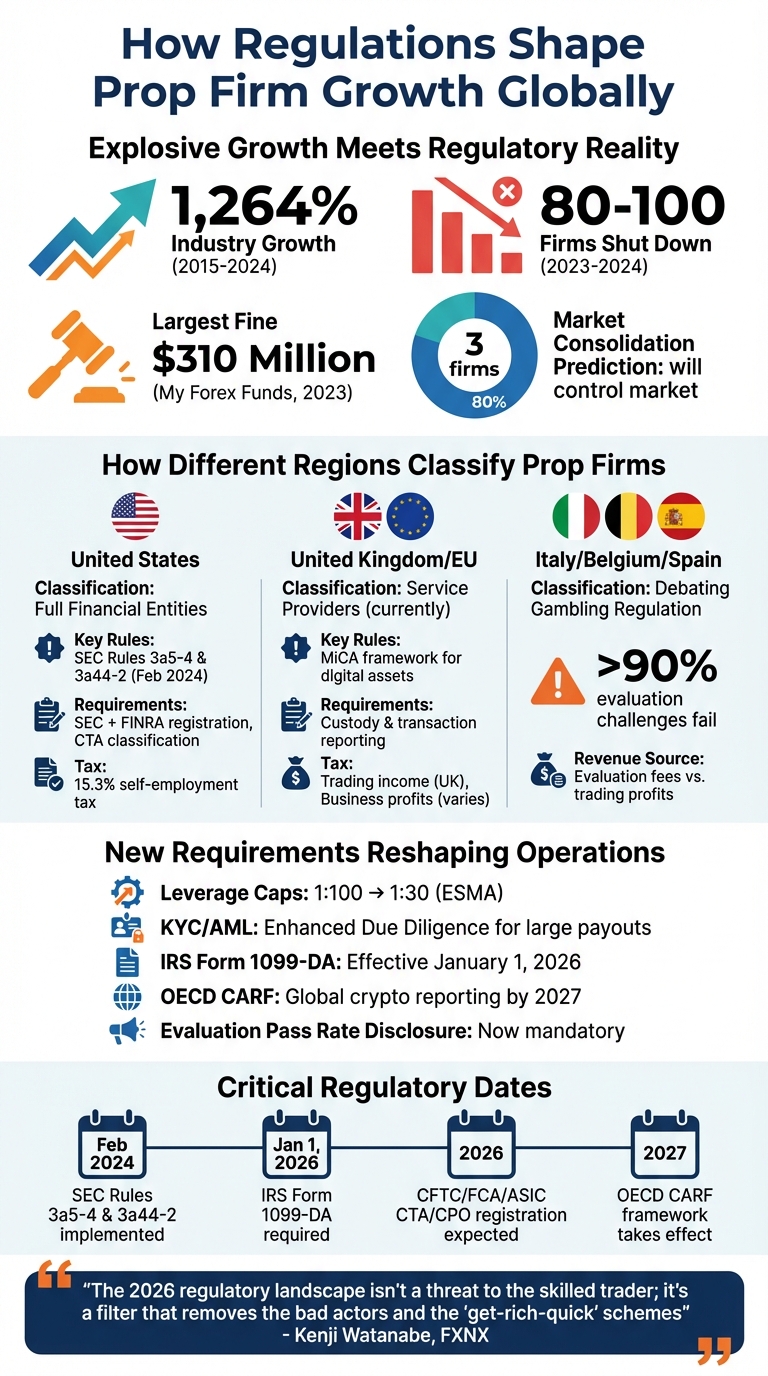
Global Prop Trading Regulation Impact: Key Statistics and Regional Differences 2023-2026
How Different Countries Classify Prop Trading Firms
Regional Differences in Regulatory Perception
The way proprietary trading firms are classified varies widely across countries, leading to different regulatory standards and operational frameworks. In the United States, regulators have started treating prop firms as full-fledged financial entities. For example, the SEC introduced Rules 3a5-4 and 3a44-2 in February 2024, expanding the definition of "dealer" to include certain prop trading setups. This change requires these firms to register with both the SEC and FINRA [1]. Similarly, the CFTC is exploring whether prop firms involved in futures trading should be classified as Commodity Trading Advisors (CTAs). If implemented, this would mean additional requirements like registration, capital adequacy rules, and regular audits [1].
In contrast, the United Kingdom and the European Union currently take a less restrictive approach. Many UK prop firms avoid FCA authorization by operating as service providers that neither hold client funds nor offer investment advice [4]. However, the FCA has been paying closer attention to areas like algorithmic trading controls and marketing practices. In the EU, prop firms are often classified as general commercial businesses or educational platforms. That said, the new MiCA framework has introduced stricter rules for firms dealing with digital assets, including custody and transaction reporting obligations [1].
Interestingly, some countries are debating whether prop trading should fall under gambling regulations instead of financial services. Regulators in Italy (Consob), Belgium (FSMA), and Spain (CNMV) are considering this shift, partly because over 90% of evaluation challenges fail, with firms earning most of their revenue from evaluation fees rather than actual trading profits [1]. This raises questions about whether such activities align more closely with gaming than investing. These differing regulatory views significantly affect both licensing requirements and how firms operate.
How Licensing Requirements Affect Operations
Licensing rules create a range of operational challenges for prop firms, depending on the jurisdiction. Many retail-focused prop firms avoid broker licensing by using demo accounts and paying traders from company funds through various profit split models. This approach sidesteps brokerage classification, as these firms neither execute live market orders nor handle client funds [4].
However, compliance costs are rising across the board. Even unlicensed firms must now implement KYC (Know Your Customer) and AML (Anti-Money Laundering) protocols, regardless of their regulatory status [1]. Taxation also varies significantly by country. In the U.S., payouts are subject to a 15.3% self-employment tax. In the U.K., they are taxed as trading income, while in Australia and India, prop traders are considered business operators, with earnings taxed as business profits [5].
These regulatory and tax differences force prop firms to carefully choose where to incorporate and operate. Many firms opt for jurisdictions like Cyprus or Seychelles, which offer business-friendly environments and fewer regulatory hurdles [4]. However, as global regulatory scrutiny increases, maintaining such strategies is becoming harder. These challenges highlight the need for prop firms to adapt their operations to meet evolving regulatory demands worldwide.
sbb-itb-46ae61d
KYC, AML, and Data Protection Requirements
Multi-Region KYC and AML Compliance Difficulties
Prop firms face growing pressure to implement strict identity verification and anti-money laundering (AML) measures. These steps are essential as banks and payment processors demand thorough payout monitoring to maintain access to their services [1].
The process is becoming increasingly rigorous. Traders are now required to provide a government-issued ID, proof of address, and documentation verifying their source of funds. For larger payouts, firms often apply Enhanced Due Diligence (EDD) protocols. If submitted documents don’t perfectly align with account details, this can create delays in processing payouts [1].
Operating across regions like the U.S., EU, and Asia-Pacific adds another layer of complexity. Firms must navigate varying regulatory frameworks, including the upcoming IRS Form 1099-DA requirements for digital asset transactions, which will take effect on January 1, 2026 [1][3].
To meet these challenges, many major prop firms are collaborating with regulated brokers to implement institutional-grade compliance systems [3][6]. However, the stakes are high – between 2023 and 2024, an estimated 80–100 prop firms shut down due to increasingly stringent global regulations. This highlights the risks for firms that lack a well-defined compliance strategy [1].
The data collected for these Know Your Customer (KYC) processes must also comply with strict privacy standards set by global regulations.
Data Privacy Laws and Their Effects on Operations
Data privacy requirements vary significantly depending on where a prop firm operates and the locations of its traders. Laws like Europe’s GDPR and California’s CCPA enforce stringent rules on how firms handle trader information, including its collection, storage, and sharing. In contrast, unregulated firms often lack the advanced data security measures required of regulated brokers [6]. This gap leaves them more exposed, especially when managing operations across multiple privacy jurisdictions.
Additionally, regulations such as the EU’s MiCA and the OECD’s forthcoming CARF mandate detailed transaction reporting and international data-sharing protocols, pushing firms to upgrade their data governance systems [1].
For traders, maintaining clear and accurate scans of government IDs and proof of address is critical to avoid payout delays [1]. Crypto traders, in particular, are encouraged to use tax software like CoinLedger or CryptoTax to track cost basis and wallet transfers, especially with the IRS’s 2026 reporting requirements on the horizon [1]. Before committing to a firm, traders should verify whether it partners with a regulated third-party broker or operates in a Tier-1 jurisdiction such as the UK, USA, EU, or Australia. These factors often indicate stronger compliance measures [3].
"If your current prop firm doesn’t have a clear roadmap toward obtaining a brokerage license or a partnership with a Tier-1 regulated broker, they are likely living on borrowed time." – FXNX [3]
Marketing Restrictions and Operational Transparency Rules
Advertising Limits and Risk Disclosure Rules
Regulators around the world are cracking down on exaggerated marketing claims and unclear operational practices in the prop trading industry. Promises like "fast money" or "90% profit shares" have drawn scrutiny, with some firms risking their licenses or facing enforcement actions for such claims [7][1]. Platforms like Google and Meta now categorize these offers as "complex speculative financial products", requiring firms to undergo certification and include strict risk warnings in their ads [11].
This regulatory pressure is reshaping how firms present themselves. Instead of promoting quick and easy profits, many firms are repositioning as "career accelerators" or platforms for building sustainable side incomes [7].
"Messaging that veers too close to ‘fast money’ now puts brands and licence opportunities, at risk." – Contentworks Agency [7]
Transparency has become non-negotiable. Firms are now required to clearly outline their business models, including how evaluation fees are allocated. This shift directly impacts how traders perceive the firms and builds trust [2][1]. In Australia, for instance, ASIC has warned financial influencers against promoting prop firms without proper risk disclosures [1]. Providing clear information about rules and fee structures not only improves trader confidence but also helps reduce customer churn [8][1].
These new marketing rules are part of a broader regulatory push that also focuses on operational risk management.
Operational Risk Management Requirements
Regulators are now demanding stricter operational controls to ensure firms can meet their payout obligations. Much like data privacy and KYC regulations, these measures require firms to maintain detailed audit trails and demonstrate their ability to honor payouts. To meet these expectations, many firms are partnering with regulated brokers to ensure trading happens on real market infrastructure rather than simulated platforms [2][1].
Operational practices are also under scrutiny. Risky trading strategies like Martingale, grid trading, and latency arbitrage, which can destabilize a firm’s risk profile, are increasingly being banned. These practices have also raised red flags with payment processors [1]. To tighten oversight, firms are adopting automated risk engines that enforce drawdown and loss rules in real time. Depending on the severity of a violation, these systems can either terminate accounts immediately or apply corrective measures like profit removal [9][10].
Between 2023 and 2024, an estimated 80–100 prop firms closed due to their inability to meet these stricter operational and transparency standards [1]. The firms that remain operational are those that have invested in compliance systems, clear rule enforcement, and thorough documentation of payouts and rule violations.
Expected Regulatory Changes and Adaptation Methods
Movement Toward Global Regulatory Consistency
The days of exploiting the "service provider" loophole are coming to an end. Regulators around the globe are rejecting claims that proprietary trading firms are merely selling educational tools or demo platforms. By 2026, major regulatory authorities like the CFTC, FCA, and ASIC are set to require these firms to register as Commodity Trading Advisors (CTAs), Commodity Pool Operators (CPOs), or broker-dealers [2]. This change closes the legal gray area that allowed some firms to bypass financial oversight [12].
Leverage restrictions are also on the horizon. Firms offering leverage as high as 1:100 will soon need to comply with retail trading limits, such as the ESMA-enforced 1:30 cap for major currencies. This is part of a larger effort to curb the exploitation of jurisdictions with lighter regulations [12].
Capital adequacy requirements are becoming a critical factor. Regulators now expect firms to demonstrate they have enough reserves to meet payout obligations without relying on income from new challenge fees. This move aims to put an end to unsustainable payout models [12]. Additionally, starting January 1, 2026, the IRS will require Form 1099-DA for digital asset transactions, directly affecting crypto-focused proprietary trading firms [1].
The industry is also moving toward consolidation. Rising compliance costs are expected to leave only a few major players standing, with predictions that three firms will control 80% of the market in the near future [1].
Methods for Long-Term Growth and Compliance
To adapt to these regulatory shifts, proprietary trading firms are focusing on strategies designed for sustainable growth. With increasing compliance demands – such as stricter KYC/AML protocols and data protection rules – firms are turning to diversified and tech-driven solutions.
One approach is partnering with or acquiring regulated brokers to create hybrid models that align with compliance requirements [12].
Another strategy is diversifying operations across multiple jurisdictions, such as the US, EU, and Australia. This reduces the risk of being caught off guard by sudden regulatory changes or geoblocking [2]. For traders, spreading capital across two or three well-regulated firms can also help safeguard against potential shutdowns [1].
Technology is playing a major role in ensuring compliance. Many firms are adopting AI-powered risk management systems to flag prohibited trading strategies like Martingale, grid trading, and latency arbitrage in real time [1]. Some are even moving away from MetaTrader to platforms like TradeLocker or DXtrade, which allow for automated rule enforcement and avoid licensing challenges [9].
Transparency has become non-negotiable. Firms must now disclose key metrics like evaluation pass rates, payout statistics, and how fees are allocated to meet evolving consumer protection standards [2]. Traders should verify that firms maintain a physical presence in Tier-1 jurisdictions (e.g., the US, UK, EU, or Australia) and work with regulated brokers and platforms [12]. With the OECD’s CARF framework for global crypto-asset reporting arriving in 2027, meticulous record-keeping – using tax software, for instance – will be essential for tracking transactions and payouts [1].
Prop Firm Trading Rules Explained for EAs (Expert Advisors)
Conclusion
Global regulations are changing the way proprietary trading firms operate and expand. The rapid growth of the industry has drawn intense regulatory attention, pushing many firms to transition from being labeled as "educational service providers" to fully regulated financial entities [1].
Navigating the challenges ahead requires forward-thinking strategies. Recent compliance missteps have led to the closure of numerous firms [1]. Those that remain are focusing on partnerships with regulated brokers, adopting AI-driven risk management tools, and establishing physical offices in Tier-1 regions like the US, UK, EU, and Australia. As Kenji Watanabe, Technical Analysis Lead at FXNX, aptly noted:
"The 2026 regulatory landscape isn’t a threat to the skilled trader; it’s a filter that removes the bad actors and the ‘get-rich-quick’ schemes" [3].
For traders, choosing a firm with a solid compliance framework is critical. Look for firms that provide clear payout statistics, collaborate with regulated brokers, and have actionable licensing plans. Understanding prop firm consistency rules is also vital for maintaining compliance. Resources like DamnPropFirms allow traders to compare verified firms such as Apex Trader Funding, Take Profit Trader, and Topstep, helping you align with firms built for longevity.
With new IRS reporting rules coming into effect on January 1, 2026, and the OECD’s CARF framework set for 2027, maintaining thorough records and aligning with regulations will be crucial. Firms that embrace transparency, institutional responsibility, and strategies spanning multiple jurisdictions will have the best chance of thriving in this shifting environment. Both firms and traders must commit to accountability and sustainability to ensure long-term success.
FAQs
Will prop firms need to register as broker-dealers or CTAs?
Current regulations are putting more pressure on prop firms to register as broker-dealers or Commodity Trading Advisors (CTAs). Regulatory bodies, including the CFTC, are taking a closer look at models that resemble financial services, such as "demo-only" setups. These shifts are geared toward improving transparency and ensuring compliance, which means firms may need to register as regulated entities to stay within the bounds of changing financial laws.
How do KYC/AML checks affect payouts and verification time?
KYC/AML checks often lead to longer verification times and may delay payouts until traders fulfill the necessary identity and compliance requirements. These procedures are becoming more common as regulators aim to promote fairness and reduce risks for everyone involved.
How can traders spot a prop firm likely to survive new regulations?
To find prop firms that are likely to thrive under new regulations, pay attention to those embracing stricter compliance standards. Key indicators include clear KYC (Know Your Customer) procedures, reasonable leverage limits, and alignment with global regulatory frameworks. Firms that are actively working to become regulated entities or collaborating with established financial institutions tend to have a stronger foundation for long-term stability. Keeping an eye on industry updates and monitoring firms’ compliance initiatives can help you gauge their potential for durability.