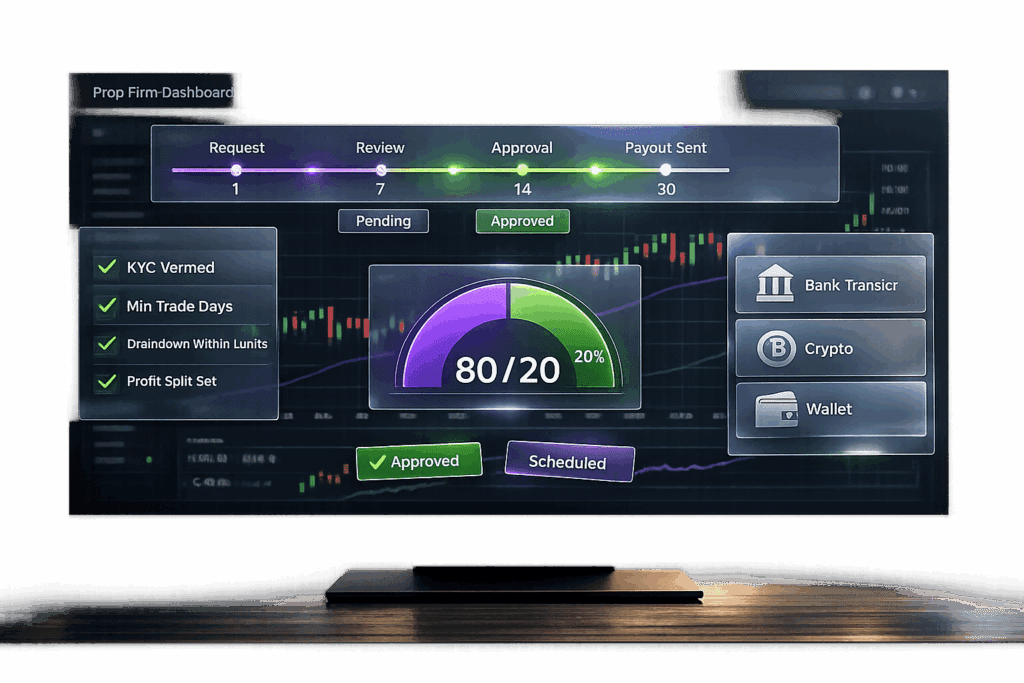
If you’re trading with a prop firm, getting paid is the whole point, right? But the payout rules, timelines, and methods can feel like a maze. Some firms, like Take Profit Trader and Tradeify, let you cash out daily from day one. Others, like Apex and Topstep, stick to stricter cycles – weekly payouts with extra hoops for your first withdrawal. The profit split also matters: Apex lets you keep 100% of your first $25k, while Topstep caps it at $10k before switching to a 90/10 split.
Payment methods range from crypto (USDT/USDC) for speed to Wise or ACH for reliability. But don’t mess up eligibility – firms have rules about trading days, profit consistency rules, and account buffers. Here’s the lowdown on how to get your money faster and avoid rookie mistakes.
Payout Eligibility and Profit Split Basics
What You Need to Qualify for Payouts
Before you can cash out, you’ll need to hit specific milestones. Futures prop firms usually have rules around qualifying trading days. For example, Apex requires 8–10 qualifying days, while Topstep asks for 5 winning days with profits above $150[2]. A qualifying day means hitting the firm’s profit threshold, which typically falls between $100 and $300, depending on your account size[3].
But don’t think you can withdraw everything you’ve earned. You’ll need to leave a cushion in your account – usually your max drawdown plus $100. Apex, for instance, requires your balance to stay above this level for withdrawals beyond the minimum amount[3]. These restrictions often apply to your first three payouts, after which the rules ease up[3].
Consistency rules are another hurdle. Firms like Apex, Topstep, and Earn2Trade enforce caps on how much of your profit can come from a single trading day within a payout cycle. Apex’s 50% rule, for example, means no single day can account for more than half of your profits in that cycle[3]. If you break these rules, you risk losing your payout eligibility.
Here’s a reality check: only 7% of funded accounts ever make it to a payout, and passing evaluations has a success rate of just 5–10%[2]. Knowing these odds can help you approach trading with a more strategic mindset.
Once you clear these hurdles, the profit split determines how much of your earnings you actually keep.
How Profit Splits Work
Futures prop firms typically offer profit splits between 80% and 90%, though some throw in promotional perks for new traders. Apex Trader Funding, for instance, lets you keep 100% of your first $25,000 in profits before switching to a 90/10 split[2]. Topstep offers a similar deal – 100% of your first $10,000, then a 90/10 split[2]. Earn2Trade, on the other hand, sticks to a flat 80/20 split[2].
Here’s how that looks in practice: if you make $10,000 in profit, you’d keep $9,000 on a 90/10 split or $8,000 on an 80/20 split. With a promotional 100% split, the full $10,000 is yours – at least until you hit the firm’s threshold for switching to a lower split[3].
Payout ladders add another layer of complexity. At Apex, if you’re trading a $50K account, your first payout is capped at $1,500, rising to $3,000 by your sixth withdrawal. A $150K account starts at $2,500 and climbs to $5,000 with consecutive payouts[3]. This system rewards traders who stick around and stay profitable over time.
Also, don’t forget about the minimum payout requirements. Most firms won’t process a withdrawal request for less than $500. And “eligible profit” isn’t your total balance – it’s what’s left after accounting for your safety net. So, plan your trades (and withdrawals) accordingly.
sbb-itb-46ae61d
Payout Schedules: When You Get Paid
The best futures prop firms offer different payout schedules, giving you options to manage your cash flow once you hit their trading requirements. The timing depends on the firm’s rules and your account level. Here’s a breakdown of weekly, on-demand, and first payout schedules to help you plan.
Weekly and On-Demand Payouts
Weekly payouts are a common choice for many firms. Take Apex Trader Funding (v4.0), for example – they require 5 qualifying days before you can access weekly payouts. Some firms go even faster with on-demand options. Take Profit Trader’s PRO+ accounts and Tradeify’s Select accounts let you request daily payouts starting day one. FundedNext processes payouts every 3–5 days, with an initial waiting period of 0–5 days, while Lucid Trading uses a 5-day cycle after a 3–8 day initial wait[3]. These quicker schedules give you more flexibility but often come with stricter rules.
First Payout Rules and Waiting Periods
First payouts usually come with extra hoops to jump through. You’ll need to meet specific milestones before you can withdraw. For instance, Apex Trader Funding requires 5 qualifying days, while Topstep asks for 5 winning days with profits over $150[3]. These steps ensure you’ve proven consistency before accessing your funds.
Payment Methods: How You Receive Your Money
How you get paid can make or break the payout experience, especially when timing matters. Most prop firms don’t send money directly to your bank. Instead, they rely on fintech platforms like Rise, Plane, or Deel to handle the transfers [5]. If speed is your priority, Rise is a solid pick. It processes crypto and USDC payments fast – sometimes within minutes of approval [5]. Plane, on the other hand, sticks to traditional bank transfers, which can take anywhere from 3 to 7 business days [5].
Crypto payments (USDT/USDC) are the fastest option, often completed within hours – even on weekends. Firms like FXIFY and FunderPro use platforms like Rise or Deel to process these transactions. Trader Pascal Kemelong shared his experience:
payout approved in under two minutes, with funds deposited within 10 minutes on a Saturday [6]
Traditional banking methods – such as ACH transfers, Wise, or SWIFT wires – are slower but more reliable for things like tax reporting. ACH transfers typically take 1–3 business days for U.S. traders, while international SWIFT wires can drag out to 10 business days [4][5]. For example, Topstep uses Wise and ACH for payouts, while FundedNext offers Rise, Wise, and traditional bank wire options [4]. Some firms even support direct card transfers through Visa Direct or Mastercard Send, which can speed things up [6].
One thing to remember: KYC verification is mandatory before any payout. Your first payout will likely take longer – 24 to 72 hours – because of this step [5]. To avoid delays when you hit your first payout milestone, it’s smart to complete KYC during the evaluation phase.
For U.S. traders who want speed, crypto via Rise is the way to go. If clear tax documentation is more important, ACH or Wise is a better fit. Brett Simba from Tradeify summed it up well:
Serious professional traders now prioritize Liquidity over account size [5]
Payout Policies at Top Futures Prop Firms
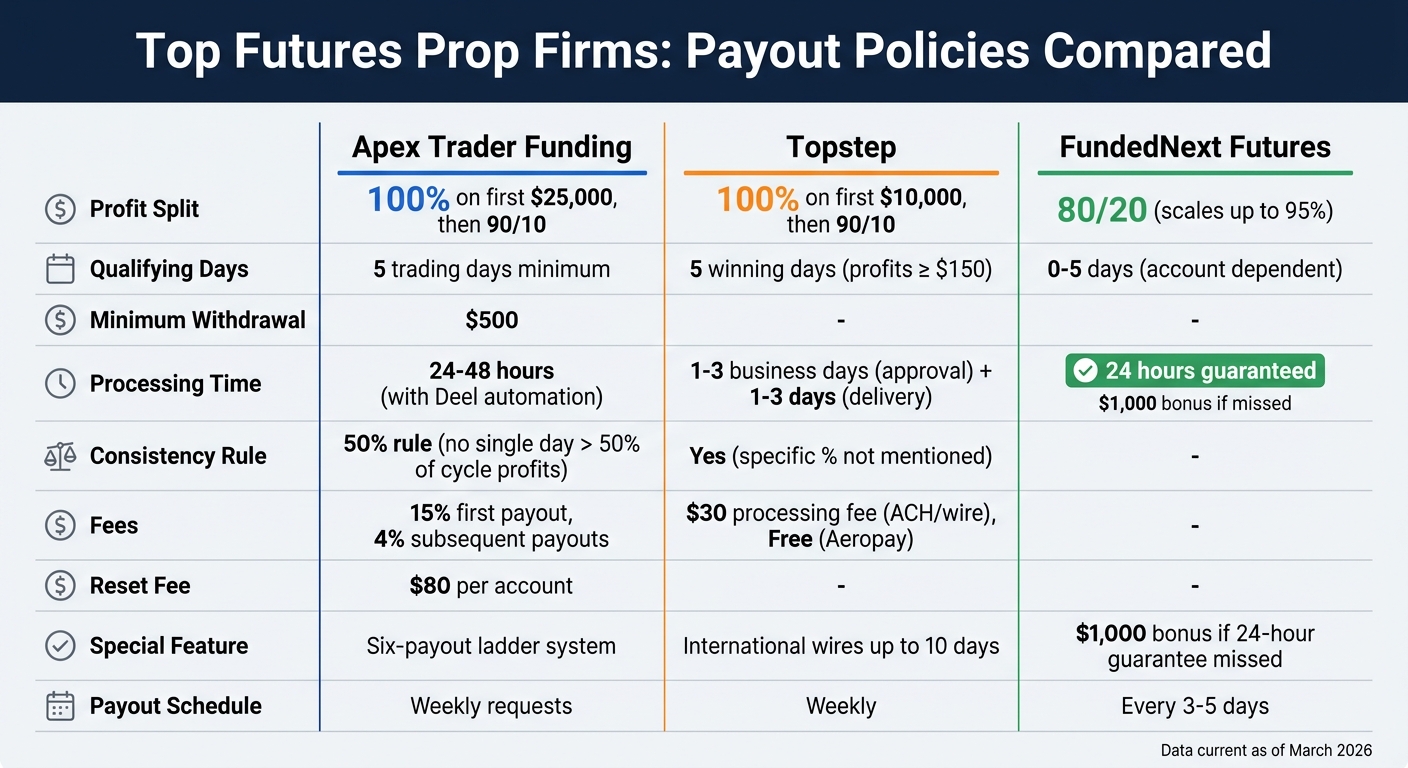
Prop Firm Payout Comparison: Apex vs Topstep vs FundedNext
Here’s a breakdown of how the top futures prop firms handle payouts. These policies highlight the rules, fees, and timelines that can affect how quickly you get paid and what you can expect.
Apex Trader Funding Payout Rules
Apex revamped its payout system on March 1, 2026, switching to a weekly payout request model with a 100% profit split on approved withdrawals[3]. To qualify, you’ll need at least 5 trading days, meet the 50% consistency rule, and hit a $500 minimum withdrawal threshold – regardless of account size[3][1].
Apex also has some fees to keep in mind. The first payout comes with a 15% processing fee, while subsequent withdrawals drop to 4%[9]. Additionally, there’s an $80 reset fee per account[9].
They use a six-payout ladder, meaning your account closes after the sixth approved payout[3][1]. Another key rule: your account balance must stay above the minimum threshold after a payout request. If it dips below during trading, the payout request will be denied[1].
Topstep Payout Rules
Topstep offers a 100% profit split on your first $10,000, then switches to a 90/10 split after that. You’ll need 5 winning days (defined as profits of at least $150) before your first payout[7][8].
Approval usually takes 1–3 business days, and payouts arrive within 1–3 days via Wise or ACH. International wires can take up to 10 days[7]. Fees include a $30 processing fee for ACH and wire transfers, but Aeropay transfers are free (though your bank might still charge its own fees)[7]. To avoid delays, make sure the email linked to your Wise account matches the one on your Adobe banking forms[7].
FundedNext Futures Payout Rules

FundedNext starts with an 80/20 profit split, which can scale up to 95%, depending on your account type. They stand out by guaranteeing 24-hour payout processing. If they miss that window, they’ll award you a $1,000 bonus.
They support both bank transfers and Wise, with the required number of trading days ranging from 0 to 5, depending on your account. While their initial split is lower than Apex or Topstep, the quick processing and potential bonus could make up for it.
Processing Times and Common Delays
How fast you get your payout depends a lot on the firm and how automated their system is. Lucid Trading is lightning-fast, processing payouts in under 30 seconds with Plaid ACH. Tradeify isn’t far behind, clocking in at about 10 minutes through Rise or Plane. Take Profit Trader also keeps it quick, offering same-day payouts via Plaid ACH or crypto. On the slower side, Topstep takes 1–3 business days (using Wise or ACH), while Apex typically processes payouts in 24–48 hours with Deel automation. However, if you’re stuck with Apex’s older system, you could be waiting 5–11 business days. Beyond just speed, compliance can play a huge role in how quickly you see your money.
What Causes Delays?
Delays often boil down to compliance and verification issues. For first-time payouts, KYC (Know Your Customer) checks can be a headache. If your documents get flagged or rejected, this process can drag out as long as 72 hours. Brett Simba from Tradeify explains:
The first payout is always the slowest due to Know Your Customer (KYC) laws. Verification on platforms like Rise or Plane usually takes 24 hours but can take up to three days if documents are rejected. [5]
Simple mistakes like mismatched names, expired IDs, or providing a wire routing number when ACH is required are common culprits. These are easy to avoid if you double-check your details.
Another major issue? Trading after requesting a payout. If your account balance drops below the required level or you hit loss limits after submitting your request, your payout gets canceled. Some firms also limit daily profits to 30%–50% of your total cycle profits. If you exceed that, you’ll need to win on more trading days to rebalance your eligibility [1].
Fees can also trip you up. For example, Apex charges a 15% processing fee on your first payout. If you request exactly the minimum amount, that fee might drop your net payout below their threshold, and your request will be denied [9]. Always factor in fees and make sure your balance has enough cushion to cover them.
How to Avoid Payout Delays
Want to sidestep these issues? Here’s what you can do:
- Verify your accounts early: Make sure your payment platform is set up and verified well before you hit your profit target.
- Stop trading after requesting a payout: Don’t risk invalidating your request by dropping below the balance requirement or hitting a loss limit.
- Leave a buffer: Requesting the absolute maximum can backfire if fees or commissions eat into your balance.
- Double-check your details: Ensure your banking info, names, and IDs match across all forms.
- Know your firm’s rules: Understand profit thresholds and how fees affect your payout eligibility.
Some firms, like FundedNext Futures, even offer guarantees. They promise 24-hour payouts and back it up with a $1,000 bonus if they miss the deadline. In July 2024, they paid out $176,000 in compensation to traders who experienced delays ($1,000 each) [4].
How to Get Paid Faster and Avoid Problems
If you want to speed up payouts and avoid headaches, preparation and discipline are key. Let’s break it down.
First, don’t wait until you hit your profit target to set up your payout account. If you’re using platforms like Deel or Wise, get your account verified at least a week ahead of time. This simple step can save you from unnecessary delays.
When you submit a payout request, stop trading immediately. Seriously, don’t risk it. If your balance falls below the required threshold or you hit a loss limit after the request, your payout could get canceled. To avoid this, keep a buffer in your account – don’t request the exact maximum, as fees might eat into your balance and mess things up.
If your firm has a consistency rule (like profits from one day can’t exceed 30%-50% of your total profits), start tracking this manually around day five. A single huge trading day can block your payout until you balance it out with more consistent wins. Some dashboards don’t make this easy to see, so stay on top of it yourself.
Double-check that your name, ID, and banking details match perfectly across all platforms. Even a small mismatch can lead to rejected payouts.
Finally, know your firm’s rules and fee structures inside and out. If the rules seem unclear when you’re signing up, expect issues down the road. Read the fine print, understand the fees, and plan your withdrawals carefully. It’s all about being proactive to avoid last-minute surprises.
FAQs
What counts as a qualifying trading day?
A qualifying trading day typically means you need to trade for a specific number of days – usually between 5 and 10 – without breaking any of the firm’s rules. On top of that, you’ve got to hit the profit targets and meet consistency rules set by the prop firm. These requirements are there to make sure you’re eligible for payouts and following their policies.
How do consistency rules block a payout?
Consistency rules can mess up your payout plans if you don’t stick to the firm’s performance and risk guidelines. These usually cover things like keeping your account balance above a set level, staying under the daily loss limit, and hitting the payout minimum. If you break any of these rules, you could face delays – or worse, get your withdrawal denied altogether. Bottom line: follow the firm’s rules to avoid headaches when it’s time to cash out.
What’s the fastest way to get paid in the U.S.?
The quickest way to get your payouts in the U.S. is by choosing firms that process payments fast – sometimes in just minutes, but usually within 24 hours. They often rely on bank transfers or electronic payment platforms to keep things simple and efficient.