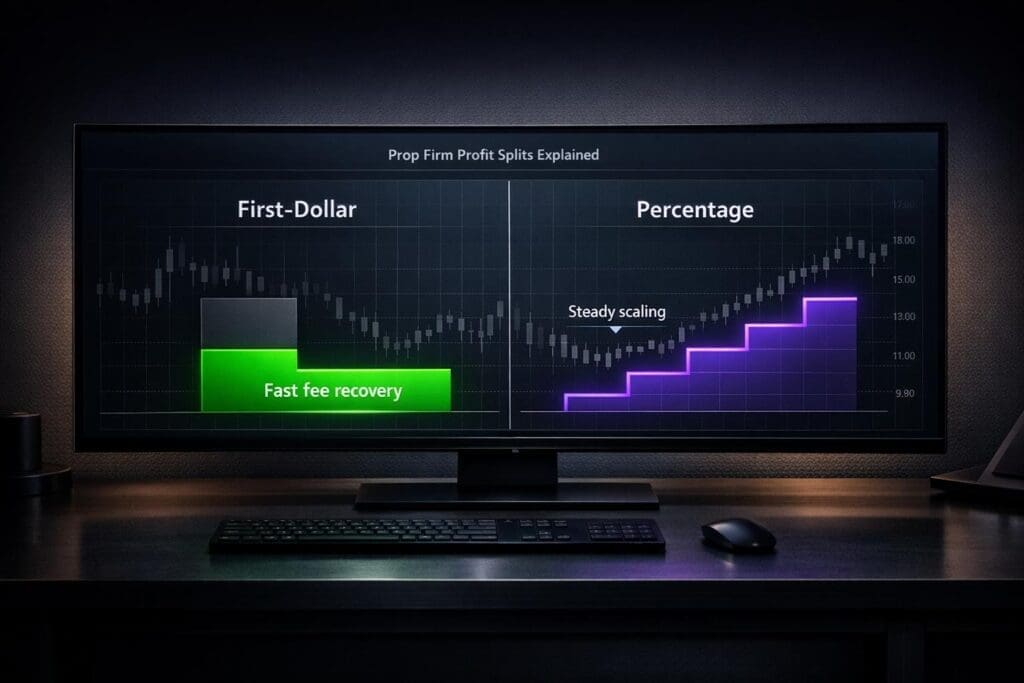
First-dollar splits let you keep 100% of your profits up to a cap (like $10k or $25k) before the firm takes a cut. Percentage-based splits (80/20, 90/10, etc.) apply from day one, with some firms offering higher splits as you hit milestones. If you’re looking to recover fees fast, first-dollar models are the way to go when evaluating the best futures prop firms. But for long-term growth with bigger accounts, percentage-based splits often make more sense. Here’s how the two compare and which might fit your trading style better.
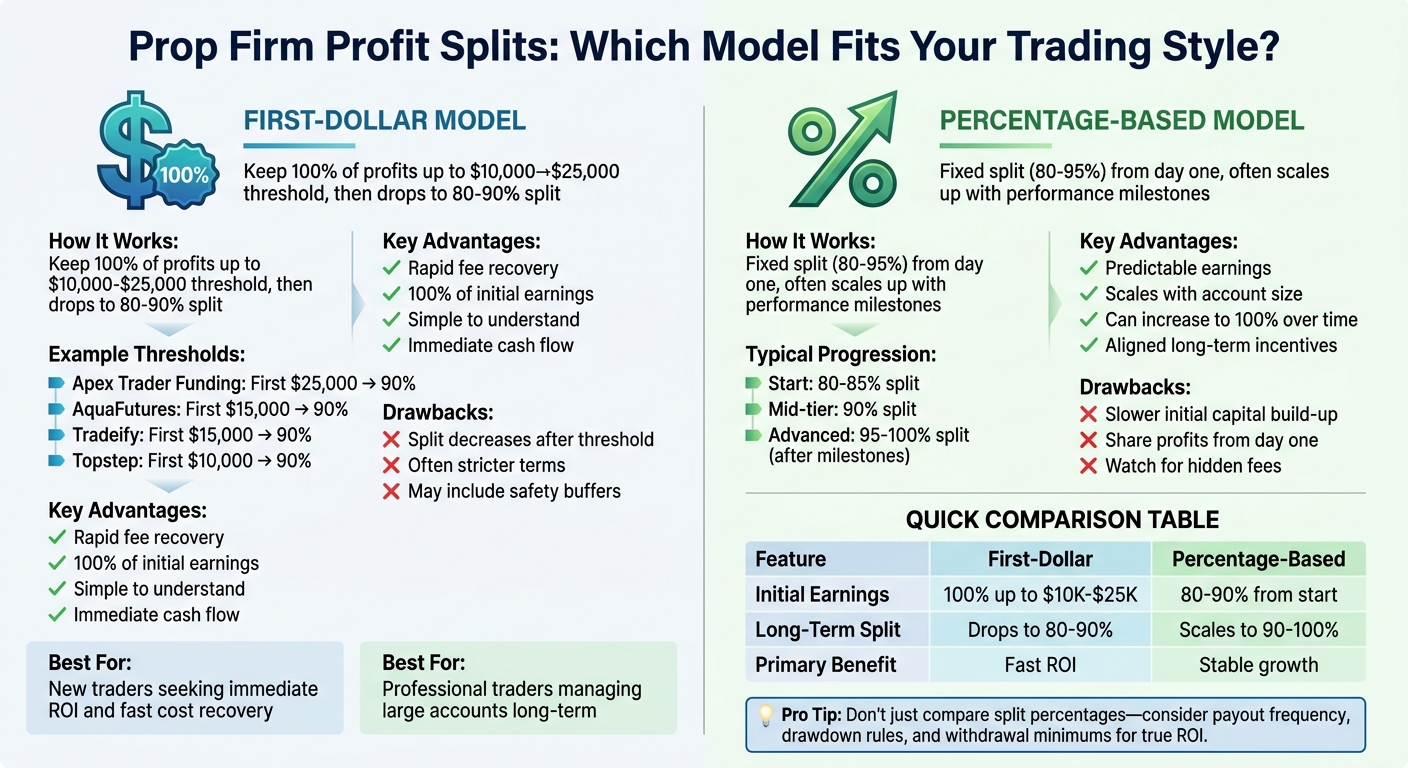
First-Dollar vs Percentage-Based Prop Firm Profit Splits Comparison
1. First-Dollar Profit Splits
Profit Distribution
The first-dollar model, also known as a "honeymoon" or "front-loaded" structure, lets you keep 100% of your initial trading profits up to a specific dollar limit before the firm takes any cut [1][2]. Once you hit that limit, the profit split shifts to a standard percentage, usually 90/10 or 80/20 [1][3].
Here’s how this setup looks at different firms:
| Firm | 100% Profit Threshold | Post-Threshold Split |
|---|---|---|
| Apex Trader Funding | First $25,000 | 90% |
| AquaFutures | First $15,000 | 90% |
| Tradeify | First $15,000 | 90% |
| Topstep | First $10,000 | 90% |
Let’s break it down with an example. If you’re working with a standard 80/20 split on $10,000, you’d take home $8,000. But with a first-dollar threshold of $10,000, you’d pocket the full $10,000 – giving you 25% more in early profits [4].
Now let’s talk about what this structure does for traders.
Trader Incentives
This model isn’t just about keeping more of your profits; it’s designed to motivate traders. One big perk? You can recover your capital quickly. As Pratik Thorat, Head of Research at Prop Firm Bridge, explains:
This model… provides immediate cash flow to help traders recoup evaluation costs, and limits the firm’s exposure on new funded accounts where trader quality remains unproven [1].
Evaluation fees for a $100K account can range from $345 to $540, so being able to recover those costs without splitting your early profits is a big deal. Considering industry stats from 2026 show that only 5–15% of traders pass two-phase challenges, this front-loaded structure can be a game-changer for those who make it.
Scalability
Even though the 100% split eventually drops to 90%, many firms combine this model with scaling programs. For example, The5ers and FundedNext offer opportunities to scale up to $4,000,000 in funded capital [1][2][4]. As Flux Trading puts it:
A 90% split on a $4M account (The5ers) generates more income than 100% on a $50K account [4].
Some firms also let traders manage up to 20 accounts at once, massively increasing earning potential. This setup can help you reinvest in more challenges or scale up to larger accounts faster.
While the benefits are clear, the math behind it is refreshingly simple.
Complexity
This structure is easy to understand. You don’t have to worry about percentages or platform fees until you hit the profit threshold. Just track your cumulative withdrawals – once you exceed the cap, the standard split kicks in. It’s straightforward and makes financial planning a breeze [2][4].
sbb-itb-46ae61d
2. Percentage-Based Profit Splits
Profit Distribution
In a percentage-based profit split, you’re guaranteed a fixed percentage of your profits right from the start, usually between 80% and 90%. There’s no minimum profit threshold before the split kicks in. For example, if you earn $10,000 in profit with an 80/20 split, you’ll walk away with $8,000. Bump that split to 90/10, and your take-home rises to $9,000. The math is simple and consistent, making it easy to plan your earnings.
Some firms sweeten the deal by offering tiered increases. You might start at 80% but can climb to 90% or even 100% by hitting specific profit milestones or completing several successful payouts. For instance, Funded Trading Plus boosts your split to 100% once you achieve a 30% cumulative profit, while My Crypto Funding adds 5% to your split after every five successful withdrawals [3].
Scalability
The size of your account plays a bigger role than the split percentage when it comes to scaling. A 5% monthly return on a $200,000 account generates $10,000 in profit. With an 85% split, that’s $8,500 in your pocket. Compare that to a smaller $50,000 account: the same 5% return yields $2,500 in profit, and even with a 95% split, you’d only take home $2,375. Bigger accounts amplify your earnings far more than chasing a slightly higher percentage.
Firms like FundedNext, The5ers, and Earn2Trade are known for offering clear pathways to scale up. As your managed capital grows from $100,000 to $400,000 or more, the amount you keep grows exponentially since you’re working with a larger base. This scalability can significantly boost your income over time.
Trader Incentives
This model aligns your goals with the firm’s: the more you earn, the more they profit too. It encourages you to focus on consistent growth rather than short-term wins, which naturally leads to more sustainable trading strategies.
Tiered progression adds another layer of motivation. With consistent performance and multiple successful payouts, your profit split can increase from 80% to 90% or higher [3]. Over time, this creates a compounding effect – earning more per dollar of profit as you scale to larger accounts.
Complexity
The math here is refreshingly simple: multiply your profit by the agreed percentage, and that’s your payout. If you make $5,000 with a 90% split, you’ll net $4,500. No thresholds, no juggling different rates – it’s straightforward.
However, watch out for hidden costs. Some firms deduct platform fees, data charges, or withdrawal costs before applying your split [2][1]. For example, a $150 fee on a $5,000 profit means your 90% split is calculated on $4,850, not $5,000. This reduces your actual payout, so always check if your split applies to gross or net profits. While the math is simple, these details can impact your overall earnings.
Advantages and Disadvantages
Let’s break down the trade-offs between the two payout models: the quick-hit appeal of immediate full payouts versus the steadiness of long-term percentage splits.
The first-dollar model is perfect if your priority is recovering entry fees fast. With this setup, you keep 100% of your profits up to a set limit – commonly $10,000 or $25,000. This means you can make back your fees in just one or two payouts. But once you hit that cap, the split usually drops to 80–90%, which can feel like a step down after the initial phase. These models often come with stricter terms, like trailing drawdowns, safety net buffers (which lock up part of your balance), or multi-step payout systems that delay access to your funds [2]. If quick ROI is your main goal, the first-dollar model is your go-to.
On the other hand, percentage-based models offer simplicity and stability. With a fixed split – say 80% or 90% – you know exactly what you’ll keep from each trade. Some firms even reward you with better splits as you hit profit milestones or complete multiple payouts. This setup works well for traders who manage larger accounts and aim for steady, long-term growth. But keep in mind, sharing profits right from the start can slow your initial capital build-up. As TradersYard puts it, "The allure of keeping 90% or even 100% of trading profits sounds compelling, but the headline number rarely tells the complete story" [2].
Here’s a quick comparison of the two models:
| Feature | First-Dollar Model | Percentage-Based Model |
|---|---|---|
| Initial Earnings | Keep 100% up to a set limit (e.g., $10,000) | Keep a fixed portion (e.g., 80%) from the start |
| Long-Term Split | Drops to 80–90% after the threshold | Often scales up to 90–95% over time |
| Primary Advantage | Rapid recovery of entry fees | Consistent, predictable income for high-volume trading |
| Primary Disadvantage | Earning potential decreases after the initial phase | Slower initial capital accumulation |
| Best For | New traders aiming for immediate ROI | Professional traders managing large accounts long-term |
While a 100% split sounds unbeatable on paper, don’t forget to check the fine print. Does the split apply to gross or net profits? Are there buffers or restrictions on your balance? And how quickly can you actually get your funds? Knowing these details can make or break your trading strategy when choosing a prop firm.
Conclusion
Choosing between first-dollar and percentage-based profit splits really depends on your trading goals and how you operate. First-dollar models let you keep 100% of your early profits – usually the first $10,000 to $25,000 – which is perfect if you’re looking to cover costs quickly. But after you hit that cap, the split shifts to a standard ratio, typically around 90%. On the flip side, percentage-based models offer steady splits from the start, ranging from 80% to 95%, and some even scale up to 100% over time. These work better for traders managing bigger accounts who care more about stable, long-term returns than immediate payouts.
Think about your style: fast payout models are great for active traders, while steady splits benefit long-term planners. Scalpers, for instance, need frequent access to funds, so payout frequency might matter more than the split percentage. Day traders often prefer static drawdowns and consistent splits and proper risk management to handle daily market swings. Swing traders, with their larger but less frequent payouts, should aim for higher splits (90%+) and scaling options since every extra percentage adds up [2].
Don’t just focus on the headline split numbers. Consider the whole picture – payout frequency, drawdown rules, activation fees, and withdrawal minimums, and consistency rules all affect your bottom line. For example, a firm offering an 85% split with same-day payouts might actually give you better yearly cash flow than one with a 95% split but only monthly payouts.
Before you commit, crunch the numbers with our Profit Split Calculator. Look at your profit potential, trading frequency, and account size to figure out the real returns. The best split model isn’t just the one with the flashiest percentage – it’s the one that fits your trading style and helps you hit your financial goals.
FAQs
Does the profit split apply to gross profit or after fees?
Profit splits are typically based on your gross profit – that’s before any fees or charges are taken out. But watch out, some firms knock off platform fees or other costs before splitting the profits. Make sure you dig into the rules for each firm so you know exactly how they calculate your cut.
How do payout rules and withdrawal timing affect my real take-home pay?
Payout rules and withdrawal schedules play a big role in how quickly and how much of your earnings you can actually pocket from prop trading. Things like required minimum trading days, payout limits, and consistency rules can slow down your access to funds. Timelines for withdrawals differ too – some firms pay out daily, others bi-weekly or monthly – which directly affects your cash flow. On top of that, withdrawal caps and fees can chip away at your profits, so knowing these details upfront is key to figuring out your real take-home pay.
Which split model is better for my trading style (scalping, day trading, or swing trading)?
The right profit split model really comes down to how you trade. First-dollar splits give you earnings right from the start, which works great if you’re scalping or day trading and stacking up small, regular wins. On the other hand, percentage-based splits (like 80/20 or 90/10) reward steady performance over time, making them a better match for swing traders or those running longer-term strategies. Pick the one that fits your trading style and goals best.