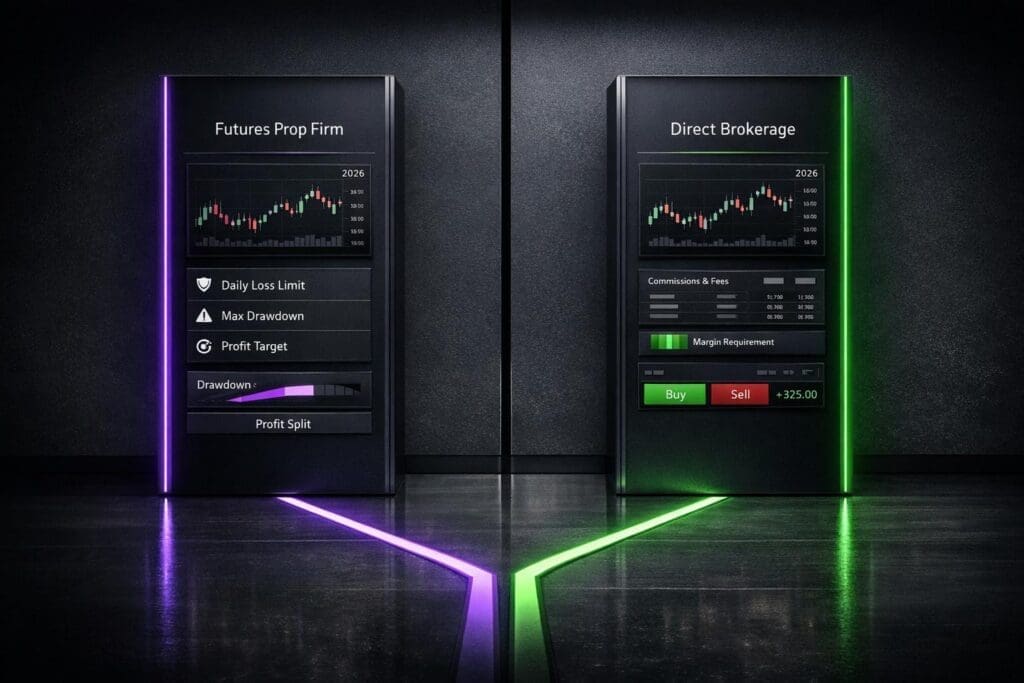
If you’ve got less than $10,000 to trade, futures prop firms win hands down. For $50–$150, you can access $50,000+ in buying power, and your risk is capped at the fee. But if you’ve got $100,000 or more and want full control, direct brokerages let you keep 100% of your profits and avoid annoying rules like daily loss limits or no overnight positions. These restrictions often include complex drawdown rules that can catch beginners off guard.
This breakdown covers the pros, cons, and costs of both options so you can decide which fits your trading style and bankroll. Let’s dive in.
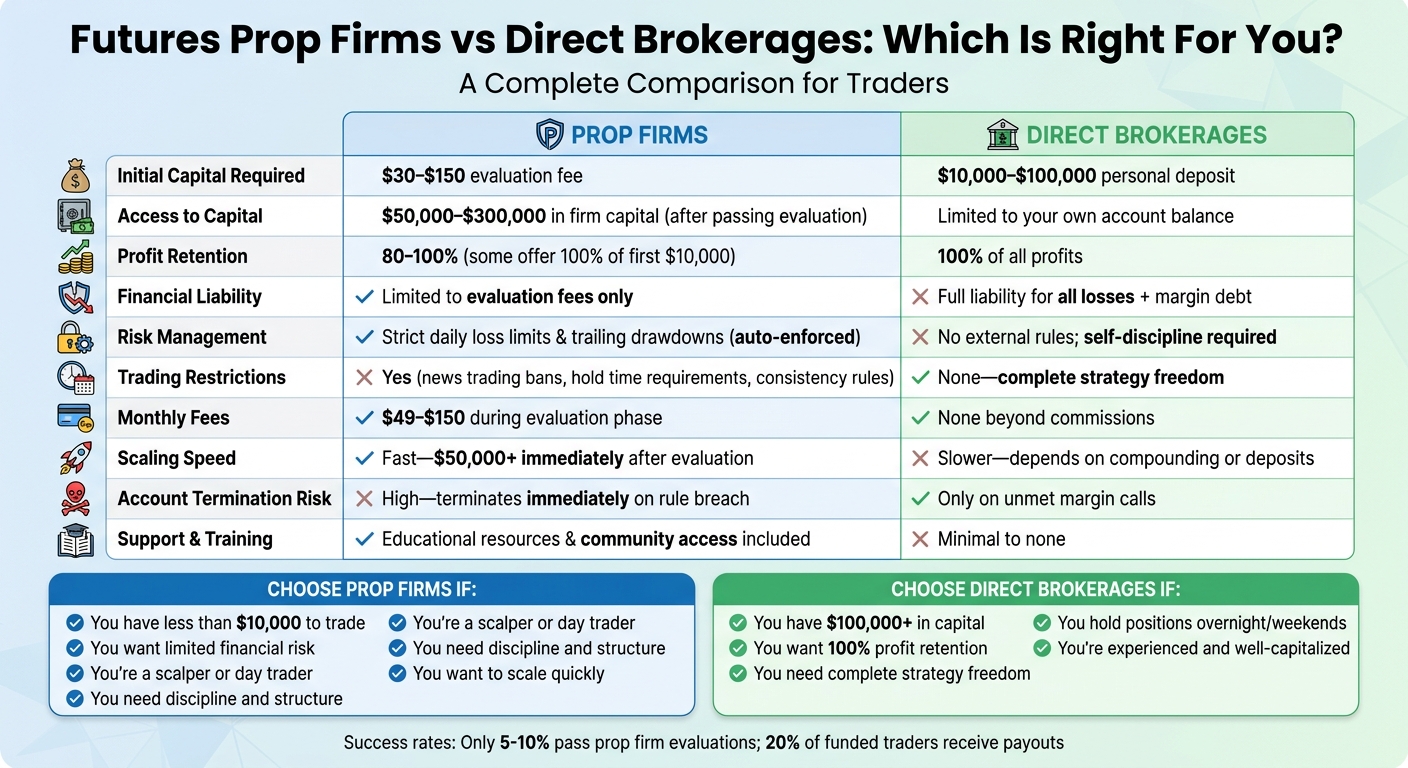
Futures Prop Firms vs Direct Brokerages: Complete Comparison Chart
The Prop Firm Benefits Traders Overlook | RakeTrades Podcast

sbb-itb-46ae61d
Core Differences Between Futures Prop Firms and Direct Brokerages
The big divide between these two options boils down to one thing: whose money you’re trading and who eats the loss when things go south. Everything else stems from that.
Funding Sources and Access to Capital
With direct brokerages, you’re trading your own money, which means you’ll need $10,000–$100,000 to trade at a meaningful level. On the other hand, prop firms let you trade their money after paying a relatively small evaluation fee – usually between $30 and $150 [1]. These fees can give you access to accounts ranging from $50,000 to $300,000, with some firms even offering accounts as large as $1,000,000 [6]. This setup gives you far more buying power than you’d likely fund on your own.
Risk Management and Financial Liability
The risk setup is another major difference.
When you trade with a brokerage, every dollar you lose is your own. You’re 100% on the hook. But with a prop firm, your financial exposure is limited to what you pay in evaluation and activation fees. If you blow up your funded account by breaking the firm’s rules, that’s it – you don’t owe them anything extra.
Prop firms enforce this through automated controls like daily loss limits and maximum drawdowns. If you hit those limits, your account is automatically terminated. As ProRiskManager puts it:
Individual accounts enforce nothing. You can hold losers, overtrade, or blow up quietly [3].
This difference in risk management is why prop firms have stricter trading rules.
Trading Rules and Restrictions
The rules are where things really diverge.
Brokerages give you total freedom. You can hold positions overnight, trade during news events, and adjust your risk however you want. Prop firms, on the other hand, come with plenty of restrictions. They set daily loss limits, unrealized trailing drawdowns, and often ban holding positions overnight or during high-impact news events. Some firms even cap the number of contracts you can trade based on your account size. These rules are there to protect the firm’s money while encouraging disciplined trading.
In short, prop firms give you access to big capital with limited personal risk, but you have to operate within their framework. Brokerages let you do whatever you want – but you’re fully responsible for any losses.
Advantages of Futures Prop Firms
Now that we’ve covered how these firms are set up, let’s dig into why they attract so many traders – especially those who don’t have the cash to fully fund a traditional brokerage account. Here’s why prop firms are worth considering.
Access to Big Leverage Without Big Capital
The biggest draw? You can trade with institutional-level capital for just the cost of an evaluation fee. Most futures prop firms charge between $30 and $150 for these evaluations [1], and in return, you get access to accounts ranging from $25,000 to $300,000 or more. Compare that to a personal brokerage account, where you’d need to cough up the full margin requirement upfront.
This setup is a game-changer if you’ve got a solid trading strategy but limited funds. Instead of tying up your own money, you pay a small fee and instantly gain access to much larger buying power. If things don’t go well, your loss is capped at that fee – your savings stay untouched.
Limited Financial Risk
One of the biggest perks is how these firms cap your financial risk. The most you’re ever on the hook for is what you’ve already paid – the evaluation fee and maybe some activation or data fees. That’s it. If you hit a risk limit or blow the account, you don’t owe the firm anything extra.
As TheAlphaDesk puts it, "Your maximum immediate financial risk is the subscription and any activation/data fees, not your savings." They also point out that funded accounts come with "institutional risk rails" that help protect you from the kind of impulsive trades that could wipe out a small self-funded account [8]. This safety net is a huge bonus for traders looking to manage risk more effectively.
Learning Tools and Room to Grow
Prop firms don’t just hand you capital – they also provide resources to help you sharpen your skills. Many offer structured education programs, like masterclasses on market fundamentals or order flow, and active Discord communities where you can swap tips with other funded traders. Some firms even throw in performance coaching to help you handle the mental side of trading.
And it doesn’t stop there. Once you show you can trade consistently, most firms have scaling plans that let you grow your account from $25,000 to $300,000 or more. Plus, you can often manage multiple accounts at once, giving you even more earning potential – all without risking extra personal funds.
Disadvantages of Futures Prop Firms
Leverage and limited personal risk might sound appealing, but they come with plenty of strings attached. Prop firms aren’t charities – they’re businesses built on evaluation fees, profit splits, and strict rules. While trading with firm capital has its perks, the downsides can’t be ignored. Let’s break it down.
Evaluation Requirements and Profit Splits
Using proven strategies to pass challenges is essential, as passing the evaluation phase is no walk in the park. Reports show that only 5–10% of traders make it through these challenges [12]. Even if you’re one of the few who gets funded, only 20% of those traders ever see a payout [12]. Translation: most people burn through evaluation fees without ever making a dollar.
Then there’s the profit split. Futures prop firms typically offer an 80% to 90% split [1], which might sound fair until you remember that with a direct brokerage, you keep 100% of your profits [10]. Some firms take as much as 50%, depending on the account type [9]. That’s a hefty cut for someone else’s capital.
Trading Rules and Account Termination Risk
Prop firms pile on rules that can feel suffocating compared to the freedom you’d get with a direct brokerage. Many firms ban overnight positions, weekend trades, hedging, and trading during major news events [11][2][13]. Some even enforce odd requirements like ensuring over 50% of your trades and profits come from positions held longer than 10 seconds to discourage microscalping [11].
Break any of these rules, and your account is terminated on the spot. Hit your daily loss limit (usually around 3–5%), exceed your trailing drawdown, or forget to close a position before the market shuts down – you’re out [15][16]. No warnings, no appeals. You’re back to square one, paying reset fees to start over.
Ongoing Fees and Limited Control
Even after passing the evaluation, the financial hurdles don’t stop. Funded traders often get classified as “professional traders” by exchanges, which means you’re stuck covering market data fees – roughly $130 per month per exchange, like CME or CBOT [14][15]. Add platform fees for tools like NinjaTrader, which run $75–$99 monthly [14][15], and you’ve got significant overhead before you’ve even placed a trade.
On top of that, there are reset fees ($60–$100), activation fees (up to $360), and monthly evaluation subscriptions ($85–$150). These costs add up fast, with the average trader spending $4,270 [14][15][2][1][16]. And here’s the kicker: 60% of traders lose their initial capital, and those who do turn a profit only average about 4% of their allocated funds [16]. That’s a lot of effort for not much return.
Advantages of Direct Brokerages
Direct brokerages put you in the driver’s seat when it comes to your trading. You control your capital, your strategy, and, most importantly, your profits. Let’s break it down by looking at profit retention, strategy flexibility, and direct market access.
100% Profit Retention
One of the biggest perks of using a direct brokerage is that you keep every dollar you earn, minus the usual commissions and fees. There’s no profit split – everything you make stays in your account [6]. FundedNext explains it like this:
When using a broker, traders are limited to using their own funds… Brokers provide the full profit (or loss) of a trade, minus their commission, to their customers [5].
This setup means your account can grow faster, especially if you’re trading with a hefty balance (think $100,000 or more) [6]. No middleman taking a cut means you get to see the full impact of compounding gains.
Total Strategy Freedom
Trading through a direct brokerage means you’re the boss of your own strategy. Want to hold positions overnight? Go for it. Planning to trade during a major news event? That’s your call. Need to hedge multiple contracts? As long as you meet margin requirements, you’re good to go. Phidias Propfirm sums it up well:
When trading with a broker using your own capital, you enjoy maximum flexibility… No predefined profit targets or time constraints [6].
This is a sharp contrast to prop firms, where strict rules often force traders to exit trades earlier than they’d like. With a direct brokerage, the only limits are the ones you set for yourself, allowing you to experiment and trade on your own schedule.
Direct Market Access and Execution Speed
Direct brokerages give you a straight line to centralized exchanges like the CME Group. You’ll get live market prices, real-time order books, and depth of market data right at your fingertips [7]. This setup removes conflicts of interest since your broker isn’t on the other side of your trades. Plus, you avoid issues like requotes or server freezes during high-volatility events [7].
For scalpers, this can be a game-changer. Even a few seconds of delay can cause the market to move by 2–3 ticks, throwing off your trade’s risk/reward ratio [4]. With direct market access, you’ll see better order fills and clearer visibility of limit order walls, giving you an edge in execution.
| Feature | Direct Brokerage | Futures Prop Firm |
|---|---|---|
| Profit Retention | 100% (minus commissions) | 70% to 95% (after splits) |
| Trading Rules | Full flexibility; margin-based | Strict (drawdowns, daily loss limits) |
| Position Holding | Flexible; margin-based | Often restricted to intraday |
| Market Access | Immediate live trading | Requires passing an evaluation |
| Execution Speed | High (direct to exchange) | Variable (intermediary delays) |
Disadvantages of Direct Brokerages
Direct brokerages give you full control over your trades, but that freedom comes with some serious challenges. These issues can directly affect your trading strategy, risk exposure, and even your finances.
High Capital Requirements
Getting started with a direct brokerage isn’t cheap. You’re typically looking at an initial capital requirement of $10,000 to $100,000 – no small chunk of change. Compare that to prop firms, where you can access up to $1,000,000 in buying power for just the cost of an evaluation fee. With a brokerage, scaling your account depends entirely on your ability to make consistent profits or pump in more of your own money. Prop firms, on the other hand, might fund you within weeks if you pass their evaluation process [6].
Full Financial Liability for Losses
Trading through a direct brokerage means you’re on the hook for every dollar you lose. As FundedNext puts it:
When using a broker, traders are limited to using their own funds. While brokers offer leveraged accounts, traders are still responsible for the full amount owed when they lose a trade [5].
This means losses can easily exceed your initial deposit, especially if you’re trading on leverage. For example, if you deposit $10,000 and hit a bad streak during volatile market conditions, those losses come straight out of your pocket. It’s not just your account balance at risk – your personal finances could take a hit too [6].
Here’s a quick comparison of risk factors:
| Risk Factor | Direct Brokerage | Prop Firm |
|---|---|---|
| Max Loss | Entire account balance plus potential margin debt | Evaluation fee only |
| Drawdown Rules | None (until margin call) | Strict daily and total limits |
| Psychological Impact | High fear of personal financial ruin | Focus on execution and rules |
No Built-In Support or Training
Direct brokerages, especially discount ones, usually don’t offer much in the way of guidance. You’re responsible for managing your strategy, emotions, and risk on your own [6]. Prop firms, by contrast, often provide tools like Daily Loss Limits and structured risk management to help you avoid blowing up your account [7]. They may also offer educational resources or community support, which can make a big difference, especially if you’re still building your skills.
Without these guardrails, trading with a direct brokerage can feel like navigating a minefield. The psychological pressure is intense, and if you don’t have substantial capital (think $100,000 or more) and years of experience, the odds of failure increase significantly [6].
These challenges underscore how important it is to weigh your risk tolerance, financial situation, and need for support when deciding between a direct brokerage and a prop firm.
Side-by-Side Comparison: Futures Prop Firms vs Direct Brokerages
Here’s a quick breakdown to help you figure out which trading model works better for you. The table below highlights the main differences.
| Feature | Futures Prop Firm | Direct Brokerage |
|---|---|---|
| Initial Capital Required | $30–$150 evaluation fee [1] | $10,000–$100,000 personal deposit |
| Access to Capital | $50,000–$300,000 in firm capital after passing evaluation [1] | Limited to your own account balance |
| Profit Retention | 80–100% (some firms offer 100% of the first $10,000) [2] | 100% of all profits |
| Financial Liability | Limited to evaluation and activation fees only [3] | Full liability for all losses, including margin debt |
| Risk Management Rules | Strict daily loss limits and trailing drawdowns enforced automatically [1] | No external rules; self-discipline required |
| Trading Restrictions | Yes (news trading, hold times, consistency requirements) [1] | None – complete strategy freedom |
| Monthly Fees | $49–$150 during evaluation phase (varies by firm) [17] | Typically none beyond commissions |
| Scaling Speed | Fast – access to $50,000+ immediately after passing evaluation [3] | Slower – depends on compounding profits or additional deposits |
| Account Termination Risk | High – account terminates immediately upon rule breach | Only if margin call isn’t met |
| Support and Training | Often includes educational resources and community access | Minimal to none, especially with discount brokers |
This table lays it all out: prop firms let you trade big capital for a relatively small upfront cost, but you’ll need to follow their rules to the letter. On the other hand, direct brokerages give you complete freedom, but you’ll need to bring significant funds to the table and be prepared for the risks.
As Funded.Now puts it:
"For traders on a budget, a futures prop firm often provides a lower barrier to entry, especially during promotional periods" [1].
If you’ve got deeper pockets and need total freedom for strategies like news trading, direct brokerages might be your best bet [3].
The choice boils down to your starting capital, risk appetite, and ability to stick to strict rules. Up next, we’ll dive into specific scenarios where each option excels. You can also explore our prop firm articles for more in-depth guides on funding rules.
When Futures Prop Firms Make More Sense
If you’re trading with less than $10,000, futures prop firms can be a game-changer. They let you work with much larger accounts for a fraction of the cost. Evaluation fees, typically between $55 and $165, keep your financial risk low compared to putting your own money on the line. This is especially important when your personal funds are tight. As Phidias Propfirm puts it:
An 80% share of profits from a $200,000 account will typically exceed 100% of profits from a $10,000 personal account [6].
Simply put, trading a bigger funded account with a profit split often beats grinding it out with a small personal account.
For scalpers and high-frequency traders, futures prop firms offer some real perks, though you must navigate consistency rules for scalping futures to stay funded. Fixed commissions, high leverage, and the Depth of Market (DOM) visibility in the futures market are tough to beat. Forex, for instance, just doesn’t offer the same level of transparency [7]. Add to that the fact that more professional traders are shifting to futures prop firms due to regulatory changes affecting certain broker models [7].
One of the most appealing aspects of prop firms is how they cap your downside. Your risk is limited to the evaluation fee. Take Phidias Propfirm as an example: a $25,000 Static account costs about $55.40 and comes with a $500 maximum drawdown (see how this compares to the prop firm with the largest drawdown) [6]. That means you’re only risking a small fee to access significant buying power.
These firms also enforce strict rules, which can be a blessing in disguise. It forces you to trade with discipline and manage risk effectively, reducing the chance of emotional mistakes. This structure also makes it easier to diversify your strategies. Some experienced traders even hedge their bets by running accounts at multiple firms, like Topstep and Apex, to protect against unexpected rule changes [2].
Another big draw is how quickly you can scale your account with a prop firm. With strong performance, you could move from a $50,000 account to over $150,000 in no time – sometimes by hitting benchmarks like three payouts or earning $75,000 cumulatively [6]. Compare that to self-funding, where scaling up often takes years of compounding or a big cash injection. Prop firms make growing your trading capital faster and more accessible.
When Direct Brokerages Make More Sense
If you’ve got $100,000 or more in trading capital, direct brokerages might be your best bet. Why? Because you get to keep all your profits. Compare that to most futures prop firms, where you’re giving up 10–20% of your earnings. That difference adds up fast when you’re trading at scale[6].
Another big plus is the freedom. With direct brokerages, there are no daily drawdown limits, no consistency rules, and no profit targets. You trade how you want, when you want. This is especially important if your strategy involves holding positions overnight or over the weekend – something many prop firms either prohibit or charge extra for. You also avoid the hassle of forced liquidations or extra swing account fees.
And let’s talk about speed. With a direct brokerage, there’s no waiting around for evaluations or challenges. You fund your account and start trading live right away. For experienced traders, this means less downtime and more time actually trading.
On top of that, regulated brokers bring an added layer of trust. They’re overseen by financial authorities, keep client funds in separate accounts, and follow strict rules for handling disputes. This oversight ensures your money is managed securely and transparently.
That said, this route isn’t for everyone. With direct brokerages, you’re taking on 100% of the risk. There’s no safety net if things go south, so this option is best for traders who are both well-capitalized and confident in their skills. If you’re profitable and want full control over your trading, a direct brokerage can be a solid long-term choice.
How to Choose: Capital, Experience, and Trading Goals
Deciding between a futures prop firm and a direct brokerage boils down to three key factors: how much cash you’ve got, how experienced you are, and what you’re aiming to achieve with your trading.
If you’re working with less than $10,000, best futures prop firms are usually the better choice. Their evaluation fees are relatively low – typically ranging from $50 to $600 – so you don’t need to tie up a ton of margin. To figure out if this works for you, add up the costs of 3–5 evaluations and activation fees, then compare that to the returns you’d expect from early funded trading. Most traders who succeed in prop firms tend to break even within 1–2 months [17]. On the other hand, if you’ve got $100,000 or more to trade with, direct brokerages start to make more sense because you keep 100% of your profits. This ties back to the differences in risk and funding we’ve already covered.
Next, think about your trading experience. If you’re new to futures, prop firms can help you stay disciplined with their built-in risk controls while you trade with their capital. For intermediate traders who have a solid strategy but limited funds, prop firms offer a huge advantage: the chance to scale up quickly. Some firms provide access to as much as $1 million in funding, which could take years to build up on your own. On the flip side, seasoned pros with a strong bankroll might lean toward direct brokerages. They offer complete freedom to trade your way without restrictions [6].
Finally, your trading goals and style matter a lot. Are you scalping or day trading and need high leverage and pro-level platforms? Prop firms are built for that. But if you’re a swing trader or someone who holds positions overnight, you might want to look at direct brokerages – or at least a prop firm that offers a "Swing" account type. Most standard funded accounts require you to close all positions daily, which won’t work for every strategy. And if your trading approach involves high variance that could trip up firm-specific rules, a direct brokerage might be the better fit since you’re only limited by market conditions.
Final Recommendations: Matching Your Profile to the Right Option
Based on the comparisons we’ve gone through, here’s how to match your trading profile to the best funding approach.
If you’re starting with limited capital, futures prop firms are a no-brainer. The evaluation fees are way cheaper than the upfront capital you’d need to trade on your own. Even if you need a few tries to pass, it’s still far less expensive than self-funding. As PropJournal puts it:
A $100 evaluation that you fail is more expensive than a $300 evaluation that you pass [17].
The key is to find a firm with rules that fit your trading style – not just the one with the lowest fees. That’s where prop firms stand apart from trading with your own funds.
On the flip side, if you’ve got the cash to fully fund your own account, a direct brokerage might make more sense. You’ll keep 100% of your profits, and you won’t have to deal with things like daily drawdown limits or consistency rules. This freedom is a huge advantage if you can handle the ups and downs of the market without breaking a sweat.
For newer traders, prop firms offer risk controls that act like training wheels. Those restrictions aren’t just there to annoy you – they help you build discipline, which is critical for sticking around in the game long-term. If you’re an intermediate trader with a solid strategy but not much capital, prop firms can give you access to the kind of buying power that would take years to build on your own.
Scalpers and day traders often lean toward prop firms for their high leverage and advanced platforms. But if you’re planning to hold positions overnight, watch out – some prop firms require you to close trades intraday. In those cases, a direct brokerage might be a better fit, since they’re usually more flexible with holding periods. These recommendations all boil down to your capital, risk tolerance, and trading style.
And here’s the thing – you don’t have to pick just one. You can start with a prop firm evaluation while slowly building your personal account. It’s a smart, flexible way to grow your trading career over time.
FAQs
How do I calculate whether prop firm fees beat trading my own account?
To weigh prop firm fees against trading your own account, you’ve got to break down all the costs. For prop firms, this means looking at evaluation fees, platform charges, profit splits, and any sneaky hidden fees they might tack on. On the flip side, personal trading costs include your own capital, broker commissions, and platform expenses.
Once you’ve added up the numbers, think about the profit splits too. If the prop firm’s fees are lower and still let you keep a solid chunk of your profits, they might end up being the smarter move.
Which prop firm rules usually disrupt swing or news-based strategies?
Prop firms often impose rules that can mess with swing or news-based strategies. A common one is the requirement to close all positions by a set time, like 4:59 PM ET. This kills the ability to hold trades overnight, which is crucial for swing traders relying on market gaps or extended volatility to hit their targets.
When does keeping 100% profits at a broker outweigh a prop firm profit split?
Keeping all your profits with a broker is a solid choice if you’re trading with your own money and want complete control over your earnings. This setup works well for traders who don’t want to split profits and are okay with funding their accounts themselves. Brokers that operate this way let you trade your own capital while keeping every dollar you make.