- Accounts: $5K, $10K and $25K; up to 10 funded accounts per trader.
- Price: $25–$450 evaluation (36 configurations), $15–$90 two-step, $10–$1,000 instant.
- Drawdown: fixed 6% ($1,500 on the $25K), never trails; optional 3% or 4% daily limit.
- Split: 80% or 90% on evaluation accounts, 95% on instant accounts.
- Payouts: claim any time, no caps, no minimum days, USDC credited within 24 hours.
- Markets: ES and NQ (75x and 50x), stocks, ETFs, crypto, FX, commodities; 24/5, crypto 24/7.
- Restricted countries: China, Cuba, North Korea, Iran, Russia, Syria; the US and UK are not on the prop list.
- Verdict: the loosest funded rules in prop trading, with offshore counterparty risk you manage by withdrawing often.
The prop firm and the exchange are two different products with two different sets of terms, and keeping them straight answers most of the questions people ask about this firm.
I opened my first Vest Capital accounts on September 29, 2026, did $14,000+ in profit across them in the first day, and withdrew $61,723 in USDC between October 2 and October 4. The transaction hashes are in the payout section, so this review is written from inside the dashboard and the block explorer, not from a press release. Every number below comes from Vest’s own site, FAQ, docs and terms as of October 6, 2026, and I’ve flagged every place where those sources disagree with each other. I’m a Vest affiliate: code DGT takes 5% off and I earn on referrals. That doesn’t change a single number in this post.
Jump to: Video · Verdict Verdict · Is it legit? · How it works · Prices · Drawdown and daily limit · Payouts · Rules · Copy trading · NQ and ES sizing · Fees and orders · US traders · vs futures prop firms · vs Breakout · Is it sustainable? · Contradictions · Discount code · Which account to buy · FAQ
Vest Markets Video Review: $60,000 in Payouts in 3 Days + How to Withdraw USDC
Everything in this review is on screen in the video: the dashboard, the Claim Profit and withdrawal flow, the account configurator and a live trade on a fresh instant funded account. It covers the $60,000+ I withdrew in three days (one $20,000 day and $15,000 in two minutes on NFP), the daily loss limit that ended my first account, and the exact $25K build I buy now.

Published October 6, 2026, recorded on the live Vest Capital dashboard. Payout transaction hashes are listed in the payouts section below.
Key Takeaways From the Video
- $60,000+ withdrawn in three days with receipts on screen: the first $10,000 paid the same day I found the firm, then a $20,000 day and $15,000 in two minutes on the NFP release.
- The daily loss limit ended my first account on one London move, which is why I now build every account with the daily loss limit set to none.
- The account I buy: bespoke $25K with no daily loss limit, $1,500 fixed drawdown, $2,500 target, funded on pass, 90% split, about $427 for that build (see prices and which account to buy).
- Withdrawals, step by step: Claim Profit moves your share to the Primary Account in USDC, then you withdraw to a wallet or exchange on Base (full flow and fees).
- Leverage in futures terms: what 75x ES and 50x NQ leverage means in contract-equivalent size, plus a live trade on a fresh instant funded account (NQ and ES sizing).
Video Chapters
Vest Markets Verdict: Who It’s For and Who It’s Not
- Best for: ES and NQ traders who want a static drawdown, no consistency rule, no payout caps, and the ability to hold through the close, overnight and across the weekend.
- Not for: anyone who needs buy-stop or sell-stop entry orders, anyone who wants a bank wire instead of USDC, and anyone who needs a regulated counterparty.
- The three best things: a $1,500 floor on the $25K that never moves; unlimited, uncapped claims credited in 24 hours; and a 95% split on instant accounts with no daily loss limit.
- The three biggest risks: a Panama-law contract with a 100-Balboa liability cap and the right to change the program “at any time”; a venue that liquidates you on margin as well as on the floor, with three pricing incidents between April and June 2026; and terms documents that contradict each other on refunds, fees and what the capital is.
- Bottom line: fast, cheap, and the loosest funded rules in the business, with counterparty risk you price in yourself. Claim after every meaningful win and withdraw.
Use code DGT at checkout. The 5% applies to evaluation and instant accounts.
Is Vest Markets Legit?
Vest Markets is a real company with real backers and a real payout record, and the exchange its accounts trade on is an unregulated offshore dealer. Both things are true, so here’s the evidence on each side.
On the legit side. Vest Labs raised a $5 million seed in March 2025 from Jane Street, Amber Group, Selini Capital, QCP Capital and Big Brain Holdings, with Justin Ma as CEO. The homepage lists Portal Ventures and Coinbase as backers alongside Jane Street and Selini. Jane Street is the name that matters: it’s one of the largest market makers on the planet and it does not put its name on things casually. Vest’s smart contracts are audited by OtterSec. The platform publishes incident reports with dates, affected-account counts and the fix, which is more than most prop firms do. And payouts are happening: dozens have been posted publicly since late September, and four of them are mine, $61,723 in USDC across four on-chain withdrawals between October 2 and 4, each one linked below so you can check the block explorer yourself.
On the other side. The Vest Capital prop terms are a Panama-law contract with a Panama corporation as the provider, disputes go to arbitration in Panama, no regulator is named anywhere, no license is claimed, and liability is capped at the fees you paid or 100 Panamanian Balboa, whichever is greater. Vest can “modify, suspend, or terminate any aspect of the Program at any time in its sole discretion.” Trustpilot has zero reviews for vestmarkets.com as I write this. And the homepage’s own disclosure says the program “uses virtual accounts to collect nonbinding trade ideas” and that “all displayed balances and results are virtual,” while the docs page for instant accounts says “Real Vest capital. Not simulated.” Those two sentences cannot both be true, and the legal one wins.
Three pricing incidents on the exchange side in eleven weeks are worth knowing about. On April 15, 2026 a pricing issue caused erroneous liquidations on about 10% of active accounts; Vest rolled the platform back to a clean snapshot and says no user funds were permanently lost. On June 8 a large order moved prices enough to liquidate some users, who were compensated. On June 30 a mispricing in the EWY market hit around 20 accounts, and P&L was adjusted. No hack, no fund loss, no enforcement action. But a rollback “to a verified clean snapshot” tells you something important: your balance is an entry in a database Vest controls until you withdraw it.
So: legit, yes. Risk-free, no. The rest of this review is about pricing that risk.

How Does Vest Markets Work? Prop Firm vs Exchange
Two products, and you need to understand both, because the first one lives on top of the second.
Vest Markets, the prop firm. Its funded-account program is Vest Capital. You pay a one-time fee for a simulated account of $5,000, $10,000 or $25,000, either pass an evaluation or skip it with an instant account, and then trade with Vest’s risk rules on top: a fixed drawdown floor, an optional daily loss limit, and a profit split. Your profits are paid in USDC. The prop firm has its own Prop Trading Terms of Service, its own FAQ, its own restricted-country list, and its own rules on everything from refunds to how many accounts you can run.
Vest Exchange, the venue. This is the perpetual futures platform the funded accounts trade on. Perps are futures contracts with no expiry: instead of rolling from December to March, you pay or receive a small funding rate that keeps the perp price pinned to the underlying. Vest Exchange isn’t an order book where you trade against other traders. It’s a dealer model: the Vest Liquidity Pool is the counterparty to every trade, and a risk engine Vest calls zkRisk sets the spread, the funding and the risk premium on each fill. That’s how it can advertise zero fees on ES and NQ: it makes its money on spread, funding and the losses of the traders it’s facing, not on commissions. The exchange has its own, separate Terms of Service for people who deposit their own money and trade it directly.
Three account states to keep straight:
- Primary Account: your Vest wallet. Deposits, withdrawals, and up to 100x leverage if you trade your own money on the exchange. Every Vest Capital claim is credited here.
- Evaluation Account: simulated, with a profit goal. You can’t withdraw anything from it. Pass it and you get a Funded Account of the same size instantly, no manual review.
- Funded Account (Live): where you earn. Capped at 50x on NQ and, as of October 6, 2026, 75x on ES. Instant accounts start here from the moment you pay.
Vest’s own disclosure describes what the prop firm does with your funded trades: it “may record a hypothetical result without executing a live trade, or independently enter into trades or hedges for our own accounts using our own capital,” some of which “may be executed on Vest Exchange, an affiliated trading venue.” Hold that thought for the sustainability section. It’s the whole ballgame.
Vest Capital Account Tiers and Prices (Evaluation vs Instant)
Three ways in. Every account is $5K Silver, $10K Gold or $25K Platinum, and every evaluation-path account carries a fixed 6% max drawdown: $300, $600 or $1,500. The prices below are from docs.vestmarkets.com on October 6, 2026. They changed between mid-September and early October without any announcement, so check the checkout.
1-Step Evaluation: You Build the Price
Vest doesn’t sell one evaluation per size. It sells a configurator. You pick a 10% or 20% profit target, a 3%, 4% or no daily loss limit, and an 80/20 or 90/10 split, and the price moves with each choice. Thirty-six combinations, $25 to $450, all one-time.
| Target | Daily loss limit | Split | $5K Silver | $10K Gold | $25K Platinum |
|---|---|---|---|---|---|
| 10% | 3% | 80/20 | $40 | $80 | $210 (the homepage default) |
| 10% | 3% | 90/10 | $48 | $96 | $252 |
| 10% | 4% | 80/20 | $60 | $110 | $280 |
| 10% | 4% | 90/10 | $72 | $132 | $330 |
| 10% | None | 80/20 | $75 | $150 | $375 |
| 10% | None | 90/10 | $90 | $180 | $450 |
| 20% | 3% | 80/20 | $25 | $50 | $130 |
| 20% | 3% | 90/10 | $30 | $60 | $156 |
| 20% | 4% | 80/20 | $33 | $65 | $170 |
| 20% | 4% | 90/10 | $40 | $78 | $204 |
| 20% | None | 80/20 | $50 | $95 | $250 |
| 20% | None | 90/10 | $60 | $114 | $300 |

On the $25K, the 10% target is $2,500 and the 20% target is $5,000, against a $1,500 floor either way. The daily limit is $750 at 3% and $1,000 at 4%. Max drawdown is the same $1,500 on every row. No time limit on any of them. With code DGT the default Platinum is $199.50 and the top-of-the-range no-daily-limit 90/10 is $427.50.
2-Step Evaluation: The Cheap Ticket
$15 Silver, $35 Gold, $90 Platinum. A 10% goal, then a further 5% goal, with a 3% daily limit, 80/20 split and the same 6% drawdown. On the $25K that’s $2,500 then $1,250 for $90 ($85.50 with DGT). Per dollar of drawdown it’s the cheapest thing Vest sells, and the second step is smaller than the first.
Instant Accounts: The Fee Is the Drawdown
No evaluation, no tiers, no daily loss limit, live from the moment you pay, 95% split. The price is literally your loss budget: 2% on the $500 account, 4% on the rest.
| Capital | One-time price | Max drawdown | Rate | Split | With code DGT |
|---|---|---|---|---|---|
| $500 | $10 | $10 | 2% | 95% | $9.50 |
| $5,000 | $200 | $200 | 4% | 95% | $190 |
| $10,000 | $400 | $400 | 4% | 95% | $380 |
| $25,000 | $1,000 | $1,000 | 4% | 95% | $950 |
Two things people miss. First, the instant $25K has $1,000 of room, not $1,500: you’re paying for a smaller floor than the evaluation path gives you. Second, there’s no daily limit on instant accounts at all, which on the evaluation path costs you nearly double ($375 vs $210 for the 10%/80-20 Platinum).
Which Configuration Is Actually Worth It?
Price it per dollar of drawdown and the picture is clear:
- 2-Step Platinum, $90: 6 cents per dollar of room. Cheapest by a mile, but two goals to hit.
- 1-Step Platinum, 20% target, 3% DLL, 80/20, $130: 8.7 cents. The budget single-step, with a $5,000 target.
- 1-Step Platinum default, $210: 14 cents. $2,500 target, $750 daily limit.
- 1-Step Platinum, 10%, no DLL, 90/10, $450: 30 cents. You’re paying $240 over the default for no daily limit and ten more points of split.
- Instant $25K, $1,000: a dollar per dollar. You’re buying the 95% split and skipping the test; you are not buying more room.
The question a lot of people asked on YouTube is the right one: if it costs you around $1,000 in failed attempts to pass at 80/20, is the instant at $1,000 and 95% the smarter buy? For a trader who’s confident, yes, because the split difference compounds on every claim. For anyone else, the $130 or $210 evaluation is a cheaper way to find out whether your edge survives a 6% floor and 50x leverage. And a 10% target with a 6% drawdown is a 1.7-to-1 ratio, which is friendlier than the 1.5-to-1 you get at most CME firms ($1,500 target on $1,000 of room at $25K).
Max is 10 Live funded accounts per user, across evaluation and instant paths combined, and 100 evaluation accounts. Ten $25K accounts is $250,000 of funded capital under one login, and that’s the ceiling for now: $25K is the largest account Vest sells. Vest’s team says larger sizes are planned after the copy trader launches. When they ship, the sizing section below needs new numbers, because leverage on a bigger balance is a lot of notional.
Vest Markets Drawdown and Daily Loss Limit Explained (Static, Not Trailing)
This is where most of the breaches I’ve seen complained about actually come from, so read it twice.
Max drawdown is a fixed floor. It’s set once, when the account is created, at starting balance minus 6%. On the $25K, that’s $23,500, forever. Grow the account to $40,000 and the floor is still $23,500. It never trails up, which is the single biggest structural difference from Apex, Tradeify, Lucid, FundedNext and E8, where the floor follows your closed profits until it locks at starting balance. On the instant accounts the floor is starting balance minus the fee: $24,000 on the $25K.
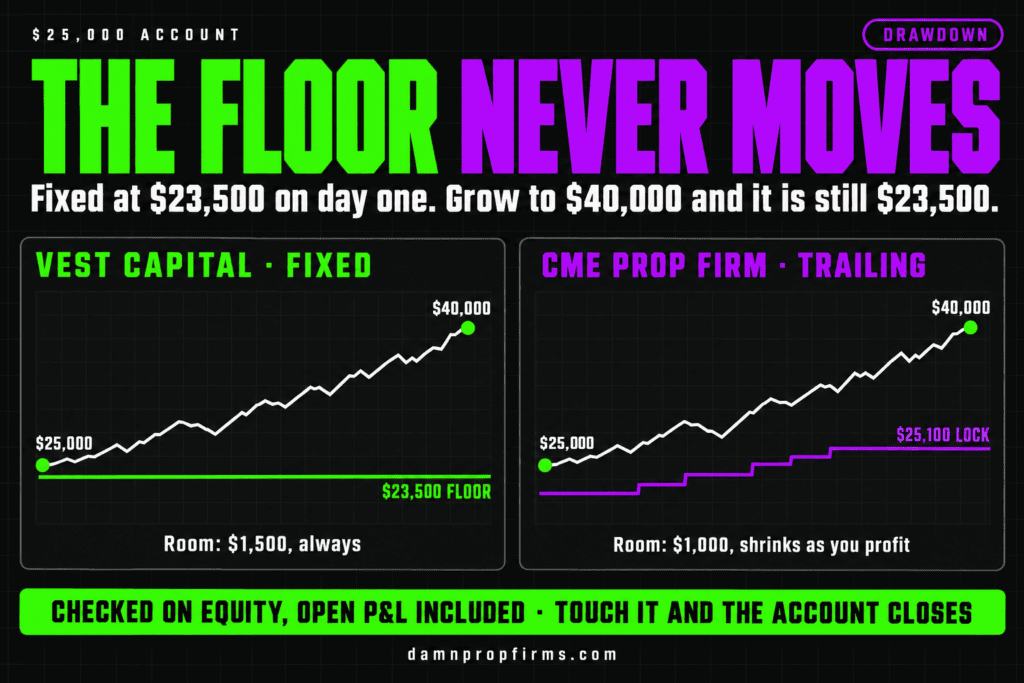
The floor is checked on equity, including open P&L. “If your total account value, including unrealized PnL, touches or drops below that fixed floor at any point, the account closes immediately and permanently.” No warning, no grace period, no appeal. That’s intraday, on mark price. An open position that dips to the floor and recovers has already killed the account.
The daily loss limit is optional, evaluation-path only, and it’s a hard breach. You choose 3%, 4% or none at purchase. The daily floor is set at 8:00 PM ET from your reset balance, which per the docs excludes unrealized P&L (the FAQ’s worked example uses “account equity” instead; the docs formula is the more specific one, and it only matters if you’re holding open P&L through 8 PM). On a $25K with the 3% option, you can lose $750 in a day before the account closes. Not pauses. Closes.
Here’s the trap that caught one trader on a $10K: “they closed my 10k eval account after a daily loss of 300, even though I had 250 left in my max drawdown.” $300 is exactly 3% of $10,000. The daily limit and the max drawdown are two separate tripwires, and the daily one fires first on a bad day. If you can’t trade inside a $750 day on a $25K, pay the extra for the no-DLL configuration or buy the instant account, which has none.
One more: evaluation fees you pay in-platform count against your drawdown and daily limit “the same way a realized loss would.” Fund the Primary Account with enough that the fee doesn’t come out of your trading room.
How Vest Markets Payouts Work (USDC, 24 Hours, No Caps)
This was the most-asked question in every comment section I read, usually phrased “do they only pay in crypto?” Yes. Here’s the full flow.
Prefer to watch it? The video review walks through a real Claim Profit and withdrawal on screen from 9:10.
Step 1: Claim Profit (Funded Account → Primary Account)
From a Live funded account you hit Claim Profit. Your share (80, 90 or 95%) moves to your Primary Account in USDC within 24 hours, every claim, regardless of how old the account is. There’s no minimum trading days, no minimum profitable days, no cap on the amount, no cap on how often, and no buffer you have to build first. You may need to close open positions before claiming. Claims are irrevocable once submitted.
Step 2: Withdraw (Primary Account → Your Wallet or Exchange)
From the Primary Account you withdraw USDC to any address you give it. Minimum 1 USDC. If you signed up with email or Google, withdrawals go out on Base or Arbitrum One; wallet-login accounts can use any chain shown. Withdrawals are instant on paper unless you’ve moved more than $50,000 in a rolling 24 hours, in which case there’s a 24-hour processing hold; in practice mine took about a day to land at the exchange (details below). That $50K limit applies to withdrawals, not to claims. Nothing extra is required for a first withdrawal.
Can You Withdraw During the Evaluation?
No. Evaluation accounts are simulated for assessment only, and nothing is paid from them. Pass, get funded instantly, then claim. The “withdraw immediately” you see in videos is on funded and instant accounts.
Cashing Out USDC If You’ve Never Touched Crypto
If you’ve only ever been paid by Plaid or wire, this is the part nobody explains, and it’s simpler than it sounds. You don’t need a self-custody wallet at all. What I did: open the USDC deposit screen on Kraken (or Robinhood, which also takes USDC on Base), select the Base network, copy the deposit address, paste it into Vest’s withdrawal screen, pick Base, confirm. The USDC shows up as a deposit on the exchange, you sell it for dollars or just hold it as USDC, and you send the dollars to your bank. If you’d rather hold it yourself, a self-custody wallet that supports Base or Arbitrum (Coinbase Wallet, Rabby, MetaMask with the Base network added) works the same way. One warning either route: match the chain. Sending Base USDC to a deposit address that only accepts Arbitrum is how people lose money, and Vest can’t recover it for you.
On tax: you’re receiving a stablecoin, not a wire. It has a cost basis on the day you receive it and a disposal event when you convert it, and Vest issues no tax forms. Keep your own records. That’s a description, not advice.
My Payouts, On-Chain
Screenshots are easy to fake, which is why a 246K-subscriber channel ran a video titled “Don’t Trust Payout Screenshot Posts” about this exact firm. Transaction hashes aren’t. These are four USDC withdrawals from Vest’s contract on Base to my own exchange deposit addresses in the first week, each one public on the block explorer. Click any hash and you’ll see the amount, the timestamp and the Vest contract (0x5513…07aF) on the sending side.
| Date (ET) | Amount | Chain | Transaction |
|---|---|---|---|
| Oct 2, 2026, 8:46 AM | 5,000.00 USDC | Base | 0x79bb…6628a |
| Oct 2, 2026, 6:33 PM | 22,954.76 USDC | Base | 0xa3ec…f40a8 |
| Oct 3, 2026, 4:50 PM | 13,528.31 USDC | Base | 0x8e8e…e495c |
| Oct 4, 2026, 5:17 AM | 20,240.03 USDC | Base | 0xfeb5…b048d |
| Total | 61,723.10 USDC | Four withdrawals in 45 hours, three days after opening the accounts | |
I’ve posted these same transactions on Reddit. Ask me questions or post your own Vest payouts in the Vest payout discussion on r/DamnPropFirms.

The first one was $5,000; the three after it were five figures. Here’s the real timeline, start to bank, because nobody else publishes it:
- Claim → Primary Account: under 24 hours. Every one of the four was approved and credited inside the window Vest promises.
- Primary Account → exchange: about 24 hours. I withdrew two straight to Kraken and two straight to Robinhood, both on Base. Vest’s docs say withdrawals under $50K are instant; in practice mine took around a day to show up as a credited deposit on the exchange side. Budget a day.
- Exchange → bank: instant, for a fee. Kraken’s instant bank transfer cost me about $50; Robinhood’s instant transfer fee capped at $150. The free, slower rails exist at both if you’d rather wait.
So the honest number is roughly 48 hours from “Claim Profit” to dollars in a bank account, with $50 to $150 in off-ramp fees on a five-figure payout. That’s slower than the homepage’s “instant” and still faster than the five-qualifying-days-then-weekly cycle at most CME firms, and there was no cap and no count on any of the four.
Rules CME Futures Traders Won’t Expect
Everything in this list is confirmed by Vest’s FAQ or docs, and most of it is the opposite of what you’re used to:
- No consistency rule. “No cap on how much of your profit can come from a single day.” Not in the evaluation, not funded.
- No minimum trading days to pass, to claim, or between claims. Pass in a session, claim the next day.
- No time limit on the evaluation.
- News trading is allowed. “You are free to open and hold positions before, during, and after any news release.”
- No daily flatten. Hold through the 4:10 PM close, through the CME maintenance window, overnight.
- Weekend holds are allowed, but non-crypto markets are 24/5 since July 31, 2026: no new ES, NQ, commodity or stock positions from Friday 8:00 PM ET; ES, NQ and commodities reopen Sunday 6:00 PM ET and single stocks Sunday 8:00 PM ET. Positions you’re already in stay open across the weekend and Vest warns they’re “exposed to greater risk.” Crypto trades 24/7.
- The homepage still says “24/7.” It’s 24/7 for crypto only now.
- XRP and HYPE are excluded on funded accounts.
- No API trading on funded accounts. No bots, no third-party copiers.
- Refunds: the FAQ says 28 days if you haven’t placed a trade; the refund policy and prop terms say 3 days. Assume 3. One trade voids it regardless.
Can You Copy Trade or Run 10 Vest Accounts at Once?
You can hold up to 10 Live funded accounts and 100 evaluations under one login, and that number is in the FAQ and the docs. What the official sources say about trading them together is thinner than it should be. The prohibited-practices list bans “coordinating across Funded Accounts to manipulate or exploit the system, for example taking opposite sides of the same market on different accounts.” Hedging one account against another is out. Same trade, same direction, on several accounts is not addressed either way, and the API is disabled on funded accounts, so TradeSyncer-style external copiers don’t work here. The prop terms also say you may operate “only one Account in the Program,” which reads as one login rather than one funded account given the 10-account rule, but the terms use the same capitalized word for both, and I’d want that resolved in writing before I built a stack.
There is no copy trader on Vest today. Vest’s team has told me one is coming, built into the platform, and that bigger account sizes are planned after it ships. Until it’s live, running ten accounts means ten sets of clicks, and I’d treat “coming soon” the way you’d treat it from any prop firm: nice if it lands, don’t buy ten accounts on the promise. I’ll update this section the day it goes live.
Compare that to the CME side, where the policy is explicit: TPT allows approved copiers across your own accounts, FundedNext lets you “freely copy trades between their own FundedNext Accounts,” E8 allows it, Tradeify says “no multi-account copying,” and Apex bans copying with other traders. Vest needs a sentence like those in its FAQ.
Sizing on Vest Is Not Futures Sizing (NQ and ES Conversion)
This is the question that gets traders breached in week one. Vest doesn’t deal in contracts. It deals in notional: account balance times leverage, cross-margined, and you size in units of the index where 1 Vest NQ moves $1 per point. There are no micros because there’s no contract at all, just a quantity.

The NQ rule: 1 Vest NQ = $1 per point = half a micro. 2 Vest NQ = 1 MNQ ($2/pt). 20 Vest NQ = 1 NQ mini ($20/pt). At 50x, a $10K account buys roughly 17.5 Vest NQ (about 9 micros) and a $25K account roughly 42 Vest NQ (about 21 micros, or two minis) at full margin, with NQ near 29,800. Those numbers move with price and balance.
The ES rule, updated October 6, 2026: Vest raised ES leverage on funded accounts from 50x to 75x. NQ stays at 50x. The same arithmetic applies: 1 Vest ES = $1 per point, so 5 Vest ES = 1 MES and 50 Vest ES = 1 ES mini. At 75x, a $25K account is $1.875 million of notional, which at ES around 7,600 is roughly 247 Vest ES, or just under five minis (about 25 micros). A $10K account at 75x is about 99 Vest ES, roughly two minis.
| Account | NQ at 50x | Futures equivalent | ES at 75x | Futures equivalent |
|---|---|---|---|---|
| $10K | ~17.5 Vest NQ | ~9 MNQ | ~99 Vest ES | ~2 ES minis (~20 MES) |
| $25K | ~42 Vest NQ | ~21 MNQ / 2 NQ | ~247 Vest ES | ~4.9 ES minis (~25 MES) |
Now the part that matters more than the leverage: the floor is the limiter, not the 50x or 75x. At full ES size on the $25K, each point is worth about $247, so the $1,500 drawdown is six ES points away. At full NQ size, each point is $42 and the floor is about 36 NQ points away. Nobody should trade max size on these accounts; the leverage is there so you can size a 2-mini ES position without posting $30,000 of margin, not so you can run five. Work backwards from the $1,500 (or $750 daily) and pick a quantity where your normal stop is a fraction of it.
Three more differences from a CME chart. The perp price is not the CME price; it tracks it through funding, but it can print moves CME doesn’t, especially overnight and around the Friday lock. Non-index markets are far less levered on funded accounts: gold, silver, crude and most single stocks are 5x to 10x, FX majors 5x, BTC and ETH 15x, so a gold trader gets a fraction of the notional an index trader does. And a Vest account can die three ways, not one: the drawdown floor, the daily limit, and an exchange liquidation when equity falls below maintenance margin on mark price. The CME sims only have the first.
Fees, Spread, Slippage and Order Types
Fees. Vest’s FAQ and Markets page say maker orders are always free, ES and NQ carry a 0.25 basis point taker fee, and everything else is 1 basis point. The Fees page says ES and NQ are “No fee” in all sessions and that equities and FX are free in regular hours with fees only overnight and at weekends. One of those pages is stale, and I think it’s the Fees page, because it still lists weekend fees for markets that no longer trade at weekends. Either way, on a $250,000 NQ position a 0.25 bp taker fee is about $6. Commissions are not where Vest’s cost lives.
Spread and slippage are. Vest says it straight in the FAQ: “Why is my realized profit lower than the unrealized profit shown before I closed? This comes from slippage and spread at the moment of execution.” You’re trading against a dealer pool, and the spread is the dealer’s income. It’s tight on ES and NQ in regular hours and wider everywhere else, especially overnight. Funding settles continuously (the FAQ says hourly) and it’s small on index perps, but hold a position for a week and check the funding line.
Order types. Market, Limit and Scale orders, with Reduce Only, GTC, IOC, FOK and post-only options. Take Profit and Stop Loss are attached to a position after it fills. What’s missing is the one futures traders use every day: there is no buy-stop or sell-stop entry order. If you trade breakouts off a resting stop, you’re clicking a market order when price gets there, or placing a limit inside the level and accepting the fill. Several traders have also reported that a limit placed on the wrong side of price fills instantly as a market order, because that’s how a limit works. Watch which side of the book you’re on.
Can US Traders Use Vest Markets? Restricted Countries
Yes on the prop firm side, and this is where keeping the two products straight matters most.
The Vest Capital program has its own Prop Trading Terms of Service, and its prohibited-jurisdiction list is six countries: China (including Hong Kong and Macao), Cuba, North Korea, Iran, Russia and Syria, plus sanctioned persons and the Government of Venezuela. The United States and the United Kingdom are not on it. That’s the contract you accept at checkout when you buy an evaluation or an instant account, and Vest’s position is that the funded program is open to US residents.
Vest Exchange, the perpetuals platform, has a separate Terms of Service for people who deposit their own money and trade the exchange directly, and that document does list the US and UK among its prohibited jurisdictions. It governs the exchange’s own self-funded trading product, not the prop program. If you’re a US trader, the practical reading is simple: buy and trade under the prop terms, don’t fund a Primary Account and trade the exchange on your own money, and withdraw your claims promptly rather than leaving USDC sitting on the platform. Two more things the prop terms are clear on: VPNs to get around any restriction are prohibited, and the disclosure says waiving the evaluation “does not waive identity checks,” so expect an identity check at some point even though sign-up is email, Google or wallet with no documents.
India, Canada, Australia, the EU, Thailand and most of the rest of the world are on neither list. The US traders page and the restricted countries glossary show how this compares across firms.

Vest Capital vs Futures Prop Firms: Lucid, TPT, Tradeify, Apex, FundedNext and E8
The most-liked comment I found on any Vest video was “so technically, this is like TPT? just without the need to build a buffer?” That’s a good instinct, and the table below is the full version of it. Vest’s biggest account is $25K, so this is the $25K-class comparison; the CME firms all go to $50K and beyond, which is covered on their review pages. Every CME figure is from the firm’s own help center on October 5, 2026.
| $25K | Vest Capital 1-Step | Lucid Flex | TPT Test → PRO | Tradeify Select | Apex EOD | FundedNext Rapid Pro | E8 Signature |
|---|---|---|---|---|---|---|---|
| Price | $130–$450 one-time ($210 default; $199.50 with DGT) | One-time, see review | Monthly, see review | One-time, see review | One-time, see review | $79.99 offer ($159.98 list) | $114 sale ($120 list) |
| Profit target | $2,500 (10%) or $5,000 (20%) | $1,250 | $1,500 | $1,500 | $1,500 | $1,500 | $1,500 |
| Max drawdown | $1,500 fixed, never moves | $1,000 EOD trailing, locks at $25,100 | $1,500 EOD trailing | $1,000 EOD trailing | $1,000 EOD trailing, locks at $25,100 funded | $1,000 EOD trailing, locks at $25,100 | $1,000 EOD dynamic, locks at $25,000 |
| Daily loss limit | $750 / $1,000 / none, your choice, eval only | Optional add-on | Not stated | None (Flex) or $500 (Daily) | $500, soft | None (add-on available) | None in challenge, $500 pause when funded |
| Consistency eval → funded | None → none | 50% → none | 50% → not stated | 40% → none | None → 50% since last payout | None → 40% | None → 35% |
| Min days | None | Not stated | 3 | 3 | None (30-day limit) | Not stated | Not stated |
| Max size | Balance × leverage (NQ 50x, ES 75x) | 2 minis / 20 micros | 3 minis / 30 micros | 1 mini / 10 micros | 4 contracts | 2 minis / 20 micros | 2 contracts |
| Split | 80 or 90 (eval), 95 (instant) | 90 | 80 PRO, 90 PRO+ | 90 | 100 | 90 | 80 |
| Payout cadence | Any time, credited in 24 h | Any day, 2 business days | Day one after the buffer, 50% withdrawable for 60 days | Every 5 winning days (Flex) or daily | Up to weekly after 5 qualifying days | Every 3 days, ~40 h | On demand, earliest 3 days |
| Cap per request | None | $1,000 | Not stated | $1,250 / $600 | $1,000 | $800 | $1,000–$1,250 |
| Payouts before close / live | Unlimited | 5, then live | PRO+ by review | Elite Live at 3 | 6, then closed | 5, then concluded | 4, then replaced |
| Rails | USDC only | Plaid, ADP, PayPal, crypto | Plaid, PayPal, Wise | Rise, Plane | ACH | USDT, USDC, Rise, bank | Rise, WorkMarket, Aeropay |
| Daily flatten / overnight | None / allowed | 4:45 PM ET / no | 4:55 PM ET / no | 4:45 PM ET / no | 4:59 PM ET / no | Yes / no | Yes / no |
| Max funded accounts | 10 | 5 | 5 | 5 | 20 | 5 | 5 |
| US traders | Yes (prop terms) | Yes | Yes | Yes | Yes | Yes | Yes |
| Governing law | Panama | Delaware | Florida | Florida | Texas | UAE | Texas |
Where Vest wins. The drawdown: $1,500 of room that never shrinks, against $1,000 of trailing room at five of the six (TPT matches the $1,500). No consistency rule at any stage, where the CME funded accounts run from none up to Apex’s 50%. No payout cap, no payout count, no buffer: a FundedNext Rapid $25K can pay at most 5 × $800 = $4,000 before it’s concluded, an E8 Signature $25K at most $4,500 across four payouts, an Apex $25K at most 6 × $1,000 = $6,000 before the account closes. Vest has no ceiling on paper. No daily flatten, overnight and weekend holds, earnings and the Sunday open are all tradable. And ten funded accounts against five everywhere but Apex.
Where Vest loses. Every CME firm pays fiat; Vest pays USDC and only USDC, and you’ll pay $50 to $150 to get it into a bank fast. The CME firms have one way to breach (the trailing drawdown); Vest has three. There are no stop-entry orders. The contract is Panama law rather than Delaware or Florida, and the sim at Apex or Tradeify is fake money on a real, regulated CME price while Vest’s funded account is a virtual program on a real but unregulated dealer price. And the evaluation-path accounts carry a daily limit that most CME funded accounts don’t.
The TPT question, answered. Yes, it’s like Take Profit Trader without the buffer. TPT PRO makes you build a buffer equal to the drawdown before you can withdraw and holds back half your profit for the first 60 trading days; Vest has no buffer, no hold-back and no cap, and pays in 24 hours instead of day one after the buffer. TPT still holds the uncapped crown on the CME side. If you trade both, they’re the two most payout-friendly accounts I know of.
Vest Markets vs Breakout (and Why Hyperliquid Isn’t the Comparison)
The firm people bring up next to Vest is Breakout, and the two are less alike than they look. Breakout is a crypto-native perp prop firm that Kraken acquired in September 2025. It trades 70+ crypto pairs on Bybit liquidity plus four non-crypto tracking instruments (XYZ100, S&P500, crude oil and silver), runs evaluations up to $100K per account ($200K combined), pays up to 95% with on-demand USDC payouts, and takes US traders. Its new Spark evaluation is a $50K account with a $3,000 target and a $1,500 trailing drawdown, no daily limit and no consistency rule, with instruments sized to compare to NQ and ES. Breakout’s standard evaluations run up to 5x leverage; a $25K Vest account runs 50x on NQ and 75x on ES. Vest gives you more size and a static floor at a lower price; Breakout gives you a regulated-exchange parent, real crypto depth and a bigger account. For an index trader, Vest. For a crypto trader, Breakout.
Hyperliquid is the exchange people mean when they say “perps,” and it’s not a prop firm at all. If you have $25,000 of your own, you can trade perps on Hyperliquid with no evaluation, no split and no floor. Vest Capital exists for the trader who doesn’t want to put $25,000 of their own money at risk and will pay $210 and give up 10 to 20% of the upside to avoid it. That’s the trade.
Is Vest Markets Sustainable? How a Perp Exchange Can Afford 95% Splits
This is the question I get most, and the one that deserves the most careful answer, because the enthusiasts and the skeptics are both arguing on the wrong axis.
The skeptics’ frame is wrong. “They’re paying out too much, the fees can’t cover it, it’s My Forex Funds all over again.” That logic applies to a simulated prop firm, where the only income is evaluation fees and every payout is a pure cost. Vest’s fees are $25 to $450 and its payouts are uncapped. If Vest Markets were a fee-funded sim, it would already be insolvent. It isn’t, so it isn’t a fee-funded sim.
The enthusiasts’ frame is also unproven. The argument Vest makes, and the one I’ve heard from the team, is that the exchange side wins whether or not the prop traders do: the Vest Liquidity Pool is the counterparty to every trade, it earns spread, risk premium and funding on all of them, it keeps the losses of the traders who lose, and winning trade ideas get mirrored or hedged with Vest’s own capital so that a winning trader’s payout is funded by a real trading gain rather than by someone else’s evaluation fee. That’s an A-book story and it’s coherent. The problem is that Vest’s own disclosure is written to permit it without committing to it: the prop firm “may record a hypothetical result without executing a live trade, or independently enter into trades or hedges for our own accounts,” and “you may not know whether or how we use an idea.” No hedging policy is published. No pool size, no P&L, no number of accounts funded or paid, no payout totals. Prop Firm Pal lists Vest as “Unverified” for exactly that reason.
What the independent data shows. DefiLlama on October 5, 2026: $2.19 billion of perp volume on Vest Exchange in the last 30 days, $96 million of open interest, $20.3 billion cumulative volume, and a trackable TVL of only $238,000 (that figure is the EVM deposit contracts, not the clearing layer, so it understates what’s inside). Recorded fees fell from $2.77 million in Q3 2025 to $203,000 in Q3 2026 while volume stayed above $2 billion a month. The most likely explanation is that Vest switched to zero explicit fees on ES, NQ and equities and the tracker can only see crypto and off-hours fees, so the dealer’s real income (spread and funding) is invisible to it. That’s a benign explanation, but Vest never announced or dated the change, which is the pattern with Vest: the numbers are probably fine and the disclosure is thin.
What’s actually verifiable. Payouts are structurally fast and uncapped, and they’re happening. Vest publishes incident reports and compensated the affected accounts. It raised $5 million from a named tier-one market maker. There’s no payout-denial pattern, no hack, no enforcement action. Also verifiable: the prop contract is Panama law with a 100-Balboa liability cap and the right to change or end the program at will; the exchange is the counterparty to leveraged index perps through illiquid overnight hours and had three pricing incidents in eleven weeks; and the firm publishes none of the numbers that would let you check the A-book story.
One thing the A-book story doesn’t fix, and Vest discloses it rather than hiding it: when your funded trades are executed “on Vest Exchange, an affiliated trading venue,” the Vest group is the counterparty to its own prop traders. That’s the conflict the CFTC went after My Forex Funds for. Vest writes it into the disclosures (“these arrangements may create conflicts of interest”) instead of denying it, which I’d rather have than the alternative, but it’s a conflict all the same.
My verdict. Lower fee-model fragility than any CME sim firm, because the exchange is a second income engine that scales with volume. Higher counterparty and operational risk, because that engine is an unregulated offshore dealer that has rolled back its ledger once already. Less transparency than a Florida LLC with a Trustpilot page. The contrast with FundedSeat, which closed on September 29, 2026 after its platform vendors cut it off while it was paying around $700,000 a month, is instructive: Vest can’t be cut off by Tradovate or Rithmic because it owns the venue. It just has a different way to fail. The practical response, and Vest’s own rules make it easy: claim after every meaningful win, withdraw the same day, and treat anything you leave on the platform as unsecured exposure to an offshore counterparty.
Where Vest’s Own Documents Contradict Each Other
I counted more than a dozen. These are the ones that change what you’d do.
| Topic | One official source says | Another says | Go with |
|---|---|---|---|
| Refund window | FAQ: 28 days from purchase if no trades, via Stripe | Refund policy and prop terms: 3 days | 3 days |
| What the capital is | Docs: “Real Vest capital. Not simulated”; FAQ: “The capital behind it is real” | Homepage disclosure and prop terms: “all displayed balances and results are virtual” | Virtual. The terms govern. |
| Who’s restricted | Prop terms: six countries, no US or UK | Exchange terms (for the DEX’s own product): US and UK included | Prop terms for the funded program; don’t trade the exchange on your own money from a restricted country |
| Number of accounts | FAQ and docs: 10 live funded, 100 evaluation | Prop terms: “only one Account in the Program” | Probably one login; get it in writing |
| Payout speed | Homepage: “Instant Payouts,” “hit your wallet immediately” | Docs: 24 hours per claim, then a separate withdrawal | Plan on ~24 h to Primary and ~24 h more to your exchange (my four did) |
| Daily loss anchor | Docs: reset balance excluding unrealized P&L | FAQ: account equity at 8 PM ET | Docs formula; only matters with open P&L at 8 PM |
| ES/NQ taker fee | FAQ and Markets page: 0.25 bps | Fees page: no fee, all sessions | Check a live fill; it’s about $6 either way |
| Friday lock | Markets page: 5 PM ET | July 29 notice and FAQ: 8 PM ET | 8 PM ET (the dated notice) |
| Trading hours | Homepage: “24/7. With Our Money.” | July 29 notice: non-crypto is 24/5 | 24/5 (crypto 24/7) |
| Leverage | Homepage: “100x Leverage” | Docs: funded accounts cap at 50x (ES now 75x); most non-index markets 5x–15x | Docs, and the in-app limit |
| KYC | X, Oct 2025: “a non-KYC… platform” | Disclosure: waiving evaluation “does not waive identity checks” | Expect a check at some point; trigger undocumented |
None of these is a scam signal on its own. Together they tell you Vest ships product faster than it updates paperwork, and that you should screenshot the rules you bought under, because the pricing matrix changed between mid-September and October with no changelog. One data point from the affiliate side on the refund question: Vest holds my referral commissions for 30 days as a refund and chargeback window, which lines up with the FAQ’s 28 days far better than the 3 days in the terms. I still treat 3 days as the number that counts, because it’s the one in the contract.
Vest Markets Discount Code: 5% Off With DGT
Vest runs a referral program rather than coupon campaigns, and mine is approved: sign up through my link and code DGT takes 5% off evaluation and instant accounts. It’s 5%, not 25%; the “X25” code from Vest’s January 2026 launch campaign was a limited promotion and I can’t confirm it still works. If you see “SAVE5”-style codes on random sites and Amazon listings, those are referral spam; there’s no official Vest coupon page.
What 5% looks like: the default $25K evaluation is $199.50 instead of $210, the no-daily-limit 90/10 Platinum is $427.50 instead of $450, the 2-Step Platinum is $85.50, and the $25K instant account is $950 instead of $1,000.
Use code DGT at checkout.
Code: DGT · 5% off every Vest Capital account · verified October 6, 2026

Final Verdict: Which Vest Account Should You Buy?
Buy the 1-Step Platinum at $130 (20% target, 3% daily limit, 80/20) if you want the cheapest single-step route to a $25K funded account with $1,500 of fixed room and you can live with a $750 day. The $5,000 target is a lot, but there’s no clock.
Buy the 2-Step Platinum at $90 if you’d rather hit $2,500 and then $1,250 than $5,000 in one go. Cheapest per dollar of drawdown Vest sells.
Buy the $25K instant at $1,000 if you already know your edge holds at this leverage and you want the 95% split with no daily limit from day one. You’re paying for the split and the skip, not for room: it’s $1,000 of drawdown against the evaluation path’s $1,500.
Pay up for the no-daily-limit configuration only if a $750 day is a normal day for you. For most index traders it isn’t, and the $165 you save on the default is a second account.
Don’t buy anything if you need stop-entry orders to trade your system, if you want a wire instead of USDC, or if you’re not prepared to treat an offshore counterparty as a risk you manage by withdrawing often.
Vest is the first perp prop firm I’ve put real time into, and the rules are the best part. The floor doesn’t move, nobody tells you how much you’re allowed to make in a day, and the money shows up in 24 hours with no cap and no count. Everything I’d change is in the fine print, not the trading. Read the fine print, size off the $1,500 and not the leverage, and claim often.
If you want the CME-side version of these rules on a regulated price, start with Take Profit Trader for uncapped payouts, Lucid Trading for the best all-round $25K and $50K accounts, or the no-consistency-rule firms and instant funding firms filters. The full rankings are on the futures prop firms hub.
Vest Markets FAQ
Is Vest Markets legit or a scam?
Legit, with caveats. Vest Labs raised $5 million from Jane Street, Amber, Selini, QCP and Big Brain in March 2025, its contracts are audited by OtterSec, it publishes dated incident reports, and payouts are being made in USDC within 24 hours of a claim, including $61,723 of my own across four on-chain withdrawals in the first week. The caveats: the prop contract is Panama law with a 100-Balboa liability cap, no regulator is named, and the accounts are "virtual" under Vest's own disclosure.
Does Vest Markets only pay out in crypto, or can I get a bank transfer?
USDC only. A claim moves your profit share from the funded account to your Primary Account in USDC within 24 hours; a withdrawal then sends it to any address you give it on Base or Arbitrum One (email and Google sign-ups) or any listed chain (wallet sign-ups). There is no bank wire, Plaid, PayPal or Rise option. The simple route is to withdraw straight to the USDC deposit address at an exchange like Kraken or Robinhood on Base, sell for dollars, and send to your bank; I did exactly that for four payouts, and the instant bank transfer cost about $50 at Kraken and up to $150 at Robinhood.
How long does a Vest Markets withdrawal take?
About 48 hours from claim to bank, in practice. The claim from a funded account is credited to your Primary Account within 24 hours, every time, regardless of account age. The withdrawal from the Primary Account is instant on paper unless you've withdrawn more than $50,000 in a rolling 24-hour window (then a 24-hour processing period); my four withdrawals each took around a day to show up as a credited deposit at Kraken and Robinhood. From there an instant bank transfer is same-day for a fee. Minimum withdrawal is 1 USDC. The homepage's "instant payouts" wording refers to the second step only.
Can you withdraw profits during the Vest evaluation?
No. Evaluation accounts are simulated for assessment only and nothing is paid from them. When you hit the profit goal you're funded instantly with no manual review, and the funded account is where you claim. Instant accounts skip the evaluation and are live from purchase, so you can claim from day one on those.
Is the Vest Markets drawdown static or trailing?
Static. The max drawdown is a fixed floor set when the account is created at 6% below starting balance ($23,500 on the $25K, $9,400 on the $10K, $4,700 on the $5K) and it never moves, no matter how much profit you make. On instant accounts the floor is starting balance minus the fee ($24,000 on the $25K). It's checked on total account value including unrealized P&L, so an open position that touches the floor closes the account permanently even if it would have recovered.
Is the daily loss limit a hard breach on Vest?
Yes. The daily loss limit is optional (3%, 4% or none, chosen at purchase) and applies to evaluation-path accounts only, never to instant accounts. The daily floor is set at 8:00 PM ET from your reset balance. Hit it and the account closes immediately and permanently, with no warning and no appeal, even if you still have max-drawdown room left. On a $25K with the 3% option that's $750 in a day; at 4% it's $1,000. Skipping the daily limit roughly doubles the evaluation price.
Can you copy trade your 10 Vest funded accounts?
You can hold up to 10 live funded accounts and 100 evaluations under one login. Vest prohibits coordinating across accounts to exploit the system, with taking opposite sides of the same market as the example, and the API is disabled on funded accounts, so external copiers like TradeSyncer can't connect. Same-direction trading across your own accounts isn't addressed in the FAQ or terms. There's no built-in copy trader yet; Vest's team says one is coming, with larger account sizes to follow it. Get Vest's answer on manual mirroring in writing before you build a stack.
Is Vest Markets USA restricted? Can UK or Indian traders use it?
The Vest Capital prop program's terms list six prohibited countries: China (including Hong Kong and Macao), Cuba, North Korea, Iran, Russia and Syria. The United States, United Kingdom and India are not on it, so US, UK and Indian traders can buy, trade and claim on the prop side. Vest Exchange, the perpetuals platform, has a separate Terms of Service for self-funded trading that does list the US and UK; it governs trading the exchange directly on your own money, not the funded program. VPN use to get around any restriction is prohibited.
Does Vest Markets require KYC?
Not at sign-up: you can register with an email, a Google account or a wallet and start trading immediately. Vest marketed itself as "non-KYC" in October 2025, but its prop disclosure says waiving the evaluation "does not waive identity checks," and no page states when those checks are triggered. Assume an identity check can happen before or at payout. Vest Capital purchases require an email or Google account; wallet-only sign-ins can't buy a funded account.
What is the commission per trade on Vest Markets?
Maker orders are free. The FAQ lists a 0.25 basis point taker fee on ES and NQ and 1 basis point on everything else, while the Fees page says ES and NQ are "no fee" in all sessions; either way it's about $6 on a $250,000 position. The real cost is spread and slippage against the dealer pool, which Vest acknowledges in its FAQ, plus continuous funding on positions you hold.
Can you trade NQ micros or set a buy-stop order on Vest?
There are no contracts on Vest, so no micros: you trade a quantity where 1 Vest NQ moves $1 per point, meaning 2 Vest NQ equals one MNQ and 20 equals one NQ mini. Order types are Market, Limit and Scale, with Take Profit and Stop Loss attached after a fill. There is no buy-stop or sell-stop entry order; a breakout entry is a market order when price arrives or a limit inside the level.
Is a Vest instant account real capital or simulated?
Vest's docs call it "Real Vest capital. Not simulated," but the homepage disclosure and the prop terms say "all displayed balances and results are virtual" and that participants "do not trade live capital." The terms govern. Vest may hedge or mirror your trade ideas with its own capital on Vest Exchange, but it doesn't commit to doing so and says "you may not know whether or how we use an idea." Your profit share is real USDC regardless.
Why are Vest accounts so expensive for the drawdown you get?
They mostly aren't. The $25K 1-Step ranges from $130 to $450 for $1,500 of fixed drawdown, which is 9 to 30 cents per dollar of room, and the 2-Step is $90, about 6 cents. A CME $25K evaluation typically buys $1,000 of trailing room. The expensive one is the instant account, where the price equals the drawdown ($1,000 for $1,000 of room) because you're paying for the 95% split and skipping the evaluation, not for extra room.
How is Vest different from Take Profit Trader or Breakout?
Versus TPT: both have no consistency rule and uncapped payouts, but TPT PRO requires a buffer equal to the drawdown before withdrawing and holds back half your profit for 60 trading days, pays fiat and trades real CME prices; Vest has no buffer or hold-back, pays USDC in 24 hours, and uses a static floor instead of a trailing one. Versus Breakout: Breakout is Kraken-owned, crypto-first with four index and commodity tracking instruments, and goes to $100K per account at 5x leverage; Vest is index-first with 50x to 75x leverage, maxes at $25K per account, and offers instant accounts.
Does Vest Markets have a token or airdrop?
No token as of October 2026. Vest Exchange runs a points program that has rewarded trading volume, and points programs in this space often precede a token, but nothing has been announced and nothing about Vest Capital depends on one. Treat it as zero until Vest says otherwise.