
Free Futures Prop Firm Calculators & Trading Tools
Every tool on this page is free. No signup required. Built for futures traders who are actively managing prop firm evaluations and funded accounts at Apex Trader Funding, Tradeify, Take Profit Trader, Alpha Futures, Lucid Trading, FundedNext, and similar firms.
These are not generic trading calculators. They are built around the specific rules, payout structures, contract limits, and consistency requirements that define funded futures trading. Whether you are checking compliance before requesting a payout, sizing a position on NQ to stay inside drawdown limits, or mapping out your Apex payout ladder across 20 accounts — each tool removes a layer of guesswork that costs funded traders real money.
If you are managing a prop firm account and using mental math or spreadsheets to track rule compliance, this page is for you.
Why Prop Firm Traders Need the Right Calculators
The difference between passing a futures prop firm evaluation and blowing it is rarely about trading skill. It is usually about one misunderstood rule applied at the wrong moment.
Most experienced traders know how to read a chart. Far fewer know exactly what their Apex consistency rule threshold looks like with four trading days left on an eval, or how many MNQ contracts they can trade on a $50K Tradeify account without breaching per-trade drawdown limits. These are the calculations that end evaluations and revoke funded accounts.
Prop firm rules are specific and unforgiving. The consistency rule alone trips up traders who have technically hit the profit target but distributed gains in a way that disqualifies the payout. This is not a rare edge case — it is one of the most common reasons payouts get denied at Apex, Tradeify, and Take Profit Trader. A prop firm consistency rule calculator eliminates that outcome entirely. You know your status before you trade the next session, not after.
Drawdown miscalculations are a separate problem. Most traders understand the concept of a trailing drawdown, but fewer do the live math on every session. If you are trading a $150K Apex account and your drawdown trail is at $148,200 — and you take a two-point loss on three NQ contracts — that is $120 of drawdown consumed. Small errors compound quickly. A futures position sizing calculator that accounts for prop firm drawdown constraints gives you exact contract counts, not guesses.
Contract sizing is another consistent failure point. Tick values across futures markets are not intuitive. NQ, MNQ, ES, MES, CL, GC — each has different tick and point values. Traders who migrate from equities or who trade across multiple instruments get these wrong regularly. When you are operating under strict profit targets and daily loss limits, a miscalculated position size does not just cost you money — it can end an evaluation in a single trade.
The cost of blowing a funded account is not just the trade loss. You lose the activation fee and must pay to restart the evaluation. With eval costs ranging from $100 to $600+ depending on the firm and account size, preventable rule violations are expensive. Free prop firm trading tools eliminate that cost entirely.
Featured Tools
Prop Firm Consistency Rule Calculator
The consistency rule is the most misunderstood rule in futures prop trading, and violating it is the most common reason payouts get denied at Apex, Tradeify, and Take Profit Trader.
Here is how the rule works: your single best trading day profit cannot exceed a set percentage of your total net profits. Apex uses a 30% threshold. Tradeify uses a range of 20–35% depending on the account. Take Profit Trader applies a 50% rule during evaluations. If one large trading day skews your distribution, even a technically profitable account fails the consistency check.
The prop firm consistency rule calculator removes the ambiguity. Enter your total net profit across all trading days, your best single-day profit, and the consistency rule percentage required by your firm. The calculator tells you immediately whether you are compliant — and if not, by how much you need to smooth out your distribution before submitting a payout request or completing an eval.
This matters most in two situations: the day before you plan to withdraw, and the day before you hit the profit target. Traders who run the check at the end of each session instead of at the end of the eval period have time to adjust. Traders who run it at the last moment often do not.
The calculator works for any firm that applies a consistency rule, including Apex (30%), Tradeify (20–35%), Take Profit Trader, Alpha Futures, and others. It does not matter how many trading days are in the sample — input your actual numbers and get a pass or fail result.
For a full breakdown of how consistency rules work across major firms, see the Prop Firm Consistency Rules: Complete Calculator Guide.
Apex Payout & Scaling Calculator
Apex Trader Funding has one of the most specific payout structures of any futures prop firm, and most traders do not fully understand how the ladder works until they are sitting on a funded account with money on the line.
The apex payout calculator maps your entire payout sequence across all six allowed withdrawals per account. Apex caps each withdrawal based on which payout in the sequence it is. For a $25K account, the first payout is capped at $1,000. By the sixth payout, that cap reaches $5,000. The caps scale differently for larger account sizes — a $150K account starts at $2,500 on the first payout. Missing this structure means traders either request too much (and get denied) or leave money on the table by under-requesting.
The calculator covers both EOD (End of Day) and Intraday account types, which have different trailing drawdown structures and different payout eligibility requirements.
For traders running multiple Apex accounts — the firm allows up to 20 active funded accounts per trader — the calculator shows what your total payout potential looks like across the full account stack at each stage of the payout ladder. Understanding this at the portfolio level, not just per account, is how traders plan withdrawal timing to maximize cash flow.
This calculator has been updated to reflect Apex’s v4.0 rules effective March 2026. If you are referencing older documentation, verify your assumptions against the current structure.
For a full breakdown of Apex’s current rules, fees, and funded account structure, see the Apex Trader Funding review.
Futures Trading Profit Calculator
Before you size a trade, you need to know exactly what a one-point move is worth in dollars. This sounds basic. But tick and point values vary significantly across futures markets, and traders — including experienced ones — confuse them regularly, especially when switching between full and micro contracts.
The futures profit calculator handles this correctly. Select your contract (ES, NQ, CL, GC, RTY, or their micro equivalents), enter your entry price, exit price, and number of contracts — and the calculator returns the tick value, point value, and total dollar P&L for the trade.
The values that matter most for prop firm traders: NQ is $5 per tick and $20 per point. ES is $12.50 per tick and $50 per point. MNQ (micro NQ) is $0.50 per tick and $2 per point. MES (micro ES) is $1.25 per tick and $5 per point. A trader who confuses NQ and MNQ point values when sizing a position is off by a factor of ten — which means a 10-contract MNQ position is $20/point, not $200.
The futures trading profit calculator covers all major CME futures markets, including E-mini and Micro contracts across equity indices, energy, and metals. It accounts for both long and short trades and gives gross P&L before commissions.
Use this calculator before entering a trade to confirm your risk in dollar terms, not points.
Futures Contract Size Converter
When you are managing funded accounts across multiple prop firms, or scaling from a single account to a multi-account structure, position size translation between full, mini, and micro contracts becomes a practical daily problem.
The futures contract size converter handles the conversion instantly. Enter any contract size in full, mini, or micro units and the tool converts across all three for the relevant market. One ES contract equals ten MES contracts. One NQ contract equals ten MNQ contracts. The math is straightforward, but doing it live while managing active trades across multiple accounts creates room for error.
The converter is useful in several specific scenarios: traders who want to replicate a full-size contract position using micros for more precise scaling, traders who are transitioning between account sizes at different prop firms, and traders building multi-account strategies who need consistent notional exposure across accounts with different contract limits.
Supported markets include ES/MES, NQ/MNQ, CL, GC, and other major CME products. The futures contract size converter eliminates conversion errors that can result in unintended oversizing — particularly relevant when prop firms set maximum contract limits per account.
Nasdaq Futures Risk Management Planner
Standard risk management advice — risk 1–2% of your account per trade — does not translate directly to prop firm trading. The reason is that prop firms constrain your risk from two directions simultaneously: the account’s maximum drawdown limit, and per-account contract maximums.
The Nasdaq futures risk management planner is built specifically for this environment. Enter your account size, your target risk percentage per trade, and your stop distance in points. The tool outputs the exact number of NQ or MNQ contracts you can trade without exceeding the prop firm’s drawdown threshold — accounting for both the dollar risk constraint and the contract limit.
Why NQ specifically: NQ is the most actively traded instrument across Apex, Tradeify, Take Profit Trader, and similar firms. It has high volatility and wide intraday swings, which means stop distances of 15–25 points are common. At $20 per point on NQ, a 20-point stop on three contracts is $1,200 of risk per trade — which can consume a significant portion of a $50K account’s trailing drawdown in a single trade. The planner makes this calculation automatic.
The tool covers NQ and MNQ sizing and can be adapted for ES and MES position sizing as well. It is designed for traders on Apex, Take Profit Trader, Tradeify, and any other firm that enforces both a trailing drawdown and a per-account contract maximum.
Futures Trading Rule Analyzer
The futures trading rule analyzer is a pre-payout compliance check. Before you hit the withdrawal button — or before the last session of an evaluation — this tool tells you whether your trading record passes or fails standard prop firm rules.
Input your session data: total number of trading days, cumulative profit, maximum drawdown consumed, and contract limits used. The analyzer cross-references your stats against standard prop firm rule sets and flags any violations or near-violations across three categories: daily loss limit breaches, contract limit violations, and consistency rule triggers.
The practical use case: you are on day 12 of a 14-day evaluation. You are at the profit target. Before you trade the final two sessions, you run the rule analyzer to confirm that your drawdown usage, your best-day distribution, and your contract sizing are all compliant. If the analyzer flags a consistency issue, you have two sessions to address it rather than finding out after the eval ends.
The prop firm rule analyzer also functions as a post-session audit tool. Traders who run it at the end of each day on their funded accounts catch compliance drift before it becomes a payout denial.
Copy Trading Tools for Futures Prop Traders
Traders managing multiple funded accounts face an execution problem that has nothing to do with market analysis: how do you place the same trade on five, ten, or twenty accounts simultaneously without error?
Apex allows up to 20 active funded accounts per trader. Tradeify allows up to five. Take Profit Trader allows up to five. At scale, manually entering the same order across accounts in real time is not realistic — fills are uneven, some accounts miss the trade entirely, and the cognitive load increases risk of input errors.
Copy trading solves this. A trade copier replicates your master account trades to all connected follower accounts in real time, with consistent position sizing relative to each account’s parameters.
TradeSyncer is the recommended trade copier for futures prop firm traders. It runs in the cloud, which means it does not depend on your local machine being on during market hours. It supports Apex, Tradeify, Take Profit Trader, Lucid Trading, and FundedNext, and it can copy trades across different broker platforms — including Rithmic to Tradovate copying, which matters for traders who run accounts at multiple firms on different clearing platforms.
For traders building a multi-account funded trading operation, selecting the right trade copier for prop firms is as important as selecting the right prop firm. A bad fill on a 20-account copy trade does not just cost you one trade — it costs you the same trade twenty times.
The following guides cover this topic in depth:
-
Top 6 Trade Copying Platforms Compared — a head-to-head breakdown of the major platforms by latency, broker compatibility, pricing, and prop firm support
-
Top 5 Trade Copying Platforms for Futures Traders — a futures-specific ranking
-
Trade Copier Latency: Causes and Fixes — the technical reasons copy trades lag and how to reduce the gap between master and follower fills
Platform Setup Guides
Having the right tools and the right prop firm account does not matter if your trading platform is misconfigured. A bad fill caused by an incorrect data connection, a missed trade because of plugin bridging failure, or a disconnected session that leaves orders orphaned — these are preventable problems that end funded accounts.
The Rithmic Setup for Prop Firms guide covers the full configuration process: Rithmic credentials and account provisioning, R|Trader Pro installation and settings, and plugin bridging for NinjaTrader and Quantower. Rithmic is the clearing platform behind most major prop firms including Apex, Tradeify, and Take Profit Trader. Getting the setup right from the start prevents the connection issues that cause missed trades and partial fills.
The Volume Profile guide — How Volume Profile Reveals Hidden Support Zones — covers one of the most effective tools for identifying trade locations in futures markets. Volume profile plots traded volume at each price level rather than across time, which surfaces support and resistance zones that standard moving average or price-based indicators miss. For traders who rely on structure for entries and exits in NQ, ES, and CL, this guide explains the mechanics and practical application.
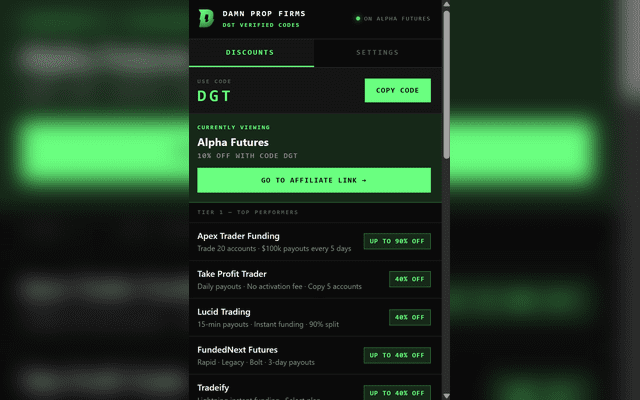
Futures Prop Firm Discount Finder
Find the best prop firm discounts for futures trading! Enter your account size or volume to uncover top deals and save on fees today.

Replikanto Review 2026 – NinjaTrader Copy Trader for Prop Firms
Replikanto streamlines multi-account futures trading by copying trades instantly across linked NinjaTrader accounts. Whether you’re managing multiple prop firm evaluations or scaling funded accounts, it offers the reliability and precision serious traders need for 2026.
Prop Firm Tools & Calculators FAQ
Answers to common questions about our prop firm calculators, consistency rule tools, futures profit planner, and micro futures support.
Are these prop firm calculators free to use?
There are no paywalls, email opt‑ins, or trial limitations. You can adjust the inputs, run as many scenarios as you want, and use the results to plan your risk, payouts, and consistency profile before you risk real money.
Which prop firms do these calculators work for?
The futures profit calculator, contract size converter, and risk management planner are firm‑agnostic. They work for any futures account — personal or prop — because they rely on exchange‑defined contract specifications, tick values, and margin structures rather than a single firm’s ruleset.
How do I calculate my Apex payout correctly?
The Apex payout calculator automates this ladder. You choose your account size and which payout you are requesting, and the tool returns the exact maximum amount you are eligible to withdraw, so you no longer have to manually cross‑reference Apex’s payout tables or guess your cap.
What is the consistency rule and how does it affect payouts?
Each prop firm sets its own threshold: Apex uses 30%, Tradeify uses 20–35% depending on account and phase, and Take Profit Trader uses 50% during evaluations. The consistency rule calculator analyzes your day‑by‑day (or session‑by‑session) profit distribution and tells you whether you are currently compliant, so you can adjust your remaining trading days before requesting a payout or closing out an evaluation.
Do these tools work for micro futures contracts?
This is especially important for traders who use micros to pass evaluations, scale into positions more precisely, or manage risk tighter on smaller funded accounts. You can model both mini and micro position sizes in the same tools without changing formulas manually.
Find the Right Prop Firm to Use These Tools With
These tools are only useful if you are trading with a prop firm worth your time. If you have not chosen a firm yet — or want to compare your current firm against alternatives — the Best Futures Prop Firms rankings cover every major firm with real rules, real payout structures, and current evaluation pricing. No marketing copy, no affiliate spin.
If you are ready to open an account, code DGT gets you the best available discount at most major firms — including up to 90% off evaluations at Apex Trader Funding. The full list of verified discount codes is at Futures Prop Firm Discounts.