IQ Capital is the cheapest way onto this list to get a funded futures account — and the one with the most unusual rulebook. A $50K Core challenge is 135 with code DGT (list $675), your first $50K challenge is $9 as a new customer, and the funded account pays 90% from the first dollar with no minimum payout. Every price on this page was verified on IQ Capital’s own checkout with code DGT applied on Sep 20, 2026, not copied from a marketing deck.
We have not cashed a payout from IQ Capital yet. This review is built from their live checkout, their help center, and the rules you actually sign — when a DGT payout lands, the proof goes right here, same as every other firm on this site.
Not to be confused with “IQ Capital Invest” (a BaFin-warned scheme) or IQ Capital, the UK venture fund. This review covers iqcapital.io, operated by and founded by Christoph Radecker.
What Makes IQ Capital Different From Every Other Futures Prop Firm We’ve Reviewed
Most of the firms on DamnPropFirms compete on the same three levers — payout speed, profit split, and how forgiving the drawdown is. Lucid wins on speed with 15-minute payouts, Tradeify and Take Profit Trader win on daily payouts, and Apex wins on account count. IQ Capital doesn’t try to out-race them. It changes the rules of the account itself.
- The entry price is a rounding error. 135 for a $50K challenge with code DGT, and $9 for your first one. Nothing else on this site is close. DGT always carries IQ Capital’s highest available discount, so the price you see here is the price at checkout.
- You can breach and keep the account. Every other firm here hard-fails you the moment you cross a limit. IQ Capital’s Max Position Loss rule closes the position and leaves the account alive — a “soft breach.” You get two. The third is the real one. That’s the difference between a bad five minutes and a dead account.
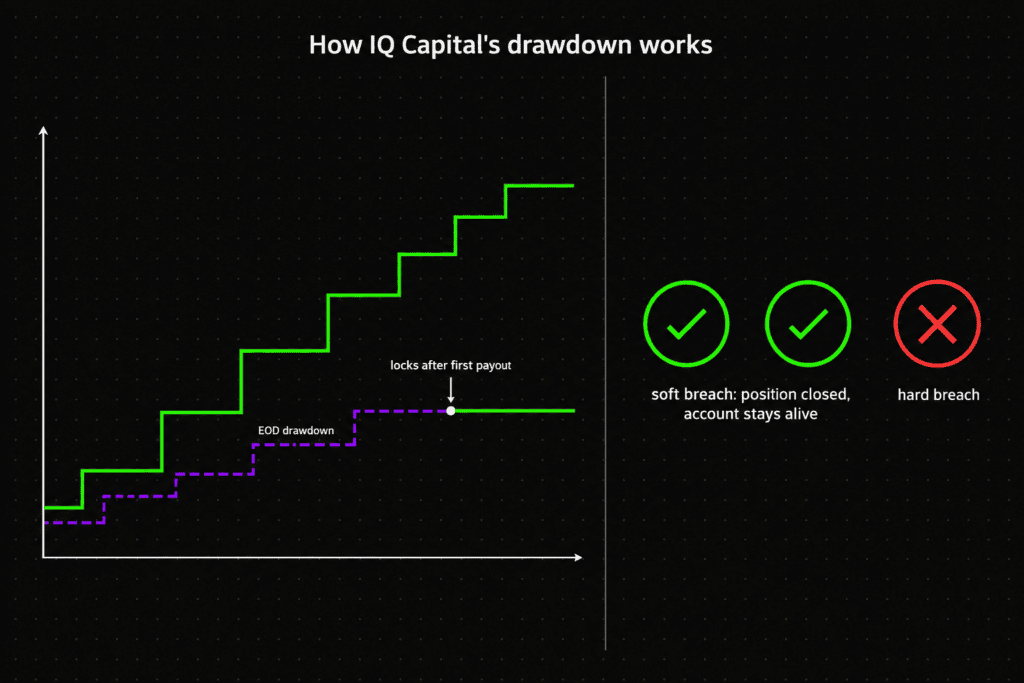
- End-of-day trailing drawdown that stops trailing. The drawdown only moves at the daily close, so an intraday spike against you can’t knock you out. After your first payout it locks at the starting balance permanently — from then on it behaves like a static drawdown.
- 90% from dollar one, no minimum payout, and a 48-hour guarantee. No “earn the first $X first” tier. Payouts go out in USDC or by bank transfer, and if IQ Capital misses its 48-hour window it pays 100% of that payout instead of 90%.
- Core Position-Loss accounts have no daily loss limit and no minimum trading days. Your only jobs in the evaluation are the profit target and the drawdown. Pass in one session if you can.
- Copy trading across prop firms is allowed. If you run Apex or Tradeify alongside IQ Capital through TradeSyncer, this firm is fine with it — we confirmed it with them directly, because the help center’s wording reads stricter than the actual policy.
- Your platforms, not theirs. Tradovate, NinjaTrader, TradingView, Quantower, ATAS, and their own DeepChart — on a dxFeed feed with CME Level 1 included. No platform lock-in and no data subscription to pass an eval.
Where it is not better — read this part. There are only two sizes, $50K and $100K, so “up to $1M” means ten accounts, not one. Payouts are capped per request — $1,500 to $2,500 on a $50K Core account depending on how many you’ve taken — and you can only withdraw half your profits at a time. Core funded accounts run a 30% consistency rule; Rapid accounts pay 80/20 instead of 90/10 and close after five payouts. And there’s a 15-second scalping rule: at least half your profit has to come from trades held longer than that. If you’re a tick scalper or you want one big withdrawal, Take Profit Trader’s no-cap payouts or Tradeify’s daily, no-consistency funded accounts are the better fit. If you want the cheapest possible seat at a firm that lets you survive a mistake, keep reading.

IQ Capital Accounts & Pricing: Core, Rapid, and Instant Funding
IQ Capital sells three tracks in two sizes, $50K and $100K, and every track comes in two risk models. That’s twelve products, but the decision is really two questions: do you want to pass an evaluation or skip it, and would you rather be limited per position or per day. All prices below are with code DGT — 80% off list — verified at IQ Capital’s checkout on Sep 20, 2026.
Core — the standard evaluation
Core is a 30-day evaluation with a 6% profit target and no minimum trading days. The $50K is $39 with DGT (list $195); the $100K is $95. Pass it and you pay a one-time activation of $129 ($50K) or $149 ($100K) to open the funded account, where the split is 90% from the first dollar and payouts unlock every 10 trading sessions.
The two risk models change what “safe” means:
- Position Loss — the bigger drawdown ($3,000 on $50K, EOD trailing) and no daily loss limit, but no single market position may lose more than 1% of the account (0.5% once funded). Blow through it and the position is closed for you; the account survives. Three of those and it’s over.
- Daily Loss — a smaller drawdown ($2,000 on $50K) plus a soft daily limit of $1,000, with no per-position cap. Costs $49 on $50K. This is also the only model that runs on Tradovate, NinjaTrader and TradingView — choose it at checkout, because accounts can’t be switched afterward.
Our read: if you trade one position at a time with a hard stop, Position Loss gives you 50% more room to be wrong. If you scale in, average, or hold multiple contracts across correlated markets, the 1% per-position rule will bite before the drawdown ever does — take Daily Loss.
Rapid — faster payouts, sprint account
Rapid costs more up front — $135 for $50K, $225 for $100K — but activation is free and the payout clock is the fastest at the firm. Both Rapid variants share the evaluation: same 6% target, a tighter $2,000 drawdown on $50K, a 40% consistency rule during the eval, and 3 minimum trading days.
- Rapid 1D — request a payout after every trading day. No consistency rule once funded. One daily-loss-limit violation forgiven.
- Rapid 3D — payout every 3 sessions, 40% consistency stays on in funding, no daily loss limit, and larger per-request caps than 1D.
Two things the sales page won’t lead with: Rapid pays 80/20, not 90/10, and a Rapid funded account closes after its fifth payout. It’s built to be milked quickly and retired, not held for a year. If you want a long-running funded account, that’s Core.
Instant Funding — skip the evaluation
Instant Funding puts you straight into a funded account under Core’s funded rules: $50K for $349 (list $1,745) or $100K for $699, in either risk model. You still need 10 trading sessions before the first payout, the 30% consistency rule applies from day one, and a funded reset is $299 ($50K) or $599 ($100K), maximum two. Instant makes sense if you already have a proven edge and value the month you’d otherwise spend in evaluation more than the roughly $300 premium over Core plus activation.
The $9 Welcome Gift
New customers get their first $50K Core Position-Loss challenge for $9. It’s the same account, same rules, same $129 activation if you pass — the discount is on the entry fee only, and it’s once per customer. If you’ve never tried IQ Capital, there is no reason to start anywhere else.
Resets, extensions, and the fees that aren’t on the price tag
- Evaluation reset: the same price as the challenge you bought ($39 / $95 Core Position-Loss, $49 / $95 Core Daily-Loss, $134 / $224 Rapid).
- Extension: +$19 buys another 30 days on any evaluation.
- Funded reset: $299 ($50K) or $599 ($100K), maximum two, on Core and Instant.
- Activation: $129 / $149 on Core; free on Rapid; none on Instant (the purchase is the funded account).
- Monthly fee: IQ Capital’s checkout lists a $19/month “monthly funded fee” on Core and a $19/month “renewal” on Instant. [CONFIRM WITH IQ — see note below]
- Data: CME Level 1 is included; nothing extra to pass an evaluation. Level 2 and Eurex / COMEX / NYMEX / CBOT add-ons are optional through the dashboard. Commissions are $0.50 per side on micros and $1.50 per side on minis.
You can buy 1, 3, 5, 10 or 15 evaluations in one checkout, and run up to 10 Core funded accounts at once (5 on Rapid). With cross-firm copy trading allowed, that’s the combination most multi-account traders here will actually use.
IQ Capital Rules & Payouts: How the Account Actually Behaves
IQ Capital’s rulebook is short, but three of its rules work differently from any other firm on this site. Read this section before you buy — the account you pick at checkout decides which rules you live under, and it can’t be changed afterward.
Drawdown: end-of-day, then it stops trailing
Every IQ Capital account uses an end-of-day trailing drawdown measured on closed balance. The limit only moves once per day, at the session close, so an intraday spike against you can’t breach an account that ends the day fine — the biggest structural difference from a live trailing drawdown, which follows your open equity tick by tick. On a $50K Core Daily-Loss account that’s $2,000 of room; Position-Loss gets $3,000.
After your first payout the drawdown locks at the starting balance and never moves again. From that point it behaves like a static drawdown: every dollar of profit above the start line is buffer you keep. That single rule is why a $2,000 drawdown here is more survivable than the number suggests — the trailing phase only lasts until you’ve been paid once.
Soft breaches: the account survives the first two mistakes
Every other firm we’ve reviewed treats a rule breach as the end of the account. IQ Capital splits breaches into two kinds:
- Soft breach — your position is closed automatically and trading continues. On Position-Loss accounts this is the max position loss rule: 1% of the account per market during the evaluation, 0.5% once funded, including slippage and commissions, with multiple positions in the same market counted together. On Daily-Loss accounts it’s the daily loss limit — None on a $50K.
- Hard breach — the account is closed. Crossing the max drawdown is always a hard breach. So is the third soft breach on Core and Instant, or the second daily-loss violation on Rapid 1D.
Practical translation: on a $50K Position-Loss account, a single trade can lose $500 before the firm flattens it for you. Size so your stop sits well inside that — slippage counts against the 1%, and a fast market can turn a $450 stop into a $520 fill.
Consistency rule: 30% in funding, none in the Core evaluation
Core and Instant accounts have no consistency rule during the evaluation — pass in one day if you can. Once funded, a 30% rule applies to each payout cycle: your best day can’t be more than 30% of the profit you’re requesting against. Rapid flips this — 40% consistency during the evaluation, then 40% in funding on the 3D variant and none at all on 1D. Consistency resets fully after every payout and is recalculated from the best day of the new cycle, so one big day only ever costs you the current cycle, not the account.
Payouts: 90% from the first dollar, capped per request
Funded Core and Instant accounts keep 90% of every dollar — no earn-first tier, no scaling ladder, and no minimum payout. Rapid pays 80%. Payouts go out in USDC (ERC-20) or by bank transfer, and IQ Capital guarantees processing within 48 hours — if they miss it, that payout is paid at a 100% split. The site claims a 3-hour average; we’ll hold them to it and post our timing on the verified trader reviews page as they come in.
The payout cycle is where IQ Capital is slower than the fast-payout firms. You need 10 active trading days between requests on Core and Instant (a day counts if you placed at least one trade — no minimum profit). Rapid 1D pays daily and Rapid 3D every three sessions. Lucid Trading pays in 15 minutes on demand and Tradeify pays daily — if payout speed is the deciding factor, they win.
Two limits shape every request:
- 50% of profits per request. Each payout can be at most half your total profit; the rest stays in the account as a buffer. After the first payout you must generate new profit equal to at least 50% of the next request before you can ask again.
- A hard payout cap per request, which grows with each payout:
| Account | Payouts 1–2 | Payouts 3–4 | Payout 5+ |
|---|---|---|---|
| Core / Instant $50K | $1,500 | $2,000 | $2,500 |
| Core / Instant $100K | $2,000 | $2,500 | $3,000 |
| Rapid 1D $50K | $1,000 | $1,500 (payouts 3–5) | |
| Rapid 1D $100K | $1,500 | $2,000 (payouts 3–5) | |
| Rapid 3D $50K | $2,000 | $2,000 (payouts 3–5) | |
| Rapid 3D $100K | $2,000 | $3,000 (payouts 3–5) | |
Worked example, $100K Core, first payout: you’re up $6,000. The 50% rule allows $3,000, but the first-payout cap is $2,000 — so $2,000 is requested, 90% of it lands ($1,800), and $4,000 stays in the account. That’s the trade-off against Take Profit Trader, which has no payout caps at all: IQ Capital is cheaper to get into and harder to get a big lump sum out of.
Rapid accounts close after five payouts. That’s not a typo. A Rapid funded account is a sprint — five payouts against the caps above, then it’s retired and you buy another. Core and Instant have no payout count limit.
The scalping rule
Every funded account has a 15-second rule: at least 50% of the profit in a payout request must come from trades held longer than 15 seconds, and at least two such trades must exist in the cycle. Tick scalping as a strategy is also on the prohibited list. If your average hold is measured in seconds, this isn’t your firm — but for anyone holding through even a single 1-minute candle the rule is invisible.
What’s allowed
- News trading: fully allowed, no blackout windows.
- Overnight and weekend holds: allowed, subject to the drawdown — the EOD measurement doesn’t stop for a gap.
- Copy trading across prop firms: allowed. Running IQ Capital alongside Apex or Tradeify through TradeSyncer is fine by them (confirmed directly — the help center’s wording is stricter than the policy).
- Automated systems: only if you own the source code and control the logic. Third-party bots, signal copying and HFT are prohibited, as is hedging on futures accounts and account sharing.
Rules at a glance
| Rule | Core / Instant | Rapid 1D | Rapid 3D |
|---|---|---|---|
| Drawdown | EOD trailing, locks at starting balance after first payout | ||
| Consistency (eval) | None | 40% | 40% |
| Consistency (funded) | 30% | None | 40% |
| Min trading days (eval) | None | 3 | 3 |
| Sessions between payouts | 10 | 1 | 3 |
| Profit split | 90% | 80% | 80% |
| Soft breaches allowed | 2 (position loss) | 1 (daily loss) | — |
| Max payouts | Unlimited | 5 | 5 |
| Max active funded (futures) | 10 | 5 | 5 |
| Scalping rule (15 s) | Applies to every funded account | ||
The rules are live and fully verified with code DGT on IQ Capital’s discount page, which tracks every change to pricing and terms the day it happens.
IQ Capital Platforms, Data & Costs
IQ Capital runs futures on a dxFeed prop data feed with CME Level 1 included in the purchase price — there is no separate data subscription to pass an evaluation, and the monthly Level 1 fee that stings at some firms doesn’t exist here. Level 2 depth, and Eurex / COMEX / NYMEX / CBOT market data, are optional add-ons from the dashboard (the CME Group Level 1 package, about $4.50/month, is required to switch those exchanges on).
Commissions are flat and cheap: $0.50 per side on micros, $1.50 per side on minis — an MNQ round trip costs $1.00, an NQ round trip $3.00. Compare that against the $1.80–$2.50 per side that Rithmic-based firms typically charge on minis and it’s a real edge for anyone trading more than a handful of contracts a day.
Which platform, which account
This is the part that catches people. The platform list depends on the risk model you buy, and the choice is final at checkout:
| Platform | Position-Loss accounts | Daily-Loss accounts | Notes |
|---|---|---|---|
| DeepChart (desktop + web) | Yes | Yes | IQ Capital’s own platform — order book heatmaps, market depth, mobile apps |
| ATAS | Yes | Yes | Order flow, footprint charts, volume clusters and delta |
| Quantower | Yes | Yes | Multi-asset, algo support, customizable workspaces |
| Tradovate | No | Yes | Daily-Loss accounts only; Challenge accounts can’t be migrated to it later |
| NinjaTrader | No | Yes | Via the Tradovate connection — Daily-Loss accounts only |
| TradingView | No | Yes | Via the Tradovate connection — Daily-Loss accounts only |
If you live in NinjaTrader or TradingView, buy the Daily-Loss model. If you’re already on ATAS or Quantower, either model works and Position-Loss gives you the bigger drawdown. DeepChart is worth a look even if you don’t switch to it — the web version means you can manage a position from a phone without a VPS, which matters on a 15-second scalping rule and an EOD drawdown that doesn’t pause for a bad exit.
Markets: the full CME / CBOT / NYMEX / COMEX list (index minis and micros, rates, energy, metals, ags, FX futures, Bitcoin and Micro Bitcoin) plus Eurex (DAX, Euro STOXX 50, Bund) as an add-on. Contract limits are 5 minis / 50 micros on a $50K and 10 / 100 on a $100K, and micros count at a tenth of a mini toward the limit. For a broader look at how these platforms compare across firms, see our prop firm trading platforms guide.
Who Should Trade at IQ Capital — and Who Shouldn’t
Buy an IQ Capital account if…
- You want the cheapest possible seat. A $9 first challenge and $39–$49 after that is the lowest entry cost on this site by a wide margin. If you’ve blown three $150 evaluations elsewhere this year, the math is obvious.
- You’ve lost accounts to intraday spikes. The end-of-day drawdown ignores what happens between the open and the close. If your problem has been stop-runs that recovered by the bell, this drawdown is built for you.
- You want a mistake not to be fatal. Two soft breaches before a hard one is unique on this roster. Every other firm here ends the account on the first crossed line.
- You trade one clean position at a time. The Position-Loss model’s no-daily-limit, $3,000-drawdown account is the most forgiving evaluation here for a single-position, hard-stop trader.
- You run multiple firms. Cross-firm copy trading is allowed, funded accounts stack to 10, and you can buy up to 15 evaluations in one checkout. Pair it with the TradeSyncer setup and it slots straight into a multi-firm stack.
Skip it if…
- You need fast, uncapped payouts. Ten sessions between requests, a 50%-of-profits rule and per-request caps starting at $1,500 are the price of the cheap entry. Take Profit Trader has no caps; Lucid pays in minutes.
- You want $150K or bigger. Two sizes only. “Up to $1M” means ten $100K accounts, not one large one.
- You scalp ticks. The 15-second rule and the ban on extreme scalping are aimed directly at you.
- You want a no-consistency funded account. Only Rapid 1D drops the consistency rule, and it pays 80% and retires after five payouts. Tradeify does daily payouts with no consistency rule on a permanent account.
- You’re in a restricted country. 23 sanctioned jurisdictions are blocked (Russia, Iran, Cuba, North Korea and the usual list). The US, UK, Canada, Australia and the EU are all accepted; if your country isn’t on either list you have to email them first.
IQ Capital Review Verdict
IQ Capital is not the fastest-paying or the most generous funded account we’ve reviewed. It is the cheapest way to get funded, and the only account here that lets you survive your first two mistakes. Those two facts together are the whole pitch: for the cost of a lunch you get a 30-day, no-minimum-days evaluation on a drawdown that only moves at the close, and a funded account that pays 90% from the first dollar with a written 48-hour guarantee.
The catches are real and we’ve listed every one: payout caps, the 50% rule, the 30% consistency rule in funding, the 15-second scalping rule, Rapid’s five-payout lifespan, and only two account sizes. None of them is hidden, all of them are on the checkout page before you pay, and none of them changes the fact that this is the lowest-risk first evaluation a new funded trader can buy right now.
DGT Score: 7.5/10/10. The score is driven by the data on this page and moves as the firm’s terms move. We have not taken a payout from IQ Capital yet; when we do, the proof and the timing go on the trader reviews page and this verdict gets updated to match.
Best first purchase: the $9 Welcome Gift ($50K Core Position-Loss). Best value after that: the $50K Core Daily-Loss at $49 if you want Tradovate / NinjaTrader, or Position-Loss at $39 if you don’t. Skip: Instant Funding until you’ve passed one Core evaluation — at $349 it’s the same funded rules you’d reach for $49 plus $129.
IQ Capital FAQ: Live Rules, Payouts and Pricing (September 2026)
Every answer below is generated from the live IQ Capital data on this page and refreshes automatically when the firm changes a rule, fee, or price.
Is IQ Capital a legit prop firm?
IQ Capital has been operating since 2023 from Saint Lucia and reports $3.5M since 2023 paid out to traders. Our editorial review of IQ Capital was last re-verified against the official rulebook on Sep 20, 2026.
How many funded accounts can I have at IQ Capital?
IQ Capital allows up to 10 simultaneous funded accounts per trader. Check the copy-trading rules before running the same strategy across accounts, and compare the IQ Capital Core, IQ Capital Instant Funding, and IQ Capital Rapid plans in the table above.
Does IQ Capital have a consistency rule on funded accounts?
IQ Capital applies a consistency rule on funded accounts: 30% on IQ Capital Core and IQ Capital Instant Funding; 40% on IQ Capital Rapid. A consistency rule caps how much of your total profit can come from a single day at payout time — check the exact percentage for the plan you buy, because it decides when your first withdrawal is eligible.
What is the activation fee at IQ Capital?
IQ Capital charges no activation fee on IQ Capital Instant Funding, but $149 on IQ Capital Core and IQ Capital Rapid; $129 on IQ Capital Core and IQ Capital Rapid. The activation fee is paid once when you move from the evaluation to the funded account; the plans table on this page shows the fee next to each plan.
How often does IQ Capital pay out, and how fast?
IQ Capital lists its payout frequency as 1 day. Payouts are capped at $2K per cycle on IQ Capital Core, IQ Capital Instant Funding, and IQ Capital Rapid; $1.5K per cycle on IQ Capital Core, IQ Capital Instant Funding, and IQ Capital Rapid. Daily payout requests are available on funded accounts. Payout terms on this page are taken from the official IQ Capital payout policy and re-verified on Sep 20, 2026.
What profit split does IQ Capital offer?
IQ Capital offers up to a 90% profit split on funded accounts. Check the plans table for how the split applies to the first payout versus later payout cycles.
Does IQ Capital allow news trading, scalping, and automated strategies?
News trading: allowed. Scalping: allowed. Copy trading between your own accounts: allowed. Automated strategies and bots: allowed. Weekend holds: not allowed. Overnight holds: not allowed. VPN use: allowed. Rules can differ between evaluation and funded accounts, so confirm the phase each rule applies to in the official IQ Capital rulebook.
What is the cheapest way to get started at IQ Capital?
With code DGT, the Rapid 50k - $50K plan at IQ Capital is $135 (regular price $675) — 80% off. The $50K evaluation is 135 with the code applied. See the current IQ Capital discount code and how to apply it.
Which trading platforms does IQ Capital support?
IQ Capital supports Bookmap, DXtrade, NinjaTrader, Quantower, TradingView, and Tradovate. Platform availability can differ between evaluation and funded accounts, so confirm your platform is enabled at the stage you are trading.
Which countries can trade with IQ Capital?
IQ Capital restricts traders from 23 countries. The country-by-country eligibility list is on our prop firms by country pages.
What are the minimum trading days at IQ Capital?
IQ Capital requires a minimum of 3 trading days to pass the evaluation.
How much capital can I get funded at IQ Capital?
IQ Capital funds up to $1M across all accounts and up to 10 accounts per trader.
IQ Capital FAQ: The Questions the Rulebook Doesn't Answer Clearly
What is a soft breach at IQ Capital?
A soft breach is a rule violation that closes your position but not your account. On Position-Loss accounts it's crossing the max position loss (1% of the account per market in the evaluation, 0.5% funded); on Daily-Loss accounts it's crossing the daily loss limit. You get two soft breaches on Core and Instant accounts and one daily-loss violation on Rapid 1D. The next one after that is a hard breach and the account closes. Crossing the end-of-day max drawdown is always a hard breach.
Is the $9 IQ Capital challenge real, and what's the catch?
Yes. New customers can buy their first $50K Core Position-Loss challenge for $9 through our link. It's the same 30-day evaluation with the same rules and the same 90% funded split. The catch is only that it's once per customer and that the $129 activation fee still applies if you pass — the $9 covers the entry, not the funded account.
How often can I withdraw from an IQ Capital funded account?
Core and Instant accounts can request a payout every 10 active trading days — a day counts if you placed at least one trade. Rapid 1D can request daily and Rapid 3D every three sessions. Each request is limited to 50% of your total profit and to a per-request cap that starts at $1,500 on a $50K Core account and rises with each payout. There is no minimum payout amount, and IQ Capital commits to processing within 48 hours.
Why does a Rapid account close after five payouts?
Rapid is designed as a short-cycle product: free activation, daily or 3-day payouts, an 80/20 split, and a maximum of five payouts before the account is retired. It suits traders who want to extract profit quickly and buy again rather than hold one account for months. Core and Instant accounts have no limit on the number of payouts.
Can I copy trades between IQ Capital and other prop firms?
Yes — copy trading across prop firms is allowed, including with tools like TradeSyncer. What IQ Capital prohibits is copying someone else's trades: external signals, third-party bots you don't control, and mirror-trading services. Your own trades copied across your own accounts are fine. Hedging across futures accounts is not allowed.
Can I use Tradovate or NinjaTrader with IQ Capital?
Yes, on Daily-Loss accounts only. Tradovate, and NinjaTrader and TradingView through it, connect to the Daily-Loss risk model; Position-Loss accounts run on DeepChart, ATAS and Quantower. Choose the risk model at checkout — accounts can't be switched or migrated to Tradovate afterward.
Does IQ Capital accept US traders?
Yes. The United States is on IQ Capital's accepted-jurisdictions list, along with the UK, Canada, Australia, the EU and EEA, and most of Asia and Latin America. Twenty-three sanctioned jurisdictions are blocked. Countries on neither list need to email IQ Capital to confirm eligibility before registering.
What is the IQ Capital scalping rule?
To qualify for a payout, at least 50% of the profit in the request must come from trades held longer than 15 seconds, and at least two such trades must exist in the payout cycle. Trades held for seconds still count toward your P&L — they just can't be the majority of a payout. Extreme tick scalping as a strategy is separately prohibited.