
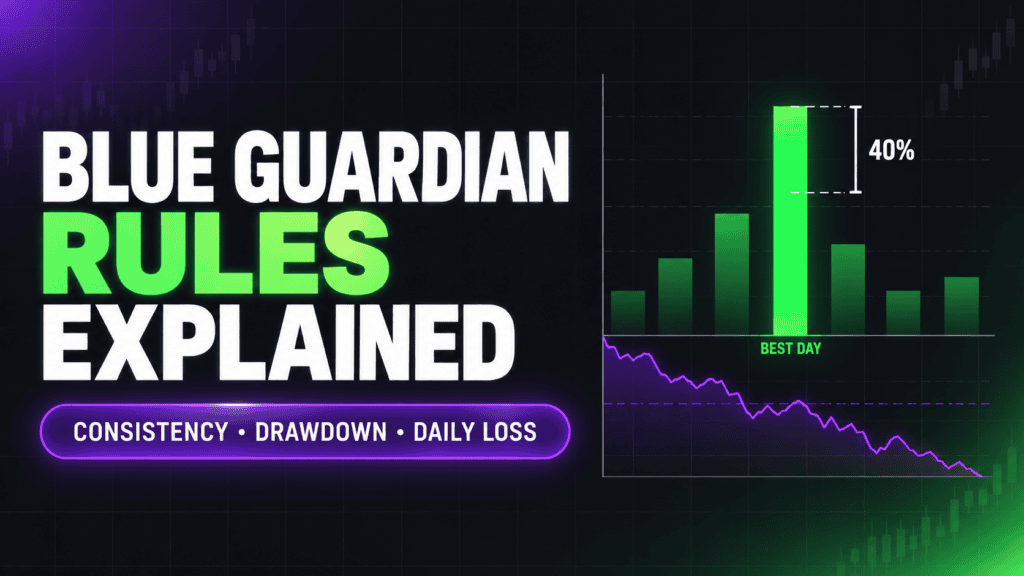
Quick answer: yes, Blue Guardian Futures has a consistency rule — but which one depends on the account. Standard has none in the evaluation and 40% once funded. Reserve and Express are the reverse: 40% (or an optional 50%) in the evaluation and none once funded. Direct, the instant-funded account, steps from 20% to 25% to 30% as you take payouts. Blue Guardian shows it in your dashboard as a consistency score — your best day divided by your total profit — and the same score decides whether you can pass in one, two or three days. Drawdown is end-of-day trailing on every model and locks after your first payout; daily loss limits are soft. Every rule, with the math, is below.
What the Blue Guardian consistency score is
The consistency score is one number: your single best trading day as a percentage of your total profit in the period the rule covers (the evaluation, or the profit built toward your next funded payout). A $1,000 best day on $2,500 of total profit is a score of 40%. The rule sets a ceiling on that score — 40%, 50%, 20% depending on the model and stage — and you can’t pass or withdraw until your score is at or under it. Nothing about the score breaches an account. It only delays the pass or the payout until you’ve added enough profit on other days for the ratio to work.
On Reserve, Blue Guardian applies a 1% cushion, so a score of 40.9% still passes a 40% rule; the other models are read at the stated number. If you want to run scenarios before you buy, the consistency calculator takes your best day and target and tells you how much more you need.
Which Blue Guardian model has which consistency rule
The funded column below is live from our plan records; the evaluation column is as verified on 25 September 2026.
| Model | Evaluation | Funded (live) | Fastest pass |
|---|---|---|---|
| Standard | None | 40% | 1 day |
| Reserve | 40% (default) or 50% option | None | 3 days (40%) / 2 days (50%) |
| Express | 40% (default) or 50% option | None | 3 days (40%) / 2 days (50%) |
| Direct (instant) | No evaluation | 20% → 25% → 30% by payout | n/a |
Read that table before anything else on this page, because the two halves of the lineup are mirror images. If you hate consistency rules while you’re proving yourself, Standard is the only model that lets a single big day pass you — but you’ll live with 40% on every payout after. If you’d rather carry the rule for two or three days and then never think about it again, Reserve and Express drop it completely once you’re funded. The 40%-versus-50% choice on those two is a checkout option: 50% costs more and buys the two-day pass. Direct is its own animal and has its own rules post.
Why 40% means a 3-day pass and 50% means 2
This is pure arithmetic. If your best day can be at most 40% of your total, then total ≥ 2.5 × best day, which no two days can satisfy unless one of them is negative — so three winning days is the floor. At 50%, two equal days do it: each is exactly half the total, and Reserve’s cushion means “exactly half” clears. That’s the whole story behind Blue Guardian calling them the 3-Day Pass and the 2-Day Pass. It also tells you how to trade the evaluation: aim for even days, not one hero session.
Worked examples on the $50K
Standard $50K — one day. Target $3,000, no evaluation consistency rule. A single +$3,000 session passes. Funded, the 40% rule switches on: the $2,100 buffer stays in the account, and when you request your first payout (capped at $2.5K), your best day since funding can’t exceed 40% of the profit you’ve built. With a $1,500 best day that means at least $3,750 of total profit before the ratio works — $2,100 of it locked as buffer, the rest withdrawable up to the cap.
Reserve $50K at 40% — three days. Target $3,000. Days of +$1,200, +$1,000 and +$800 total $3,000 with a best day of exactly 40%; the 1% cushion covers rounding. Two days of +$1,500 each would score 50% and fail the 40% version even though the target is hit — you’d need one more green day to push the ratio down. Funded, there is no rule at all: payouts are 50% of profit up to $2K after five winning days, best day irrelevant.
Reserve or Express $50K at 50% — two days. Same $3,000 target; +$1,500 and +$1,500 passes on the second day. That’s what the extra checkout cost buys. On Express, once funded, the daily payout cap ($1.1K per day on the $50K) takes over and consistency disappears.
Direct $50K — 20% on payout one. Payout goal $3,000 and a 20% ceiling means a best day of $600 or less at $3,000 of profit. A $1,200 best day pushes the requirement to $6,000 before the first withdrawal. Loosens to 25% and then 30% on later payouts.
Blue Guardian drawdown: end-of-day trailing, then locked
Every Blue Guardian model uses an end-of-day trailing drawdown. It’s measured once, at the 4:10 PM ET close, against your closed end-of-day high-water mark — so a position that goes against you intraday and recovers by the close never touches it. The allowance by model and size, as of September 2026:
| Max drawdown | $25K | $50K | $100K | $150K |
|---|---|---|---|---|
| Standard | $1,000 | $2,000 | $3,500 | $5,000 |
| Reserve | $1,000 | $2,000 | $3,000 | $4,500 |
| Express (evaluation · funded) | $1,000 · $1,000 | $2,000 · $2,000 | $3,000 · $2,500 | $4,500 · $3,500 |
| Direct | $1,500 | $2,000 | $3,500 | $4,500 |
Two things make Blue Guardian’s version easier to live with than the intraday trailing drawdowns at older-style firms. First, it locks: once you take a payout, the drawdown line stops at your starting balance plus $100 and never trails again — after that you can only be breached by going $100 below your start. Second, on Standard and Express the buffer that has to stay in the account is the drawdown plus $100, so the moment your balance is a full drawdown above start, the trailing line has already reached the lock point; the buffer and the lock are the same milestone. Reserve and Direct have no buffer, so the line keeps trailing until the first payout locks it. If EOD trailing is new to you, our guide to end-of-day drawdown shows the day-by-day mechanics.
Daily loss limits are soft — and the $50K numbers live on the review
Most sizes carry a daily loss limit, and it is soft: hitting it flattens you and locks the account for the rest of the session, nothing more. Standard $25K and the Express $25K evaluation have none; Reserve lets you buy the account with or without one (the DLL version is cheaper); Direct has one from day one. The exact figure for every model and size — including the $50K limits people search for — is kept in one place, the Blue Guardian Futures review, so it updates when the firm changes a number.
The 2% price-limit rule
Blue Guardian rejects orders placed more than 2% away from the current market price. In practice that catches two things: stops and targets parked absurdly far from price, and stale limit orders left in the book from a previous session. Keep working orders inside that band. It’s a rejection, not a breach — but a rejected stop on a live position is exactly the kind of surprise you don’t want at 4:09 PM.
Prohibited strategies that do breach you
- Latency or HFT bots and any automation built to exploit the sim feed.
- Arbitrage between accounts or against the real market.
- Hedging across your own accounts or across firms (long here, short there).
- Copy trading from anyone else’s account. Copying your own trades between your own Blue Guardian accounts is allowed.
- Group or pooled trading and account sharing — the account holder places every trade.
- Exploiting pricing errors or platform glitches.
- VPN or location misrepresentation (see restricted countries).
Scalping is fine. News trading is allowed in evaluation and funded sim accounts; it’s barred only on the earned Live Account.
Trading hours and the 4:10 PM flatten
The session runs 6:00 PM to 4:10 PM ET. Anything still open at 4:10 PM is closed automatically, and the firm states that auto-close is not a violation. What that means for rules: there is no overnight holding, no weekend holding and no swing-trading Blue Guardian, on any model. Futures trading hours covers the CME session structure if you want to plan around it.
Minimum trading days: none, with two footnotes
Blue Guardian has no minimum trading-day requirement on any evaluation or funded account. The two footnotes are the ones this page has already explained: the consistency arithmetic makes Reserve and Express a two- or three-day pass in practice, and Reserve funded payouts require five winning days ($100 / $150 / $200 / $250 by size) before each request. There’s also an inactivity rule on funded accounts — place a trade at least every 30 days.
How Blue Guardian’s rules compare
Against the other firms we review: Standard’s 40% funded rule sits where Tradeify’s and Lucid’s do; the no-funded-rule Reserve and Express are the models to compare with the no-consistency products at Tradeify and Take Profit Trader; and nothing at Blue Guardian is as heavy as Apex’s 50% rule. The EOD-only drawdown is a real advantage over intraday-trailing firms for anyone who trades through pullbacks. Whichever model fits, code DGT returns the largest discount Blue Guardian offers on it — current prices are on the Blue Guardian discount page, or go straight to Blue Guardian Futures and enter DGT at checkout.
Blue Guardian rules FAQ
Does Blue Guardian have a consistency rule on funded accounts?
Standard, yes — 40% of profit per payout cycle. Direct, yes — 20% on the first payout, 25% on the second, 30% after. Reserve and Express, no: their consistency rule applies in the evaluation only and disappears once funded. The Live Account has none.
How is the Blue Guardian consistency score calculated?
Best single day divided by total profit for the period the rule covers, shown as a percentage in your dashboard. A $1,000 best day on $2,500 total is 40%. You pass or withdraw when the score is at or below the rule for your model and stage; Reserve adds a 1% cushion.
Can you pass a Blue Guardian evaluation in one day?
On Standard, yes — there's no evaluation consistency rule, so one session that hits the 6% target passes. Reserve and Express need at least three winning days at the default 40% rule or two at the 50% option, because of the ratio math, not a minimum-days rule.
What is the difference between the 2-Day Pass and 3-Day Pass?
They're the two consistency options on Reserve and Express. The 3-Day Pass is the default 40% rule (fastest pass in three winning days); the 2-Day Pass is a 50% rule sold for a higher fee (fastest pass in two). Both apply to the evaluation only.
Is Blue Guardian's drawdown intraday or end of day?
End of day, on every model. It trails your closed end-of-day high-water mark, is checked at the 4:10 PM ET close, and locks at your starting balance plus $100 once you take a payout. Intraday moves that recover by the close don't count.
Can I hold trades overnight at Blue Guardian?
No. Every open position is closed automatically at 4:10 PM ET, and the firm doesn't count that auto-close as a violation. There's no overnight or weekend holding on any model, so swing strategies don't fit.
Is scalping allowed at Blue Guardian?
Yes. Scalping is permitted on all models. What's prohibited is latency or HFT automation, arbitrage, cross-account hedging, copying other people's trades, account sharing and exploiting platform errors. The 2% price-limit rule rejects orders more than 2% from the market, which scalpers rarely touch.
What actually breaches a Blue Guardian account?
Hitting the end-of-day trailing drawdown, or using a prohibited strategy. A daily loss limit only closes your day; a consistency score above the rule only delays a pass or payout; the 4:10 PM auto-close is never a breach. Evaluation and funded breaches can be reset or reactivated on Standard, Reserve and Express; a breached Direct account is a new purchase.

