
Trading with a futures prop firm means sharing profits with the firm, typically ranging between 80% to 100% in favor of the trader. Here’s what you need to know:
- Most Common Splits: 80/20, 90/10, or 100% for initial profits up to $10,000–$25,000.
- Key Factors Beyond Splits: Payout frequency, evaluation difficulty, drawdown rules, and scaling opportunities significantly impact profitability.
- Top Firms to Consider: Apex Trader Funding, Take Profit Trader, FundedNext Futures, Alpha Futures, Tradeify, and more, each offering different profit-sharing structures and payout terms.
- Passing Evaluations is Tough: Only 5–10% of traders succeed, making it essential to understand all rules before committing.
Quick Comparison Table
| Firm | Profit Split | First Payout | Payout Frequency | Key Features |
|---|---|---|---|---|
| Apex Trader Funding | 100% (first $25K), 90% | Day 8 eligible | Every 8 days | High early profits, large withdrawal caps |
| Take Profit Trader | 80-90% | Day 1 eligible | Daily | No consistency rules, quick payouts |
| FundedNext Futures | 80 | 3 days (Rapid) | 3-5 days | No activation fees, flexible payouts |
| Alpha Futures | 70% → 90% (tiered) | After 14 days | Bi-weekly | Gradual split increase |
| Tradeify | 100% (first $10K), 90% | Day 5 eligible | Every 8 days | Fast early payouts |
| FundingTicks | 80 | Varies | Weekly/Bi-weekly | Customizable drawdown options |
Key Takeaway: Higher splits don’t always mean more earnings. Consider payout timing, rules, and fees to ensure the firm aligns with your trading goals.
ULTIMATE Futures Prop Firm Tier List (That I’ve Taken Payouts With)
1. Apex Trader Funding

Apex Trader Funding has designed a profit-sharing model that prioritizes trader earnings. Specializing in CME futures products – such as equity index, energy, metals, currency, and agricultural futures – the firm caters to intraday and swing traders aiming to maximize their income through a structured and timely payout system.
Base Profit Split
Apex offers an attractive starting point: 100% of your first $25,000 in profits is yours to keep for each funded account. For example, if you generate $5,000 in your first month, you pocket the entire amount. Similarly, if you make $15,000 over a few months, that full $15,000 is yours before any profit-sharing kicks in.
This $25,000 threshold is one of the most generous in the futures prop trading industry, giving traders a significant edge. But Apex doesn’t stop there – their ongoing profit split continues to deliver value.
Maximum Profit Split
After surpassing the $25,000 mark, Apex transitions to a 90/10 profit split in favor of the trader. This means you retain 90% of all profits beyond the initial $25,000, while the firm takes 10%. Compared to many firms that start with 80% splits and require traders to scale up over time, Apex’s 90% split is highly competitive from the outset.
Here’s an example: If you generate $30,000 in total profits, you’d keep the first $25,000 entirely. For the remaining $5,000, you’d retain 90% ($4,500), bringing your total payout to $29,500 before taxes. By contrast, a firm offering a flat 80% split would only pay $24,000 on the same $30,000 profit – showing why Apex’s structure is so appealing.
Payout Frequency
Apex provides payouts every 8 trading days, offering traders frequent access to their earnings. This is a significant advantage over firms that limit withdrawals to biweekly or monthly schedules. For U.S.-based traders, the ability to access funds every eight days can greatly improve cash flow management.
Additionally, each payout can be as high as $70,000, which is ideal for high-volume traders. Unlike some firms that impose strict caps on withdrawal amounts, Apex allows traders to withdraw substantial sums without unnecessary restrictions.
Special Payout Rules
While Apex’s profit-sharing terms are highly favorable, there are a few conditions to keep in mind. Traders must meet a minimum profit threshold before requesting their first payout. Early withdrawal cycles may also have limits to ensure account stability and maintain drawdown buffers.
It’s important to follow risk management rules, including trailing drawdowns and daily loss limits, as violations can result in losing the account and forfeiting future profits. Additionally, frequent withdrawals can make it harder to maintain a buffer above drawdown thresholds, so it’s crucial to plan withdrawals carefully to avoid breaching these limits.
For traders focused on maximizing take-home income in USD, Apex’s combination of 100% initial profits, a generous 90% ongoing split, and frequent payouts every eight days makes it a standout choice. To compare Apex with other leading futures firms, explore verified reviews, discount codes, and tools like consistency rule calculators at DamnPropFirms.
2. Take Profit Trader

Take Profit Trader provides U.S. futures traders with access to firm capital for trading CME-listed and micro futures, focusing on active intraday strategies.
Base Profit Split
Take Profit Trader starts with an 80/20 profit split, where traders keep 80% of their net profits. While this split might seem modest compared to other futures prop firms in 2025, it balances risk management for the firm with a solid earning potential for traders. For example, if you generate $5,000 in monthly profits, your take-home would be $4,000 per month, or approximately $48,000 annually before taxes. This setup serves as a foundation for potential upgrades, which we’ll explore next.
Maximum Profit Split
Traders can improve their profit share to a 90/10 split by meeting specific evaluation criteria and activating PRO status, typically for a one-time fee. This upgrade becomes increasingly valuable as your profits grow. For instance, earning $10,000 a month at the base split would leave you with $8,000, but at the 90/10 level, you’d take home $9,000 – a difference of $1,000 per month. Over a year, that adds up to an extra $12,000, which could significantly impact your financial planning, whether for personal expenses or reinvestment.
Payout Frequency
One of Take Profit Trader’s standout features is its daily withdrawal option for funded traders. As of December 2025, you can request payouts every day, offering unparalleled flexibility in managing your cash flow. This means if you make $2,000 in your first week on a funded account, you can withdraw those earnings immediately instead of waiting for a scheduled payout cycle. This daily access to funds can be a game-changer, especially when paired with the profit split upgrades.
Special Payout Rules
Take Profit Trader keeps things simple with no mandatory consistency rules. Instead, traders are only required to adhere to standard risk management guidelines, such as daily loss limits and trailing drawdowns.
For U.S. traders considering whether this setup aligns with their goals, DamnPropFirms provides verified reviews, discount codes, and tools like consistency rule calculators to help you assess if Take Profit Trader’s structure fits your trading style and income needs.
3. FundedNext Futures

FundedNext Futures is the futures-focused branch of FundedNext, offering U.S. traders funded accounts with scalable profit-sharing options. The firm provides two account types – Rapid Accounts and Legacy Accounts – each designed to suit different trading preferences and payout needs. Similar to Apex Trader Funding and Take Profit Trader, FundedNext tailors its profit splits to reward traders who show consistent performance.
Base Profit Split
FundedNext Futures starts traders with an impressive profit split ranging from 80% to 90%, significantly higher than the 50–80% splits offered by many competitors. For instance, with an 85% split on $5,000 in profit, you’d take home $4,250. This starting split provides a strong foundation for traders aiming to grow their earnings through the firm’s scaling program.
The firm places a strong emphasis on consistency and risk management when determining profit shares. Instead of offering the highest splits upfront, FundedNext rewards traders who maintain steady performance over time. This approach makes it an appealing option for those focused on sustainable growth rather than quick payouts.
Maximum Profit Split
What sets FundedNext apart is its ability to scale profit splits as traders prove their success. Maximum splits can climb to 90–95%, with some accounts allowing traders to keep 100% of their initial profits before the split kicks in. Here’s an example to illustrate: if you earn $5,000 and are entitled to keep the first $10,000 entirely, that $5,000 is yours outright. Later, if you generate an additional $20,000 on a 90% split, you’d retain $18,000 while FundedNext takes $2,000. This means your total earnings across both phases would be $23,000, all in U.S. dollars.
Achieving these top-tier splits requires meeting specific benchmarks, including maintaining profitability, adhering to drawdown limits, and progressing through payout milestones. FundedNext also offers account scalability, with funded accounts reaching up to $4,000,000 in notional size. For traders who reinvest their profits, this scalability can significantly amplify earnings over time.
Payout Frequency
FundedNext provides frequent payouts, typically on a bi-weekly schedule. For traders using Rapid Accounts, payouts can be processed in as little as 3 days after completing the evaluation phase, which itself can be finished in just 1 day. This quick turnaround gives traders faster access to their earnings, making it easier to align withdrawals with personal financial needs while still allowing for account growth.
Special Payout Rules
FundedNext Futures includes several features designed to benefit traders. For example, Legacy Accounts have no consistency rule, meaning there’s no restriction on how profits are distributed across trading days. This flexibility is a major advantage for traders who prefer a less rigid approach to their strategies. Additionally, the firm does not charge monthly subscription fees or activation fees, eliminating extra costs.
However, FundedNext enforces minimum payout thresholds tied to risk parameters, such as maximum drawdown limits. While aggressive withdrawals might reduce safety buffers during volatile market conditions, the high profit splits can make up for these stricter rules.
For U.S. traders evaluating these terms, DamnPropFirms offers verified reviews and tools to help estimate payouts in dollars and determine which firm aligns best with your trading style and goals. Their site also includes detailed reviews of other firms like Topstep and Phidias Prop Firm for additional comparisons.
4. Alpha Futures

Alpha Futures is a proprietary trading firm specializing in futures trading. They provide traders with firm capital in exchange for a share of the profits. What sets them apart is their tiered profit-sharing model, which rewards traders as they demonstrate consistent performance. This structure encourages disciplined trading and steady growth, offering a clear path to higher earnings.
Base Profit Split
Newly funded traders start with a 70% profit split, which is on the higher end of the industry standard (typically 50–80%). For instance, if you generate $5,000 in profit in your first month, you’d take home $3,500, while the firm retains $1,500. This initial split strikes a balance between rewarding traders and maintaining the firm’s sustainability. Traders who stick to risk management rules can progress to higher tiers quickly.
Maximum Profit Split
Alpha Futures offers the potential to scale up to a 90% profit split as traders prove their ability to generate consistent profits. The scaling works as follows: starting at 70% for the first two payout cycles, traders move to 80% for the next two cycles and reach 90% after meeting specific performance benchmarks.
Here’s how this scaling translates financially:
- At the 70% tier, earning $4,000 per cycle means taking home $2,800.
- At 80%, that rises to $3,200.
- At 90%, you’d keep $3,600.
For traders generating $10,000 in monthly profit, the 90% tier means $9,000 in take-home pay. This gradual progression rewards discipline and contrasts with firms that offer flat splits from the start.
To reach the 90% tier, traders must meet benchmarks tied to profitability, risk management, and adherence to drawdown limits.
Payout Frequency
Alpha Futures operates on a bi-weekly payout schedule, allowing traders to withdraw profits every 14 days once they meet minimum thresholds. This setup provides two potential payout opportunities per month for active traders.
The firm requires a minimum payout request of $125, and traders may need to meet specific profit levels or achieve a certain number of profitable trading days before requesting a withdrawal. Instead of making frequent small withdrawals, it’s often better to wait until you’ve accumulated $1,000 to $2,000 in net profit. This strategy minimizes the impact of fees, taxes, and any effect on your Maximum Loss Limit (MLL), ensuring you retain more of your earnings.
Special Payout Rules
One important rule to note: withdrawals count against your Maximum Loss Limit (MLL). For example, if your trailing loss limit is $3,000 and you withdraw $2,500, your buffer for future losses shrinks to $500. This increases the risk of breaching the MLL and losing your account.
To manage this, experienced traders treat their MLL as essential equity. A smart approach is to stagger withdrawals, taking partial payouts when you’re well above the MLL buffer while reinvesting some profits back into the account. This strategy helps you compound gains, scale up your trading size, and work toward the 90% split without risking a major loss.
The firm caps individual withdrawals at $15,000 for Advanced and Standard Accounts. If you earn more than $15,000 in a single payout cycle, you’ll need to request multiple withdrawals or wait for the next cycle to access the remaining funds.
This payout structure rewards traders who maintain steady, disciplined performance. Swing traders and intraday futures traders who consistently generate a few thousand dollars in monthly profits while managing risk are well-positioned to climb the payout tiers and maximize their earnings.
For U.S. traders comparing Alpha Futures to other firms, DamnPropFirms offers verified reviews and tools to benchmark Alpha Futures against competitors like Take Profit Trader, Tradeify, FundingTicks, and Topstep. With filters for high profit splits, frequent payouts, and flexible rules, you can evaluate how Alpha Futures aligns with your trading goals and use tools like the Consistency Rule Calculator to refine your decision.
5. Tradeify
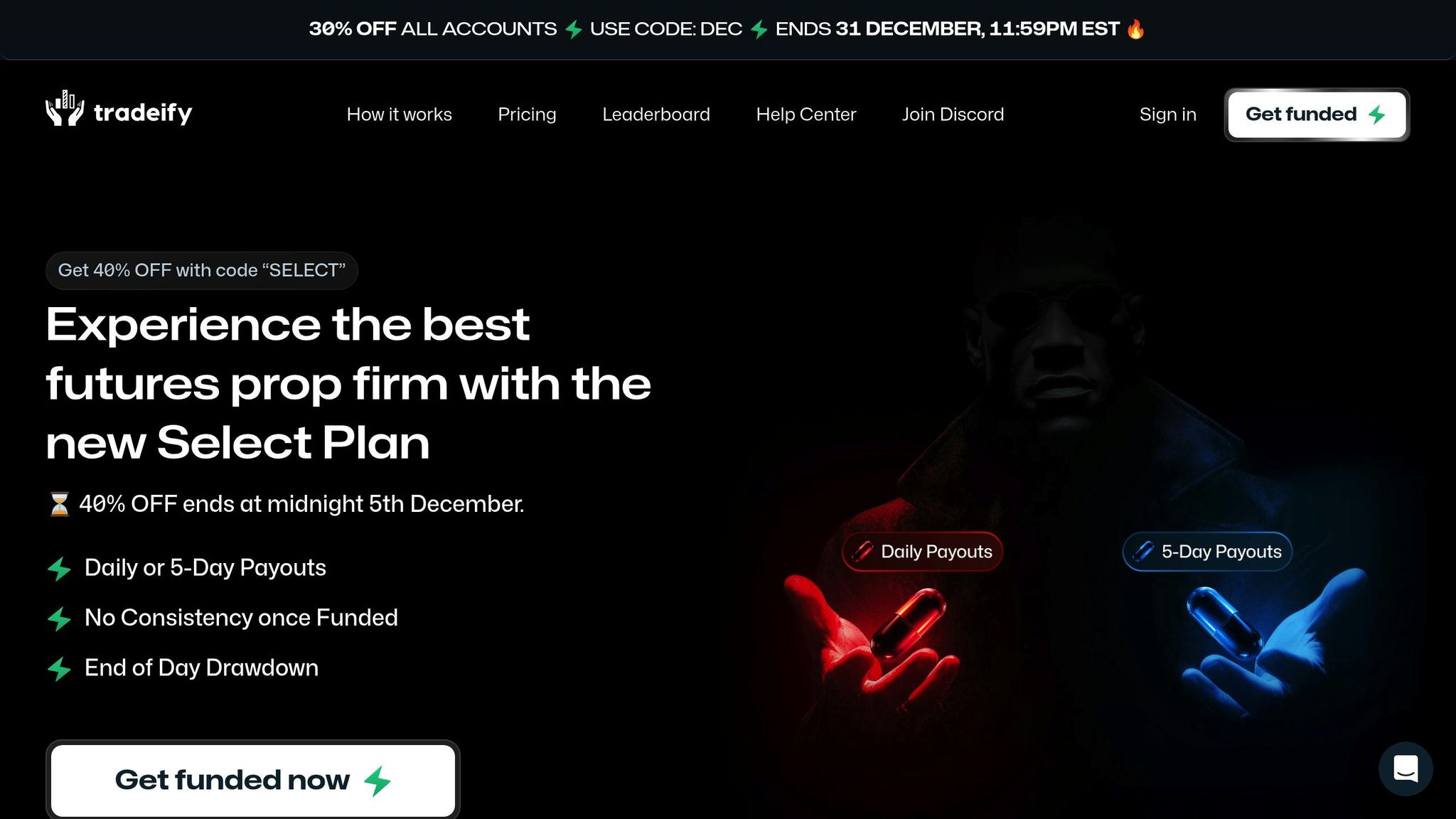
Tradeify is a proprietary trading firm focused on futures, offering a tiered profit-sharing model that appeals to traders looking to maximize their early earnings. Instead of a flat profit split from the start, Tradeify provides a substantial boost on initial profits, allowing traders to capitalize on their early success and reinvest quickly.
Base Profit Split
Once you’re funded, Tradeify offers an 80% profit split, meaning you keep 80% of your profits while the firm retains 20%. This setup is in line with industry standards, comparable to firms like Apex Trader Funding, which also operate in the 80–90% range.
For example, if you earn $4,000 in a payout cycle, you would take home $3,200, with the firm keeping $800. This competitive base split sets the foundation for Tradeify’s standout early earnings model.
Maximum Profit Split
What truly distinguishes Tradeify is its 100% profit retention on the first $10,000 you earn. This means every dollar of your initial $10,000 in profits is yours to keep, with no portion going to the firm. Once you surpass that milestone, the standard 80% split applies to all additional earnings.
Let’s break it down:
- If you earn $8,000, you keep the entire $8,000.
- If you make $15,000, you keep the first $10,000 and 80% of the remaining $5,000 ($4,000), totaling $14,000.
- If your total profit reaches $25,000, you keep $10,000 plus 80% of the additional $15,000 ($12,000), giving you $22,000.
This structure is particularly appealing for traders who can generate strong profits early on. Keeping 100% of the first $10,000 allows traders to reinvest or withdraw without sharing their initial success. Afterward, the 80% split remains competitive with other firms in the industry. Tradeify’s model aligns with Topstep, which offers a similar 100% profit retention for the first $10,000, making it an excellent option for traders prioritizing early cash flow.
Payout Frequency
Tradeify processes payouts every 8 trading days, with a fixed payday on Tuesdays once your master account is active. This schedule allows traders to withdraw profits roughly every two weeks, offering more frequent access to earnings compared to firms with monthly payout cycles.
In some cases, payouts can be processed in as little as 5 days, though the standard cycle remains 8 trading days. This quicker payout frequency aligns with the trend among top futures prop firms moving toward weekly or bi-weekly payouts, catering to traders who value faster access to their funds.
For traders in the U.S., this means you could potentially receive two payouts per month if you’re actively trading and meeting profit benchmarks. Payments are typically made via bank wire, ACH, or other standard methods, with funds issued in U.S. dollars for domestic traders.
Special Payout Rules
Tradeify also has additional payout considerations beyond the 100% first $10,000 feature. For example, its Dynamic Consistency Rules apply to Instant Funding accounts, requiring traders to meet specific consistency benchmarks to remain eligible for payouts. These rules are designed to encourage disciplined, steady trading rather than risky, high-stakes strategies.
Another noteworthy feature is Tradeify’s Growth Evals, which can be completed in as little as one day. This fast-track option benefits experienced traders who can demonstrate profitability quickly, speeding up the transition from evaluation to funded status.
However, traders must adhere to strict risk management rules. Violating limits such as the daily loss cap or trailing drawdown can result in account termination and forfeiture of payouts. Treating drawdown limits as critical equity is essential to avoid aggressive trading that could jeopardize your account.
If you’re comparing Tradeify to other futures prop firms, DamnPropFirms offers verified reviews and tools to benchmark Tradeify against competitors like FundedNext Futures, FundingTicks, and Lucid Trading. With filters for profit splits, payout cycles, and flexible rules, you can evaluate how Tradeify’s model fits your trading goals. Tools like the Consistency Rule Calculator can also help refine your strategy.
6. FundingTicks

FundingTicks is a futures-focused proprietary trading firm that emphasizes high profit splits. They provide evaluation-based funded accounts for popular U.S. futures instruments like ES, NQ, CL, and YM. With platforms such as Rithmic and Tradovate, they aim to offer traders flexible rules, customizable drawdown options, and no activation fees, making their terms appealing to those seeking simplicity.
Base Profit Split
FundingTicks provides a base profit split ranging from 80% to 90% once you pass their evaluation. The starting percentage depends on the account type and any optional add-ons, but the structure is designed to be competitive within the industry. For example, earning $5,000 would result in $4,000 at an 80% split or $4,500 at a 90% split. This reflects the broader trend in the futures market, where firms are offering higher shares to attract traders in a space known for its leverage and volatility.
What sets FundingTicks apart is their consistent approach – whether you’re trading a $25,000 account or a larger one, the profit-sharing percentage stays the same. This straightforward structure makes it easier for traders to estimate their earnings without worrying about tiered splits tied to account size.
On top of this, FundingTicks offers an attractive maximum profit split for early earnings.
Maximum Profit Split
FundingTicks allows traders to retain 100% of their profits on the first $10,000–$25,000 earned, with the standard 80–90% split applying to anything beyond that. For instance:
- Earn $8,000, and you keep the entire amount.
- Earn $20,000, and you keep the first $10,000, plus 80% of the remaining $10,000 ($8,000), for a total of $18,000.
- Earn $30,000, and you keep $10,000 at full retention, plus 80% of the additional $20,000 ($16,000), totaling $26,000.
This setup allows traders to benefit from their early successes without sharing profits right away. Once the threshold is reached, the 80–90% split kicks in, which remains competitive with firms like Alpha Futures and TickTickTrader.
Notably, there are no extra milestones or requirements to unlock the 100% retention – it applies automatically after passing the evaluation. This means traders can start earning their full share of profits from their very first funded payout.
Payout Frequency
In addition to competitive splits, FundingTicks offers frequent payout schedules, typically weekly or bi-weekly, depending on the account type and trading activity. This is a major perk for traders, as many firms in the industry are moving toward faster payout cycles, moving away from the traditional monthly model.
For U.S.-based traders, this could mean receiving two or more payouts each month if you’re actively trading and meeting profit thresholds. The minimum profit required for a payout request is usually $200–$500, varying by account size. Once you meet the minimum, withdrawals are processed within a few business days.
Payouts are issued in U.S. dollars via ACH or wire transfer, which simplifies the process for domestic traders by avoiding currency conversion fees or international transfer delays. Compared to firms that stick to monthly payouts, FundingTicks’ faster schedule is a clear advantage.
For detailed comparisons of payout schedules and terms, DamnPropFirms provides verified reviews and benchmarks against competitors like FundedNext Futures, Lucid Trading, and The Futures Desk.
Special Payout Rules
FundingTicks also stands out with its Pro+ account type, which eliminates consistency rules during the funded stage. This means traders aren’t required to spread profits across multiple winning days or meet specific benchmarks to qualify for payouts. You can focus on your trading style, even if it involves larger wins on fewer days, without worrying about disqualifications due to consistency requirements – a contrast to firms that impose strict payout conditions.
However, standard risk management rules, such as daily loss caps and trailing drawdown limits, still apply. For example, if you earn $10,000 and withdraw $8,000, your account balance drops, reducing the buffer between your current equity and the drawdown threshold. Aggressive withdrawals can increase the risk of account termination, so careful planning is essential.
For traders looking to bypass evaluations, FundingTicks offers up to $300,000 in instant funding, allowing experienced traders to start trading funded accounts immediately. While this option comes with stricter risk controls, it provides a faster route to accessing capital.
Lastly, U.S. traders should remember that profits from proprietary trading are taxable income. Keeping track of payouts in U.S. dollars and consulting a tax professional ensures compliance with IRS reporting requirements.
If you’re weighing FundingTicks’ profit splits and payout terms, DamnPropFirms offers tools like the Consistency Rule Calculator and reviews to compare FundingTicks with firms such as Phidias Prop Firm, FundedFuturesNetwork, and Topstep. These resources can help you decide if their model aligns with your trading goals and risk preferences.
7. Lucid Trading
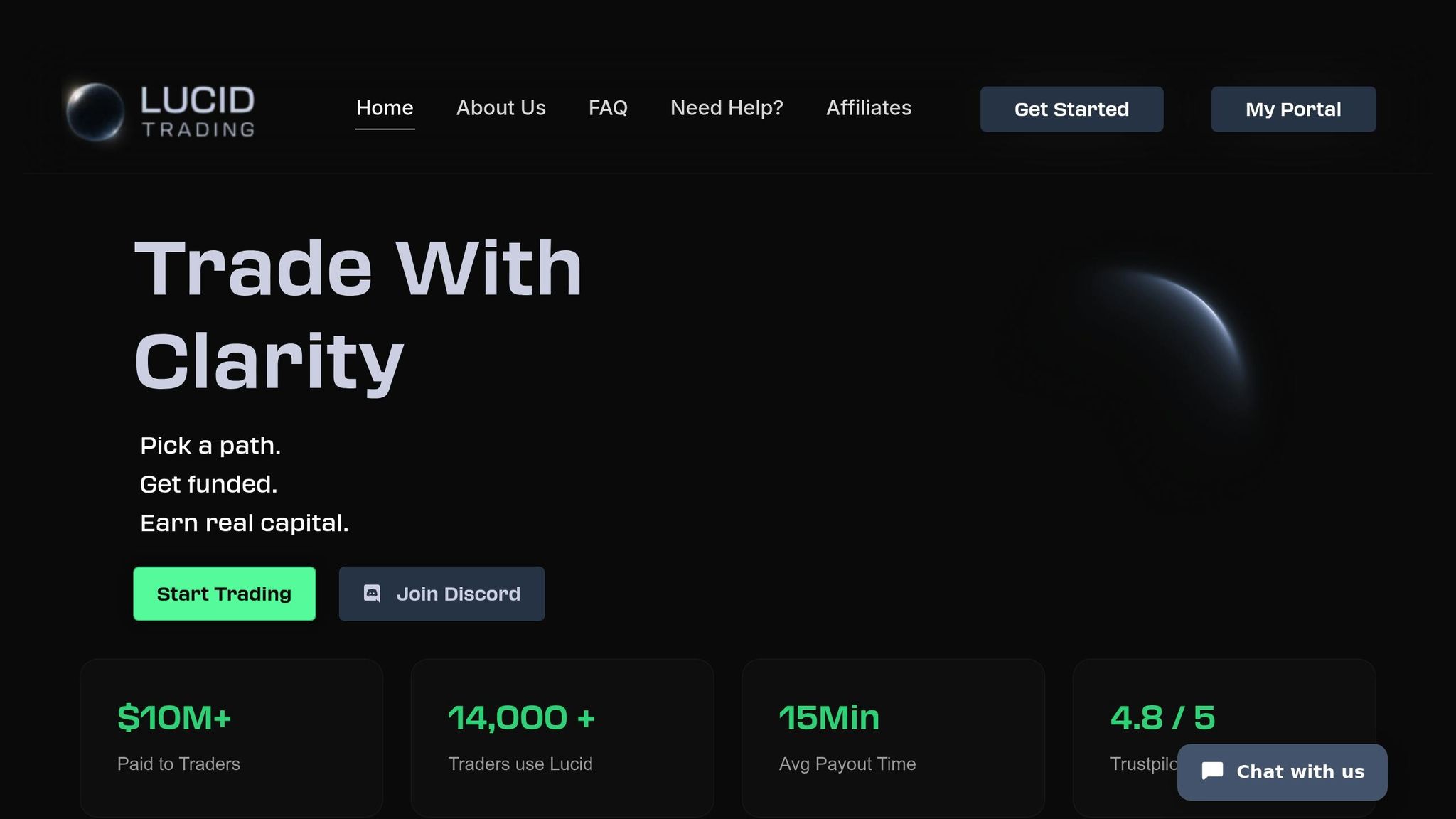
Lucid Trading is a proprietary trading firm that specializes in U.S. futures contracts like ES, NQ, and CL. Using platforms such as NinjaTrader, the firm places a strong emphasis on consistency and risk management. With a transparent, performance-driven profit split model, Lucid Trading is tailored for traders aiming to build long-term success.
Base Profit Split
Lucid Trading offers an 80% base profit split for standard funded accounts. This means traders keep 80% of their earnings, while the firm retains 20%. For instance, if you generate $5,000 in profit, $4,000 goes directly to you. This flat 80% split applies consistently across all account sizes, making it straightforward to understand.
Maximum Profit Split
For traders who maintain consistent profitability over several months and adhere to daily loss caps and trailing drawdown limits, the profit split increases to 90%. In this case, earning $10,000 in profits would net you $9,000 instead of $8,000. Over time, this additional 10% can significantly enhance your overall earnings. Compared to firms like Alpha Futures and TickTickTrader, which also provide a 90% maximum split, Lucid Trading’s progression system is easy to follow and designed to support steady cash flow.
Payout Frequency
Traders with standard accounts can request payouts every two weeks, while higher-tier accounts are eligible for weekly withdrawals. Payments are processed in U.S. dollars via ACH or wire transfer, provided you meet the minimum profit threshold, which typically ranges from $100 to $200 per payout cycle.
Special Payout Rules
Lucid Trading has specific rules for withdrawals beyond the profit splits and regular payout schedules. To start, you must meet a minimum net profit threshold (usually $100–$200) before initiating a withdrawal. Initially, withdrawals are capped at 50–70% of your accumulated profits, but these limits relax as your trading track record improves.
One important consideration is that withdrawals impact your account’s Maximum Loss Limit (MLL). For example, if you have a $50,000 account with a $2,500 MLL and withdraw $2,000, your remaining buffer shrinks, which could increase your risk during a losing streak. This approach is common across firms like Phidias Prop Firm and FundedFuturesNetwork.
A standout feature is the LucidFlex account, which removes consistency rules during the funded stage. This allows traders the freedom to pursue their own strategies – even if profits are unevenly distributed – while still adhering to standard risk management guidelines.
If you’re considering Lucid Trading’s profit split and payout structure, DamnPropFirms provides detailed reviews and tools, like the Consistency Rule Calculator, to help you determine if their approach aligns with your trading objectives.
sbb-itb-46ae61d
8. The Futures Desk
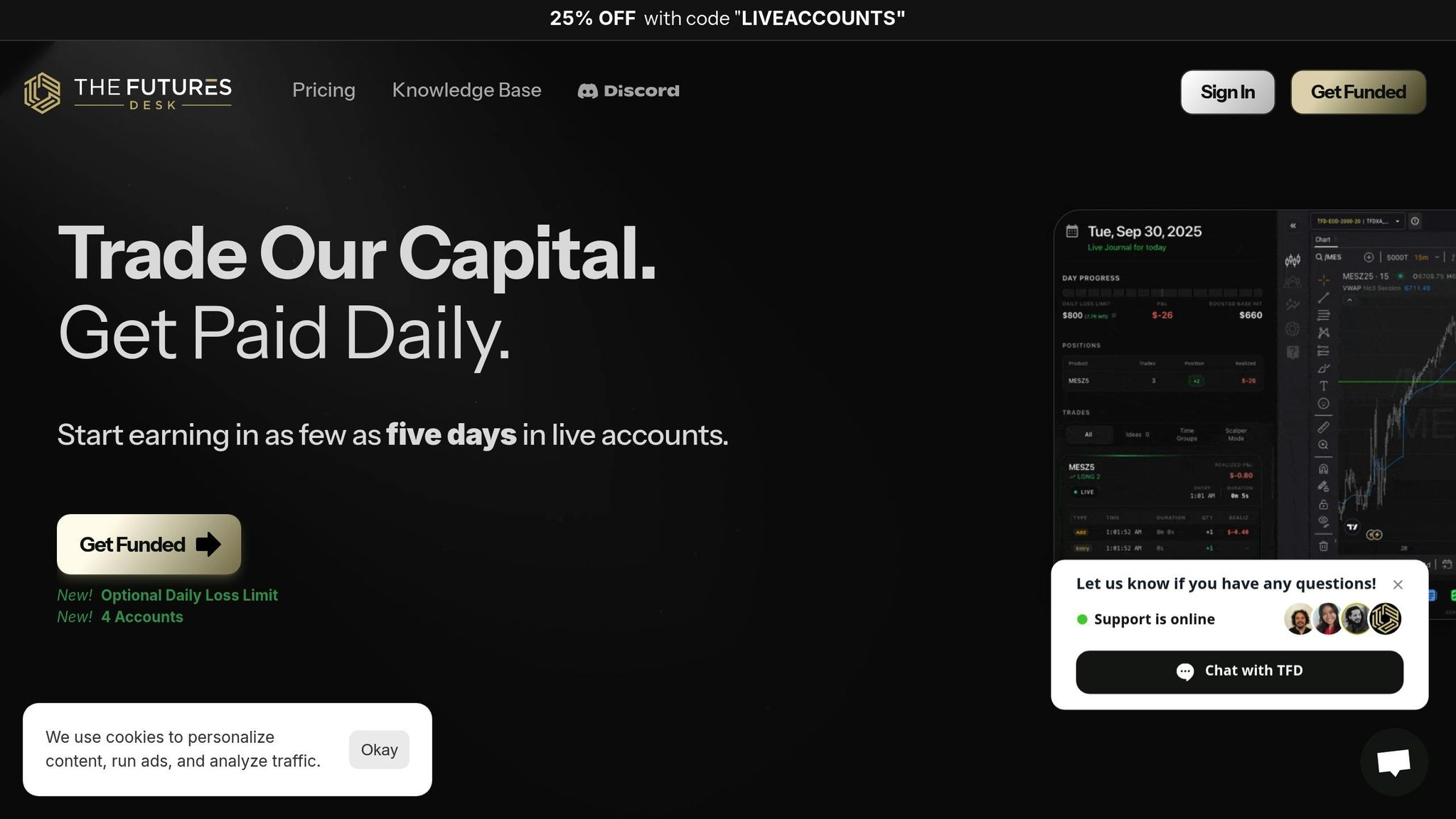
The Futures Desk is a proprietary trading firm based in the U.S. that specializes in offering funded accounts for trading major CME futures contracts. Traders can access these accounts through platforms like NinjaTrader and Tradovate, but first, they must complete an evaluation process that adheres to specific rules. The firm places a strong emphasis on consistent risk management and operates with a profit-sharing model aimed at ensuring predictable payouts.
However, details about the profit split – such as base and maximum percentages, payout frequency, and withdrawal terms – haven’t been disclosed yet. If you’re looking for the most up-to-date information, check out our full review on DamnPropFirms. This lack of transparency highlights how futures prop firms can differ in the level of detail they provide about their offerings.
9. TickTickTrader

TickTickTrader is a prop trading firm exclusively focused on CME futures. They offer two evaluation paths: a traditional route and an Express option, both designed with straightforward rules and flexibility in mind. Traders can hold overnight positions (within exchange limits), making it a suitable choice for active scalpers.
Base Profit Split
TickTickTrader starts funded traders with a base profit split of 80%. For instance, if you earn $1,000 in verified profits, you’ll keep $800, while the firm takes $200. This competitive split applies to both evaluation-based accounts and the Express program. Keep an eye on their website for updates, as promotional changes could occasionally impact these terms.
This consistent 80% split ensures a transparent profit-sharing model, giving traders a solid foundation for building their earnings.
Maximum Profit Split
As traders achieve performance milestones, TickTickTrader increases the profit split to 90%, allowing you to retain $900 out of every $1,000 earned. The firm uses a tiered system based on cumulative payouts or other performance criteria, though specific thresholds are not publicly disclosed. This higher split rewards traders who generate consistent profits, offering an extra incentive for high-volume futures trading.
Payout Frequency
TickTickTrader does not openly disclose its payout frequency. Some reports suggest flexible withdrawal options, but the exact details – such as minimum trading periods or profit thresholds – are best confirmed on their official website. For the most accurate and up-to-date information on withdrawal terms and processing times, refer directly to their site.
Special Payout Rules
There are a few key policies to keep in mind when planning withdrawals. Accounts operating under a trailing drawdown model may see their protective buffer reduced after large withdrawals, so pacing your payouts strategically is important. While the firm doesn’t prominently mention caps or reduced splits on initial withdrawals, it’s wise to double-check if any minimum profit or activity requirements apply before requesting a payout.
Additionally, fees like commissions, platform charges, and exchange costs are deducted from your gross profits before the profit split is calculated. This means your payout at an 80% split will be based on net profits, not gross earnings. Managing your withdrawals carefully can help maintain your buffer and maximize returns.
Overall Comparison
TickTickTrader provides a straightforward profit-sharing structure with clear rules, making it an appealing choice for CME futures traders in the U.S. Its transparent terms and flexibility cater to those looking for a no-nonsense trading experience. For a deeper dive into how TickTickTrader stacks up against competitors like Apex Trader Funding, Topstep, and FundedFuturesNetwork, visit DamnPropFirms for reviews, comparisons, and discount codes.
10. Phidias Prop Firm

Phidias Prop Firm stands out as a strong choice for U.S. futures traders thanks to its competitive profit-sharing structure. Traders can access funded accounts after completing an evaluation phase, during which profits are tracked solely for qualification purposes.
Base Profit Split
Phidias starts traders with an 80% profit split, ensuring you keep a significant portion of your earnings. For example, if you earn $1,000 in net profits, $800 stays in your pocket. This starting split aligns with the industry standard among top futures prop firms, comparable to what traders find at firms like Alpha Futures and FundingTicks.
Maximum Profit Split
With consistent performance and meeting specific milestones, traders can graduate to a maximum profit split of 90%. At this level, if you generate $1,000 in net profits, you’d retain $900. The progression to this higher tier depends on hitting performance benchmarks, such as achieving cumulative profit goals and maintaining consistency. These upgrades directly affect how much you take home during payouts.
Payout Frequency
Phidias offers payouts on a biweekly or monthly schedule, striking a balance between timely access to earnings and effective risk management. While some firms, like Apex Trader Funding, provide payouts as often as every 8 trading days, Phidias ensures a steady payout rhythm. Keep in mind, initial withdrawals might take longer to process.
Special Payout Rules
Phidias has specific conditions around payouts that traders should be aware of. For example, there’s typically a minimum payout threshold, requiring you to accumulate a few hundred dollars in profits before withdrawing. Additionally, initial payouts may have capped limits or longer waiting periods. It’s important to plan withdrawals carefully, especially to maintain enough capital to cover trailing drawdowns or prevent breaching maximum loss limits.
Overall Comparison
Phidias Prop Firm offers a solid profit-sharing model ranging from 80% to 90%, which is competitive within the futures trading space. The combination of a strong base split, a clear path to higher earnings through performance milestones, and a reliable payout schedule makes it a great option for traders focused on CME futures.
For a closer look at how Phidias compares to other firms like Take Profit Trader, FundedNext Futures, Tradeify, and Topstep, check out DamnPropFirms. Their detailed reviews, discount codes, and tools can help you evaluate payout terms, consistency rules, and overall trader-friendliness. Dive into their side-by-side comparisons to see how Phidias measures up.
11. FundedFuturesNetwork

Details about FundedFuturesNetwork’s profit split structure are somewhat elusive. While the firm seems to align with modern practices aimed at providing trader-friendly terms, specific information about their base split, maximum profit tiers, payout frequency, or unique conditions hasn’t been widely disclosed.
Typically, many futures prop firms allow traders to retain 100% of profits up to a certain point, after which the split shifts to 80–90%. However, there’s no official confirmation if FundedFuturesNetwork uses a similar approach. This lack of clarity makes it essential for traders to compare FundedFuturesNetwork with other well-documented models.
To make informed decisions, traders should directly confirm the latest terms with FundedFuturesNetwork, ensuring these align with their trading strategies and risk management plans. For a broader comparison of profit split structures and payout terms across top futures prop firms, check out DamnPropFirms. Their reviews cover firms like Apex Trader Funding, Lucid Trading, The Futures Desk, TickTickTrader, and Topstep.
12. Topstep

Let’s dive into Topstep, a standout name in the U.S. futures prop trading space. Known for its trader-friendly profit-sharing structure, Topstep offers a unique approach that could align well with your trading objectives. Here’s what you need to know about their profit split and payout guidelines.
Base Profit Split
Topstep employs a two-tier profit split system that’s designed to reward traders early on. You get to keep 100% of your first $10,000 in profits. Yes, every dollar up to that amount is yours, no sharing involved. After hitting the $10,000 mark, the split transitions to an 80/20 structure.
This setup is pretty competitive in the futures prop trading world, where profit splits typically range from 70% to 90%. Some firms have even stretched the 100% profit window to $15,000 or more, but Topstep’s model has become a standard many traders look for. It’s a great way to get a strong start while building your trading capital.
Maximum Profit Split
Once you’re past the initial $10,000 phase, Topstep’s ongoing profit split usually ranges between 80% and 90%. This means you keep the lion’s share of your earnings while the firm takes care of operational costs like risk management and infrastructure. Plus, when you consider the 100% phase at the start, your overall profit retention during the early stages is even more favorable.
Payout Frequency
Topstep offers a bi-weekly payout schedule, with some traders qualifying for weekly payouts. This frequency is in line with industry norms, where payout cycles are typically set at two weeks or monthly. Having access to your profits every two weeks provides decent liquidity, whether you’re reinvesting in your trading or covering personal expenses.
However, keep in mind that Topstep requires traders to meet minimum profit levels and maintain account health before withdrawals are approved. These rules ensure that payouts are timely while keeping trading accounts stable.
Special Payout Rules
One of Topstep’s standout features is its “100% of the first $10,000” rule, which plays a central role in its payout strategy. To make the most of this, focus on building your early profits while staying within drawdown limits to avoid losing your account.
It’s a smart move to pace your withdrawals carefully. Keeping your account above drawdown thresholds ensures you maximize the 100% profit phase. Once you’re in the 80/20 split zone, you can settle into a more regular payout rhythm, whether bi-weekly or weekly.
Topstep also ties payout limits to account size and risk parameters. While high-performing traders can scale their withdrawals over time, it’s wise to leave enough equity in your account. This allows you to trade at your desired contract size and handle market volatility without breaching risk rules.
For traders comparing Topstep to other firms, platforms like DamnPropFirms offer head-to-head reviews with competitors such as Apex Trader Funding, Take Profit Trader, FundedNext Futures, Alpha Futures, and Tradeify. Much like Apex Trader Funding and Tradeify, Topstep’s model emphasizes rewarding early success before transitioning to a standard split, offering a balanced approach to fit a variety of trading styles.
Advantages and Disadvantages
When evaluating a firm’s value, it’s essential to look beyond profit splits and consider how they interact with liquidity, risk, and other terms. A higher profit split might seem appealing, but restrictive conditions can leave you with less money compared to a lower split with more flexible rules. For example, a 90% split with tight restrictions could result in less cash flow than an 80% split at a firm with more lenient terms. Here’s a breakdown of how different structures can align with your trading style.
Side-by-Side Comparison
Below is a comparison of 12 top firms, highlighting features that are particularly relevant to U.S. futures traders:
| Firm | Profit Split | Special Tiers | First Payout | Payout Frequency | Key Conditions | Best For |
|---|---|---|---|---|---|---|
| Apex Trader Funding | 100% / 90% | 100% of first $25,000, then 90% | Day 1 eligible | Every 8 days | Payouts up to $70,000 per payout | Aggressive scalers wanting fast, large withdrawals |
| Take Profit Trader | 100% / 90% | 100% of first $10,000, then 90% | Day 1 eligible | Daily available | No consistency rules; 100% refund at first payout | Active traders needing daily liquidity |
| FundedNext Futures | 60–95% | Varies by program | 3 days (Rapid) | Varies by account type | No consistency rule on Legacy; no activation fees | Traders prioritizing speed and low entry costs |
| Alpha Futures | 70–90% | Scales from 70% → 80% → 90% | After 14 days | Every 14 days | Withdrawals count toward maximum loss limit | Consistent traders willing to prove longevity |
| Tradeify | 100% / 90% | 100% of first $10,000, then 90% | Day 5 eligible | As fast as 5 days | Competitive early payout structure | Traders wanting quick initial returns |
| FundingTicks | 80–90% | Customizable options | Varies | Varies | Flexible drawdown and payout settings | Traders who want tailored risk parameters |
| Lucid Trading | 80–90% | Standard tiered model | Varies | Typically bi-weekly | Standard consistency and drawdown rules | Balanced approach traders |
| The Futures Desk | 80–90% | Standard tiered model | Varies | Typically bi-weekly | Standard consistency and drawdown rules | Traditional evaluation seekers |
| TickTickTrader | 80–90% | Standard tiered model | Varies | Typically bi-weekly | Standard consistency and drawdown rules | Mid-tier traders seeking stability |
| Phidias Prop Firm | 80–90% | Standard tiered model | Varies | Typically bi-weekly | Standard consistency and drawdown rules | Traders valuing straightforward terms |
| FundedFuturesNetwork | 80–90% | Standard tiered model | Varies | Typically bi-weekly | Standard consistency and drawdown rules | Network-focused traders |
| Topstep | 100% / 80–90% | 100% of first $10,000, then 80–90% | After qualification | Bi-weekly or weekly | Must maintain account health; profit thresholds apply | Traders wanting strong early incentives |
This comparison highlights the trade-offs in payout structures and conditions that can impact your overall profitability.
Understanding the Trade-Offs
The table brings to light some key patterns that might be overlooked in promotional materials. Firms offering 100% profit splits on initial earnings are ideal for traders who need frequent payouts. However, most firms eventually switch to an 80–90% split once certain profit levels are reached, which can benefit those focused on long-term growth.
Take Alpha Futures, for instance. Their tiered model starts at 70% but scales up to 90% as traders hit performance milestones. While the initial split may seem less appealing, this structure rewards consistent performance over time. It’s worth noting that withdrawals reduce your maximum loss limit, which could make it harder to recover during volatile periods.
FundedNext Futures stands out for its variety of account options. Their profit splits, ranging from 60% to 95%, cater to different trading goals. Some accounts emphasize speed, offering payouts in as little as three days, while others eliminate consistency rules and activation fees. This flexibility can be a benefit if you have a clear strategy, though it might feel overwhelming for those still fine-tuning their approach.
Payout Timing vs. Split Percentage
Payout timing can be just as critical as the profit split, especially for traders managing living expenses. Imagine you have a $100K account and make a $10K profit:
- Scenario A: A 90% split with monthly payouts and a $5,000 minimum means you’d get $9,000 in one lump sum after 30 days.
- Scenario B: An 80% split with payouts every 8 days (no minimum) lets you withdraw $2,400 after 8 days, another $2,400 after 16 days, and $3,200 after 24 days. Although the total ($8,000) is slightly lower, the frequent payouts provide better cash flow.
For traders who rely on regular income, frequent payouts might outweigh the appeal of a higher split percentage.
Hidden Costs That Erode Your Split
Even a high profit split can lose its shine when hidden costs come into play. Here are a few factors to watch for:
- Activation fees: These one-time fees, often ranging from $200 to $500, can cut into your earnings. If you fail the evaluation or break the rules early, these fees become sunk costs. FundedNext Futures simplifies things by waiving activation fees on its Legacy accounts.
- Drawdown rules: Some firms reduce your loss cushion with each withdrawal, making it harder to recover during market downturns. This structure can discourage frequent withdrawals, even if the profit split looks favorable on paper.
Ultimately, it’s vital to evaluate the entire package – profit splits, payout timing, fees, and risk parameters – before choosing the firm that best suits your trading approach and financial goals.
Conclusion
When deciding on a futures prop firm based on profit splits, it’s essential to look beyond the headline percentages. While most firms hover between 80% and 90% splits, the real value lies in the finer details – like payout timing, fees, drawdown rules, and how well the structure fits your trading style.
Let’s take a closer look at a few standout options. Apex Trader Funding is a top pick for traders seeking strong early returns and competitive long-term splits. They offer 100% of the first $25,000 in profits and 90% thereafter. With fast payouts and the ability to scale up to 20 accounts, it’s an appealing choice for aggressive traders aiming to maximize returns early on.
FundedNext Futures sets itself apart with some of the highest splits in the industry – up to 95% on specific account types. Their flexible payout options, removal of consistency rules, and lack of activation fees on Legacy accounts make them a strong option for traders who prioritize either quick access to profits or maximum profit-sharing potential.
For those who value reliability and education, Topstep remains a solid choice. Its reputation for coaching and support, combined with competitive splits and strong early incentives, makes it a great option for newer traders or those willing to trade slightly lower long-term splits for added stability. High-frequency traders and scalpers often appreciate the reduced restrictions offered by Topstep, even if it means sacrificing marginally higher splits.
Take Profit Trader eliminates consistency rules for funded accounts and allows daily withdrawals, giving traders quick access to their earnings without putting their account at risk. The 100% refund on the first payout effectively boosts initial earnings, making it a smart choice for traders who want immediate access to their profits.
Swing traders and low-frequency traders might find the most value in firms that offer 90%+ splits with relaxed time limits and generous drawdowns. These traders, who typically generate fewer but larger payouts, can capitalize on high-split tiers without needing frequent withdrawals. Firms like Alpha Futures, which scale splits from 70% to 90% based on performance milestones, reward consistent performance over time. This approach reflects a broader trend among top firms, where long-term consistency is often rewarded.
As highlighted, each firm’s structure presents unique benefits. In 2025, treating 80% as the baseline for profit splits makes sense. Firms offering lower splits need to provide exceptional perks to justify the difference. The smartest approach is to test one or two firms with smaller account sizes, track your net payouts after fees, and then scale up with the firm that delivers the best results over multiple payout cycles.
Platforms like DamnPropFirms make this decision process easier by offering verified reviews, profit split comparisons, and detailed rule breakdowns for all major futures prop firms. Tools such as the Consistency Rule Calculator can help you understand how specific rules impact your payouts in real dollars, allowing you to make decisions based on your trading performance and risk tolerance – not just flashy percentages.
Ultimately, the best profit split is the one that maximizes your net income after accounting for fees, rules, and restrictions. By focusing on the complete package, you’ll find the futures prop firm that aligns perfectly with your trading strategy.
FAQs
What should I look for in a futures prop firm besides profit split percentages?
When choosing a futures prop firm, there’s more to consider than just the profit split percentages. Start by examining the evaluation process – are the trading requirements realistic and attainable? This can make a big difference in setting you up for success. Also, check the payout speed – fast access to your earnings is always a plus.
Another key factor is trader support. Does the firm provide helpful tools, educational resources, or guidance to enhance your trading journey? And don’t overlook the firm’s standing in the trading community – a solid reputation often speaks volumes about trustworthiness and reliability. Finally, take a close look at their consistency rules and funding options to ensure they match your trading style and long-term goals.
By taking all these elements into account, you’ll be better equipped to pick a firm that not only offers appealing payouts but also fosters your development as a trader.
How do drawdown rules and payout schedules affect traders’ earnings with futures prop firms?
Drawdown rules and payout schedules are key factors in determining a trader’s success when working with futures prop firms.
Drawdown rules set the limit on how much risk a trader can take before their account is deactivated. These rules directly shape trading strategies and earning potential. Firms with more lenient drawdown policies often give traders more room to maneuver, allowing for greater flexibility and the opportunity to build long-term profitability.
Payout schedules dictate how often traders can withdraw their earnings, which plays a big role in managing cash flow and financial planning. Some firms provide frequent payouts – weekly or bi-weekly – while others might require traders to wait longer. Knowing these details is crucial for choosing a firm that fits your trading style and financial objectives.
Why do so few traders pass futures prop firm evaluations, and how can I improve my chances?
Passing a futures prop firm evaluation is tough – only about 5–10% of traders make it through. Why so low? Strict rules, the mental strain of trading under pressure, and insufficient preparation often trip people up.
Want to improve your odds? Start by building a strong trading plan that outlines your strategies and goals. Pair that with smart risk management and consistent execution of your trades. Tools like the Consistency Rule Calculator can help you stay on track, and verified reviews can guide you toward firms with fair and trader-friendly policies. With preparation, discipline, and the right resources, you can give yourself a much better shot at success.