The difference between a winning trade and a losing one often comes down to timing. In futures trading, knowing when to enter and exit is just as critical as picking the right market direction. Mistimed entries or exits can lead to unnecessary losses, even with a solid strategy. Here’s what you need to know:
- Entry Timing: Breakout entries aim to catch new trends but risk false signals, while pullback entries focus on safer setups with tighter stops. Time-based entries (e.g., market opens) leverage predictable institutional activity, while indicator-based entries rely on technical tools but may lag in fast markets.
- Exit Timing: Fixed stop-losses limit losses but don’t protect profits. Trailing stops lock in gains during trends but can trigger early in choppy markets. For take-profit exits, predefined levels lock gains, while divergence-based exits adapt to weakening momentum.
- Prop Firm Rules: Futures prop firms like Apex Trader Funding and Tradeify enforce strict rules – positions must close by 4:59 PM ET, and traders must avoid major news windows. Mismanaging timing can lead to violations or missed payouts.
Timing isn’t just about profit; it’s about discipline and compliance. Whether you’re using breakout entries, VWAP reversions, or trailing stops, the key is balancing precision with prop firm requirements.
Futures Trading Entry and Exit Strategies Comparison Guide
Ultimate Beginners Guide to Timing Entries & Exits for Momentum/Trend Trading
sbb-itb-46ae61d
Trade Entry Strategies Compared
Your entry strategy shapes your trading outcomes, from managing risk to meeting prop firm guidelines. The right approach depends on market dynamics and your personal trading style. Let’s dive into how these strategies stack up in terms of execution and risk.
Breakout Entries vs. Pullback Entries
Breakout entries are triggered when the price breaks through established support or resistance levels, aiming to ride the momentum of a new trend. On the other hand, pullback entries wait for the price to retrace within an existing trend, allowing traders to enter at a more favorable level during a temporary dip.
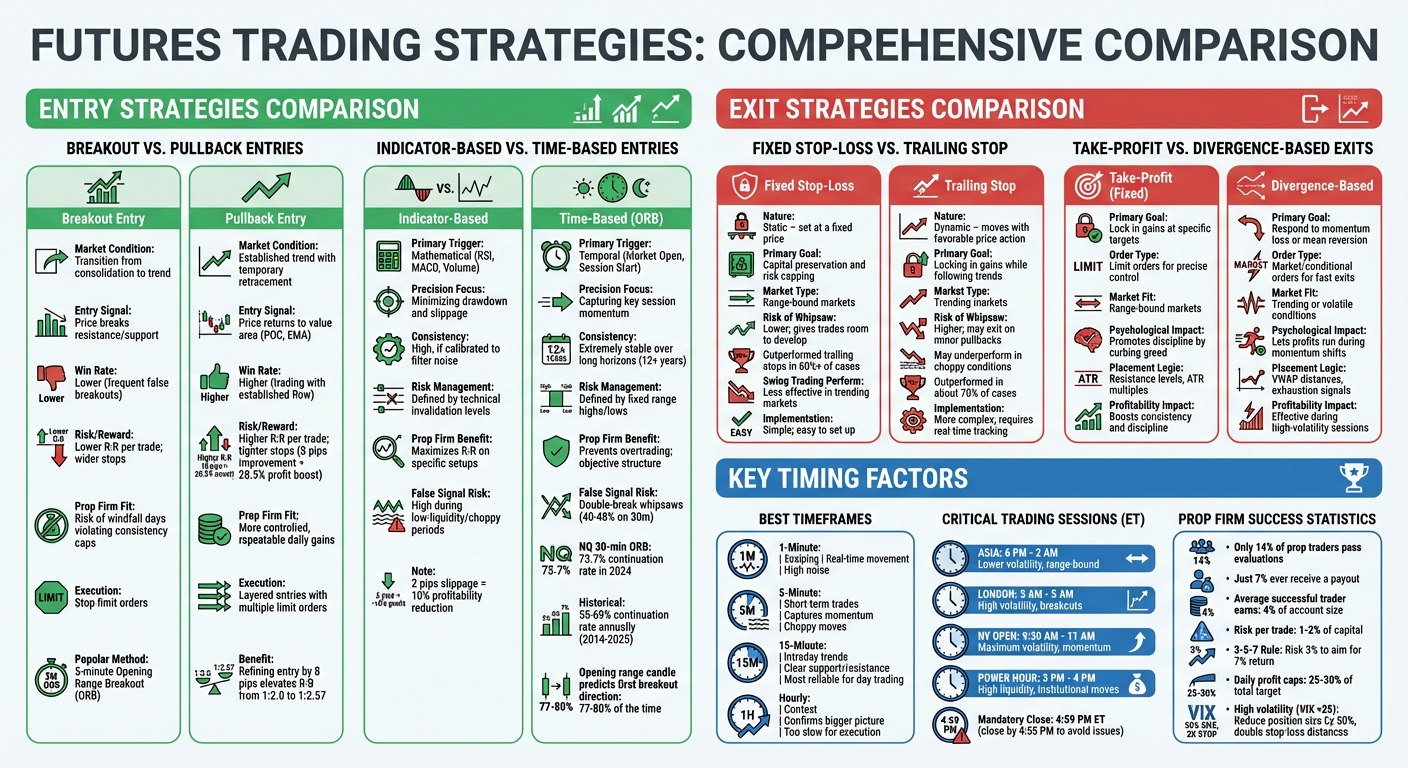
The key difference lies in risk and potential reward. Pullback entries often allow for tighter stop-losses since you’re entering closer to the "structural invalidation point" – the level where your trade idea is no longer valid. This tighter stop can significantly improve your reward-to-risk (R:R) ratio. For example, refining your entry by just 8 pips can elevate your R:R from 1:2.0 to 1:2.57, boosting profits per trade by 28.5%. Breakout entries, however, typically need wider stops to account for initial volatility and the risk of "whipsaws" – false breakouts that quickly reverse.
Pullback strategies are known for higher win rates but yield smaller individual profits. Breakout strategies, while prone to false signals, can capture larger market moves. For prop firm traders, this distinction is crucial. Many firms cap daily profits at 25–30% of your total target. A single large breakout win could breach these limits, forcing you to extend your trading days to balance the percentages.
Execution methods differ for each strategy. Pullback traders often use "Layered Entries", scaling into positions with multiple limit orders at key levels like the Point of Control (POC). Breakout traders, on the other hand, rely on stop-limit orders to avoid chasing price if it moves too far beyond the trigger level. As BellsForex puts it:
Precision execution is not a search for perfection, but a systematic effort to maximize the profit potential of every setup while minimizing exposure to unnecessary drawdown.
A popular breakout technique is the 5-minute Opening Range Breakout (ORB), which uses the high and low of the first five minutes of the New York session (9:30–9:35 AM EST) as key breakout levels. To avoid false breakouts, seasoned traders often wait for a retest – where the price breaks out, then returns to test the breakout level as new support or resistance before entering. Justin Trading highlights this:
The 5-minute ORB checks all the boxes: you only take one or two trades per day – reducing overtrading.
| Feature | Breakout Entry | Pullback Entry |
|---|---|---|
| Market Condition | Transition from consolidation to trend | Established trend with temporary retracement |
| Entry Signal | Price breaks resistance/support | Price returns to value area (e.g., POC, EMA) |
| Win Rate | Lower (frequent false breakouts) | Higher (trading with established flow) |
| Risk/Reward | Lower R:R per trade; wider stops | Higher R:R per trade; tighter stops |
| Prop Firm Fit | Risk of windfall days violating consistency caps | More controlled, repeatable daily gains |
For prop firm traders, such as those working with Apex Trader Funding, pullback entries often align better with consistency rules.
Indicator-Based Entries vs. Time-Based Entries
Indicator-based entries rely on technical tools like RSI, MACD, or Bollinger Bands to generate objective signals. These methods offer clear, rule-based triggers but can lag in fast-moving markets. Time-based entries, on the other hand, use specific times or sessions – like market opens – to capitalize on institutional activity and trending movements.
Indicator-based strategies excel in providing consistency through mathematically defined conditions that can be backtested and replicated. However, their main drawback is the risk of lagging signals, especially during periods of low liquidity when choppy price action can produce false triggers. Even a small slippage of 2 pips can reduce profitability by up to 10%.
Time-based entries, such as the Opening Range Breakout, have demonstrated historical reliability. For instance, the NQ 30-minute ORB showed a 73.7% continuation rate in 2024, with continuation rates ranging between 55–69% annually from 2014 to 2025. Additionally, the opening range candle’s internal direction predicts the first breakout direction 77–80% of the time across various timeframes.
For prop firm traders, time-based strategies offer a crucial advantage: they naturally limit overtrading by restricting trade windows to specific sessions. This structure helps prevent profit spikes that could violate consistency rules. Using a consistency calculator can help you stay within these limits. As TradingStats puts it:
The ORB is not a trade signal – it is a framework. The raw breakout tells you the market broke. The context tells you whether to trust it.
A professional approach often blends both methods. Traders may identify setups using indicators on higher timeframes and then confirm entries with lower timeframe momentum candles, such as a Bullish Engulfing pattern, for precise execution. This combination aligns with the precision and risk control needed for prop trading.
| Feature | Indicator-Based Entries | Time-Based Entries (e.g., ORB) |
|---|---|---|
| Primary Trigger | Mathematical (RSI, MACD, Volume) | Temporal (Market Open, Session Start) |
| Precision Focus | Minimizing drawdown and slippage | Capturing key session momentum |
| Consistency | High, if calibrated to filter noise | Extremely stable over long horizons (12+ years) |
| Risk Management | Defined by technical invalidation levels | Defined by fixed range highs/lows |
| Prop Firm Benefit | Maximizes R:R on specific setups | Prevents overtrading; objective structure |
| False Signal Risk | High during low-liquidity/choppy periods | "Double-break" whipsaws (approx. 40–48% on 30m) |
When deciding between these strategies, think about your trading style and prop firm expectations. Firms like Apex Trader Funding, Tradeify, and Topstep reward disciplined, repeatable methods that deliver steady results over flashy wins.
Trade Exit Strategies Compared
Exiting trades is just as important as entering them. While an entry strategy gets you into the market, your exit strategy determines whether you walk away with profits or losses. A well-timed exit can protect gains or limit risks, and the best approach often depends on market behavior, your trading style, and any rules imposed by your prop firm.
Stop-Loss Exits vs. Trailing Stop Exits
A fixed stop-loss sets a specific price level where you will exit a trade to limit losses. It stays in place unless you manually change it. A trailing stop, however, adjusts automatically as the trade moves in your favor, keeping a set distance from the current price.
The key difference is how they handle profits. Fixed stop-losses are great for minimizing potential losses but don’t protect unrealized gains. For instance, if the market moves in your favor and then reverses, a fixed stop won’t preserve those gains. Trailing stops, on the other hand, lock in profits by moving with the trade as it goes your way.
As Kamil from Markets&Manners points out, "the comfort of a trailing stop can sometimes cost more than it saves."
Market type plays a big role in choosing between these options. Fixed stop-losses work well in sideways or choppy markets, where price swings might prematurely trigger a trailing stop. Research shows that in day trading E-mini S&P 500 futures, fixed stops outperformed trailing stops in over 60% of tested strategies. However, for swing trading, trailing stops were more effective in about 70% of cases. Scalping strategies generally favor fixed stops since market noise can easily trigger trailing stops before the trade has a chance to develop. Most professional traders also limit their risk to 1–2% of their total trading capital per trade.
A hybrid method combines the two: start with a fixed stop-loss to define risk, then switch to a trailing stop once gains reach 1.5–2 times the initial risk. Using the Average True Range (ATR) to set stop distances – typically 1.5 to 2 times the ATR – can help account for market volatility. However, moving stops to break-even too soon can be risky, as markets often retest entry points before continuing in your favor.
For prop firm traders using platforms like Apex Trader Funding or Tradeify, understanding drawdown rules is crucial. Many firms use an End-of-Day (EOD) Trailing Drawdown model, where the drawdown floor rises with the day’s closing balance. When closing trades near the 4:59 PM ET deadline, market orders are usually preferred over limit orders to ensure execution.
| Feature | Fixed Stop-Loss | Trailing Stop-Loss |
|---|---|---|
| Nature | Static – set at a fixed price | Dynamic – moves with favorable price action |
| Primary Goal | Capital preservation and risk capping | Locking in gains while following trends |
| Market Type | Works best in range-bound markets | Ideal for trending markets |
| Risk of Whipsaw | Lower; gives trades room to develop | Higher; may exit on minor pullbacks |
| Day Trading Performance | Outperformed trailing stops in 60%+ of cases | May underperform in choppy conditions |
| Swing Trading Performance | Less effective in trending markets | Outperformed in about 70% of cases |
| Implementation Complexity | Simple; easy to set up | More complex; requires real-time tracking |
Take-Profit Exits vs. Divergence-Based Exits
Both take-profit and divergence-based exits aim to secure gains, but they rely on different methods and suit different market scenarios.
Take-profit (TP) exits involve setting predefined price levels – such as resistance zones, measured-move projections, or multiples of the ATR – where trades automatically close. This approach helps traders avoid the temptation to hold out for more and risk losing gains. Structured TP orders also promote discipline by sticking to the plan.
Divergence-based exits, on the other hand, focus on identifying when market momentum weakens or a trend is reversing. These exits use indicators to detect signs of exhaustion or mean reversion. Fixed TP levels work best in mean-reverting markets with quick, repeatable trades, while divergence-based exits are better for trending markets that allow for larger moves.
Execution is another important factor. TP exits typically use limit orders to lock in a specific price, while divergence-based exits often rely on market orders for faster execution. This distinction is especially relevant near the end of the trading day, where failing to close positions by the mandatory flat time (around 4:59 PM ET) can lead to auto-liquidation and unfavorable fill prices.
One popular divergence-based strategy is the VWAP reversion, which targets the Volume Weighted Average Price as a magnet when prices are significantly overextended. Brett Simba from Tradeify explains:
"If price is significantly overextended from the VWAP by 3:00 PM, look for exhaustion candles. Fade the move, targeting the VWAP line as the ‘magnet’ price into the close."
Using volatility-adjusted targets – like ATR multiples – rather than arbitrary numbers can reduce second-guessing. Combining methods, such as taking partial profits with a trailing stop, balances discipline with the potential for additional gains. Many traders also use One-Cancels-Other (OCO) orders, where executing one order automatically cancels another, to simplify this process.
For traders at firms like Take Profit Trader, FundedNext Futures, or Alpha Futures, the Power Hour (3:00 PM–4:00 PM ET) is a crucial time. During this period, institutions rebalance portfolios, leading to high trading volume and liquidity flushes. This makes it an ideal window for executing exit strategies, whether based on daily range breakouts or VWAP reversions. To avoid technical issues, it’s smart to close all positions by 4:55 PM ET.
| Feature | Take-Profit (Fixed) Exits | Divergence-Based Exits |
|---|---|---|
| Primary Goal | Lock in gains at specific targets | Respond to momentum loss or mean reversion |
| Order Type | Limit orders for precise control | Market/conditional orders for fast exits |
| Market Fit | Best for range-bound markets | Ideal for trending or volatile conditions |
| Psychological Impact | Promotes discipline by curbing greed | Lets profits run during momentum shifts |
| Placement Logic | Resistance levels, ATR multiples, etc. | VWAP distances, exhaustion signals, etc. |
| Profitability Impact | Boosts consistency and discipline | Effective during high-volatility sessions |
Timing Factors in Futures Prop Trading
Best Timeframes for Entry and Exit
Picking the right timeframe can make or break your trading strategy. Experienced traders often use a mix of charts: daily for trends, hourly for overall direction, 15-minute for setups, and 5- or 1-minute charts for pinpointing entry and exit points.
The 15-minute chart is a favorite for many day traders because it balances short-term trend identification with reduced market noise. As Patrick Wieland explains:
The 15-minute chart is often considered the most reliable time frame for day trading because it captures short-term trends without excessive noise.
For scalpers and high-frequency traders, 1-minute and 5-minute charts offer a closer look at real-time price movements, though they come with the risk of false signals. A smart approach involves validating the trend on a higher timeframe (like the hourly chart), planning setups on the 15-minute chart, and executing trades on a 5-minute chart for precision.
| Time Frame | Best For | Pros | Cons |
|---|---|---|---|
| 1-Minute | Scalping | Real-time movement | High noise, false signals |
| 5-Minute | Short-term trades | Captures momentum | Prone to choppy moves |
| 15-Minute | Intraday trends | Clear support/resistance | May miss ultra-short moves |
| Hourly | Context | Confirms bigger picture | Too slow for execution |
Prop Firm Rules and Consistency Requirements
Beyond chart timeframes, understanding and following firm-specific timing rules is crucial for success in prop trading. Many futures prop firms require positions to be closed by 4:59 PM ET to avoid violations. Brett Simba highlights the importance of this:
If you are trading with a prop firm like Tradeify, understanding End of Day trading is not just a strategy; it is a survival skill.
To avoid last-minute execution issues, aim to close positions by 4:55 PM ET. Use market orders to ensure execution, as limit orders may not fill if the market moves quickly.
Timing also plays a role in drawdown models. Firms with End-of-Day (EOD) Trailing Drawdown – like Tradeify’s Growth or Lightning accounts or Apex Trader Funding’s EOD accounts – calculate the drawdown floor based on the closing balance at 4:59:59 PM ET. This gives traders more flexibility during intraday volatility. On the other hand, intraday drawdown models adjust in real time, potentially forcing earlier exits.
Some firms also impose minimum trade duration rules to discourage micro-scalping. For example, firms like FundedNext may flag accounts where 40% or more of total profit comes from trades lasting less than 10 seconds.
The "Power Hour" (3:00 PM–4:00 PM ET) is a pivotal trading period. This hour often sees heavy institutional activity from Market on Close (MOC) orders and portfolio adjustments. A breakout above the day’s high around 3:15 PM, coupled with strong volume, can lead to a rapid squeeze into the close.
| Trading Session | Time (ET) | Characteristics |
|---|---|---|
| Asia | 6 PM – 2 AM | Lower volatility, range-bound |
| London Open | 3 AM – 5 AM | High volatility, good for breakouts |
| NY Open | 9:30 AM – 11 AM | Maximum volatility, momentum |
| Power Hour | 3 PM – 4 PM | High liquidity, institutional moves |
During Tier 1 news events, avoid trading within 2- to 5-minute windows, as many firms enforce this as a rule. Similarly, avoid entering trades when a product is within 2% of its CME price limit, as this is often flagged as a high-risk or rule-violating move.
For traders working with firms like Take Profit Trader, FundedNext Futures, Alpha Futures, Lucid Trading, or Topstep, staying updated on rule changes is essential. For instance, Apex Trader Funding introduced significant rule changes in March 2026, impacting drawdown and position sizing strategies.
To navigate these evolving requirements, tools like the Consistency Rule Calculator and verified reviews on DamnPropFirms can be valuable resources for staying compliant and improving your trading game.
Combining Entry and Exit Strategies
Pairing entry and exit strategies effectively is a cornerstone of success in futures prop trading. For example, a breakout entry combined with a trailing stop can harness momentum while managing the risk of reversals. When the price breaks above resistance with a surge in volume (at least double the average), the trailing stop moves upward as the price advances. This locks in profits while the trend continues to develop.
This method works well with End-of-Day (EOD) Trailing Drawdown accounts, like those provided by Tradeify or Apex Trader Funding. In these accounts, the drawdown floor updates at 4:59 PM ET based on your closing balance. This setup offers more flexibility for intraday swings compared to real-time intraday models, making it a great complement to high-probability entry strategies.
Timing your entries during high-probability moments, such as the Opening Range Breakout (ORB), can significantly improve trade outcomes. For instance, entering on a confirmed breakout – validated by a 5-minute candle close rather than a wick touch – can reduce false signals by about 14%. These precise entry methods lay a solid foundation for effective exit strategies.
For traders working under microscalping rules, where over 50% of trades must last longer than 10 seconds, trailing stops naturally extend trade durations to meet these requirements. If trading during the Power Hour (3:00 PM–4:00 PM ET), focus on high-volume breakouts above the day’s high and close positions by 4:55 PM ET using market orders to comply with firm guidelines.
| Strategy Combination | Entry Signal | Exit Strategy | Best For |
|---|---|---|---|
| Breakout + Trailing Stop | Range break with 2× volume | Trailing stop behind price | EOD Drawdown accounts |
| ORB + Fixed Target | 30-min ORB confirmation | 1.0× range extension (64.3% hit rate) | All account types |
| VWAP Reversion + Target | Price significantly overextended from VWAP | Exit at the VWAP line | Growth accounts |
To ensure your combined strategy aligns with firm rules, tools like the Consistency Rule Calculator on DamnPropFirms can help. These tools are especially useful for avoiding single-day profit cap violations – typically set at 20%–40% of total gains – which could prevent payouts at firms like Take Profit Trader, FundedNext Futures, or Alpha Futures.
Conclusion
Successfully navigating entry and exit strategies is what separates profitable prop traders from those who struggle to pass evaluations. While a well-timed entry opens the door to opportunity, it’s the exit that ultimately determines your profit or loss – making it a critical component of your trading strategy. The statistics are eye-opening: only 14% of prop traders pass evaluations, and just 7% ever receive a payout, with the average successful trader earning roughly 4% of their account size.
Planning your exits before entering a trade is essential. Define your risk-reward ratio in advance; experienced traders typically risk only 1%–2% of their account per trade. A useful guideline is the 3-5-7 rule: risk 3% of your capital per trade to aim for at least a 7% return. This structured approach minimizes emotional decision-making and ensures alignment with prop firm requirements, such as consistency rules and daily loss limits. This kind of preparation becomes even more crucial when markets are volatile.
Adaptability is key in changing market conditions. For instance, during periods of high volatility (VIX above 25), reducing position sizes by 50% and doubling stop-loss distances can help prevent premature exits. In trending markets, trailing stops can lock in profits dynamically, while tools like Average True Range (ATR) multiples can help set targets adjusted for volatility. For futures traders working with firms such as Apex Trader Funding or Tradeify, understanding drawdown mechanics – whether End-of-Day (EOD) or intraday models – is crucial for managing risk during volatile sessions. While strategies may need to shift with the market, strict adherence to firm rules remains non-negotiable.
Following firm-specific rules is critical. As Brett Simba aptly states:
Understanding End of Day trading is not just a strategy; it is a survival skill.
Tools like the Consistency Rule Calculator on DamnPropFirms can help you stay within profit caps and avoid violations that might jeopardize payouts at firms like Take Profit Trader, Alpha Futures, or FundedNext Futures.
FAQs
How do I choose between breakout and pullback entries?
Choosing between breakout and pullback entries comes down to your trading approach and how much risk you’re comfortable taking.
- Breakout entries involve jumping in when the price pushes strongly above resistance, indicating a possible trend continuation. However, these can be tricky because of the chance of false breakouts.
- Pullback entries wait for the price to retrace back to a support or resistance level after a breakout. This approach generally offers a more cautious entry with reduced chances of false signals.
The best choice depends on how you trade and the level of risk you’re willing to take. Make sure your decision matches your overall strategy.
When should I use a fixed stop versus a trailing stop?
A fixed stop is perfect when you need to set a specific exit price to limit losses or lock in profits. This approach is especially useful in ranging markets or when prices are near clear support or resistance levels. On the other hand, a trailing stop shines in trending markets. It adjusts upward as prices climb, helping secure gains while leaving room for further potential upside. For long positions, it only moves upward and remains unchanged if the market turns against you.
How can I avoid prop firm timing rule violations near 4:59 PM ET?
To steer clear of timing rule violations close to 4:59 PM ET, it’s important to understand your prop firm’s trading hours and any auto-close policies they have in place. Aim to close your positions at least 10-15 minutes before the cutoff to avoid potential delays or unexpected market issues.
If your firm offers an auto-liquidation feature, consider using it to help ensure you stay compliant with their rules. Additionally, pay attention to overnight positions – while some firms may allow overnight trading, they might still enforce strict end-of-day rules, so it’s crucial to know the specifics.