Prop firm pricing plans can be tricky, but understanding the costs upfront can save you hundreds. Here’s what you need to know:
- Evaluation Fees: Typically range from $59 to $350 for a $50,000 account. Discounts can reduce these fees significantly.
- Reset Fees: If you fail, expect to pay $59–$169 per reset. Some firms charge more for funded account resets.
- Activation Fees: After passing, fees range from $0 to $300, though many firms waive this cost.
- Profit Splits: Most firms offer 80–90%, with some going up to 100% for initial profits.
- Hidden Costs: Watch out for platform fees, data fees, and drawdown rules that may inflate your total spend.
Key takeaway: While some firms advertise low fees, multiple resets or hidden charges can push your total spend to $400–$600 or more before you even start trading live. Make sure to read the fine print and leverage discounts to minimize costs.
For a quick comparison of leading firms like Apex Trader Funding, Take Profit Trader, and FundedNext Futures, keep reading.
Prop Firm Pricing Comparison: Fees, Profit Splits, and Payout Terms
Prop Firm Fee Structures Explained
Types of Fees You’ll Encounter
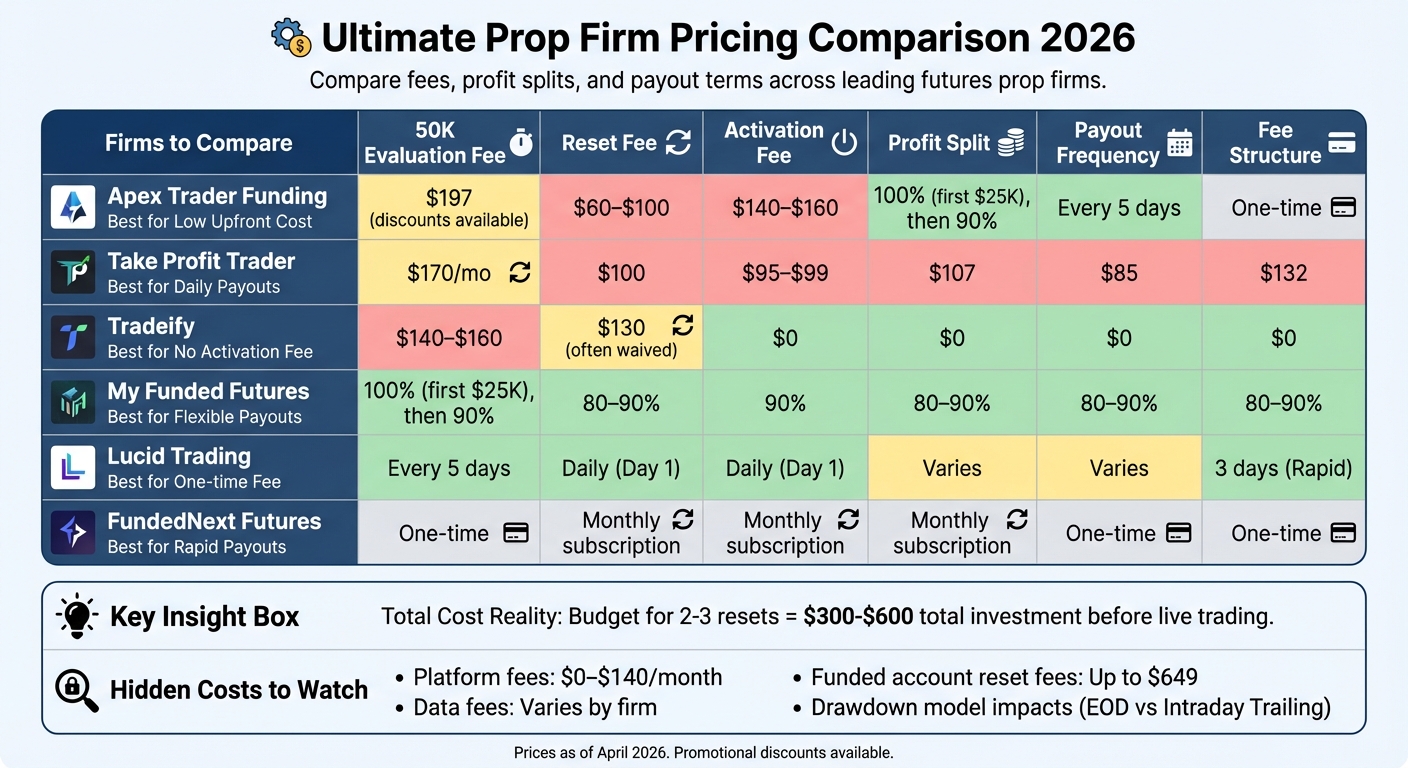
When signing up with a prop firm, you’ll encounter a variety of charges. Evaluation fees are the first hurdle. For example, Apex Trader Funding charges about $197 for a standard 50K evaluation, while My Funded Futures offers a more affordable $107 monthly option.
Reset fees can add up quickly, especially if you need multiple attempts to pass. These fees typically range from $59 to $169 per reset, but some firms charge much more for funded account resets. For instance, Take Profit Trader‘s PRO funded reset is priced at a steep $649.
Activation fees come into play after passing the evaluation. While firms like Tradeify and Lucid Trading charge nothing for activation, others, such as Apex, require fees in the range of $140 to $160 to activate your funded account. Additionally, data and platform fees can range from $0 to $140 monthly, though many firms waive these fees during the evaluation phase.
The cost structure is also influenced by the drawdown model. Intraday trailing drawdowns, used by firms like Apex and Take Profit Trader’s PRO accounts, adjust in real-time with unrealized profits. This model often leads to more frequent breaches and higher reset costs compared to End-of-Day (EOD) models, which only calculate at the close of the trading day.
| Firm | 50K Eval Fee | Reset Fee | Activation Fee |
|---|---|---|---|
| Apex Trader Funding | $197 (with discounts) | $60–$100 | $79–$109 |
| Take Profit Trader | $170/mo | $100 | $130 (often waived) |
| Tradeify | $159/mo | $95–$99 | $0 |
| My Funded Futures | $107/mo | $107 | $0 |
| Lucid Trading | $130 (one-time) | $85 | $0 |
| FundedNext Futures | $150 | $132 | $0 |
Understanding these fees is crucial to navigating the financial commitment, whether you’re dealing with recurring charges or one-time payments.
One-Time vs. Recurring Fees
Your fee structure choice depends largely on how quickly you plan to pass your evaluation. Recurring subscription models charge you monthly until you pass or fail. For example, Alpha Futures offers a $79/month subscription, while Tradeify just switched to a one time billing plan. These plans can be cost-effective if you’re confident in passing within a single billing cycle.
On the other hand, one-time evaluation fees provide flexibility, allowing you to take as long as needed without additional charges. Lucid Trading, for instance, charges a flat $130, which becomes a better deal if it takes you more than two months to pass. Compare this to Tradeify’s Compare this to Tradeify’s $159 one time plan 59 one time plan by looking at the best futures prop firms: if it takes three months to pass, you’d pay $477 – far more than the one-time fee.
Once you’re funded, the fee structure changes again. Some firms, like Apex, charge ongoing monthly fees for "Performance Accounts" – $85/month or a $140 lifetime option. Others, such as Take Profit Trader, charge a one-time $130 activation fee with no recurring costs, making them a better option for long-term traders.
Hidden Costs to Watch For
Beyond the obvious charges, there are hidden costs that can significantly affect your overall investment. The advertised price often doesn’t reflect the full expense. Reset and activation fees, for instance, can push your total investment far beyond the initial headline price.
"The real cost of getting funded is rarely the number advertised on the checkout page." – Kane Simons
It’s wise to budget for at least 2–3 resets, which can bring your total spend to $300–$600 before you even place your first live trade. Additionally, keep an eye out for platform and data fees that may kick in once you’re funded, potentially adding up to $140 per month. Other less obvious costs include scaling add-ons and high reset fees for funded accounts, which aren’t always prominently displayed on pricing pages.
The drawdown calculation method also plays a role in overall costs. Intraday trailing drawdowns, which adjust with unrealized profits, lead to higher chances of account failure compared to EOD models. EOD drawdowns only update at market close, offering traders more flexibility and reducing the likelihood of breaches.
sbb-itb-46ae61d
Don’t Get Scammed: 8-Step Prop Firm Evaluation Guide (2026)
Profit Sharing and Payout Models
When it comes to understanding how much you’ll actually take home from your trading efforts, profit sharing models are just as important as fee structures. They play a major role in shaping your net returns.
How Profit Splits Work
Profit splits determine how much of your trading gains you keep. Most firms offer splits ranging from 70% to 90%, but the game changed in 2026 when Apex Trader Funding introduced a 100% payout split on approved withdrawals. Of course, this comes with specific caps and limitations.
For higher splits, firms often enforce strict rules like the 50% consistency rule. This rule prevents a single trading day from contributing more than half of your total profits, encouraging a steady trading approach rather than relying on one lucky streak. Firms such as Take Profit Trader and Tradeify offer 80-90% splits with similar consistency requirements. When paired with clear fee structures, these models help traders better predict their profitability – something this guide aims to address.
Payout Schedules and Withdrawal Limits
The timing of payouts is another key factor to consider. Firms like Take Profit Trader and Tradeify’s Select program allow daily payouts starting on day one, while Apex requires five qualifying trading days before you can make a withdrawal. On the other hand, Instant Funding’s IF1 program processes payouts within 24 hours.
Withdrawal limits also play a role in your overall returns. Apex operates with a "Safety Net" system, requiring your account balance to remain above the drawdown limit plus $100. For example, on a $50,000 account, you must maintain at least $52,100 to withdraw funds. If you’re taking the minimum $500 payout, the threshold drops slightly. Apex also introduced a 6-payout ladder system in March 2026. For a $150,000 account, the first withdrawal is capped at $2,500, gradually increasing to $5,000 by the sixth payout. The total lifetime limit for such an account is $20,500 before it closes.
| Firm | Payout Frequency | First Payout Eligibility | Profit Split |
|---|---|---|---|
| Take Profit Trader | Daily | Day 1 | 80-90% |
| Tradeify (Select) | Daily | Day 1 | 90% |
| Apex Trader Funding | Every 5 days | 5 Qualifying Days | 100% (up to caps) |
| FundedNext Futures | 3 days (Rapid) | 3 days | 80 |
Grasping these payout schedules and limits is vital for planning your trading strategy and scaling your operations.
How to Scale Your Account
Profit sharing models also play a big role in scaling your trading. Scaling often involves managing multiple accounts, and Apex allows traders to handle up to 20 active Performance Accounts using copy-trading software. If you fully utilize this option with 20 $150,000 accounts, your combined payout potential across the 6-payout cycle could total $410,000 to $430,000.
The type of drawdown model you choose can make or break your scaling efforts. End-of-Day (EOD) models only update at market close, giving you more flexibility during the trading day. In contrast, Intraday trailing drawdowns adjust in real-time with unrealized profits, which can be risky if your trades retrace before you close them. EOD models are generally more forgiving and help reduce the chances of breaching multiple accounts at once.
Some firms also offer tier-based scaling. As your account grows, they automatically increase your Daily Loss Limit and maximum contract sizes. This allows you to trade larger positions without having to pass extra evaluations. However, consistency rules and safety net requirements still apply, so careful planning is essential.
Evaluation vs. Instant Funding Pricing Models
Let’s dive into the key differences between evaluation-based and instant funding models. Choosing the right one boils down to balancing cost against speed. Each model has distinct pricing structures, profit splits, and rules, all of which can influence your trading strategy and outcomes.
Costs and Profit Splits Compared
Evaluation models are generally easier on the wallet. For a $50,000 account, fees typically fall between $50 and $250 upfront. For example, Tradeify charges about $97 for its $50,000 Growth Evaluation, while Apex Trader Funding’s fee is around $197 – though promotions offering 70–90% discounts are common. Some firms also tack on an activation fee, ranging from $0 to $150, after you pass the evaluation. Even with these added costs, total expenses usually stay under $400 [8,9,10].
Instant funding, on the other hand, offers immediate access to trading capital but at a significantly higher cost. Activating a $50,000 account can cost anywhere from $244 to over $2,000. For instance, Tradeify’s Lightning model charges approximately $356 for a $50,000 account. Brett Simba from Tradeify explains it this way:
"The higher upfront fee of a Lightning account… serves as a premium paid for speed and efficiency".
Profit splits also vary widely between the two models. Accounts gained through evaluation often reward traders with higher profit splits – typically 80–90% – to acknowledge the discipline required to pass. Instant funding accounts, however, tend to offer lower splits, generally ranging from 50% to 80%, though some firms like Tradeify maintain a 90% split across all account types. To put it in perspective, a $100,000 evaluation account might cost about $150 with a 90% profit split, while an instant funding account for the same amount could cost $1,000 with a 60% split.
Speed and Flexibility Differences
Instant funding is all about speed. It gives traders immediate access to capital without requiring them to prove their skills first. In contrast, evaluation-based models require traders to demonstrate their proficiency, which can take anywhere from 1 to 15+ trading days. For example, Apex Trader Funding mandates five qualifying trading days before releasing your first payout, while other firms might require hitting profit targets, such as $3,000 on a $50,000 account [8,11].
Flexibility is another area where these models differ. Evaluation models often allow traders more choice in drawdown types, like End-of-Day (EOD) or intraday trailing, during the testing phase. Instant funding models, however, sometimes come with stricter rules. For instance, Tradeify’s Lightning model uses a progressive consistency rule that tightens over time – from 20% on the first payout to 30% by the third [8,13].
There’s also a psychological element to consider. The higher upfront cost of instant funding can add pressure, while evaluation models provide a lower-cost way to build consistent trading habits. As Michael Patak, Founder and CEO of Topstep, puts it:
"Test your strategy in a trading combine, and set yourself up for success in a funded account".
Evaluation vs. Instant Funding Comparison
Here’s a quick comparison of the two models:
| Feature | Evaluation-Based Model | Instant Funding Model |
|---|---|---|
| Account Size Range | $10,000 – $150,000+ | $10,000 – $150,000+ |
| Entry Fee Range | $50 – $250 | $244 – $2,000+ |
| Activation Fee | $0 – $150 (post-pass) | $0 (included in entry) |
| Profit Split | 80% – 90% | 50% – 90% |
| Time to Access | 1 to 15+ Trading Days | Immediate (0 Days) |
| Consistency Rule | 35% – 40% (Typical) | 20% – 30% (Often Progressive) |
| Monthly Fees | Sometimes during evaluation | Usually none (one-time fee) |
For traders with limited funds, evaluation models are appealing due to their lower costs and higher profit splits. On the other hand, experienced traders who value time over cost may find instant funding to be a better fit.
Discounts, Refunds, and Ways to Save Money
Prop trading firms are constantly competing to offer savings, from steep evaluation discounts to retry-friendly policies. Knowing how to take advantage of these opportunities can help you save hundreds – or even thousands – over time.
Available Promotional Discounts
Promotional discounts on evaluation accounts are one of the easiest ways to cut costs. For example, Apex Trader Funding frequently offers discounts of 80% to 90% on evaluation fees. With promo codes from DamnPropFirms, a $50,000 evaluation that typically costs $167 can drop to just $17. These discounts apply to their new PA Lite and Pro+ plans, which require one-time, non-refundable payments and launched after March 1, 2026.
Similarly, Take Profit Trader offers 40% off evaluations through promo codes like code DGT, while FundedNext Futures provides bundle discounts of up to 40%, saving traders anywhere from $100 to $500 per activation. Some firms, such as Take Profit Trader and Lucid Trading, even waive activation fees entirely for funded accounts after evaluations.
Timing your purchases can also maximize savings. Sales events like Black Friday often include site-wide promo codes that knock off an additional 10%–15%. For instance, bundling multiple account sizes at Apex Trader Funding – like a $25,000 and a $50,000 account – can reduce a $657 bundle to just $49 with a promotional code like DGT, offering over 90% in savings.
But discounts aren’t the only way to save. Refund and retry policies can further reduce your financial risk.
Refund and Retry Policies
Refund and retry policies vary between firms, and understanding these terms can help you avoid unnecessary expenses. For instance, Take Profit Trader offers a full refund on your first failed evaluation if you stay within a 5% drawdown limit and request it within 30 days. They also provide free retries for smaller accounts, making them a solid choice for beginners.
Topstep has a 14-day refund window but deducts a $50 processing fee. While they don’t offer free retries, discounted evaluations are available through DamnPropFirms, keeping losses below $100.
Retry policies can also make a big difference. FundedNext Futures allows unlimited retries on the same account size for half the original fee. For example, if your first evaluation cost $199, a retry would only cost $99. On the other hand, Alpha Futures offers one free retry per quarter, helping to lower repeat expenses.
Refunds for successful evaluations are rare. Lucid Trading doesn’t refund fees once you’re funded, but Purdia offers up to an 80% refund within seven days if you fail without breaking major rules. Refunds are typically processed within 3 to 5 business days through the original payment method, and most firms require 5 to 10 winning days before you’re eligible for payouts.
How to Reduce Your Costs
Beyond discounts and refunds, there are practical strategies to minimize your expenses. Start by understanding drawdown rules before purchasing an evaluation. For example, Apex Trader Funding updated its rules in March 2026 to tighten consistency requirements. Choosing the wrong drawdown type – whether End-of-Day or Intraday trailing – can lead to unnecessary failures and costly resets. Comparing prop firms with the largest drawdown can help you find more forgiving limits. Tools like the Consistency Rule Calculator on DamnPropFirms can help you simulate your performance and avoid violations.
Consider firms with one-time fees instead of monthly subscriptions. For instance, Tradeify charges a single fee, removing the pressure of monthly deadlines and recurring costs. Also, avoid optional add-ons that might inflate your expenses unnecessarily.
To stay ahead, use real-time tools to track the latest discounts. DamnPropFirms offers a discount tracker with codes like APEX90 for 90% off, plus email alerts for flash sales. Many traders report saving 30% to 50% on average by checking these updates weekly. Combining discounts, refund options, and smart strategies can cut annual prop firm costs by over $1,000.
Top Prop Firm Pricing Plans Breakdown
Here’s an updated look at the top prop firm pricing plans as of April 2026. Below, you’ll find a detailed breakdown of the latest offerings from leading firms, helping you choose the plan that aligns with your trading goals.
Apex Trader Funding Pricing
Apex Trader Funding revamped its programs on March 1, 2026, introducing new EOD and Intraday Trailing Drawdown options. They now charge a one-time, non-refundable evaluation fee instead of monthly subscriptions.
With promotional pricing, a $50,000 evaluation costs approximately $35 to $37 (regularly $187), while a $25,000 account is around $29 (regularly $147). Larger accounts like the $100,000 evaluation are priced at about $57 (regularly $287), and a $150,000 account costs around $77 (regularly $387). Promo codes from DamnPropFirms can slash fees by 80% to 90%.
After passing the evaluation, traders can choose between an $85 monthly activation fee or a one-time $140 lifetime activation fee per Performance Account (PA). Payouts require 5 qualifying days, a $500 minimum, and reaching the "Safety Net" balance (drawdown limit plus $100). Apex enforces a 50% consistency rule, meaning no single trading day can exceed 50% of your total profit.
Apex allows traders to manage up to 20 active Performance Accounts simultaneously, making it ideal for scaling. However, there’s a 6-payout ladder cap: after six payouts, the account is either closed or transitioned to a live program. For instance, a $50,000 account’s first payout maxes out at $1,500, scaling up to $3,000 by the sixth payout. Additionally, Apex may limit the number of contracts once you move to a funded PA – for example, a $100,000 account might drop from 16 minis during evaluation to 6 minis in the PA.
"Apex Trader Funding currently offers the lowest upfront fees under promotional pricing – but the trailing drawdown eliminates more traders than any other rule."
- Gary M., Founder, Trader’s Second Brain
In early 2026, Apex removed the minimum trading days requirement, allowing traders to pass evaluations in just one day. With over 17,669 reviews and a 4.4/5 rating, Apex permits news trading on funded accounts (with an 8-minute restriction depending on the account type). For the latest rules, visit the Apex Trader Funding review page.
Take Profit Trader Pricing

Take Profit Trader operates on a virtual copy trading model. Trades are executed in a simulated environment and mirrored to a live account, which can cause slippage between the two.
A $50,000 Test evaluation costs $170 per month at regular pricing, or about $102 with a 40% discount via DamnPropFirms. Billing stops as soon as you pass the evaluation. Afterward, there’s a one-time $130 PRO activation fee with no recurring costs.
Take Profit Trader offers an 80/20 profit split, which can be upgraded to 90/10 on the PRO+ plan. There’s no strict consistency rule for withdrawals. During the test phase, the drawdown model is EOD Trailing, but it locks at the starting balance once the account closes at $100 above the initial balance – providing a permanent safety cushion.
"Take Profit Trader is the simpler, more forgiving choice for most futures traders… EOD trailing drawdown that locks at your starting balance."
- Gary M., Founder of TSB
If you fail, you’ll need to purchase a new Test evaluation. Discounts of 25% to 50% are often available through promo codes. Payouts are accessible from day one via Plaid, PayPal, and Wise. For more details, visit the Take Profit Trader review page.
FundedNext Futures Pricing
FundedNext Futures offers two main options: the Rapid Challenge and the Legacy Challenge. The Rapid Challenge allows payouts in just 3 days, while the Legacy Challenge supports managing up to 5 accounts simultaneously without consistency rules.
Pricing depends on the challenge type and account size. FundedNext provides bundle discounts of up to 40%, saving traders between $100 and $500 per activation. They also offer unlimited retries on the same account size for half the original fee – for example, if your first evaluation cost $199, a retry would cost $99. Additionally, traders can receive an 80% refund within seven days if they fail without breaking major rules. Profit splits and scaling options vary by challenge type. For the latest pricing, check the FundedNext Futures review page.
Top Prop Firms Pricing Comparison
Here’s a quick overview of the pricing structures for these firms:
| Firm Name | $50K Account Evaluation Fee | Activation Fee | Profit Split | Scaling Add-On Costs |
|---|---|---|---|---|
| Apex Trader Funding | ~$35–$37 (Sale) | $85/mo or $140 Lifetime | 100% (First $25K), then 90% | Tier-based scaling (Included) |
| Take Profit Trader | ~$102–$170 | $130 (One-time) | 80% (90% on PRO+) | PRO+ upgrade available |
| FundedNext Futures | Varies by Challenge | N/A | Varies by Challenge | N/A |
Apex offers the lowest upfront costs with promotional discounts but requires attention to its consistency rules and payout limitations. Take Profit Trader, while pricier, has a more forgiving drawdown model and no recurring fees after activation. FundedNext stands out for fast payouts and the ability to manage multiple accounts without consistency rules, making it a flexible option for traders.
For the latest discount codes and detailed comparisons, visit the review pages for Apex Trader Funding, Take Profit Trader, and FundedNext Futures.
How to Choose the Right Pricing Plan
What Traders Need to Remember
Selecting the right pricing plan from a prop firm isn’t just about grabbing the cheapest promo deal. The total cost of ownership (TCO) is the real factor to consider. For instance, while an evaluation might cost $40 upfront, additional expenses like reset and activation fees can push the total to $480 or more. To make an informed decision, focus on four cost elements: evaluation fees, reset fees, activation fees, and platform fees.
If you’re just starting out, consider beginning with a $25,000 or $50,000 account instead of going for the largest account size. This approach helps you minimize costs while learning the firm’s specific rules. Plan for 2–3 resets upfront, and look for firms that offer lower reset fees – some charge as little as $60, compared to others that go as high as $149. Additionally, some firms, such as Tradeify, Lucid Trading, and FundedNext Futures, waive activation fees entirely, saving you anywhere from $100 to $150.
Never pay full price if you can help it. Wait for promotional offers – these often include discounts ranging from 50% to as much as 90%, especially during holiday sales or flash events. For the most accurate and up-to-date fee details, check out the review pages for firms like Apex Trader Funding, Take Profit Trader, and FundedNext Futures. Understanding these costs will set you up for the next steps in picking the right plan.
Your Next Steps
Now that you have a better grasp of the costs involved, here’s how to move forward. Start by testing your trading strategy on a demo account. This will help you avoid unnecessary reset fees. Use tools like the Consistency Rule Calculator on DamnPropFirms to ensure that your trading style matches the firm’s payout requirements. For instance, rules like the 50% consistency rule can trip up even profitable traders if they’re not prepared.
Dive into the detailed review pages for firms such as Apex Trader Funding, Take Profit Trader, FundedNext Futures, Alpha Futures, Tradeify, Lucid Trading, Purdia, and Topstep to compare the latest discount codes, fee structures, and rule updates. The prop firm landscape changes frequently, so staying informed will ensure you find the right plan for your trading goals and budget.
FAQs
What’s the real total cost to get funded after resets and activation fees?
The overall cost of getting funded depends heavily on the proprietary trading firm you choose and their specific fee structure. Evaluation fees can range anywhere from $50 to over $1,000, while reset fees – charged when you fail an evaluation – typically fall between $50 and $169 per attempt.
Once you pass, there may also be activation fees, which can vary widely, from $0 to $800. On top of that, some firms charge monthly data fees, which can push the total expenses to anywhere between $400 and $1,200 or more, especially if multiple resets are involved or if the firm has additional charges.
Which drawdown type (EOD vs intraday trailing) is cheaper long-term?
A static drawdown tends to be more cost-effective over time because the maximum loss limit remains constant, no matter how much profit you make or how the market moves during the day. On the other hand, intraday trailing drawdowns, which adjust in real-time based on your peak equity, can be more expensive. They reduce your risk capacity during market fluctuations. Meanwhile, end-of-day (EOD) trailing drawdowns are often a less costly option. Since they only reset after the market closes, they provide greater flexibility for intraday strategies like scalping or swing trading.
Evaluation or instant funding: which is better for my budget and payout goals?
Instant funding firms provide a faster way to start live trading without the burden of recurring costs. For a one-time fee – usually ranging between $399 and $699 – traders can gain immediate access to a funded account. These programs often offer generous profit splits, sometimes up to 100%, and payouts can be processed in as little as 7 days.
On the other hand, evaluation programs may promise access to larger accounts, but they come with challenges. High failure rates (around 85–95%) and recurring fees make them a riskier and more expensive option. For those seeking lower costs and quicker payouts, instant funding is a more appealing choice.