Trade copying is a game-changer for traders managing multiple funded accounts. It automates the replication of trades from a master account to follower accounts in real-time, saving time and reducing errors. This technology is essential for scaling trading operations efficiently, especially when speed and accuracy are critical in volatile markets. Here’s a quick breakdown:
- What it does: Automatically mirrors trades, stop-losses, and profit targets across accounts.
- Key benefits: Saves time, minimizes errors, ensures consistent execution, and simplifies scaling.
- Risks: Latency issues, rule violations, and position sizing errors.
- Top tools: TradeSyncer (cloud-based) and Replikanto (NinjaTrader integration) are popular choices.
- Supported firms: Apex Trader Funding (up to 20 accounts), Take Profit Trader, and Lucid Trading allow trade copying, while some firms like Earn2Trade and TradeDay prohibit it.
Trade copying simplifies multi-account trading but requires careful setup, compliance with prop firm consistency rules, and robust risk management. Start small, test your setup, and scale cautiously to avoid pitfalls.
Benefits and Challenges of Trade Copying
Main Advantages of Trade Copying
Trade copying simplifies managing multiple funded accounts by removing the need for repetitive manual actions. For example, placing a trade on your master account automatically replicates it across all linked accounts using copy software. While manually executing trades across 10 accounts might take close to a minute, automation can complete the process in milliseconds.
This speed is critical, as manual execution often leads to missed opportunities or slippage, potentially costing traders up to 30% of their income. On volatile contracts like NQ or ES, even a brief delay of 1–2 seconds can result in significantly different fill prices or entirely missed trades.
With trade copying, scaling becomes much easier. You can apply the same strategy to anywhere from 3 to over 20 funded accounts at once. For instance, Apex Trader Funding allows up to 20 active accounts, while other firms like Topstep and Tradeify limit traders to 5 accounts. Modern trade copiers also handle position sizing automatically. For example, if your master account trades 1 full contract on a $100,000 account, the software can adjust this proportionally to 10 micros on a $25,000 follower account.
Another key benefit is the reduced mental strain. Focusing on a single master account minimizes the risk of "fat-finger" errors, like forgetting to set stop losses on one account or mistakenly entering duplicate trades. Automated systems synchronize stop losses and profit targets across all accounts, and many tools include emergency features like "panic buttons" to instantly close all positions during unpredictable market swings.
While the advantages are clear, trade copying also comes with its own set of challenges.
Common Risks and How to Avoid Them
Execution latency is one of the biggest technical risks. If your connection is slow, follower accounts might experience delays of several ticks. A latency of 5–10 seconds could even cause follower accounts to hit their loss limits, even if the master account remains profitable. Ensuring your setup is optimized for fast execution is essential.
Another challenge is rule violations, as different proprietary trading firms enforce unique policies. For instance, some firms have strict rules on news trading, daily loss limits, or consistency requirements. A trade that complies with your master account’s rules might break the daily loss threshold on a smaller follower account. Additionally, some firms, like TradeDay and Earn2Trade, explicitly ban trade copying between funded accounts, and violations can lead to immediate account termination.
Position sizing errors are another common issue. Managing accounts with varying balances, such as $50,000 and $150,000, requires precise calculations to avoid over-leveraging, especially in fast-moving markets. Using automated position multipliers, calculated as (Follower Account Size / Master Account Size), helps maintain proportional risk levels.
To minimize these risks, start by testing your setup on demo accounts for several days. This allows you to confirm that stop losses, partial exits, and position multipliers work correctly before trading live. Regularly monitor your central dashboard to track real-time performance metrics, connection status, and daily loss thresholds across all accounts. Finally, familiarize yourself with each firm’s specific rules – some use end-of-day drawdown (like Alpha Futures), while others, such as Topstep, rely on trailing drawdown. These differences require tailored risk management strategies.
How I Use a Trade Copier to Trade Multiple Prop Accounts [Full Tutorial]
In this video, I demonstrate how to sync executions across multiple accounts. If you haven’t chosen a tool yet, you can compare the top trade copying platforms to find one that fits your specific platform and broker setup.
Top Prop Firms That Allow Trade Copying
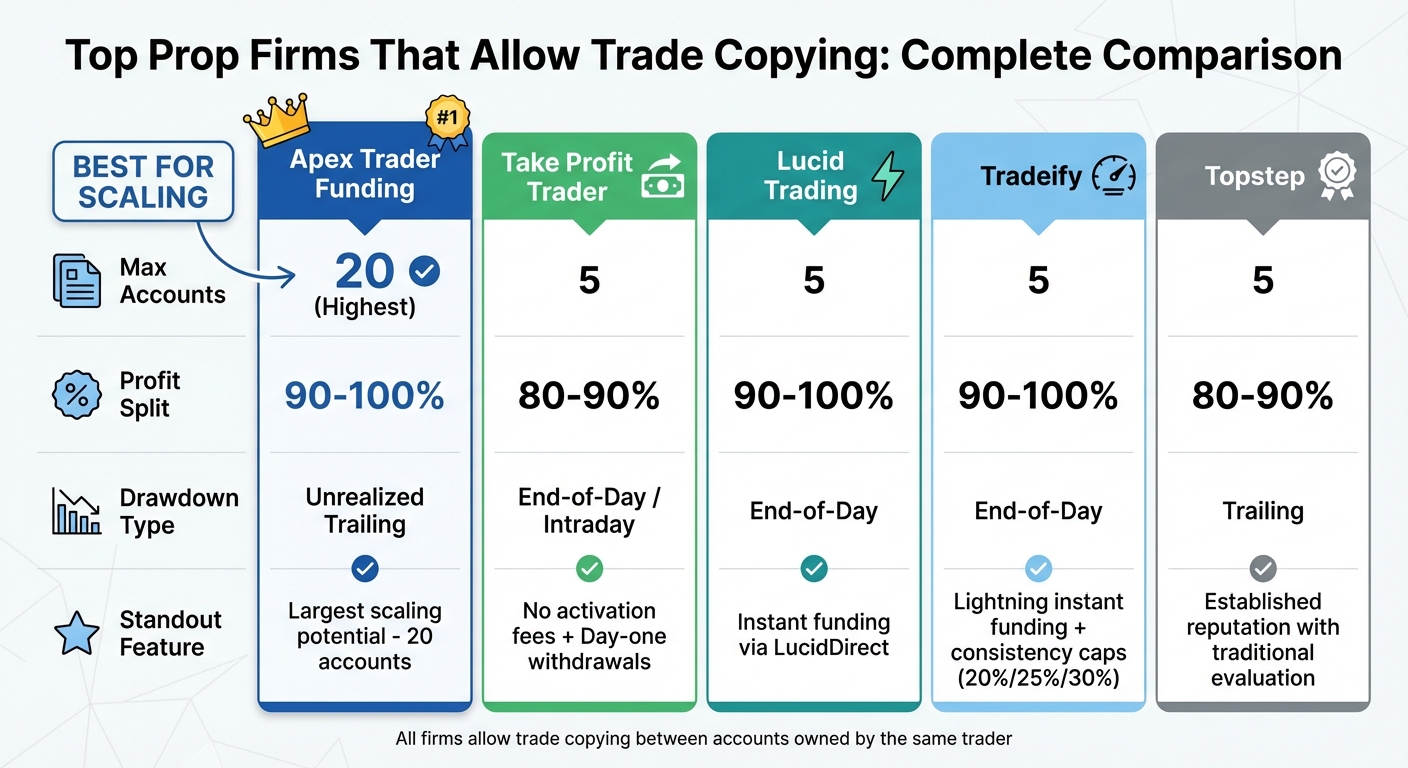
Top 5 Futures Prop Firms Trade Copying Comparison: Account Limits, Profit Splits & Features
When it comes to futures prop firms, not all of them support trade copying, and those that do often have specific rules and account limits. Knowing which firms provide multi-account management and understanding their policies is key to scaling your trading operations effectively. Here’s a look at some of the top firms that allow trade copying.
Apex Trader Funding
Apex Trader Funding stands out as the only futures prop firm that supports copy trading across up to 20 accounts. Traders enjoy a 90–100% profit split, keeping 100% of the first $25,000 in profit per account. Payouts are processed every 8 trading days, meaning if you manage 20 accounts, you could withdraw up to $70,000 in your first payout cycle. Since 2022, the firm has paid out over $500 million and boasts a 4.5/5 rating on Trustpilot with over 15,000 reviews.
Apex enforces a 30% consistency rule, ensuring no single trading day accounts for more than 30% of your total profits when requesting a payout. By stacking multiple $50,000 accounts, traders can aim for manageable profit targets (around $3,000) with activation fees as low as $140. During promotional periods, discounts can bring evaluation account costs down to just $33.40. For a deeper dive, check out our Apex Trader Funding review.
Take Profit Trader

Take Profit Trader supports copy trading for up to 5 live funded accounts. The firm is known for its trader-friendly policies, including:
- Day-one withdrawals
- No activation fees
- No consistency rules
It offers an 80–90% profit split and uses an end-of-day drawdown model during evaluations, switching to intraday drawdown for Pro accounts. These features make it ideal for traders looking to withdraw profits quickly. For more details, visit our Take Profit Trader review.
Lucid Trading
Lucid Trading allows copy trading for up to 5 accounts and offers instant funding through its LucidDirect program. With a 90–100% profit split and an end-of-day drawdown model, Lucid provides flexibility for traders. Its standout LucidFlex account removes consistency rules once funded, making it easier to manage profits across trading days. Additionally, Lucid charges no activation fees for both instant funding and evaluation accounts. Learn more in our Lucid Trading review.
Tradeify

Tradeify permits copy trading across up to 5 funded accounts per household. The firm offers Lightning instant funding, which skips the evaluation phase and lets traders start with funded capital immediately. Profit splits range from 90–100%, and the firm uses an end-of-day drawdown model.
Tradeify also enforces scaling consistency caps (20%, 25%, and 30% across successive payout cycles) to ensure no single trading day dominates profits. Additionally, at least 50% of trades and profits must come from trades held longer than 10 seconds to comply with microscalping rules. For traders using third-party tools like TradeSyncer, holding trades for at least 20 seconds is recommended to avoid latency issues. Read our Tradeify review for more information.
Topstep

Topstep supports trade copying with tools like TradeSyncer and allows up to 5 funded accounts. However, the firm has faced some execution challenges due to its ProjectX infrastructure. It uses a trailing drawdown model, which adjusts dynamically based on the account’s peak balance. While this model requires careful position sizing and risk management, Topstep remains a reputable choice for traders. For a detailed breakdown, check out our Topstep review.
| Prop Firm | Max Accounts | Profit Split | Drawdown Type | Standout Feature |
|---|---|---|---|---|
| Apex Trader Funding | 20 | 90–100% | Unrealized Trailing | Largest scaling potential with copy trading across 20 accounts |
| Take Profit Trader | 5 | 80–90% | End-of-Day / Intraday | No activation fees; day-one withdrawals |
| Lucid Trading | 5 | 90–100% | End-of-Day | Instant funding via LucidDirect; no activation fees |
| Tradeify | 5 | 90–100% | End-of-Day | Lightning instant funding with scaling consistency caps (20%/25%/30%) |
| Topstep | 5 | 80–90% | Trailing | Established reputation; traditional evaluation with a trailing drawdown model |
With these firms in mind, the next step is choosing the right tools to manage your multi-account trading setup efficiently.
sbb-itb-46ae61d
Popular Trade Copying Tools
Once you’ve selected a prop firm, the next step is finding the right tool to manage multiple accounts seamlessly. Automated trade replication tools can save time and reduce errors, but choosing the right one depends on your trading style and platform preferences. Below, we break down some of the leading tools, highlighting their features to help you choose from the best futures prop firms for your needs.
TradeSyncer: Multi-Account Management
TradeSyncer is a cloud-based platform boasting 99.9% uptime, which means you don’t need a VPS, local software, or a constantly connected desktop to use it. It works with popular platforms like NinjaTrader, Tradovate, TradingView, Rithmic, dxFeed, Quantower, and Sierra Chart. Trades are copied from lead to follower accounts in under 100 milliseconds on average, and the platform has already facilitated over 1,000,000 trades for more than 17,500 traders.
The browser-based Cockpit dashboard provides a centralized view to monitor P&L, win rates, and connection status across 50+ accounts. It also offers advanced copy methods, such as:
- Ratio Copying: Scale trades between accounts, like converting 1 contract in a lead account to 2 contracts in a follower account.
- Cross-Order Functionality: Copy trades between different contract types (e.g., standard NQ to micro MNQ), which is particularly useful for managing risk when working with smaller accounts.
TradeSyncer also includes automated risk controls, such as daily loss limits, profit targets, and position limits, helping traders stay compliant with prop firm rules. Every trade is logged automatically, eliminating the need for manual record-keeping. The platform is compatible with major firms like Apex Trader Funding, Topstep, and Take Profit Trader, provided it’s used exclusively for copying trades between a single trader’s accounts.
TradeSyncer offers a 7-day free trial, a 20% discount on annual plans, and an additional 10% off with the promo code "DGT." It has a 4.5/5 rating on Google Reviews, with users praising its speed and the convenience of not requiring a VPS.
Replikanto: Advanced Copying for NinjaTrader
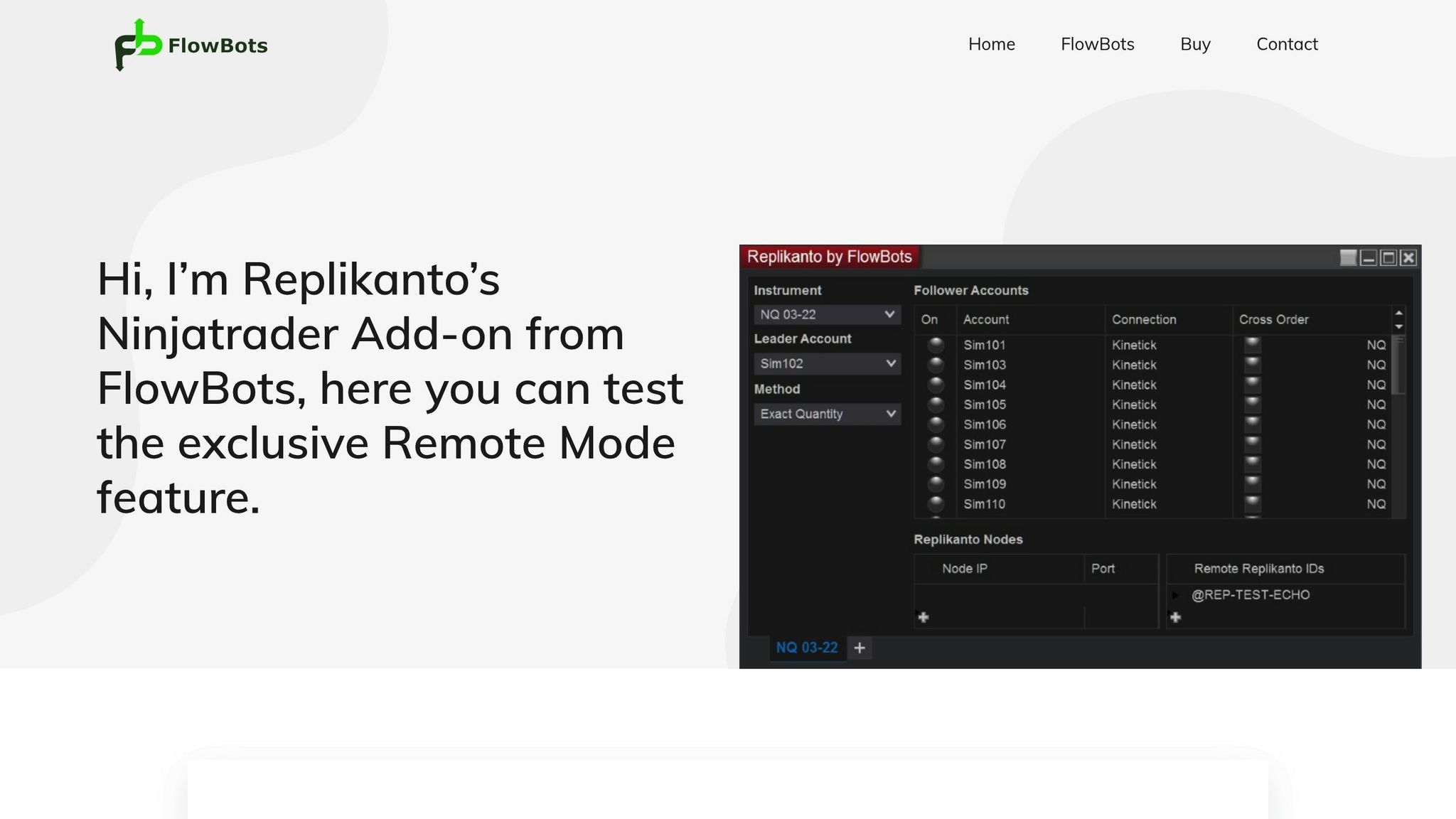
Replikanto integrates directly with NinjaTrader 8, offering real-time replication of ATM (Advanced Trade Management) strategies, including stops and targets, across follower accounts. This deep integration allows traders to manage replication settings entirely within NinjaTrader, making it an excellent choice for those who rely on the platform and need extensive customization options.
Key features include:
- Cross-Instrument Copying: Mirror trades from Mini contracts (e.g., ES/NQ) to Micro contracts (e.g., MES/MNQ).
- Follower Guard: Automatically disables accounts that breach risk limits.
- Stealth Mode: Conceals copier usage in logs.
- Network Mode: Enables replication across different computers or VPS instances via VPN or the internet.
"Replikanto is the most flexible and powerful solution I’ve found." – Roderick Casilli, Traders Dev Group
Available for a one-time fee of approximately $250 (2-machine license), Replikanto requires NinjaTrader to run on a local machine or VPS. Despite this, it’s widely regarded as an adaptable solution for managing multiple prop firm accounts.
Trade Copying Tools Comparison
Your choice of tool will depend on the platforms you use and your trading needs. For NinjaTrader users, Replikanto’s integration and customization options are hard to beat. Meanwhile, TradeSyncer’s cloud-based infrastructure is ideal for traders who work across multiple platforms. Here’s a quick comparison of the top options:
| Tool | Platform Compatibility | Risk Customization | Real-Time Execution | Prop Firm Support | Cost Structure |
|---|---|---|---|---|---|
| TradeSyncer | NinjaTrader, Tradovate, TradingView, Rithmic, dxFeed, Quantower, Sierra Chart | Daily loss limits, drawdown alerts, session lockouts, ratio copying | Under 100ms (cloud-based) | Universal (Apex, Take Profit Trader, Lucid Trading, etc.) | Subscription-based |
| Replikanto | NinjaTrader 8 with one Rithmic connection | Follower Guard, ATM Copy, Stealth Mode | Real-time (local/network) | Extensive (any NT-supported firm) | One-time (~$250) |
| ETP (Affordable Indicators) | NinjaTrader, TradingView, Tradovate, Rithmic | Risk dashboards, P&L controls | Low latency (local/VPS) | Extensive (multi-firm) | One-time license |
| Tradovate Grouping | Tradovate only | Basic order mirroring | Native (cloud) | Tradovate-supported firms only | Free/Included |
For scalpers, tools like Replikanto that support ATM Copy are essential for quick exits and synchronized bracket orders. If you’re managing accounts across multiple firms, TradeSyncer’s cloud-based system simplifies the process. Additionally, if you’re trading solely within Apex, the Apex Trade Copier offers a budget-friendly option at around $150 for a 2-machine license.
Best Practices for Trade Copying
Risk Management for Multi-Account Trading
Managing risk effectively is a cornerstone of successful trade copying, especially when dealing with multiple accounts. A key strategy is using proportional position sizing, calculated with this formula: Follower Multiplier = (Follower Account Size / Master Account Size). This ensures that risk exposure remains consistent across accounts, regardless of size differences.
Automated stop loss replication is another critical feature. Without it, follower accounts could end up holding open positions even after the master account exits, leading to unnecessary exposure. Always test stop loss replication on demo accounts to make sure it works as intended.
When starting out, limit your setup to just 1–2 follower accounts. Use this trial period to verify that synchronization is reliable and execution speeds are consistent. Once you’re confident in the copier’s performance, you can gradually add more accounts. Keep a close eye on daily loss limits for each account, as different firms calculate drawdowns in various ways. For example, Apex Trader Funding uses a trailing drawdown, while Topstep bases it on the end-of-day balance.
Take advantage of your copier’s emergency stop feature – often labeled as "Panic Button" or "Flatten All" – to quickly close positions during periods of high market volatility. Set up real-time alerts for issues like disconnections or failed orders. Additionally, as account balances fluctuate, recalculate your multipliers monthly to ensure risk remains proportional to the current buying power.
Finally, ensure your risk strategy aligns with each firm’s compliance rules. This step is crucial for protecting your funded accounts and avoiding unnecessary penalties.
Staying Compliant with Prop Firm Rules
Beyond risk management, following prop firm rules is essential for maintaining your accounts. Most firms only allow trade copying between accounts owned by the same individual. Using signal services, shared strategies, or copying another trader’s account is strictly prohibited and could lead to account bans. Before setting up a copier, reach out to your firm’s support team to confirm whether trade copying is allowed for your specific account type.
Certain firms, such as Earn2Trade and TradeDay, require each account to be traded independently and do not permit trade copying. Others, like Take Profit Trader, allow copying across up to 5 accounts with a combined allocation limit of $750,000. Meanwhile, Apex Trader Funding permits up to 20 accounts per household across all platforms.
When connecting funded accounts to a copier, always select the "Demo" or "Simulation" environment in the copier’s settings. Even funded accounts often operate on simulation servers for payout purposes, and choosing the wrong environment can disrupt the connection. Avoid making manual changes on follower accounts to prevent desynchronization.
Be mindful of specific rules for each firm. For example, E8 Futures enforces a 35% Best Day Rule, which limits profit concentration (use a consistency calculator to stay compliant). Similarly, Blue Guardian prohibits trading within 5 minutes before or after high-impact news releases on funded accounts, even though news trading is allowed during evaluations. Breaking these rules can lead to account disqualification, so always review compliance guidelines carefully before scaling up your operations.
Conclusion
Trade copying has redefined funded trading by eliminating the need to manually replicate trades, which often leads to errors and delays. Automated tools like TradeSyncer now handle this process seamlessly, executing trades in under 100 milliseconds across all linked accounts. With over 1,000,000 trades successfully copied, these tools have become essential for efficient trading setups.
Choosing the right tools and prop firms is crucial. Cloud-based trade copiers, for instance, ensure uninterrupted operation with 24/7 uptime, even if your home internet goes down. Some firms, such as Apex Trader Funding and Take Profit Trader, support multi-account copying, while others like Earn2Trade and TradeDay restrict it.
Compliance is a non-negotiable aspect of trade copying. While copying trades between personal accounts is generally acceptable, using third-party signals or duplicating another trader’s strategy can result in disqualification and loss of payouts. Always double-check firm-specific rules, such as E8 Futures’ 35% Best Day Rule or Blue Guardian’s 5-minute news trading blackout, to avoid costly mistakes.
Before committing to a live setup, test everything on demo accounts and scale cautiously. Use proportional position sizing, keep a close eye on daily loss limits, and take advantage of emergency stop features for added protection. For verified reviews, discount codes like DGT (10% off TradeSyncer), and comparison tools, visit DamnPropFirms. It’s a valuable resource for rankings, compliance tips, and insights tailored to multi-account traders.
FAQs
Is trade copying allowed on my prop firm account?
Trade copying policies differ between proprietary trading firms. Some firms permit internal copy trading, letting you replicate trades across multiple accounts you manage. However, the majority of firms strictly forbid copying trades from other traders or using third-party signal services. This is to maintain fair assessments of individual trading performance. Always review your firm’s rules carefully – breaking these policies could lead to losing your profits or even account termination.
How do I size positions across different account sizes?
To determine position sizes for accounts of varying sizes, apply risk management strategies to calculate trade sizes based on each account’s risk tolerance and available capital. Tools like Tradesyncer can help by adjusting trade sizes using ratios or multipliers. For instance, if a lead account executes a trade with 2 contracts, a follower account configured with a 2x ratio will trade 4 contracts. This approach ensures proportional risk and maintains consistency across all accounts.
How can I reduce copier latency and missed fills?
To minimize copier delays and avoid missed fills, focus on improving your network, hardware, software, and broker configurations. Opt for a stable, high-speed internet connection – wired connections are generally more reliable. Use a fast, high-performance computer and ensure your trading software is up to date. Select brokers known for quick execution speeds, and explore cloud-based tools like TradeSyncer to reduce lag. These adjustments can lead to quicker execution and more dependable trade copying.