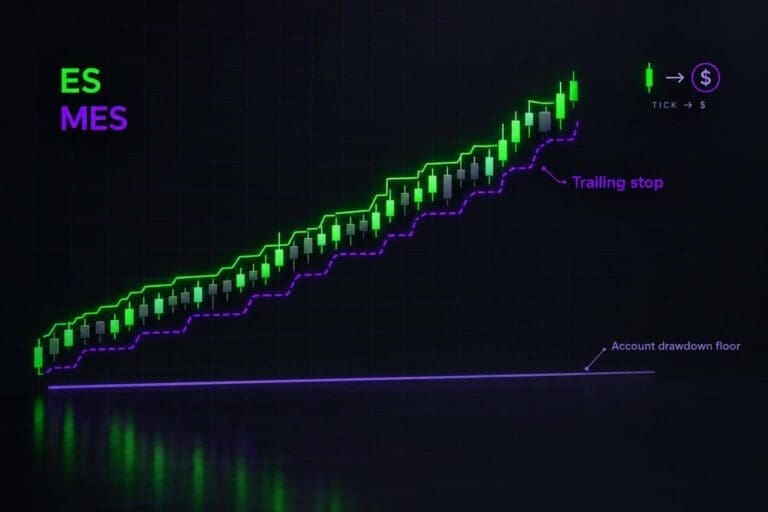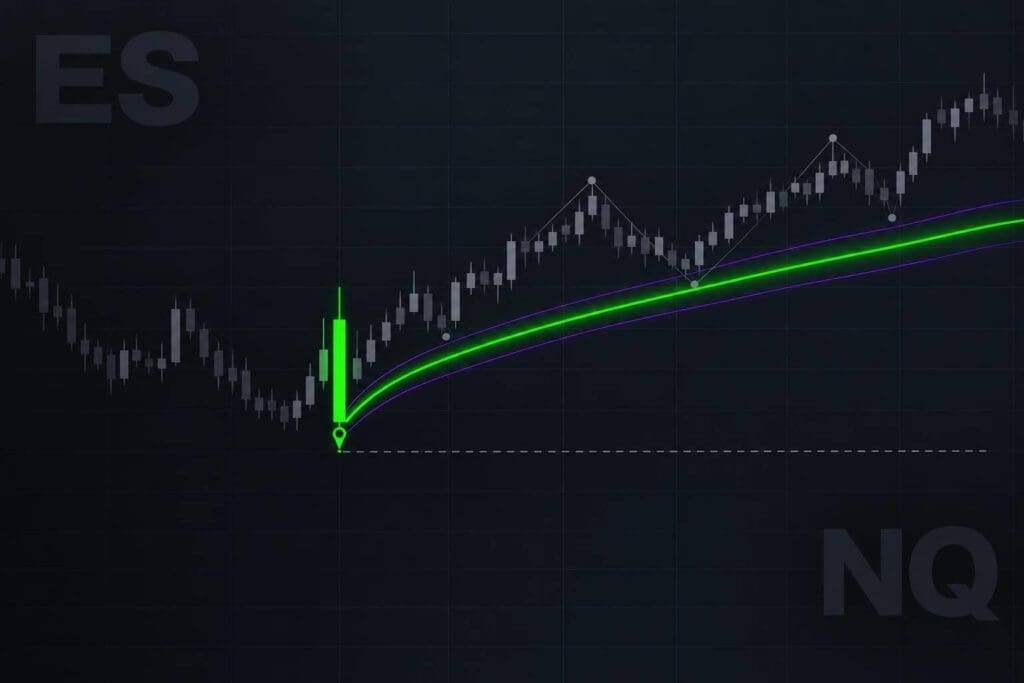
Anchored VWAP is a reference line, not a buy or sell button. I’ll show you how to choose an anchor on ES or NQ, read the price reaction, and set risk without forcing a trade around a line.
The risk math still comes first. ES pays $50 per point per contract, so a 4-point stop means $200 at risk before fees and slippage. That number doesn’t shrink because your chart looks clean.
My rule for this guide: <u>pick the event before judging the entry</u>. You’ll learn what makes an anchor worth keeping, when to skip the setup, and why price structure beats a VWAP touch.
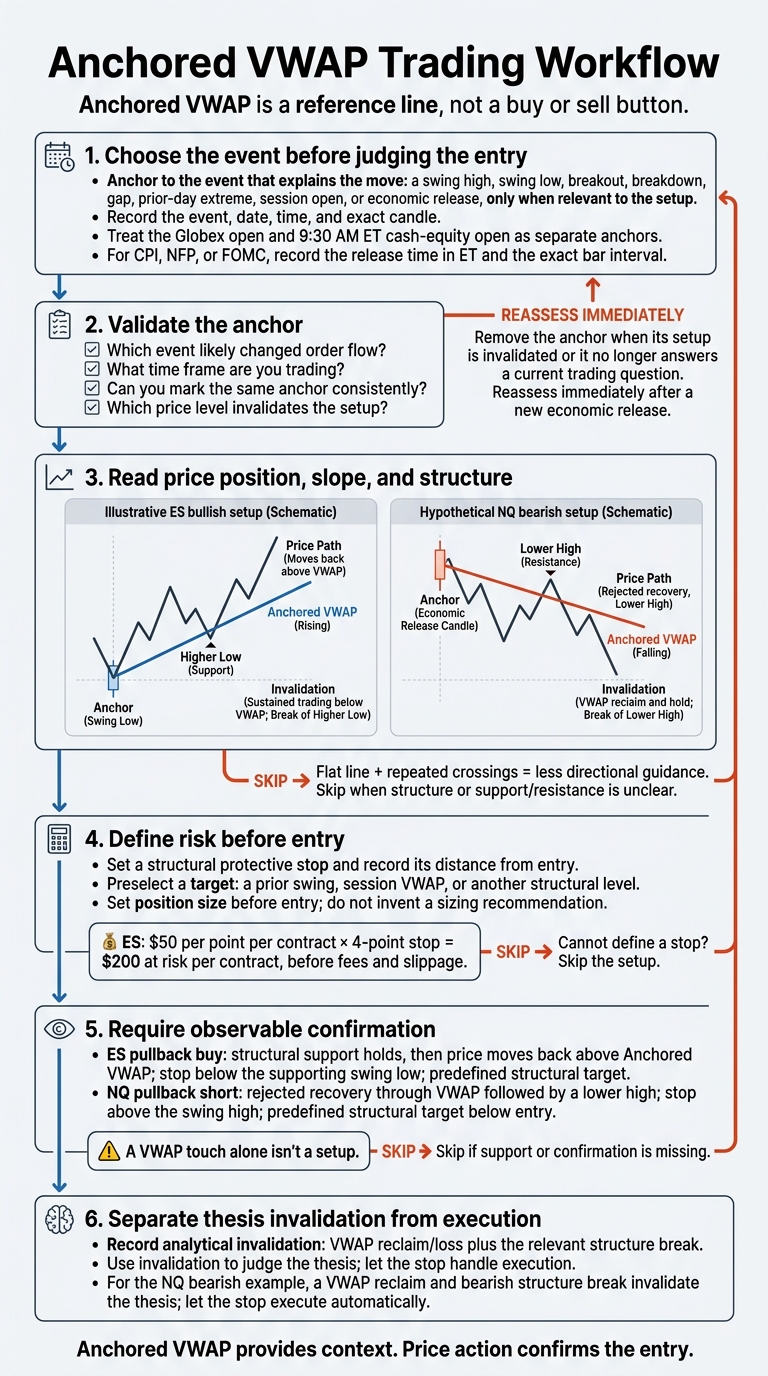
Anchored VWAP Trading Workflow
Live Order Flow Trading & VWAP Strategies with Robert Rother
sbb-itb-46ae61d
Anchored VWAP vs. Session VWAP
Session VWAP starts at the configured session’s open. Anchored VWAP starts at a bar or event you choose. That starting point changes what the line tells you.
| Feature | Session VWAP | Anchored VWAP |
|---|---|---|
| Starting point | Open of the configured session | Trader-chosen bar or event |
| Reset behavior | Resets automatically each session | Can stay in place until changed or removed |
| Time span | One session | One session or more, until changed |
| Trading question | Where is price versus this session’s average? | Where is price versus the average since the chosen event? |
Check your chart’s session settings so you know which open Session VWAP uses. With Anchored VWAP, choosing a swing, an open, or a news event gives you a reference point for judging support, resistance, and pullbacks.
How to Choose a VWAP Anchor
Pick the event that explains the move. Mark your anchor before you judge an entry, not after.
Swing Highs, Swing Lows, and Breakouts
Anchor to a swing low to assess support during a rally, or a swing high to assess resistance during a decline. Use a breakout, breakdown, gap, or prior-day extreme only if it fits your setup.
On ES or NQ, the line shows the volume-weighted average price since that event. It doesn’t show trader positions or performance.
Session Opens and Economic Releases
If the open or a data release drives price, anchor to that event. Treat the Globex open and the 9:30 AM ET cash-equity open as separate anchors. Choose the one that fits your setup, and check exchange hours with CME Group.
For CPI, NFP, or FOMC releases, record the release time in ET and the exact bar interval.
4 Questions to Check Your Anchor
Check four things: which event likely changed order flow, the time frame you trade, whether you can mark the same anchor every time, and which price level invalidates the setup.
For a swing-low rally setup, define how a break of that low would affect your plan before considering a pullback entry.
Remove an anchor when its setup is invalidated or it no longer answers a current trading question.
How to Read Anchored VWAP on ES and NQ
Read price position and slope together. Price holding above a rising anchored VWAP supports a bullish read. Price staying below a falling line supports a bearish read. A flat line with repeated crossings gives you less directional guidance.
Treat the line as potential support or resistance, not a guaranteed turning point. Check nearby swings, volume, and how price reacts on TradingView prop firms. What happens after a touch or cross matters more than the touch itself: price can recover and hold, or reject the line and move away. Volume adds context but doesn’t guarantee either outcome.
ES Example: Support After a Swing Low
In an illustrative ES setup, anchor VWAP to a swing low. As price recovers, watch for the line to rise. A pullback that holds a nearby higher low, then moves back above VWAP, supports the bullish read.
Sustained trading below the line weakens that read. A break of the supporting higher low damages the setup further. Don’t confuse a brief dip below VWAP with a break in price structure.
NQ Example: Resistance After a News Release
In a hypothetical NQ setup, anchor VWAP to an economic release and watch price trade below the falling line. Don’t short the first touch alone. Look for a failed recovery through VWAP followed by a lower high, then check whether volume backs the move away from resistance.
If NQ reclaims the line and holds above it on a retest, the bearish read weakens.
How to Build an Anchored VWAP Trade Plan
Turn your support or resistance read into a plan before placing the trade. Anchored VWAP provides context. Price action confirms the entry. Follow the same sequence in any market: anchor, confirm, define risk.
Plan an ES Pullback Buy
Anchor to the swing low. Look for a pullback that holds structural support, then a move back above Anchored VWAP. Enter only after confirmation, with a stop below the supporting swing low and a predefined structural target. Skip the setup if support or confirmation is missing.
Plan an NQ Pullback Short
Anchor to the economic-release candle. With price below Anchored VWAP, wait for a rejected recovery and a lower high. Use a stop above the swing high and a predefined structural target below entry. A VWAP reclaim and bearish structure break invalidate the thesis. Let the stop execute automatically.
Set Position Size and Exit Levels
Set your stop and target before entry, using a futures trading profit calculator to model potential outcomes. For the target, use a prior swing, session VWAP, or another predefined structural level.
Write down the plan before you enter. Use invalidation to judge the thesis; let the stop handle execution.
| Plan field | Record before entry |
|---|---|
| Anchor | Event, date, time, and exact candle |
| Thesis | Expected support or resistance and supporting structure |
| Entry trigger | Observable confirmation, not just a VWAP touch |
| Protective stop | Structural price and distance from entry |
| Target | Preselected swing, session VWAP, or structural level |
| Analytical invalidation | VWAP reclaim/loss plus the relevant structure break |
When to Skip an Anchored VWAP Setup
Before you enter, check the setup. Skip it if price keeps crossing Anchored VWAP, support or resistance isn’t clear, or you can’t define a stop.
Remove the anchor if it no longer fits the move. After a new economic release, reassess immediately. The event can invalidate the old anchor.
Even with a valid anchor, a VWAP touch alone isn’t a setup. Price must confirm the entry, and you need a defined stop.
Bottom Line: Choose the Anchor, Confirm the Setup, Set the Risk
Start with the right anchor. Anchor to the event that drove the move, not the line that fits your bias. The event matters more than the line.
Price above a rising Anchored VWAP supports longs. Price below a falling line supports shorts. In both cases, price structure must confirm the setup.
Before you enter, define what invalidates the trade, where your stop goes, and your target. Anchored VWAP adds context, not certainty. Skip the setup if price is choppy and structure is unclear.
FAQs
Does my chart timeframe change anchored VWAP?
No. Anchored VWAP starts from the point you choose, regardless of your chart’s timeframe. Switching timeframes changes how the candles or bars appear, not the underlying data used to calculate the anchored VWAP line.
Can I use multiple VWAP anchors at once?
Yes, you can plot multiple anchored VWAP lines on one chart. Anchor each to a major swing high or low, the session open, or a key economic release. Together, they can help you spot potential support and resistance.
Choosing anchors is subjective. Treat these lines as context, not guaranteed signals, and expect them to be less useful in choppy markets.
How does futures rollover affect anchored VWAP?
Futures rollover usually means manually resetting anchored VWAP. Volume data from the expiring contract doesn’t carry over continuously to the new delivery month.
Re-anchor VWAP to a key event in the active contract: its first trade, a major swing high or low, or an important economic release.