
There’s no verified typical monthly income figure in the futures payout records covered here. I’ll separate what those records tell you from what the marketing leaves out, so you can judge earnings without treating a screenshot like a paycheck.
The downside matters: one Brazilian equity-futures study found that 97% of 1,551 traders who traded for more than 300 days lost money. That’s not a U.S. prop-trader loss rate, but it’s a reason to skip easy-income claims.
My focus is <u>what you keep</u>: cash received minus trader-paid costs, including failed evaluations. You’ll see why payment size, payout frequency, consistency rules, and net income need separate checks before you put a monthly earnings number on trading.
$6,318 Topstep Payout LIVE | Why DLL Accounts Have DOUBLE Payout Caps
sbb-itb-46ae61d
What Counts as Day-Trading Income?
Prop programs may use simulated or firm-controlled accounts. The funded balance on your screen isn’t your personal capital or guaranteed income. Withdrawals depend on the program’s rules. [1][2] Keep those distinctions in mind when reading the payout data and earnings examples that follow.
Prop-Firm Withdrawals vs. Trading Profit
Gross trading profit is your trading gain before profit splits and fees. Trading costs include commissions, exchange fees, routing fees, and data fees. [1]
A prop-firm payout is cash paid after a withdrawal request gets approved, subject to the firm’s profit split and withdrawal terms. It isn’t the same as trading profit or take-home income. [1] That’s the distinction to watch when reading the reported withdrawals below.
Take-Home Income After Fees and Splits
Net income is cash payouts minus trader-paid costs for the same reporting period, before taxes. Subtract evaluation, reset, activation, subscription, platform, and data costs. [1]
Match payouts and costs to the same reporting period. Track cumulative evaluation costs separately, including what you spent on failed evaluations. [1] The next section checks this income definition against verifiable payout data.
How the Earnings Data Was Checked
Only use earnings figures that include a source, a reporting period, and a denominator. That’s the line between earnings data you can check and promotional screenshots.
Each record includes the publication date, reporting period, currency, sample size, and figure type: total, mean, median, or a single withdrawal. It also states who’s counted: all traders or only payout recipients. Mark any missing details as not disclosed.
Firm help centers, like the Tradeify payout rules, explain how withdrawals work. They don’t verify a specific payout. Use regulatory registration as a filter, and check whether money actually left the account. Dashboard gains aren’t proof of a withdrawal.
Check whether each payout figure accounts for trader-paid commissions, exchange and routing fees, data fees, platform and subscription fees, withdrawal fees, and evaluation costs. A withdrawal isn’t take-home income unless all costs are accounted for.
Count all traders, including those who received nothing. Recipients-only figures leave those traders out, and one trader can make multiple withdrawals. Exclude testimonials and guaranteed-return claims. The independent futures studies that follow use this filter.
What Independent Futures Studies Show
Independent studies provide a baseline for retail trading, not futures prop firm income. That distinction matters when reading the payout data below.
CFTC Findings on Retail Futures Traders
The CFTC study covers a fixed research window. It gives you retail trading context, not a benchmark for daily or monthly earnings.
Findings From the Brazilian Equity-Futures Study
Among 1,551 individuals who traded for more than 300 days, 97% lost money. The reported median daily loss was $23.21 after fees.
That narrow Brazilian sample doesn’t establish loss rates for U.S. futures traders or prop-firm traders.
What Documented Prop-Firm Payouts Show
Retail-trading studies report broad loss rates. Payout records show something narrower: what a subset of funded traders withdrew. The available sources do not establish a verified futures-only payout dataset. That leaves a clear gap between what the records document and what they don’t.
Reported Payout Totals and Recipient Counts
The supplied sources don’t verify reporting periods, total amounts paid, unique recipients, average or median withdrawals, or the percentage of traders who received a payout.
Limits of Multi-Firm Payout Datasets
Account counts aren’t trader counts. One trader can control multiple accounts. Without a method for removing duplicate traders, account totals can’t tell you how many individual traders received payouts.
Individual Withdrawals Are Not Typical Earnings
A usable record should include the amount, withdrawal date, covered trading period, and account count. It should also show whether the evidence confirms approval or actual receipt. Don’t turn a single withdrawal into an annual income claim.
Even a verified withdrawal can leave out costs the trader paid, including failed evaluation fees, platform subscriptions, and data fees.[1]
How Much of a Futures Payout Do You Keep?
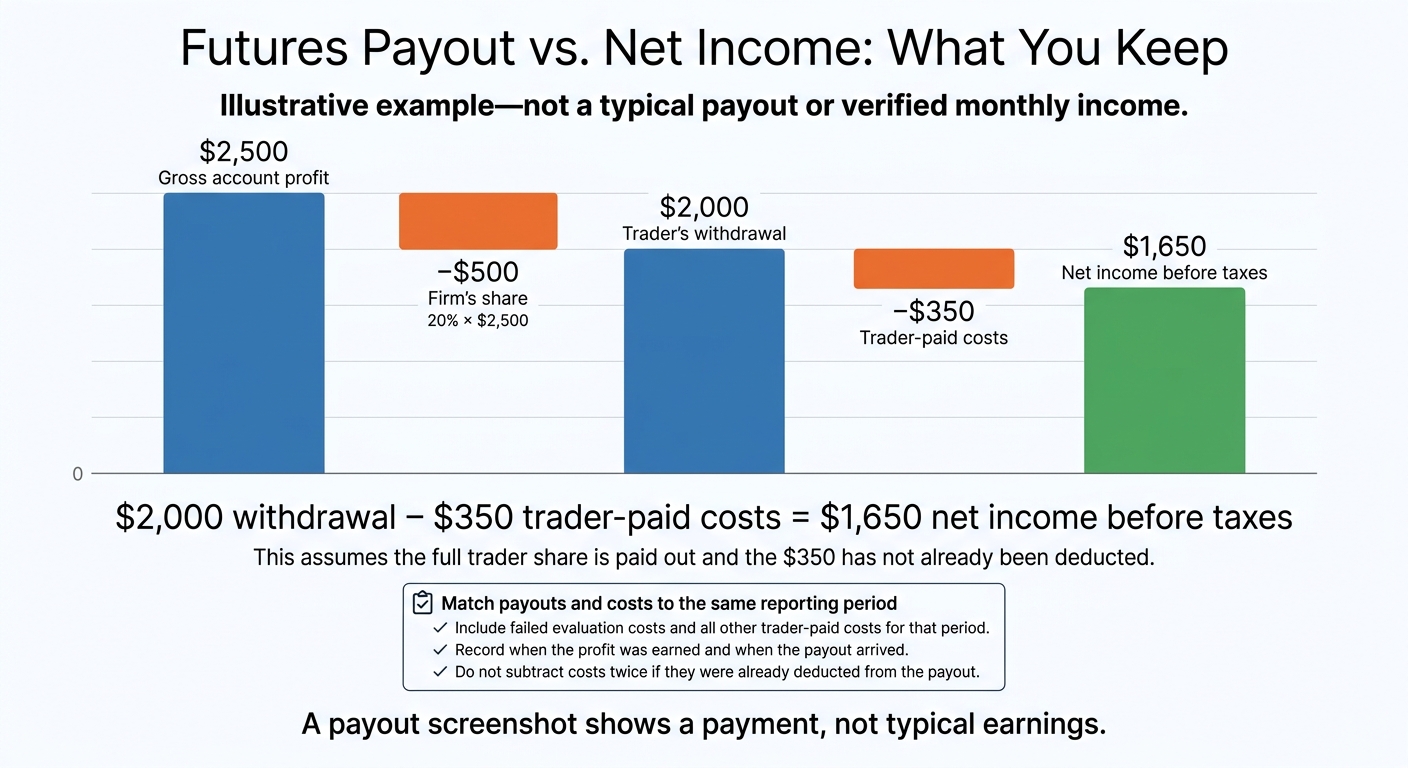
Futures Payout vs. Net Income: What You Keep
A withdrawal isn’t net income. You still need to subtract what you paid to earn it.
A $2,000 withdrawal can net $1,650 before taxes. This is an example, not a typical payout.
Component Amount Gross account profit $2,500 Firm’s share: 20% × $2,500 −$500 Trader’s withdrawal $2,000 Trader-paid costs −$350 Net income before taxes $1,650 This assumes the full trader share is paid out and the $350 has not already been deducted.
The bigger mistake is counting one payout as a full month’s earnings.
Include Failed Evaluations and All Period Costs
A $2,000 withdrawal doesn’t tell you your monthly profit. Match it to the period it covers, subtract failed evaluation costs and all other costs for that period, and record both when you earned the profit and when the payout arrived.
A payout screenshot shows a payment, not typical earnings.
Why Payout Data Cannot Establish Typical Income
Subtracting fees doesn’t make payout screenshots a measure of typical income. A verified payout proves a payment, not typical earnings. Shared screenshots tend to favor success stories. Traders who never qualify for a withdrawal or lose money may be missing entirely. That survivorship bias makes the visible results look better than the full group’s results.
The sample size matters just as much as the payout total. One trader can receive several withdrawals across multiple accounts. Divide total payouts by the number of payments, and you get the average payment size, not average income per trader. Even an average per recipient leaves out everyone who received $0. Payout totals alone don’t tell you how often traders get paid.
A big withdrawal doesn’t establish frequency or repeatability. To estimate monthly income, you need the period covered and the trader’s full payout history, including months with no payout.
A sound estimate needs a defined reporting period, a count of individual traders, participants who received $0, and net results across the full group.
Bottom Line: Track Net Income, Not Payout Screenshots
A payout screenshot shows cash received, not net income.
Track your earnings in a month-by-month ledger, including months with zero payouts. Subtract every trader-paid cost from actual withdrawals. Don’t subtract costs twice: if a cost was already deducted from the payout, leave it out.[1]
Do the ledger math before checking the firm’s withdrawal documentation. For firm-specific rules, see our futures prop firm reviews.
FAQs
How long should I track payouts before estimating monthly income?
Track payouts for at least 2–3 full payout cycles, roughly 2–3 months, before estimating monthly income. Average the results to account for differences in approval timing, fees, and profit splits. Follow your program’s payout-cycle boundaries, eligibility requirements, and withdrawal rules. One payout isn’t enough to project monthly income.
Payout histories can be selectively reported. Count only documented withdrawals within your tracking period, and exclude accounts with zero payouts.
Can I rely on futures trading to cover living expenses?
Not reliably. Scheduled prop-firm payouts don’t guarantee steady income. You still need consistent trading profits after fees and profit splits. Many traders never receive a withdrawal, so don’t count on futures day trading to cover your living expenses.
Use documented payout examples to set realistic expectations, but watch for selective reporting. The examples you see don’t tell the whole story.
How should I budget for months with no payouts?
Treat futures trading like a business with uneven income, not a steady paycheck. Prop firm payouts depend on meeting profit targets and withdrawal rules. Don’t count on them to cover your basic living expenses.
Keep a separate emergency fund with three to six months of baseline expenses. Refill that fund before treating payouts as spending money. Subtract platform fees, data costs, and potential taxes when calculating what you actually take home.