Most prop firms use simulated accounts, even in the "funded" stage. You’re trading virtual money, but the payouts are real cash, funded by the firm’s reserves (mainly from evaluation fees). Here’s the deal: firms like Apex, Topstep, and TPT all have their unique setups. Apex sticks with sim accounts, Topstep moves you to live trading after proving consistency, and TPT mirrors your sim trades to a live account. Each approach impacts fees, drawdown rules, and how profits are split. If you’re curious which firm fits your style, keep reading for the details and real-world examples.
My First $150,000 Take Profit Trader Payout After 2.5 Years | Daily Withdrawals Proof + My TPT Spend
sbb-itb-46ae61d
Simulated vs Live Accounts: How Prop Firms Work
Most futures prop firms operate with a two-stage setup: you start with a simulated account for evaluation and, if successful, move to a funded trading accounts. That funded account might remain simulated or switch to live market execution. Here’s the key: during the evaluation phase, it’s all about testing your trading discipline. Once funded, you’re eligible for real payouts – even if the account stays simulated.
Simulated accounts run on real-time market data but don’t send your orders to the exchange. Orders are filled instantly, with no market slippage. Live accounts, on the other hand, execute real trades, meaning you’ll face slippage (usually 1–3 ticks per trade, which can cost $25–$75 on futures contracts), latency, and other market factors [5]. Some firms keep traders on simulated accounts indefinitely, paying them from the firm’s revenue pool. Others promote traders to live accounts after hitting milestones like earning 3–5 payouts or reaching $10,000+ in total profit.
Here’s the catch: only 1.01% of traders in simulated funded accounts ever make it to live accounts [3]. This means most "funded" traders are still trading on sim, with their payouts coming from the firm’s reserves – largely funded by evaluation fees from traders who don’t make the cut – rather than actual market profits. While this setup limits your financial risk to just your evaluation fee, it also makes the firm’s financial health a critical factor. If the firm’s reserves dry up, so do your payouts.
| Feature | Simulated Evaluation | Simulated Funded | Live Funded |
|---|---|---|---|
| Capital Type | Virtual | Virtual | Real Capital |
| Order Execution | Instant / Perfect | Simulated (may mimic slippage) | Live Market (subject to slippage and latency) |
| Risk Exposure | None (firm absorbs sim loss) | None (firm absorbs sim loss) | Real (firm risks actual capital) |
| Payout Eligibility | No | Yes | Yes |
| Payout Source | N/A | Evaluation fees & firm revenue | Market profits & firm revenue |
These distinctions impact everything from your trading experience to how you perceive risk and your timeline for earning profits.
The mental aspect is just as important. As FundedNext explains:
"The biggest difference between simulation and live trading is not technical. It is psychological" [6].
A drawdown in sim doesn’t hit as hard as one with real money at stake. That’s why the simulated funded stage works like a "paid internship" to prepare you for the pressure of live trading [5].
1. Apex Trader Funding
Account Transition (Simulated vs Live)
With Apex Trader Funding, your trading journey stays in the simulated world – whether you’re in the evaluation phase or trading on a funded account. You start with a simulated evaluation account, where the goal is to hit a profit target. These targets range from $1,500 on a $25,000 account to $20,000 on a $300,000 account, and you’ll need to trade for at least seven days to qualify[7]. Once you pass, you move to a Performance Account, which is labeled as "funded" but still operates in a simulated environment. Since 2021, Apex has paid out over $100 million to traders, proving that even in a sim-based system, payouts are real[7].
Payout Credibility
Apex takes payouts seriously. Every withdrawal request goes through a compliance review to ensure you’ve followed all the rules – like avoiding news trades and meeting the consistency rules. For legacy accounts, the consistency rule is 30%, but for accounts purchased after March 2026, it jumps to 50%[7]. To make your first withdrawal, you’ll need at least eight winning trading days and must maintain a payout buffer[7].
Here’s the breakdown: you keep 100% of your first $25,000 in profits. After that, profits are split 90/10 in your favor[8]. Payouts are processed on a set schedule, either bi-weekly or monthly, depending on the account setup[7].
Risk Management Features
Apex uses an intraday trailing drawdown to manage risk. This means the drawdown level moves up as your unrealized profits increase but won’t drop back down if your balance dips. For example, on a $50,000 account, the trailing threshold starts at $2,500 and adjusts upward as you hit new equity highs[7]. If your strategy needs more breathing room, Static accounts offer a fixed loss limit instead of a trailing one.
To prevent traders from over-leveraging, Apex enforces contract limits. For instance, a $50,000 account is capped at 10 contracts[4][7]. They also simulate realistic fills, accounting for queue positions on limit orders and adding randomized slippage to market orders[5]. This discourages "sim-only" strategies that rely on perfect fills and prepares traders for the quirks of live market conditions.
Recent Rule Changes
Apex is always tweaking its rules to balance trader needs with firm risk. The big update as of March 2026? Metals futures are no longer allowed. This includes contracts like Gold (GC), Silver (SI), and Micro Gold (MGC), among others. If metals were your go-to, you’ll need to shift to other instruments or look at different firms. Additionally, the consistency rule for new accounts has increased from 30% to 50%, though legacy accounts stick with the original 30%[8].
Keep an eye on your trader dashboard for updates, as Apex regularly adjusts its policies to align with market changes[7].
2. Topstep

Account Transition (Simulated vs Live)
Topstep’s setup for moving traders from simulation to live trading is all about building discipline and managing risk effectively. They use a three-step process that starts with the Trading Combine. This is a simulated evaluation where you need to hit a profit target without breaking the Maximum Loss Limit or Daily Loss Limit. If you pass, you move to the Express Funded Account (XFA). While the XFA is still simulated, you can earn real payouts.
Getting to a Live Funded Account (LFA) isn’t automatic. Typically, Topstep’s Risk Team will review your performance after you’ve made three to five payouts in the XFA. They’re checking for consistent results and solid risk management. Once you’re approved, you’ll trade real futures contracts. This structured approach makes it clear how Topstep ensures traders are ready for live market conditions before they go all-in [1][10][11].
Payout Credibility
Topstep keeps things simple: they cover all trading losses and let you keep 90% of your profits. In the XFA, you can request payouts after either five winning days of $150+ (Standard path) or three days while meeting a 40% consistency rule (Consistency path). Once you’re in a Live Funded Account, things get even better. After 30 winning days of $150+, you can request daily payouts and keep 100% of your profits. On top of that, there’s over $250,000 in cash bonuses available for traders who perform consistently in live accounts [1][10][11].
Risk Management Features
Topstep’s risk tools are designed to help traders stay in the game, even when things get bumpy. They use an end-of-day (EOD) Maximum Loss Limit (MLL), which is based on your highest end-of-day account balance. Unlike intraday trailing drawdowns, this EOD approach gives you room to recover from normal market pullbacks without instantly losing your account [9]. As Topstep puts it:
"If your trade is valid and your discipline is real, you shouldn’t lose an account because of a normal intraday pullback."
The Daily Loss Limit (DLL) is another key rule. It’s more of a guideline during the Combine and XFA stages, but in Live accounts, it becomes mandatory. If you hit the DLL, your account is locked for the day. As you reach profit milestones in Live accounts and hold those levels for 10 active trading days, both your DLL and buying power increase. To keep traders from over-leveraging, Topstep also uses a Scaling Plan that limits the number of contracts you can trade based on your account balance [10][11].
Recent Rule Changes
On April 12, 2026, Topstep rolled out a new commission structure across all account types. For Minis, it’s $0.50 per side ($1.00 round turn), and for Micros, it’s $0.25 per side ($0.50 round turn). These rates apply to the Trading Combine, XFA, and Live accounts. Another new rule for Live traders: you must place a protective stop on every open position to keep your account in good standing [11].
3. TakeProfitTrader (TPT)
Account Transition (Simulated vs Live)
TPT operates on a virtual copy trading model, which means your trades in the simulated account are mirrored onto a live account managed by TPT. Unlike the typical setup where traders transition directly to a live account, this approach ensures your sim trades are replicated in real-time on TPT’s live account. Essentially, your payouts come from the actual profits generated by these mirrored trades, not just what happens in the simulated environment [2].
While this system avoids giving traders direct access to a live brokerage connection – reducing risks like platform errors – it does have a slight drawback for high-frequency scalpers. You might notice minimal slippage between your sim fills and the actual mirrored live fills. The difference is usually minor, but if you’re working with razor-thin margins, it’s worth considering.
Payout Credibility
TPT offers an 80/20 payout split right out of the gate. If you’re on the PRO+ plan, this improves to 90/10. There’s no nonsense around strict consistency rules that could block your withdrawals, and you can request payouts as soon as you start your PRO account. No waiting around for weekly or bi-weekly payout windows, which means you’re less tempted to overtrade while waiting to cash out [2][12].
The cost for a $50,000 evaluation account is $170 per month, but here’s the kicker – once you pass, the monthly billing stops. You’ll just pay a one-time PRO activation fee of $130, and after that, no more recurring fees. This straightforward pricing makes it clear what you’re paying for, without surprise costs down the line [2].
Risk Management Features
TPT stands out with its drawdown lock feature. Once your account hits a certain profit level, the trailing drawdown locks permanently at your starting balance. For example, on a $50,000 account, the drawdown floor locks at $50,000 once you reach that milestone. This means you can’t lose your funded status due to drawdown after proving you can trade profitably [2].
During the evaluation phase, TPT uses an end-of-day (EOD) trailing drawdown based on realized P&L, so you’re not penalized for unrealized intraday swings. Once you move to a PRO account, the drawdown calculation switches to intraday to reflect live market risk. However, the locked drawdown at your starting balance still protects your progress. TPT has also done away with mandatory daily loss limits, giving you more flexibility to recover from early losses. As the TPT team explains:
"When skilled traders have the flexibility to manage their positions throughout the entire trading day, they can often turn challenging days into profitable ones." [12]
Unlike some other firms, TPT doesn’t force you to shrink your position sizes after becoming funded. You can keep trading your strategy without restrictions, maintaining consistency in your approach [2]. This combination of risk management and flexibility makes TPT a compelling option for traders looking to integrate simulation and live trading seamlessly.
Pros and Cons
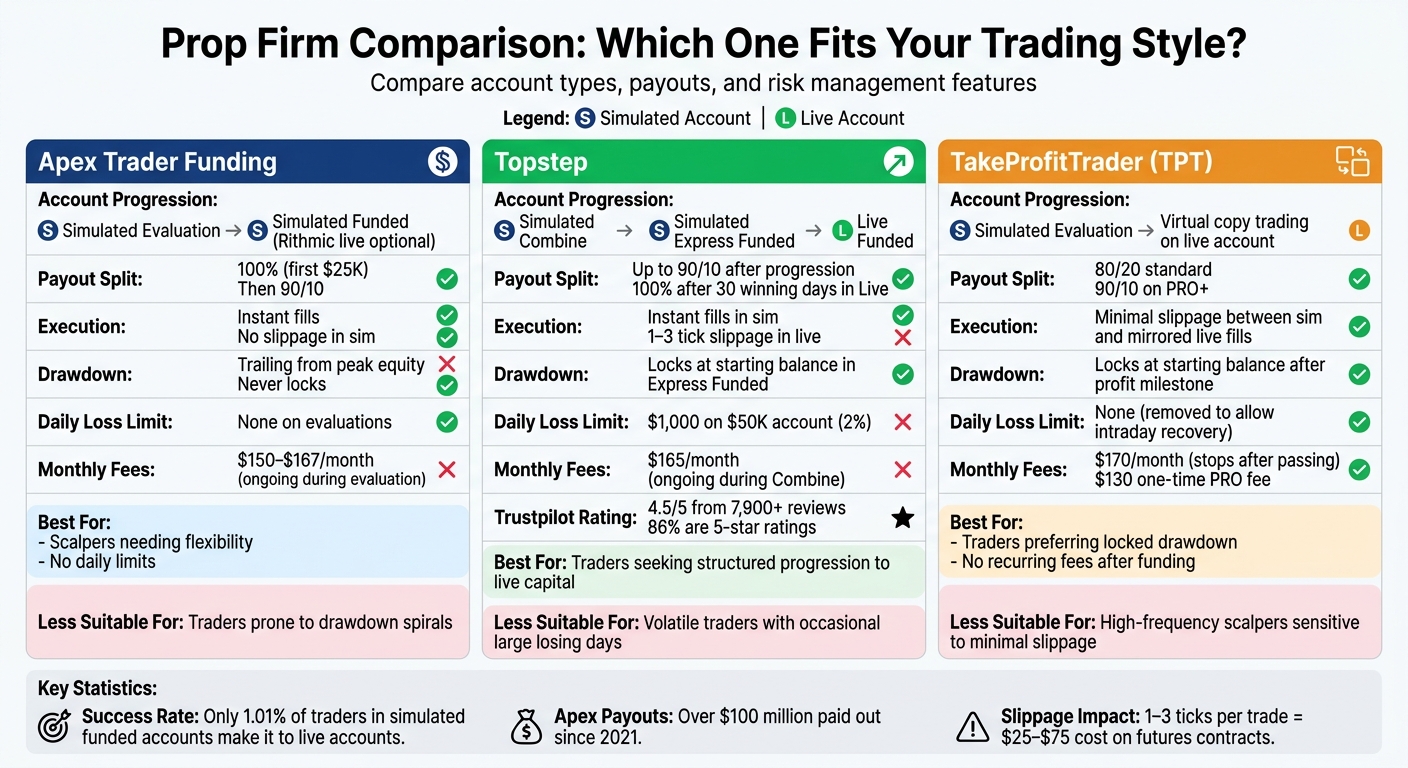
Prop Firm Comparison: Apex vs Topstep vs TakeProfitTrader Account Types and Features
Picking the right prop firm means weighing how each handles simulated and live accounts. These differences can directly impact both your trading approach and your profits. Here’s a quick breakdown to help you compare:
| Feature | Apex Trader Funding | Topstep | TakeProfitTrader (TPT) |
|---|---|---|---|
| Account Type | Simulated evaluation → Simulated funded (Rithmic live optional) | Simulated Combine → Simulated Express Funded → Live Funded | Simulated evaluation → Virtual copy trading on live account |
| Payout Split | 100% (first $25K), then 90/10 | Up to 90/10 after progression | 80/20 (90/10 on PRO+) |
| Execution Realism | Instant fills; no slippage in sim | Instant fills in sim; 1–3 tick slippage in live | Minimal slippage between sim and mirrored live fills |
| Drawdown Management | Trailing from peak equity (never locks) | Locks at starting balance in Express Funded | Locks at starting balance after profit milestone |
| Daily Loss Limit | None on evaluations | $1,000 on $50K account (2%) | None (removed to allow intraday recovery) |
| Monthly Fees | $150–$167/month (ongoing during evaluation) | $165/month (ongoing during Combine) | $170/month (stops after passing; $130 one-time PRO fee) |
| Best For | Scalpers needing flexibility and no daily limits | Traders seeking structured progression to live capital | Traders preferring locked drawdown and no recurring fees after funding |
| Less Suitable For | Traders prone to drawdown spirals (trailing never locks) | Volatile traders with occasional large losing days | High-frequency scalpers sensitive to minimal slippage |
With simulated funded accounts, you can keep up to 90% of your profits while the firm handles any losses [1]. The upside? No personal capital is at risk. The downside? Sim fills often differ from live fills by 1–3 ticks, which can mess with tight-margin strategies [5].
Live funded accounts, like those offered by Topstep, bring real market participation into play. This setup adds a layer of realism – both psychologically and technically – because you’re trading actual capital sent to the exchange. But it also introduces challenges like slippage, latency, and the stress of risking real money [5]. TPT’s virtual copy trading setup offers a middle ground: you trade in a simulated environment, but the trades are mirrored onto a live account. This ensures payouts are tied to actual market profits [2].
When it comes to risk management, TPT and Topstep both lock drawdowns at your starting balance once you’re funded. This safety net can help you recover from losses. Apex, on the other hand, uses a trailing drawdown based on peak equity, which can make bouncing back tougher during a losing streak. However, Apex’s lack of daily loss limits gives you more room to maneuver during volatile trading sessions [13].
Payout reliability is a critical factor. Topstep’s multi-stage progression ensures that payouts from live accounts are tied to real market gains [1]. Similarly, TPT’s mirrored trading model guarantees that your earnings come from actual profits, not just simulated results [2]. No matter which firm you choose, it’s smart to check their payout history on Trustpilot and confirm they’ve been around for at least 18 months to avoid any solvency issues [5].
These differences should help you zero in on the prop firm that best fits your trading style and goals.
Conclusion
The choice between simulated and live setups impacts everything from how you manage risk to how you perform as a trader. Picking the right firm comes down to finding one that aligns with your trading style and tolerance for risk. For example, Apex sticks with simulated accounts for both evaluations and funded stages. They offer 100% of your first $25,000 in profits but use a trailing drawdown tied to your peak equity[9]. On the other hand, Topstep transitions traders from simulated evaluations to live accounts, giving you real market execution. Meanwhile, TakeProfitTrader mirrors your simulated trades onto live accounts, ensuring payouts reflect actual market conditions.
Risk management is another critical factor. Both Topstep and TakeProfitTrader calculate drawdowns at the end of the day, meaning intraday swings won’t immediately hurt your account. This makes a big difference depending on how you trade and manage your positions.
Payout reliability can’t be overlooked either. Topstep’s strong Trustpilot rating – 4.5/5 from over 7,900 reviews, with 86% being 5-star ratings – shows they’ve built a reputation for consistent payouts[14]. Before diving in, it’s smart to test any firm’s rules against your own trading data. Run simulations using 90–120 days of trades across at least three separate 30-day periods[13].
At the end of the day, choosing a prop firm isn’t about ranking the best futures prop firms from best to worst – it’s about finding the one whose rules work with your trading habits, not against them[13]. Keep in mind that most firms update their rules every three to six months, so always check their official documentation to stay up to date.
FAQs
How can a prop firm pay real withdrawals if I’m trading on a sim account?
Prop firms can process real withdrawals even if you’re trading on a simulated account. They fund these payouts using the fees collected from trader evaluations. Once you pass the evaluation phase and move to a funded account with real capital, your withdrawals come directly from actual trading profits. This setup helps firms balance their risk while still paying successful traders.
What’s the fastest way to tell if a “funded” account is actually live or still simulated?
The fastest way to figure out if a "funded" account is live or just simulated is to see if it’s tied to real trades and actual profit payouts. Most prop firms rely on simulated accounts during the evaluation phase and move traders to live accounts after funding. This change is usually made clear through the firm’s platform or status updates.
Which rules matter most when moving from sim fills to live execution (slippage, drawdown, limits)?
When you move from simulated fills to live trading, the most important things to watch are slippage, drawdown limits, and trading limits.
Slippage can eat into your profits since live markets don’t always match the smooth fills you get in a sim. Drawdown limits are there to keep your risk in check – go over them, and your account could get suspended. And trading limits? They’re designed to stop you from taking on too much risk, forcing you to stick to a disciplined approach. These rules aren’t just there for show; they’re crucial for keeping your trading on track and staying profitable when it’s real money on the line.