Drawdown rules are critical for managing risk in funded trading accounts provided by futures prop firms. These rules define the maximum loss you can incur before your account is closed. Here’s a quick overview of the main types of drawdowns and how top futures prop firms implement them:
- Types of Drawdowns:
- Intraday Trailing (Unrealized): Adjusts in real-time based on your highest equity, including open trades.
- End-of-Day (EOD): Updates after the market closes, based on settled balances, ignoring intraday swings.
- Static: Sets a fixed loss limit that doesn’t change, regardless of profits.
- Firm-Specific Rules:
- Apex Trader Funding: Uses an intraday trailing drawdown for standard accounts and a static option for simpler risk management. Trailing locks at the starting balance plus $100 in funded accounts.
- Take Profit Trader: Offers EOD drawdowns during evaluation and intraday trailing for advanced accounts. No daily loss limit but enforces consistency rules.
- Tradeify: Focuses on EOD drawdowns, with daily loss limits on some accounts. Offers a locking feature to secure profits after a threshold.
- Topstep: Implements EOD drawdowns, resetting the loss limit at the end of each session. Daily loss limits apply to protect accounts.
- Blue Guardian: Uses EOD drawdowns with a locking mechanism. Offers accounts with and without daily loss limits, depending on the program.
- Key Considerations:
- Scalpers: Intraday trailing drawdowns (e.g., Apex) are better suited for tight, frequent trades.
- Swing Traders: EOD drawdowns (e.g., Tradeify, Topstep) allow holding positions through market swings.
- Predictability: Static drawdowns provide fixed limits but less flexibility.
Quick Comparison
| Firm | Drawdown Type | Daily Loss Limit | Max Drawdown ($150K) | Trailing Method |
|---|---|---|---|---|
| Apex Trader Funding | Intraday/Static | None | $5,000 | Real-time; locks at balance + $100 |
| Take Profit Trader | EOD/Intraday | No (Consistency) | $4,500–$5,000 | EOD in evaluation; intraday in advanced |
| Tradeify | EOD | Yes | $6,000 | EOD; locks at starting balance |
| Topstep | EOD | Yes | $4,500 | EOD; adjusts at session close |
| Blue Guardian | EOD | Optional | $5,000–$6,000 | EOD; locks after reaching balance |
Choose a firm based on your trading style and risk tolerance. Intraday models work well for high-frequency traders, while EOD models are ideal for managing intraday volatility. Static drawdowns offer simplicity but require tighter risk management.
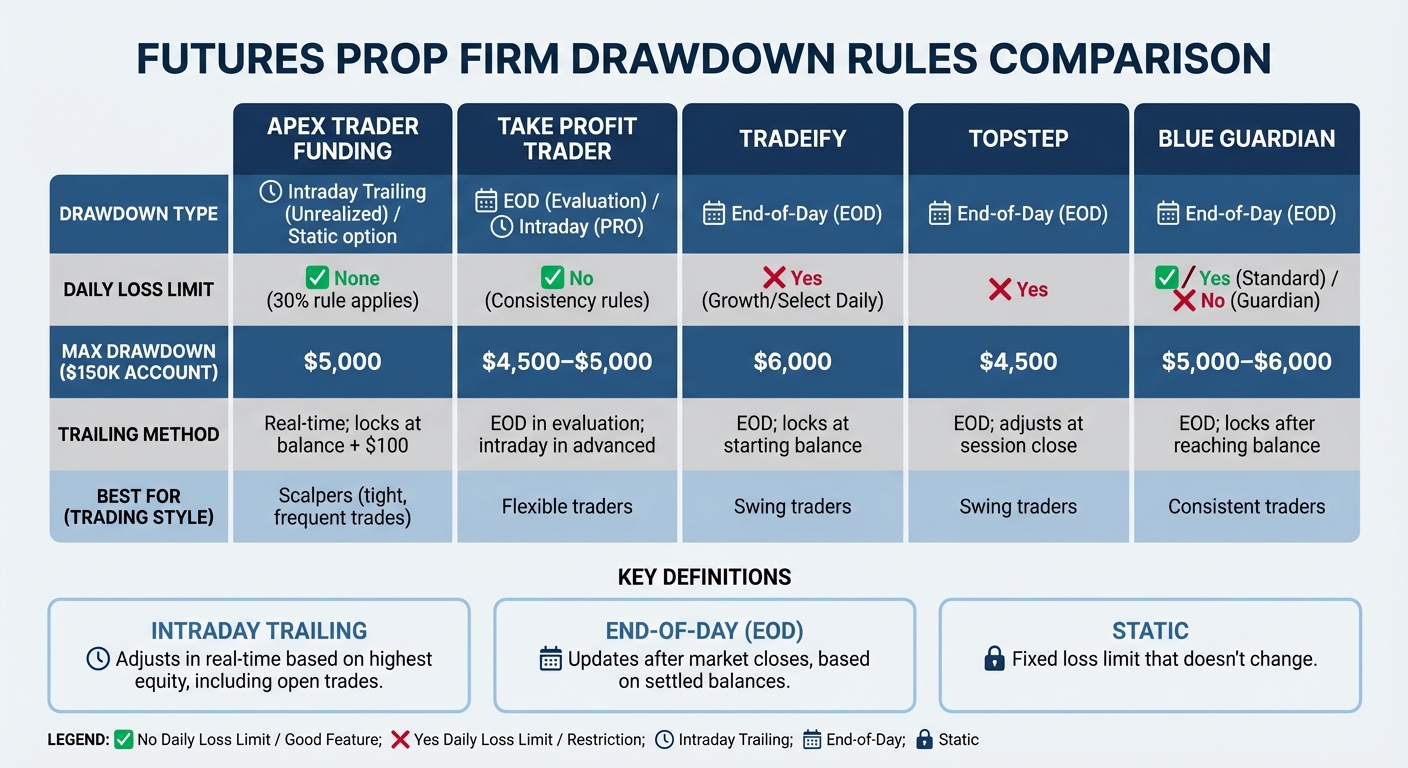
Futures Prop Firm Drawdown Rules Comparison: Apex vs Take Profit Trader vs Tradeify vs Topstep vs Blue Guardian
1. Apex Trader Funding
Drawdown Type
Apex Trader Funding applies an unrealized trailing drawdown for its standard "Full" accounts. This system tracks the highest equity peak, even including profits from open trades. As new highs are reached, the liquidation threshold adjusts upward but remains fixed if trades reverse. For those who prefer a simpler approach, Apex also provides Static Accounts with a fixed drawdown limit.[3]
Maximum Drawdown
The maximum drawdown depends on the account size. For instance, a $50,000 account comes with a $2,500 drawdown, while a $100,000 Full account allows for $3,000. However, the $100,000 Static account offers a much smaller $625 limit. Once traders advance to the Performance Account stage (i.e., the funded stage), the trailing drawdown locks at the starting balance plus $100. This creates a fixed safety net after demonstrating steady profitability.[3][5]
Trailing Method
In Apex’s system, every tick of unrealized profit increases the drawdown threshold. For example, if your trade gains $500, that amount becomes part of the locked buffer – even if the market moves against you later. If you’re using Rithmic, the "Auto Liquidate Threshold" in RTrader Pro can help track these live drawdown levels. To avoid sudden liquidations, it’s recommended to maintain a $100–$300 buffer above the threshold.[3]
Daily Loss Limit
Apex doesn’t enforce a traditional daily loss limit that resets each day. Instead, their system relies on the trailing maximum loss limit. Additionally, there’s a rule that restricts any open trade loss to no more than 30% of the day’s starting profit. All trades must be closed by 4:59 PM ET, and no single day can account for over 30% of the total profit.[5]
Next, we explore how Take Profit Trader structures its drawdown rules.
sbb-itb-46ae61d
2. Take Profit Trader

Drawdown Type
Take Profit Trader uses an End-of-Day (EOD) trailing drawdown during the Evaluation and PRO+ phases. For PRO accounts, it shifts to an unrealized intraday trailing drawdown. The EOD method only adjusts the drawdown threshold after the market closes, based on realized profits, ignoring intraday equity swings. On the other hand, PRO accounts track your highest live equity peak throughout the day, similar to the system used by Apex Trader Funding.
Maximum Drawdown
The maximum drawdown allowed depends on the account size. For example:
- A $25,000 account starts with a $1,500 drawdown limit during evaluation.
- A $50,000 account allows up to $2,000.
- A $150,000 account permits $4,500.
Once traders reach the PRO+ stage with a $150,000 account, the limit increases slightly to $5,000. These tiered limits align with the firm’s approach to managing risk as traders advance. Between January and August 2023, roughly 20.37% of traders successfully moved from evaluation to PRO accounts.
Trailing Method
The EOD trailing drawdown locks in gains based on your closing balance at the end of each trading day. This means intraday fluctuations won’t tighten your drawdown threshold, offering more stability. On the flip side, PRO accounts adjust the drawdown threshold in real time, tracking every tick of unrealized profit. For instance, a $500 gain immediately increases your threshold, leaving less room for recovery if the market reverses.
Daily Loss Limit
Take Profit Trader has removed the daily loss limit, offering traders more flexibility. Unlike firms like Tradeify, which imposes a $3,750 daily loss cap on $150,000 accounts, TPT relies on contract limits to control risk. For example, a $50,000 account is restricted to 6 mini or 60 micro contracts, but there’s no automatic liquidation if you hit a specific loss during the session.
For those looking to bypass these rules entirely, some traders prefer instant funding futures prop firms that skip the evaluation phase. Next, we’ll explore how Tradeify handles its drawdown policies.
3. Tradeify

Drawdown Type
Tradeify uses an end-of-day (EOD) trailing drawdown system for its Growth, Select, and Lightning accounts. This system updates the drawdown limit based on the highest end-of-day balance but enforces the limit at all times during trading. As explained in Tradeify’s Help Center:
"The Max Trailing Drawdown is a ‘hard breach’ – if your account balance drops to or below your drawdown limit at ANY point, your account fails immediately" [6].
For Sim Funded accounts, Tradeify provides a Drawdown Lock feature. Once a specified profit level is reached (e.g., $52,100 on a $50,000 account), the drawdown locks at $100 above the starting balance. This ensures a fixed safety net going forward [6].
Maximum Drawdown
The maximum drawdown varies depending on the account type and size. For example, a $50,000 Growth account starts with a $2,000 drawdown, while a $150,000 Lightning account allows for $6,000. Select accounts, however, have tighter limits compared to Growth accounts of the same size.
| Account Type | Account Size | Max Drawdown (EOD) |
|---|---|---|
| Growth | $50,000 | $2,000 |
| Growth | $150,000 | $5,000 |
| Lightning | $150,000 | $6,000 |
| Select | $150,000 | $4,500 |
Trailing Method
Tradeify’s EOD trailing drawdown adjusts daily based on the highest end-of-day balance. For instance, if your $50,000 account ends the day at $52,000, the new drawdown threshold is calculated from this high-water mark. Unlike some firms that track intraday fluctuations, Tradeify focuses exclusively on end-of-day figures. However, the limit remains active throughout the trading day, ensuring continuous enforcement.
Daily Loss Limit
Daily loss limits apply to Growth and Select Daily accounts, halting trading if breached (e.g., $3,750 on a $150,000 Growth account). Select Flex accounts, on the other hand, eliminate this limit entirely. Traders can use a consistency calculator to ensure they remain compliant with other profit-related rules. Lightning accounts operate differently, transitioning to a trailing drawdown once they become profitable. This allows more flexibility as your account grows.
With over $70 million in verified payouts and a 4.7/5 rating on Trustpilot, Tradeify has earned a reputation for quick processing in our futures prop firm reviews – some traders report receiving funds in as little as 10 minutes [7]. Additionally, Lightning accounts offer instant funding, a feature also provided by Lucid Trading, Legends Trading, and Purdia Capital.
Next, we’ll dive into Topstep’s distinct drawdown policies.
4. Topstep

Drawdown Type
Topstep takes an interesting approach to drawdowns by using an end-of-day (EOD) drawdown model, also called the Maximum Loss Limit. This system recalculates your drawdown threshold based on your account balance (which you can track using a futures trading profit calculator) at the close of each trading session, which is set at 5:00 PM CT. This method allows traders more breathing room during the day, especially in volatile markets.
"Topstep uses End-of-Day Drawdown, so you’ve got room to shake off a pullback, stick to your plan, and trade like you would in the real markets." – Team Topstep [9]
Here’s how it works: If your $100,000 account reaches $103,500 during the day but closes at $102,000, your new drawdown is calculated based on that closing balance. This differs from Apex Trader Funding, which uses a real-time, unrealized trailing drawdown.
Maximum Drawdown
The maximum drawdown in Topstep’s Trading Combine depends on the account size. For example:
- A $50,000 account has a $2,000 drawdown.
- A $100,000 account allows for $3,000.
- A $150,000 account offers a $4,500 drawdown.
Once you move to a Live Funded Account, the Maximum Loss Limit resets to $0. This means your account simply needs to stay in positive territory. Below is a quick breakdown:
| Account Size | Profit Target | Maximum Loss Limit | Monthly Price |
|---|---|---|---|
| $50,000 | $3,000 | $2,000 | $49 |
| $100,000 | $6,000 | $3,000 | $99 |
| $150,000 | $9,000 | $4,500 | $149 |
After completing the Trading Combine, there’s a one-time activation fee of $149 [8]. Additionally, in Live Funded Accounts, you must maintain a $500 cushion above the liquidation threshold. If your balance drops below this, the account is forfeited [10]. This structure ensures a clear and disciplined approach to managing risk.
Trailing Method
Topstep’s Maximum Loss Limit adjusts as your account grows, trailing upward based on your highest end-of-day balance. However, once it reaches your starting balance ($50,000, $100,000, or $150,000), it locks in place. For example:
- If your $50,000 account closes at $52,500 on Monday, your new drawdown threshold becomes $50,500.
- If Tuesday’s closing balance is $51,800, the threshold remains $50,500, as no new high was reached.
This EOD structure strikes a balance between the rigidity of intraday trailing drawdowns and the steadiness of static drawdowns, a model also utilized by TradeDay Prop Firm [3].
Daily Loss Limit
To further safeguard accounts, Topstep enforces a Daily Loss Limit. If this limit is hit, all open positions are closed, and pending orders are canceled until the next session begins at 5:00 PM CT. This is considered a “soft breach,” meaning trading is paused for the day, but the account itself isn’t failed [10]. In Live Funded Accounts, the Daily Loss Limit adjusts dynamically with your current balance.
Additionally, starting December 30, 2025, traders in Express Funded Accounts must maintain profitability relative to their balance after their last payout to qualify for future withdrawals [8].
Next, we’ll take a closer look at how Blue Guardian handles drawdown management.
5. Blue Guardian

Drawdown Type
Blue Guardian Futures employs an EOD (End-of-Day) trailing drawdown model. This means the maximum loss is calculated based on the closing balance rather than intraday equity fluctuations [11][12]. This setup benefits traders by allowing them to navigate intraday volatility, provided the account closes above the threshold. The firm offers two evaluation paths: the Standard Program, which includes a daily loss limit, and the Guardian Program, which eliminates the daily loss limit [12][14].
Maximum Drawdown
The maximum drawdown varies depending on the account size and the program selected. For instance, a $50,000 Standard account offers a $2,500 drawdown limit, while the same account in the Guardian Program has a tighter $2,000 limit [11]. As your end-of-day balance grows, the drawdown threshold adjusts upward, safeguarding your accumulated profits [11].
Here’s a comparison of the two programs:
| Account Size | Standard Max Drawdown | Guardian Max Drawdown | Standard Daily Loss Limit |
|---|---|---|---|
| $50,000 | $2,500 | $2,000 | $1,250 |
| $100,000 | $3,500 | $3,000 | $2,500 |
| $150,000 | $5,000 | $6,000 | $3,750 |
A standout feature is the "locking" mechanism. Once the trailing drawdown reaches your starting balance, it locks at that balance plus $100. For example, a $50,000 account locks at $50,100, ensuring your initial capital buffer is permanently secured [15].
Trailing Method
Blue Guardian’s trailing model only adjusts at the end of the trading day, which many traders find more forgiving than real-time adjustments. Unlike intraday models used by firms like Apex Trader Funding, this approach disregards temporary dips during the session [12]. The locking mechanism further sets Blue Guardian apart – once the drawdown threshold reaches your starting balance, it permanently fixes at that level plus $100, offering a safety net for future trading.
Daily Loss Limit
The Standard Program enforces a Daily Loss Limit, which terminates the account if exceeded [11]. For a $50,000 Standard account, this limit is set at $1,250. The Guardian Program, however, removes this restriction entirely but requires traders to meet higher profit targets – 8% compared to 6% for the Standard Program [11][12]. For Instant Guardian accounts, exceeding the daily loss limit results in a "soft breach", pausing trading instead of terminating the account [14].
Blue Guardian also applies Consistency Rules to ensure balanced trading. These rules cap the percentage of profits a trader can make in a single day during a payout period: 40% for Standard accounts, 30% for Guardian accounts, and 20% for Instant accounts [13][14]. Additionally, traders must maintain consistent contract sizes over at least eight days to qualify for payouts [13]. These rules provide a structured framework, distinguishing Blue Guardian’s drawdown policies from other top futures prop firms.
Next, we’ll delve into the pros and cons of these drawdown structures.
Explaining drawdown rules from different prop firms!
Pros and Cons
Different firms’ drawdown structures come with their own sets of benefits and challenges, impacting novice and experienced traders in unique ways.
Apex Trader Funding uses an unrealized trailing drawdown, which adjusts in real time. Using a futures risk management planner helps navigate these shifts, as this setup lowers costs but can catch traders off guard during normal market retracements [3]. On the other hand, firms like Tradeify and Topstep rely on end-of-day (EOD) drawdowns, recalculating only after the market closes. This allows traders to handle intraday fluctuations more comfortably [1]. Meanwhile, static drawdowns offer predictability but come with smaller safety buffers and higher fees [3].
For beginners, EOD models – especially when paired with no daily loss limits, such as Tradeify’s SELECT Evaluation – offer a less stressful environment. This setup lets them navigate intraday volatility without the constant fear of breaching limits [17]. More seasoned traders might lean toward Apex’s 300K account, which provides a $7,500 buffer. This structure accommodates larger position sizes and wider stops, with an extra $100–$300 cushion to help avoid breaches [2][3].
"EOD Drawdown typically gives a trader more room to manage volatility inside the trading day." – Brett Simba, Author, Tradeify [17]
These drawdown structures directly influence both profit potential and trading flexibility. Larger drawdowns, for instance, support swing trading strategies and allow traders to hold overnight positions. However, firms like Take Profit Trader enforce Consistency Rules, which limit single-day profits to 30%–50% of total gains. This policy discourages high-risk "lottery trading" and rewards steady performance, though it may restrict aggressive scalpers’ profit opportunities [16][17].
Here’s a table summarizing the key differences between firms:
| Firm | Drawdown Type | Daily Loss Limit | Maximum Drawdown (150K) | Trailing Method |
|---|---|---|---|---|
| Apex Trader Funding | Unrealized (Intraday) | None | $5,000 | Trails real time with equity peaks; locks at starting balance + $100 in funded stage |
| Take Profit Trader | EOD / Unrealized | Yes (Consistency Rule) | $4,500–$5,000 | EOD in Eval/Pro+; Unrealized in Pro stage |
| Tradeify | End-of-Day (EOD) | $3,750 (None in SELECT Eval) | $6,000 | Updates after market close; locks at starting balance |
| Topstep | End-of-Day (EOD) | Yes | $4,500 | Updates after market close |
The main decision boils down to balancing cost with difficulty. While unrealized trailing accounts are cheaper, they can be harder to navigate. In contrast, EOD accounts provide a better chance of survival, especially for traders still learning the ropes [3].
Conclusion
Choose a drawdown structure that aligns with how you trade. If you’re a scalper aiming for lower evaluation costs, an intraday trailing drawdown, like the one offered by Apex Trader Funding, could be a good fit. On the other hand, firms with an End-of-Day (EOD) drawdown – such as Take Profit Trader, Tradeify, and Topstep – offer flexibility, allowing traders to weather intraday market swings without immediate liquidation. For those who prefer predictability, static drawdown rules provide clarity, though they often come with higher fees or tighter buffers.
If you’re a swing trader holding positions overnight, an EOD model is crucial to avoid being liquidated during normal market fluctuations [4]. Make sure your risk buffer accounts for factors like commissions and slippage to avoid unexpected breaches.
For detailed rule breakdowns and the latest fee updates, check out the reviews on DamnPropFirms. You’ll also find tools like the Consistency Rule Calculator to help you navigate firm requirements and identify the best futures prop firms for your trading style. By focusing on these features, you can select a prop firm that complements your strategy.
FAQs
Which drawdown type fits my trading style?
The type of drawdown that works best for you hinges on your trading approach and how much risk you’re comfortable taking. Here are a few common choices:
- Static drawdowns: These provide fixed risk limits, making them easy to predict and manage.
- Trailing drawdowns: These adjust as your account grows, offering a more flexible way to manage risk dynamically.
- End-of-day (EOD) drawdowns: These are better suited for traders who want some leeway with intraday market fluctuations.
Your decision should align with your risk tolerance and whether you prefer a fixed or adaptable approach to managing losses.
How do drawdown “locking” rules work?
In futures prop trading, drawdown "locking" rules are designed to cap losses and safeguard trading accounts. These rules come in a few common forms:
- End-of-day (EOD) locks: These are based on the account balance at the close of the trading day, setting a daily loss cap.
- Trailing drawdowns: These move upward as the account gains value but never decrease, ensuring traders can’t lose more than a set amount relative to their peak balance.
- Static drawdowns: Unlike trailing drawdowns, these remain fixed at a predetermined amount, providing a consistent loss limit.
If a trader exceeds these drawdown limits, it usually results in the account being closed or "failed."
What hidden costs can breach my drawdown?
Hidden costs in futures prop trading often come from rules like unrealized trailing drawdowns. These track losses on open positions and can cause a breach even if you haven’t closed a trade. Another common risk is end-of-day (EOD) drawdowns, where your daily losses – including unrealized profit and loss (PnL) – are measured against a set limit. Knowing these rules inside and out is essential, especially when dealing with high volatility or large positions, to prevent unexpected account failures.