In futures prop trading, risk management policies vary widely across firms, impacting how traders approach drawdowns, scaling, and consistency requirements. Here’s a quick breakdown:
- Drawdowns: Firms use either trailing or static drawdowns. Trailing drawdowns adjust with unrealized profits, while static drawdowns remain fixed.
- Scaling Rules: Some firms limit trade sizes initially, requiring traders to hit specific profit milestones before increasing position sizes.
- Consistency Rules: Many firms enforce rules like the "30% Consistency Rule", ensuring traders achieve steady gains rather than relying on large, single-day profits.
Key differences between popular firms:
- Apex Trader Funding: Known for intraday trailing drawdowns and strict consistency rules. Offers up to 20 funded accounts but requires careful risk management.
- Take Profit Trader: Features end-of-day (EOD) drawdowns and no mandatory scaling plans, allowing traders to withdraw profits from day one.
- Topstep: Uses EOD drawdowns and a two-step evaluation process. Enforces a 30% consistency rule in funded accounts.
- Tradeify: Offers EOD drawdowns with a locking mechanism and instant funding options. Enforces tiered consistency rules during payouts.
- My Funded Futures: Focuses on gradual growth with milestone-driven scaling and strict drawdown policies.
Quick Comparison
| Prop Firm | Drawdown Type | Max Loss Limit | Consistency Rules | Unique Feature |
|---|---|---|---|---|
| Apex Trader Funding | Intraday Trailing | $7,500 (for $300K) | 30% Consistency Rule | 20-account copy trading |
| Take Profit Trader | End-of-Day (EOD) | $4,500 (for $150K) | None | Day-one payouts, no scaling plans |
| Topstep | End-of-Day (EOD) | $4,500 (for $150K) | 30% Consistency Rule | High reputation, two-step evaluation |
| Tradeify | End-of-Day (EOD) | $6,000 (for $150K) | Tiered payout consistency | Instant funding (Lightning accounts) |
| My Funded Futures | Trailing | Varies | Varies | Milestone-driven scaling |
Matching your trading style with a firm’s risk management policies is essential. For aggressive traders, firms like Apex or Take Profit Trader may suit your goals. If you prefer flexibility during volatile sessions, Tradeify or Topstep might be better options.
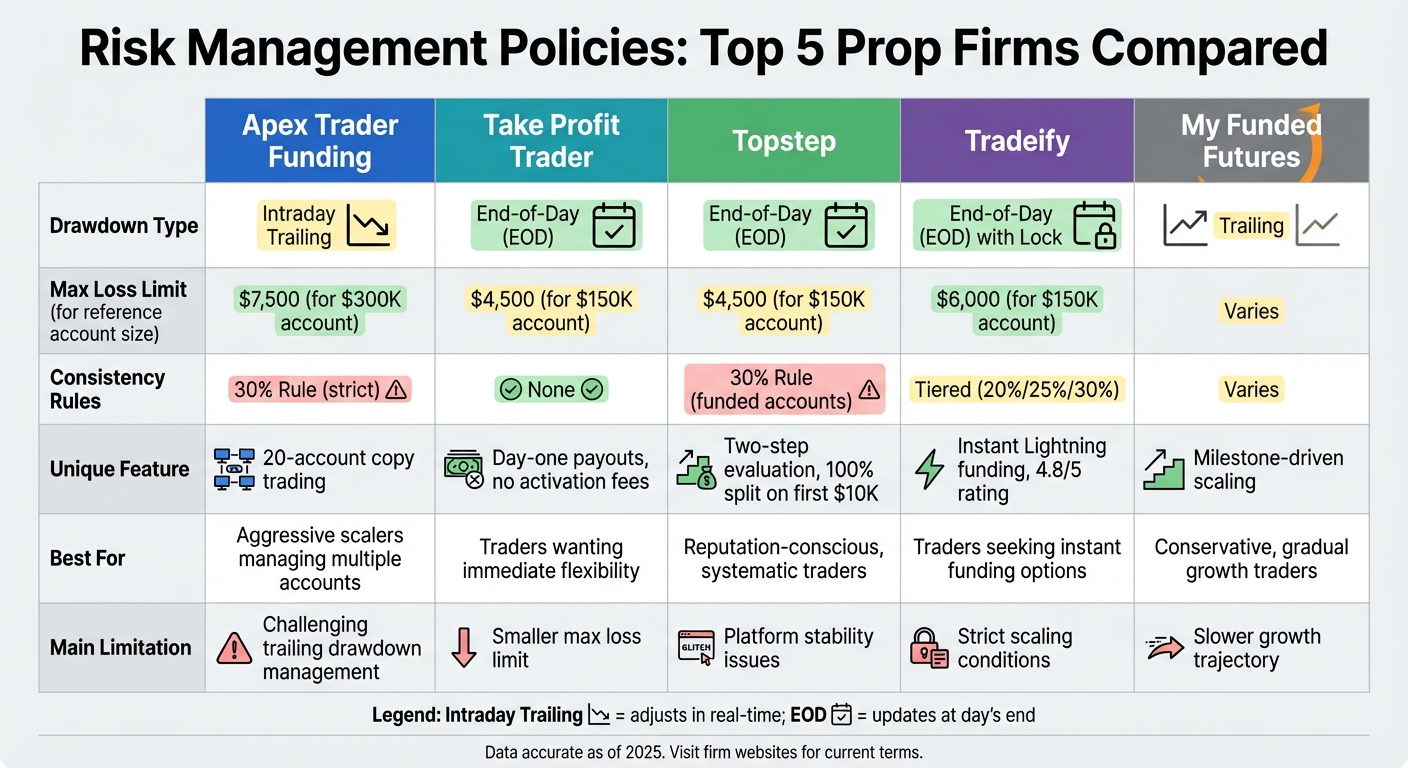
Risk Management Policies Comparison Across Top 5 Futures Prop Trading Firms
FULL Risk Management for PROP FIRMS (Excel Sheet Included)
1. Apex Trader Funding

Apex Trader Funding has made waves in futures prop trading, paying out over $500 million since 2022 [3]. Their approach focuses on unrealized trailing drawdowns, strict consistency rules, and a 20-account copy-trading system that allows traders to grow quickly – provided they demonstrate solid risk management.
Drawdown Types
Apex applies an unrealized trailing drawdown to its "Full" accounts. This type of drawdown adjusts in real-time based on your highest equity point, including unrealized gains [3]. For example, if you achieve an $800 unrealized gain, the drawdown threshold moves up accordingly. However, if your profit drops to $400, the threshold stays at the higher level, effectively reducing your buffer [3]. While this system might feel restrictive, Apex offsets it with lower evaluation fees, often discounted to around $33 per month [3].
Once a trader earns funding, the trailing drawdown stops adjusting once it reaches the starting balance plus $100. This creates a fixed floor, making Performance Accounts less risky than the evaluation phase [3]. For traders seeking more stability, Apex offers a $100K Static account with a fixed $625 drawdown that doesn’t change. However, this account has a smaller profit target and lower payout caps [3].
Scaling Rules
Apex starts traders with half their maximum contract limit until their end-of-day balance surpasses the initial balance plus the drawdown amount and an additional $100 [1]. For instance, on a $50K account with a $2,500 drawdown, traders begin with half the contract limit. They can only scale up once their balance exceeds the starting balance, drawdown, and the extra $100 [1].
The real advantage lies in Apex’s copy trading feature, which allows traders to manage up to 20 funded accounts simultaneously. This setup can result in payouts as high as $70,000 within the first 8 days [3]. However, these scaling opportunities come with rigorous daily performance monitoring, as outlined in the consistency rules.
Consistency Requirements
Apex enforces firm consistency rules to ensure traders maintain sustainable risk practices. The 30% Consistency Rule is a key requirement: no single trading day can account for more than 30% of your total profit when requesting a payout [3]. For example, if you make $1,000 on one day but only $500 across all other days, you’ll need to continue trading until that $1,000 day represents 30% or less of your total profits.
Additionally, Apex has a 30% Negative P&L Rule, which limits open losses to 30% of your start-of-day profit balance [1]. To qualify for a payout, traders must also meet specific criteria: a minimum of 8 trading days with at least 5 profitable days showing $50 or more in profit [3].
2. Take Profit Trader

Take Profit Trader takes a unique approach by using end-of-day (EOD) drawdowns during evaluations and offering immediate full buying power once funded – no mandatory scaling plans required [6]. Here’s a closer look at how their risk management system works.
Drawdown Types
Take Profit Trader employs an end-of-day (EOD) trailing drawdown for both Evaluation and PRO+ accounts, calculated based on the day’s peak balance [4]. This means your drawdown threshold remains fixed throughout the trading day, giving you flexibility to handle intraday volatility without worrying about unrealized gains altering your risk limits.
However, things change at the PRO account stage (the simulated funded phase). Here, the firm switches to an unrealized intraday trailing drawdown, which tracks your peak balance in real time, including unrealized profits [5][6]. This requires tighter risk control. For example, in a $50,000 account with a $2,000 drawdown, if you gain $1,200 in unrealized profits, your drawdown threshold adjusts upward immediately. If the trade reverses, your buffer shrinks, making risk management even more critical.
For PRO accounts, there’s also a buffer zone requirement. Traders must earn profits equal to their maximum drawdown before they can withdraw 80% of their earnings [4]. Withdrawals made before reaching this buffer are limited to 50–80% payouts [4]. PRO+ accounts, on the other hand, remove this requirement, allowing day-one withdrawals with a 90/10 profit split [4]. Combined with unrestricted contract limits, this setup creates a more flexible trading environment.
Scaling Rules
Take Profit Trader stands out by not enforcing scaling plans for PRO accounts [6]. From day one, traders can access their maximum contract limits, which can help speed up account growth. For example, a $50,000 account allows up to 6 mini contracts or 60 micro contracts immediately [6].
The firm uses a 1:1 leverage model and a 1:10 mini-to-micro ratio, which gives traders more control over their position sizes [5]. If you’re close to your drawdown limit, you can opt for micro contracts to manage risk more effectively instead of committing to a full mini contract.
Between January 1, 2023, and August 31, 2023, 20.37% of users successfully passed their trading test [6]. Traders can move to a PRO account in as little as 5 days, compared to up to 60 days at other futures prop firms [6]. This immediate access to full contract limits complements their focus on consistency.
Consistency Requirements
During the Evaluation phase, traders must follow a 50% Consistency Rule: no single trading day can contribute more than 50% of the total profit target [4]. Once you advance to the PRO or PRO+ stages, this rule no longer applies [6].
To maintain active PRO or PRO+ accounts, traders must place at least one trade per calendar week [4]. Additionally, all positions must be closed one minute before and after major news events to avoid automatic liquidation [5]. Completing a minimum of 5 trading days is required during the evaluation phase [4].
Monthly evaluation fees range from $150 for a $25,000 account to $360 for a $150,000 account [5][6]. PRO accounts require a one-time fee of $130, replacing the need for ongoing subscriptions [6]. Withdrawals over $250 are fee-free, while those $250 or less incur a $50 fee [4].
3. Topstep

Topstep takes a different approach to risk management compared to other top futures prop firms like Apex Trader Funding and Take Profit Trader. The firm relies on an end-of-day (EOD) drawdown model and enforces a 30% consistency rule to encourage disciplined trading. Traders must complete a two-step evaluation process to qualify for funding, with a profit split structure that rewards early success.
Drawdown Types
Unlike firms that use intraday trailing drawdowns, Topstep calculates your maximum loss based on your account balance at the end of the trading day. This allows for intraday fluctuations, as long as your closing balance stays above the set limit. A daily loss limit is also in place – if triggered, all positions are automatically closed. If the account balance falls below $500 after liquidation, the account is forfeited [8][13].
Once you transition to a Live Funded Account, the Maximum Loss Limit is set to $0, meaning your account balance cannot drop below your starting equity [13].
Scaling Rules
Topstep uses a performance-based scaling plan to adjust your maximum contract size based on your account balance and profits. For Express Funded Accounts, scaling updates daily. For example, a $50,000 account starts with 2 contracts, increases to 3 after $1,500 in profit, and unlocks 5 contracts once profits exceed $2,000 [11].
Live Funded Accounts follow a dynamic risk expansion model, which increases both the Daily Loss Limit and contract sizes as you achieve profit milestones. For instance, a $50,000 account begins with a $2,000 Daily Loss Limit, which expands to $2,500 after reaching $15,000 in profit [11]. Additionally, TopstepX™ allows traders to manage position sizes more precisely, where 10 Micro contracts equal 1 Mini contract [11].
To avoid violations, traders must close extra positions within 10 seconds. Enabling order confirmations is also recommended to prevent accidental trades, often referred to as "fat-finger" errors [11].
Consistency Requirements
Topstep emphasizes consistent performance during its Trading Combine evaluation. Your largest winning day cannot account for more than 50% of your total profits [13]. After funding, the 30% consistency rule kicks in, restricting any single trading day to no more than 30% of total profits.
"Topstep’s 30% consistency rule means no single trading day can account for more than 30% of total profits. If you’re up $3,000 total and $1,500 came from one session, you keep trading until the math stops calling you a ‘one-day wonder.’" – Sofia, TechNests Research Team [10]
To qualify for withdrawals, traders must complete 5 Benchmark Trading Days per withdrawal cycle. A Benchmark Trading Day is any session where you earn at least $150 in net profit [13]. Withdrawals are initially capped at 50% of your profit share until you’ve logged 30 Benchmark Trading Days, after which you can request 100% of your share [13].
Topstep offers a 100% profit split on the first $10,000, transitioning to a 90/10 split in favor of the trader after that [9][12]. Monthly subscription fees start at $49 for a $50,000 account, with a one-time $149 activation fee when moving to a funded account. Advanced market data fees are approximately $39 per month [9][14].
sbb-itb-46ae61d
4. Tradeify

Tradeify has introduced its own approach to managing drawdowns, aiming to provide traders with more flexibility as they become profitable. By combining an end-of-day (EOD) trailing drawdown with a locking mechanism, they’ve created a system designed to adapt to traders’ success. Additionally, Tradeify offers instant funding through its Lightning accounts, skipping the evaluation phase altogether. With a 4.8/5 rating from 131 verified reviews and recognition as having the "Best Payout Process" in 2025, Tradeify has earned a reputation for policies that cater to traders’ needs [17].
Drawdown Types
Tradeify calculates maximum loss based on the day’s closing balance rather than real-time fluctuations. This means intraday swings won’t result in violations, as long as the closing balance remains above the drawdown limit.
The drawdown lock mechanism adds another layer of flexibility. Once a trader’s account balance reaches the starting capital plus the max drawdown amount plus $100, the trailing adjustment stops. For example, on a $50,000 account with a $2,000 drawdown, the drawdown locks at $50,100 once the balance hits $52,100 [16]. For Select Flex accounts, the drawdown locks at zero after the first payout, ensuring the account is secure [17]. This approach highlights Tradeify’s unique perspective on account progression and risk management.
Scaling Rules
Tradeify’s scaling rules go beyond traditional contract limits. After five successful payouts, traders are upgraded to Elite Live accounts, which offer daily payouts and allow the management of up to five live accounts simultaneously [17].
Another standout feature is the absence of activation fees for all account types – Growth, Select, and Lightning. For a $50,000 account, the first month’s subscription costs range from $103 to $111 for Select accounts, significantly lower than competitors like Apex Trader Funding and other top futures prop firms, which charges activation fees that bring total costs to $165–$195 [17]. Every account also includes a 90% profit split [16].
Consistency Requirements
Tradeify enforces consistency rules to encourage disciplined trading. For Growth accounts, traders must adhere to a 35% consistency rule after funding. This means that no single day’s profit can exceed 35% of the total profit at payout time [16][19]. Lightning accounts follow a progressive structure: 20% for the first payout, 25% for the second, and 30% for the third and subsequent payouts [7][15][16]. Meanwhile, Select accounts drop the consistency rule entirely once funded, though a 40% threshold applies during the evaluation phase [15][16].
"The Consistency Rule isn’t a scam. It is a ‘Boss Fight’. If you know the mechanics then you can beat it." – Brett Simba, Tradeify [15]
If traders exceed the limit, a soft breach occurs, increasing the profit target until the daily profit percentage aligns with the rule [7][18]. Additionally, Tradeify’s 10-second rule requires that over 50% of trades and 50% of total profit come from positions held longer than 10 seconds to qualify for payouts [15]. To simplify the process, traders can use the Consistency Rule Calculator at DamnPropFirms to check their eligibility before submitting payout requests.
5. My Funded Futures
My Funded Futures has carved out a niche among futures proprietary trading firms by focusing on steady growth rather than instant funding. Unlike firms that prioritize rapid scaling, this company emphasizes building trading skills and achieving consistent profits before granting access to larger trading capacities. Here’s a closer look at their approach to drawdowns, scaling, and consistency.
Drawdown Policies
To safeguard both the firm and its traders, My Funded Futures employs strict drawdown rules. These policies limit leverage and enforce position-size restrictions, requiring traders to establish a profit cushion before taking on greater risks. This structure is designed to promote disciplined trading and protect against significant losses.
Scaling Rules
Rather than offering immediate access to higher trading limits, My Funded Futures uses a milestone-driven scaling system. For example, traders with a $50,000 account must achieve $1,500 in realized profits before their position limits are increased. This measured approach ensures traders demonstrate consistent profitability before taking on additional risk, reducing the likelihood of overleveraging.
Consistency Requirements
My Funded Futures aligns its consistency standards with industry norms. Typically, traders are required to show profitability over a minimum of 3 to 7 days, with daily profits exceeding 0.25% to 0.5%. These requirements are often tied to evaluation phases and may be adjusted as the firm evolves its policies to stay in step with industry trends and futures prop firm reviews.
Pros and Cons
Here’s a closer look at the key advantages and challenges associated with different risk management approaches among prop trading firms. The comparison primarily focuses on the aggressive intraday trailing drawdown versus the more lenient End-of-Day (EOD) drawdown models.
Apex Trader Funding stands out with its $7,500 maximum loss limit for a $300,000 account and the ability to manage up to 20 accounts simultaneously. Traders can achieve payouts of up to $70,000 every 8 days. However, its intraday trailing drawdown, which adjusts based on peak unrealized profits, demands careful risk management and can be challenging for some.
On the other hand, firms like Take Profit Trader, Tradeify, and Topstep offer EOD drawdown models. These update only at the end of the trading day, making them more forgiving during volatile sessions. Take Profit Trader, in particular, eliminates consistency requirements and activation fees, allowing traders to withdraw profits starting from day one.
Consistency rules also vary widely. Tradeify enforces tiered profit caps of 20%, 25%, and 30% per payout cycle, encouraging steady growth. In contrast, Take Profit Trader’s lack of consistency rules lets aggressive traders seize opportunities from large single-day moves without restrictions.
"The intent [of consistency rules] is to filter out lottery-ticket behavior. The side effect is that real momentum traders get taxed by arithmetic." – Sofia, TechNests Research Team [10]
Here’s a summary of the key features and drawbacks for each firm:
| Prop Firm | Drawdown Type | Max Loss Limit | Consistency Rules | Key Advantage | Main Limitation |
|---|---|---|---|---|---|
| Apex Trader Funding | Intraday Trailing | $7,500 (for $300K) | Enforces 30% consistency and strict scaling | 20 accounts, $70K/8 days | Challenging trailing drawdown management |
| Take Profit Trader | EOD (Eval/Live) | $4,500 (for $150K) | None | Day-one payouts, no activation fees | Smaller max loss limit |
| Topstep | End-of-Day | $4,500 (for $150K) | 30% Rule | High reputation | Platform stability issues |
| Tradeify | End-of-Day | $6,000 (for $150K) | 20/25/30% Caps | Instant (lightning) funding option | Strict scaling conditions limit rapid growth |
| My Funded Futures | Trailing | Varies | Varies | Milestone-driven scaling | Slower growth trajectory |
For traders who value account longevity, firms using EOD drawdown models – like Take Profit Trader or Tradeify – offer more flexibility by reducing the risk of being stopped out during intraday volatility. Conversely, Apex Trader Funding is ideal for those aiming for aggressive scaling and managing multiple accounts through trade copying platforms, provided they can handle the strict intraday trailing drawdown rules.
Momentum traders may prefer setups without consistency requirements, while systematic traders might find Tradeify’s structured scaling approach more suitable, as it rewards disciplined growth over time. These differences underscore how each firm’s structure caters to specific trading strategies and goals.
Conclusion
Matching your trading style with a firm’s risk management policy is crucial. For traders operating in high-volatility environments, firms with larger maximum loss limits can be a better fit. For example, Apex Trader Funding offers a $300,000 account with a $7,500 buffer, which could provide the flexibility you need. On the other hand, if you’re an intraday trend follower, you might benefit from end-of-day drawdown types offered by firms like Tradeify or Take Profit Trader. These options help prevent unrealized profits from tightening your risk cushion [2].
Consistency rules also play a big role. Traders using aggressive, momentum-driven strategies should steer clear of firms that impose a 30% daily profit cap. Instead, consider firms like Topstep or Take Profit Trader, which don’t enforce such restrictions in their funded accounts. For risk-averse traders, static drawdown options – where the drawdown stops trailing once you reach your starting balance – can help protect your initial capital [2].
"If you can’t explain the drawdown rule in one sentence, you don’t ‘understand the rules’ yet."
- Sofia, TechNests Research Team [10]
To make the best choice, audit each firm’s drawdown rules and profit cap limits. You can use tools like the Consistency Rule Calculator on DamnPropFirms and verified reviews to ensure the funding option aligns with your strategy. Their 7-criteria framework simplifies comparisons of profit splits, drawdown types, payout speeds, and rule stability across major firms [10].
FAQs
Which drawdown type is better for my trading style – trailing or end-of-day?
When deciding between trailing drawdown and end-of-day (EOD) drawdown, it all comes down to your trading approach and how much risk you’re comfortable with. A trailing drawdown moves in real time as your account balance increases, making it a better fit for traders focused on intraday gains. On the other hand, an EOD drawdown is calculated at the end of each trading day. This provides more breathing room for longer-term strategies but leaves you more exposed to losses that occur during the day. Think about how often you trade and your risk tolerance before choosing the right one for you.
How do consistency rules affect my ability to withdraw profits?
Consistency rules are designed to ensure that traders maintain steady performance rather than relying on a few big wins. These rules often limit how much of your daily profit or highest profit day can count toward your payout. For example, if your profit target is $9,000, a common threshold might allow only 20% of that – $1,800 – from a single day to qualify.
If these rules are violated, it could lead to delays in withdrawals, which can be frustrating. Following these guidelines is crucial, not just to ensure smooth payouts but also to maintain a good relationship with the prop firm.
What should I check first before choosing a prop firm’s risk rules?
Before choosing a prop firm, take a close look at their drawdown policies – this includes understanding the types they offer, like static, trailing, or end-of-day, and the specific limits they set. These policies directly impact how much flexibility you’ll have in your trading and how you manage risk.
Additionally, review their scaling rules and any consistency requirements to ensure they match your trading approach and objectives. Knowing these critical details can help you pick a firm whose risk guidelines work well with your strategy.