Drawdown policies are a critical part of trading with prop firms, as they determine the maximum losses allowed before your account is liquidated. These policies vary widely across firms and can significantly impact your trading strategy and payout potential. Here’s a quick breakdown of the key drawdown types and policies across major futures prop firms:
- Unrealized Trailing Drawdown: Tracks your highest intraday equity peak, used by firms like Apex Trader Funding. This method can be challenging since it reduces your drawdown cushion even if profits aren’t locked in.
- End-of-Day (EOD) Trailing Drawdown: Updates only at the close of the trading day, offering more flexibility during intraday fluctuations. Used by firms like Take Profit Trader, FundedNext Futures, and Alpha Futures.
- Static Drawdown: Fixed drawdown that does not change regardless of equity movement. Offered as an option by Apex Trader Funding.
Other key factors include:
- Daily Loss Limits (DLL): Some firms enforce strict limits, while others, like Tradeify Select Flex accounts, eliminate them entirely.
- Scaling Potential: Apex allows up to 20 accounts and $6M in funding, while others, like Take Profit Trader, cap scaling at 5–12 accounts.
- Payout Rules: Firms like Take Profit Trader offer immediate payouts, while others, like Topstep, require specific trading days or consistency rules.
Quick Comparison
| Firm | Drawdown Type | Daily Loss Limit | Max Scaling | Payout Frequency | Activation Fee |
|---|---|---|---|---|---|
| Apex Trader Funding | Intraday Trailing | Yes | 20 accounts ($6M) | Every 8 days | $75–$95 |
| Take Profit Trader | End-of-Day (EOD) | None (Pro+ Live) | 5 accounts | Day-one | $0 |
| FundedNext Futures | End-of-Day (EOD) | Varies | 12 accounts | 3–5 days | Varies |
| Alpha Futures | End-of-Day (EOD) | None (Advanced) | 3 accounts | Weekly | Varies |
| Tradeify | End-of-Day (EOD) | None (Flex) | 5 accounts | Daily/Fast | $0 (Flex) |
| Lucid Trading | End-of-Day (EOD) | None (Flex/Black) | 5 accounts | 5–8 days | $0 |
| Topstep | End-of-Day (EOD) | Yes | 5 Express accounts | Per payout cycle | Variable |
Each firm offers unique advantages depending on your trading style and risk tolerance. For high-growth potential, Apex Trader Funding stands out with its large scaling limits. For flexibility and fast payouts, Take Profit Trader and Tradeify are great options. Carefully consider the drawdown type, payout rules, and scaling options to find the best match for your trading goals.
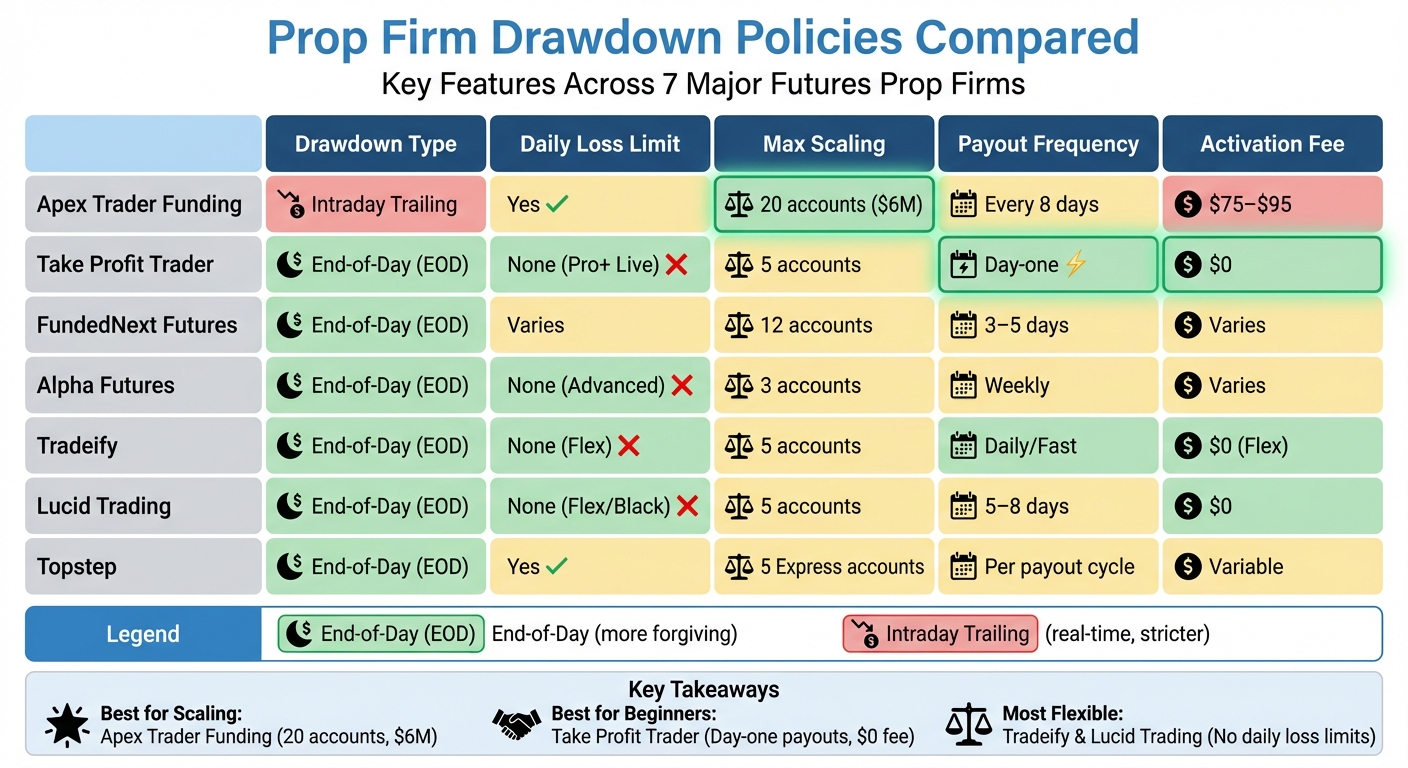
Prop Firm Drawdown Policies and Features Comparison Chart
1. Apex Trader Funding

Drawdown Type
Apex Trader Funding uses an unrealized trailing drawdown that follows your highest equity peak in real time. Here’s how it works: if a trade reaches a new peak but then pulls back, the drawdown remains locked at that peak. This means your safety cushion shrinks even if the profit hasn’t been secured yet.
Once you move to a Performance Account (PA), the trailing drawdown stops moving once it hits your starting balance plus $100. This creates a permanent floor, giving you room to scale over time. For traders who prefer a more predictable approach, Apex also offers Static Accounts with fixed drawdowns. However, these accounts usually come with smaller cushions or higher costs.
Daily Loss Limits
Apex uses the unrealized trailing drawdown as its primary safeguard against losses. Open losses on any trade are capped at 30% of the profit earned that day. Additionally, all positions must be closed by 4:59 PM ET daily. If your account equity hits the liquidation threshold at any point during the day, the account is immediately liquidated. These measures are designed to manage risk while enabling traders to scale effectively.
Scaling Potential
Scaling with Apex is driven by copy trading across up to 20 funded accounts, allowing traders to access up to $6 million in funding. Among their account options, the $50K account stands out with the highest return potential. It has a $3,000 profit target and can scale to a $40,000 maximum payout every 8 trading days when using 20 accounts. Traders keep 100% of their first $25,000 in profit per account. Since 2022, Apex has paid out over $500 million to traders.
Here’s a quick breakdown of Apex’s account parameters:
| Account Size | Min Balance for Payout | Max Payout (First 5) | Min Trading Days |
|---|---|---|---|
| $25K | $26,600 | $1,500 | 8 Days |
| $50K | $52,600 | $2,000 | 8 Days |
| $100K | $103,100 | $2,500 | 8 Days |
| $150K | $155,100 | $2,750 | 8 Days |
| $300K | $307,600 | $3,500 | 8 Days |
Payout Qualification
To qualify for payouts, your balance must stay above the drawdown floor plus $100 – this acts as a “safety net” for the first three payout cycles. Apex also enforces a prop firm consistency rule, meaning no single trading day can contribute more than 30% of your total profit when requesting a payout. Payouts can be requested every 8 trading days, and after six successful payouts, all withdrawal caps are lifted.
The firm’s largest single payout to date? A staggering $2.5 million. This payout structure highlights how Apex’s policies balance risk management with growth opportunities for traders.
sbb-itb-46ae61d
2. Take Profit Trader

Drawdown Type
Take Profit Trader uses different drawdown models depending on the account type. Evaluation and PRO+ accounts follow an End-of-Day (EOD) trailing drawdown, meaning losses are calculated only at the end of the trading day. Unrealized gains during the session won’t impact your drawdown until positions are closed. On the other hand, Standard PRO accounts use an intraday trailing drawdown, which adjusts in real time based on open profits. This approach is more restrictive since unrealized profits can lower your drawdown threshold while trades are still active. PRO+ accounts are typically invite-only and are offered to traders showing consistent performance or those making $10,000 in a single day [1].
Daily Loss Limits
Take Profit Trader has completely eliminated daily loss limits. Instead, risk is managed solely through the trailing drawdown system. This change allows traders to focus on their strategies without worrying about mid-session liquidations due to hitting a daily cap. However, all open positions must be closed by 5:00 PM EST to comply with trading rules [1].
Scaling Potential
Traders with Take Profit Trader can start using their full contract limit from the very first day. Additionally, you can manage up to five active accounts simultaneously, with a monthly cap of 10 accounts [1]. The profit split is 80/20 for PRO accounts and 90/10 for PRO+ accounts. Between January and August 2023, the firm reported a pass rate of about 20.37% [1].
Here’s a quick look at the account details:
| Account Size | Monthly Price | Profit Target | Max Trailing Drawdown | Max Mini Contracts |
|---|---|---|---|---|
| $25,000 | $150 | $1,500 | $1,500 | 3 |
| $50,000 | $170 | $3,000 | $2,000 | 6 |
| $75,000 | $245 | $4,500 | $2,500 | 9 |
| $100,000 | $330 | $6,000 | $3,000 | 12 |
| $150,000 | $360 | $9,000 | $4,500 | 15 |
These options give traders plenty of room to grow while keeping things straightforward.
Payout Qualification
Take Profit Trader’s payout system is designed for speed and simplicity. Traders can qualify for funding in as little as five trading days. Once funded, payouts are available from Day 1, with no minimum withdrawal amounts, no waiting periods, and no payout windows [1]. During the evaluation phase, no single trading day can account for more than 50% of your total profits [1]. You can use a consistency calculator to ensure your trading volume stays within these required limits. To keep your funded account active, you’ll need to place at least one trade per week [1].
3. FundedNext Futures
Drawdown Type
In a comparison of FundedNext and FundingTicks, we noted that FundedNext Futures uses an End-of-Day (EOD) Trailing Max Loss system for all account types. This approach updates the drawdown threshold only at the end of the trading day. What does this mean for you? Intraday unrealized profits won’t impact your drawdown limit while your trades are still open, giving you more breathing room during market swings. For Legacy accounts, the Max Loss Limit (MLL) resets to your starting balance after your first payout, which could tighten your risk cushion as you move forward.
Daily Loss Limits
For traders using Legacy or Rapid accounts, there’s some good news: no daily loss limits apply. Risk is instead managed through the trailing MLL system. However, the Bolt account does have a $1,000 daily soft loss limit. With the MLL, it trails upward based on your highest end-of-day balance but won’t decrease. Once the MLL reaches your initial balance – usually after your first withdrawal – it becomes fixed.
Scaling Potential
FundedNext allows traders to manage 5 or 6 funded accounts simultaneously, with a total challenge cap of $700,000. The profit split varies depending on your account type and progression. Here’s how it works:
- Legacy accounts: Start with an 80/20 split, which improves to 90/10 after 30 Benchmark Days.
- Rapid accounts: Begin at 80/20, increasing to 90/10 after the fifth payout.
- Bolt accounts: Maintain a consistent 80/20 split, but payouts are capped at 5 withdrawals before the account closes.
These scaling rules directly affect how payouts are structured.
Payout Qualification
FundedNext offers three payout structures tailored to its account types:
- Legacy accounts: Withdraw 50% of profits every 5 Benchmark Days once you’ve hit a minimum profit of $100–$200. After 30 Benchmark Days, you can withdraw 100% of profits.
- Rapid accounts: Skip the benchmark requirement – payouts are available as soon as 3 days after passing. However, there’s a 40% consistency rule, meaning no single trading day can account for more than 40% of your total profit. Initial withdrawals are capped at $800–$2,500 for the first five payouts.
- Bolt accounts: Operate on a buffer model, where you can only withdraw profits exceeding a $52,100 threshold (for a $50,000 account).
FundedNext also promises 24-hour payout processing. If they miss this deadline, they’ll credit you with an extra $1,000 bonus [2][3].
| Account Type | Monthly Price | Consistency Rule | Payout Timing | Max Payouts |
|---|---|---|---|---|
| Legacy ($50K) | $149.99 | 40% (Eval only) | Every 5 Benchmark Days | Unlimited |
| Rapid ($50K) | $199.99 | 40% (Funded only) | Every 3 Days | Unlimited |
| Bolt ($50K) | $99.99 | 40% (Eval only) | Buffer-based | 5 Total |
4. Alpha Futures

Drawdown Type
Alpha Futures uses an End-of-Day (EOD) Trailing Drawdown system. This means the Maximum Loss Limit (MLL) updates only at the end of each trading session, based on the highest closed balance. Once the MLL reaches the starting balance, it becomes fixed, providing a stable safety net during periods of market volatility [5][6].
Daily Loss Limits
Instead of a strict daily loss limit, Alpha Futures employs a Daily Loss Guard (DLG). For Standard and Zero accounts, the DLG is set at 2% of the starting balance, applying during both the evaluation and funded stages. If you hit this limit, your account is locked for the rest of the session but isn’t terminated, allowing you to resume trading the following day [5].
For Advanced accounts, the DLG is removed entirely during the funded stage as of November 11, 2025. However, during the evaluation stage, it remains at 2% [4]. These rules significantly impact how traders manage risk and approach withdrawals and scaling.
Scaling Potential
When it comes to withdrawals, there’s a notable difference between account types. For Standard and Zero accounts, withdrawals reduce the drawdown buffer on a dollar-for-dollar basis. For example, if you withdraw $2,500 from a $3,000 buffer, you’re left with just $500, increasing the risk of account termination [6][7].
Advanced accounts, however, offer withdrawal-protected payouts, meaning withdrawals don’t affect the drawdown cushion. This feature allows traders to scale without compromising their safety net. Additionally, Standard and Zero accounts enforce a 40% consistency rule, meaning no single day’s profits can exceed 40% of the total profits. Advanced accounts have no such rule once funded [4][5][7]. These differences highlight how account structures impact payout and scaling strategies.
Payout Qualification
To qualify for payouts with Alpha Futures, all account types require at least five profitable trading days per cycle, with each day generating a minimum of $200 profit. Standard accounts offer bi-weekly payouts with a tiered profit split: 70% for the first two payouts, 80% for the next two, and 90% thereafter. It takes at least 10 weeks to reach the highest profit split [6].
Zero and Advanced accounts, on the other hand, provide a flat 90% profit split right from the start, with weekly payouts for quicker access to earnings [4][5].
| Account Type | Monthly Price (100K) | Daily Loss Guard | Consistency Rule (Funded) | Profit Split | Payout Frequency |
|---|---|---|---|---|---|
| Standard | $159 | 2% | 40% | 70% → 80% → 90% | Bi-weekly |
| Zero | $199 | 2% | 40% | 90% Flat | Weekly |
| Advanced | $279 | None | None | 90% Flat | Weekly |
5. Tradeify

Drawdown Type
Tradeify uses an End-of-Day (EOD) Trailing Drawdown for its Growth and Select evaluation accounts, as well as for Select Flex and Select Daily funded accounts. This type of drawdown updates only at the end of the trading session, specifically at 5:00 PM ET. This approach helps traders manage intraday market fluctuations without facing penalties during the day. [11][12]
The trailing drawdown locks when your account balance surpasses the starting capital plus the maximum drawdown amount and an additional $100. For instance, in a $50,000 account with a $2,000 drawdown, the lock activates at $52,100. [11][12] Lightning accounts, which provide instant funding, use a dynamic daily loss limit that shifts to a trailing drawdown once the account becomes profitable. [8] These mechanisms play a crucial role in shaping daily risk management strategies.
Daily Loss Limits
Tradeify applies a soft breach policy for the Daily Loss Limit (DLL) on Growth evaluation and Select Daily funded accounts. If you hit the DLL, your account is paused for the rest of the day instead of being terminated, and trading resumes at 6:00 PM ET. [11][12] On the other hand, Select Evaluation and Select Flex accounts do not have a Daily Loss Limit, offering more flexibility for intraday trading.
For Select Daily funded accounts, the DLL is tiered based on account size:
- $1,000 for $50,000 accounts
- $1,250 for $100,000 accounts
- $1,750 for $150,000 accounts [12]
Scaling Potential
Tradeify supports growth by allowing traders to manage up to five funded accounts at the same time across Growth, Select, and Lightning account types. This setup offers the potential to access up to $750,000 in total funding. [8][10] Funded accounts implement progressive contract scaling based on end-of-day equity. For example, in a $50,000 account:
- Traders start with 2 minis (or 20 micros) when equity is between $0 and $1,499.
- Once equity exceeds $2,000, the scale increases to 4 minis (or 40 micros). [12]
After successfully completing five payouts, traders can join the Tradeify Elite program. This program transitions traders to live capital trading with no simulated profit caps and allows daily payout requests. [8][12] Additionally, Select Flex accounts lock the drawdown at zero after the first payout, ensuring that withdrawals won’t reduce the drawdown buffer. This eliminates the risk of account failure due to drawdown breaches.
Payout Qualification
Tradeify’s payout structure is designed for efficiency, offering a 90% profit split across all account types. [8][11] The consistency rules vary depending on the account type:
- Growth accounts have a 35% single-day profit cap.
- Select funded accounts have no consistency rules after funding.
- Lightning accounts feature a progressive consistency rule starting at 20% for the first payout, 25% for the second, and 30% for subsequent payouts. [8][9][11]
For payout eligibility, Growth accounts require at least five profitable trading days per cycle, with each day generating at least $150 in profits for a $50,000 account. [8][10] Select Flex accounts also require five winning days (with applicable profit thresholds), while Select Daily and Lightning accounts don’t mandate a minimum number of trading days. Payouts are processed quickly, typically within 10 minutes to 24 hours. [8]
| Account Type | Consistency Rule (Funded) | Min. Trading Days | Payout Frequency | Daily Loss Limit |
|---|---|---|---|---|
| Growth | 35% | 5 Profitable Days | Per Cycle | Yes (Soft Breach) |
| Select Flex | None | 5 Winning Days | Every 5 Days | None |
| Select Daily | None | None | Daily | Yes (Soft Breach) |
| Lightning | 20%–30% (Progressive) | None | Same-day | Yes |
6. Lucid Trading
Drawdown Type
Lucid Trading takes a distinct approach to drawdown policies by implementing an End-of-Day (EOD) trailing drawdown across all its futures prop firm account types – LucidPro, LucidFlex, LucidDirect, and LucidBlack. This policy ensures that the Maximum Loss Limit (MLL) only updates at the session’s close (4:45 PM EST). This means traders can experience intraday losses without violating the drawdown, as long as the account closes above the required threshold.
Once the account balance hits the "Initial Trail Balance" (starting balance plus the profit target), the trailing drawdown locks in place. For instance, on a $50,000 account with a $3,000 profit target, the drawdown floor becomes fixed at $50,000 when the balance reaches $53,000. This approach is particularly notable for its timing, as the lock occurs at the session’s end, offering traders some breathing room during the day [13].
Daily Loss Limits
The application of Daily Loss Limits (DLL) varies depending on the account type. LucidPro and LucidDirect accounts enforce a DLL, while LucidFlex and LucidBlack accounts do not. For LucidPro accounts, the DLL thresholds are as follows:
- $600 for a $50,000 account
- $1,200 for a $100,000 account
- $1,800 for a $150,000 account
If a trader breaches the DLL, trading is paused for the rest of the session, but the account remains active for the next trading day [25,27,30].
"The Daily Loss Limit (DLL) and Max Loss Limit (MLL) are two separate, independent rules. Hitting MLL always terminates. Hitting DLL just ends the trading day." – Paul, PropTradingVibes [13]
This DLL framework supports Lucid Trading’s flexible scaling options, allowing traders to manage risk while pursuing growth.
Scaling Potential
Lucid Trading offers a 10:1 micro-scaling rule. For example, on a $50,000 account, traders can use up to 4 mini contracts or 40 micro contracts. Additionally, traders can manage up to five funded accounts simultaneously, providing access to greater capital. For more details on how these rules compare to other providers, see our futures prop firm reviews. After completing 4–6 payout cycles, traders may qualify for LucidLive, which allows live capital trading with improved scaling options and daily withdrawal capabilities [27,28].
Payout Qualification
Lucid Trading provides a 90% profit split across all account types, though the specific payout requirements differ by account model:
- LucidPro: Requires 5 trading days and a balance buffer above the Initial MLL plus $100 before withdrawals are approved.
- LucidFlex: Needs 5 profitable days with a minimum daily profit (e.g., $150 on a $50,000 account) but eliminates consistency rules and payout buffers during the funded stage.
- LucidDirect: Enforces a 20% consistency rule.
- LucidBlack: Applies a stricter 40% consistency rule, with payout eligibility in as few as 3 days.
These terms, combined with the 90% profit split, showcase Lucid Trading’s focus on balancing risk management with scaling opportunities and payout flexibility [27,28,29].
| Account Type | Drawdown Type | Daily Loss Limit | Consistency Rule (Funded) | Payout Buffer |
|---|---|---|---|---|
| LucidPro | EOD Trailing (Locks) | Yes | 40% | Yes (MLL + $100) |
| LucidFlex | EOD Trailing (Locks) | None | None | None |
| LucidDirect | EOD Trailing (Locks) | Yes | 20% | None |
| LucidBlack | EOD Trailing (Locks) | None | 40% | None |
7. Topstep

Drawdown Type
Topstep applies an End-of-Day (EOD) drawdown policy for both Express and Live Funded Accounts. This means the Maximum Loss Limit is calculated based on the account balance at the end of the trading day, not during intraday fluctuations. Essentially, as long as the closing balance stays above the threshold, traders can withstand intraday pullbacks.
"End-of-Day Drawdown allows you to play all four quarters. This is how real trading works. You can ride out the ups, downs, and pullbacks as long as you finish the day above your max drawdown limit." – Topstep [14]
After a trader takes their first payout, the Maximum Loss Limit resets to $0. This adjustment makes the remaining capital the new drawdown buffer [18].
Daily Loss Limits
Topstep enforces a Daily Loss Limit (DLL) as a soft breach rule. If a trader hits the DLL, their positions are flattened, and any open orders are canceled. However, the account remains active for trading the next day. The thresholds for DLL are:
- $50,000 account: -$1,000
- $100,000 account: -$2,000
- $150,000 account: -$3,000
Traders using the TopstepX platform are exempt from the DLL rule in Express Funded Accounts [17][19]. For Live Funded Accounts, the DLL adjusts dynamically based on the account balance, giving traders more flexibility as profits grow [16].
These limits also tie into Topstep’s scaling structure, which adjusts trading conditions based on performance.
Scaling Potential
In Express Funded Accounts, the number of contracts traders can manage increases as the account balance grows. For example, a $100K account starts with 3 lots if profits are under $1,500, increases to 4 lots between $1,500–$2,000, 5 lots between $2,000–$3,000, and reaches 10 lots once profits exceed $3,000 [17][19].
As of July 22, 2025, Live Funded Accounts adopted a "Dynamic Live Risk Expansion" model. This system adjusts contract sizes based on real-time performance and market volatility. Traders begin with 20% of their balance available and unlock the remaining 80% in 20% increments as they hit specific profit milestones. Additionally, traders can manage up to five active Express Funded Accounts simultaneously using trade copying platforms [17][15].
Payout Qualification
Topstep rewards consistent trading performance through structured payout options.
Starting February 5, 2026, Express Funded Accounts offer two payout paths:
- Standard Path: Requires 5 winning days with a Net P&L of $150 or more. Traders can withdraw up to $5,000 with a 90/10 profit split.
- Consistency Path: Requires 3 winning days where no single day’s profit exceeds 40% of the total net profit. This path allows a maximum payout of $6,000 [18].
As of December 30, 2025, Topstep introduced a "two-rule" payout system. After the first payout, traders must remain profitable (even by as little as $0.01) since their last withdrawal to qualify for future payouts [15][18]. For Live Funded Accounts, traders gain access to daily payouts and 100% profit retention after achieving 30 non-consecutive winning days of $150 or more [18][19]. Winning days are locked in at 4:00 PM CT, and payouts via ACH or wire transfer incur a $30 processing fee [18].
Topstep’s policies are designed to balance risk management with opportunities for growth, giving traders clear steps to scale their accounts and access profits.
| Account Type | Payout Path | Days Required | Max Payout | Consistency Rule |
|---|---|---|---|---|
| Express (Standard) | Standard | 5 winning days ($150+) | $5,000 (50%) | None |
| Express (Consistency) | Consistency | 3 days | $6,000 (50%) | 40% |
| Live Funded | Performance-Based | 30 winning days ($150+) | 100% of balance | None |
End of Day Drawdown Rule Explained – Prop Firms
Pros and Cons
Each firm’s drawdown policy comes with its own set of trade-offs, impacting both how quickly you can scale your trading and how often you can access payouts.
Starting with drawdown timings, the End-of-Day (EOD) drawdown is often seen as more forgiving for beginners. This method calculates losses at the end of the trading day, giving traders room to handle intraday pullbacks without immediately hitting their loss limit. It mirrors real market conditions better, though traders still need to manage their positions carefully to avoid breaching thresholds during volatile trading sessions.
On the other hand, the intraday trailing drawdown, used by firms like Apex Trader Funding, adjusts the maximum loss limit in real time as your account equity grows. This approach helps lock in gains but can reduce your safety margin during routine market fluctuations. While it prevents large single-day losses, it can also result in a loss of funded status due to normal pullbacks, even if your strategy might have recovered later in the session.
Daily loss limits (DLL) add another layer to risk management. Some firms, like Tradeify SELECT (Flex Policy) and Alpha Futures Advanced accounts, eliminate DLL altogether, offering maximum flexibility but requiring traders to exercise strong self-discipline. Other firms enforce strict DLL caps, which can protect against devastating losses but may also cut you off prematurely during temporary dips.
Scaling potential varies widely across firms. For example, Apex Trader Funding stands out with a high ceiling – allowing up to 20 accounts and a combined $6,000,000 funding limit. In comparison, firms like Take Profit Trader and FundedNext Futures offer more modest limits, capping scaling at 5 and 12 accounts respectively. These firms often pair their scaling caps with EOD drawdown policies, simplifying the path to consistent profitability.
Finally, payout qualification rules differ significantly. Take Profit Trader allows immediate payouts from day one without consistency requirements. Meanwhile, Topstep requires traders to meet specific criteria – either five winning days (Standard Path) or three days with a 40% consistency cap (Consistency Path) – to qualify for their first withdrawal. Alpha Futures offers some of the highest payout caps, reaching up to $15,000 per week per account, but processes payouts weekly rather than daily.
Here’s a quick comparison of key features across firms:
| Firm | Drawdown Type | Daily Loss Limit | Max Scaling | Payout Frequency | Activation Fee |
|---|---|---|---|---|---|
| Apex Trader Funding | Intraday Trailing | Yes | 20 accounts ($6M) | Every 8 days | $75–$95 |
| Take Profit Trader | EOD (Eval/Live) | None (Pro+ Live) | 5 accounts | Day-one | $0 |
| FundedNext Futures | End-of-Day | Varies | 12 accounts | 3–5 days | Varies |
| Alpha Futures | End-of-Day | None (Advanced) | 3 accounts | Weekly | Varies |
| Tradeify | End-of-Day | None (SELECT Flex) | 5 accounts | Daily/Fast | $0 (SELECT) |
| Lucid Trading | End-of-Day | None (Flex/Black) | 5 accounts | 5–8 days | $0 |
| Topstep | End-of-Day | Yes | 5 Express accounts | Per payout cycle | Variable |
Conclusion
Choosing the right prop firm boils down to matching their offerings with your trading goals and risk tolerance. If you’re aiming for aggressive growth and can handle the pressure of intraday trailing drawdowns, Apex Trader Funding might be your best bet. With leverage across 20 accounts and payouts of $70K every 8 days, it’s designed for traders who thrive in high-stakes environments. On the other hand, Take Profit Trader provides a more forgiving setup, featuring End-of-Day drawdowns on Pro+ live accounts, no activation fees, and withdrawals starting on day one – offering conditions that closely mimic real trading.
For beginners or those with a cautious approach, firms like Alpha Futures and FundedNext Futures are worth considering. Both use EOD drawdowns and provide steady payout structures, with Alpha Futures allowing weekly payouts of up to $15K. If you want to skip the evaluation phase entirely, Lucid Trading and Tradeify offer instant funding, $6,000 EOD drawdown buffers, and no activation fees.
Beyond these features, it’s essential to weigh the cost-to-payout ratio. While firms like Take Profit Trader may have higher upfront costs, the absence of activation fees could save you money in the long run compared to firms with frequent reset fees. Also, pay attention to how firms handle daily loss limits – whether they result in a hard breach or just a temporary lockout for the day – as this can greatly affect your account’s longevity.
Ultimately, there’s no universal solution. Your ideal firm depends on whether you prioritize rapid scaling, fast payouts, forgiving rules, or minimizing upfront costs. Understanding how each firm’s policies impact your trading style is key to making the right choice. Take the time to evaluate your risk appetite, trading habits, and financial goals. For more insights, detailed comparisons of the best futures prop firms, and exclusive discounts, visit DamnPropFirms to find the perfect match for your trading journey.
FAQs
Which drawdown type is best for my trading style?
The type of drawdown that works best for you depends on your trading style and how much risk you’re comfortable with:
- Fixed drawdowns stick to a set limit, making them a good fit for traders who value consistency and predictable risk management.
- Trailing drawdowns move along with your account’s growth, making them suitable for traders who handle changing risks as their account evolves.
- End-of-day drawdowns calculate limits after the trading day ends, which can be helpful for those focused on managing daily performance.
Your choice should align with your trading preferences and the specific rules of the proprietary trading firm you’re working with.
How do drawdown rules affect payouts after I withdraw profits?
Drawdown rules influence how much you can withdraw by setting limits on losses relative to your account’s value. Static or end-of-day drawdowns assess these limits at specific times, offering a bit more leeway. On the other hand, intraday or trailing drawdowns adjust in real-time, taking into account unrealized gains or losses throughout the day. When policies are stricter, they can shrink withdrawal amounts during volatile periods. That’s why it’s crucial to understand each firm’s specific rules to better manage risk and plan your withdrawals wisely.
What’s the easiest way to avoid breaking a trailing drawdown intraday?
To stay within the limits of a trailing drawdown during intraday trading, it’s important to keep open losses minimal and closely monitor your account’s peak equity level. Prioritize turning profitable trades into cash promptly, stick to disciplined position sizing, and steer clear of large unrealized losses. Adhering to daily loss caps and preventing significant pullbacks after securing gains can make a big difference. The cornerstone of success here is consistent and careful risk management.