
Figuring out the right number of Apex Trader Funding accounts to trade depends on your experience, risk tolerance, and ability to manage multiple accounts effectively. Apex allows up to 20 active Performance Accounts, offering significant income potential but also increased complexity. Here’s what you need to know:
- Scaling Potential: A single $100,000 account can generate $4,000 at step six of the payout stage. Multiply that by 20 accounts, and the potential earnings reach $80,000 under similar conditions.
- Challenges: Managing multiple accounts requires strict adherence to Apex’s rules (e.g., trailing drawdowns, consistency requirements) and can lead to mistakes or mental fatigue if not handled carefully.
- Phased Approach: Start with one account, then gradually add more as you build confidence and use automation tools like Replikanto or the Apex Trade Copier.
- Account Size Considerations: Larger accounts allow higher profits but come with stricter targets and rules. For example, a $25,000 account has a $1,500 profit target, while a $150,000 account requires $9,000.
- Risk Management: Use tools to track drawdowns and ensure compliance with rules like the 50% consistency requirement and daily loss limits.
Balancing growth and control is essential. Begin with a single account, focus on consistency, and scale up only when you’re prepared to manage the added complexity.
Benefits and Challenges of Multiple Accounts
Why Trade Multiple Accounts
Trading multiple Apex Trader Funding accounts offers a massive opportunity to scale up your payout potential. For instance, a single $150,000 account limits its first payout to $2,500. But with 20 accounts, traders can aim for an initial combined payout of up to $50,000 and as much as $100,000 by the sixth payout stage[2]. This multiplication effect makes Apex’s allowance of up to 20 accounts particularly appealing – especially with their 100% profit split on approved payout amounts for both new EOD and Intraday accounts[2].
Beyond the financial boost, multiple accounts allow traders to experiment with different strategies and diversify across markets. This approach reduces the risk of a single account’s drawdown significantly impacting your overall portfolio. Tracy-Lynn Ball, a trader and mentor at Push Button Trading, highlights this benefit:
"By having more than one account, you can test different strategies or trade various markets. This helps spread out risk and increase your profit opportunities."[1]
While the advantages are clear, managing multiple accounts introduces complexities that traders need to navigate carefully.
Common Difficulties with Multiple Accounts
Managing multiple accounts isn’t without its pitfalls. As Maria, a professional futures trader, warns:
"Multiple funded accounts do not forgive mistakes. They replicate them."[6]
A single misstep can lead to compounded losses across all accounts, potentially undoing weeks of hard work and profits.
Tracking drawdowns is another challenge. EOD accounts calculate drawdowns at market close, while Intraday accounts trail in real time, factoring in peak balances – even unrealized gains[2]. This means open profits can temporarily raise your drawdown threshold, creating a potential trap if you’re not paying close attention. On top of this, each account has its own strict daily performance requirements[2]. Missing these requirements – even if you’re profitable overall – can delay or block payouts.
The psychological toll of managing multiple accounts shouldn’t be underestimated either. Balancing the need to monitor performance, the fear of losing profits, and the temptation to micromanage positions can be mentally draining[6]. There’s also the time commitment: Intraday accounts, for example, require at least one $150 net profit day within 150 calendar days to remain active. Keeping track of such requirements across several accounts can quickly become overwhelming.
Understanding these hurdles is crucial for determining how many accounts you can effectively manage without compromising performance or mental clarity.
sbb-itb-46ae61d
Huge Apex Trader Funding Update: Passing Just Got Easier

How to Choose the Right Number and Size of Accounts
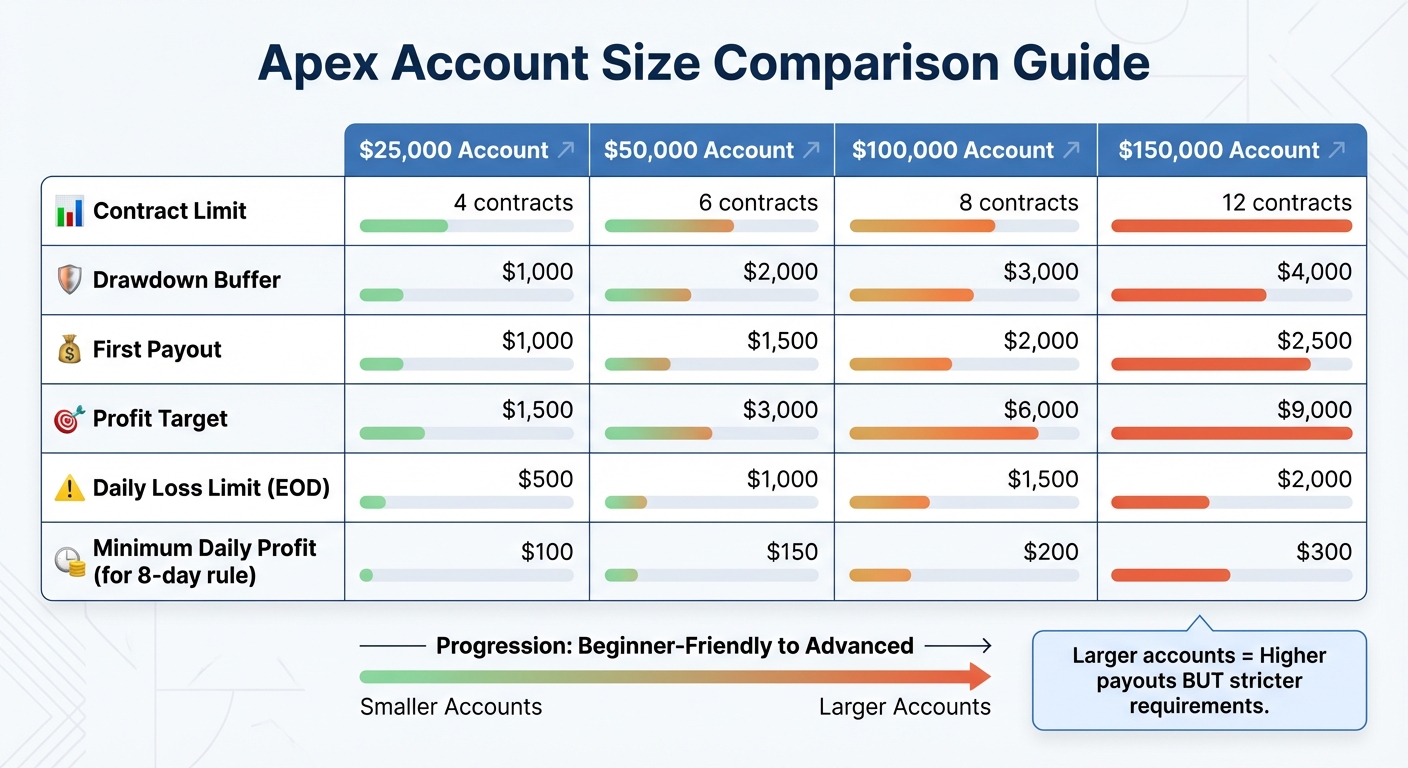
Apex Trader Funding Account Sizes Comparison: Contract Limits, Drawdowns, and Profit Targets
What to Consider When Choosing Account Numbers
Managing multiple accounts can be a balancing act, so choosing the right number is key to keeping your strategy effective while managing risk. Your level of trading experience and comfort with technology should guide this decision. Apex Trader Funding allows up to 20 active Performance Accounts per household [7], but professional traders suggest a gradual four-phase approach:
- Start with mastering a single account for three months.
- Add 2–3 additional accounts to test your ability to manage multiple accounts.
- Scale to 6–10 accounts using automation tools like trade copier software.
- Optimize and manage 10+ accounts effectively [7].
Your trading strategy also plays a big role in determining scalability. If you’re executing trades manually, managing more than three accounts can become overwhelming due to potential execution delays and mental fatigue [7]. For those looking to scale beyond this point, automation tools are almost a necessity to ensure consistency across positions.
Another important factor is the drawdown model, such as the End-of-Day (EOD) drawdown used by firms like E8 Futures. Make sure the drawdown type aligns with your trading strategy’s behavior before deciding how many accounts to open. Once you’ve determined the ideal number of accounts, the next step is figuring out the right size for each.
Picking the Right Account Sizes
The size of your account directly affects your contract limits and profit potential. For example, a $25,000 account allows up to 4 contracts, comes with a $1,000 drawdown buffer, and offers a $1,000 first payout. On the other hand, a $150,000 account supports 12 contracts, offers a $4,000 buffer, and provides a $2,500 first payout [2]. The larger drawdown buffer in bigger accounts can be helpful during periods of market volatility.
While larger accounts offer higher first payouts, they also come with higher profit targets. For instance, a $150,000 account requires hitting a $9,000 profit target, compared to just $1,500 for a $25,000 account [2]. This means you’ll need to weigh the challenge of meeting these targets against the potential payout.
Another factor to consider is the Daily Loss Limit (DLL), which varies by account size. End-of-day (EOD) accounts have fixed DLLs that halt trading for the day if exceeded. For instance, a $25,000 account has a $500 DLL, while a $150,000 account has a $2,000 DLL [2].
These factors – drawdown limits, profit targets, and daily loss rules – will directly affect your ability to manage risk and align with Apex Trader Funding’s guidelines.
For more in-depth information on Apex Trader Funding’s account options and performance, check out our review on DamnPropFirms: Apex Trader Funding Review.
Risk Management and Rule Compliance Across Accounts
How to Manage Trailing Drawdown on Each Account
When managing multiple accounts, keeping a close eye on the trailing drawdown is essential. As of March 1, 2026, Apex offers two types of trailing drawdown models: Intraday Trailing and End-of-Day (EOD) Trailing. The Intraday model adjusts in real-time based on your peak unrealized gains, meaning even temporary profits can permanently raise your liquidation threshold. For example, if a trade is up $1,000 but retraces before you close it, your safety cushion shrinks permanently. In contrast, the EOD model updates only at market close and takes effect the next trading session [2].
"The unrealized trailing drawdown at Apex Trader Funding is the single biggest rule that trips up traders." – DamnPropFirms [8]
To avoid being caught off guard, always maintain a buffer of $100–$300 above your liquidation threshold [8]. Apex’s Safety Net feature, available in Performance Accounts, helps by locking the trailing drawdown once your balance reaches the starting balance plus the drawdown amount plus $100. For example, on a $50,000 account, the Safety Net activates at $52,100 [2]. Until you reach this point, every dollar of profit raises your liquidation level.
When handling multiple accounts, treat each one as a separate entity. Avoid mentally combining them into a single pool of capital. Ensure that trades – entries, exits, and stop-losses – are executed identically across all accounts. This consistency prevents scenarios where some accounts survive while others fail due to uneven execution [8, 6].
Once you’ve got drawdown management in place, the next step is maintaining strict compliance with all account rules.
Staying Compliant with Multiple Accounts
In addition to managing drawdowns, following Apex’s compliance rules is critical for long-term success. Here are some key rules to keep in mind:
- Risk-to-Reward Ratio: Apex enforces a mandatory 5:1 risk-to-reward ratio. For instance, risking $500 to make $100 is acceptable, but risking $500 to make $50 violates this rule. Unrealized losses on open trades must also stay below 30% of your current profit balance [4, 11].
- 50% Consistency Rule: For 2026 accounts, no single profitable day can contribute more than 50% of your total net profit between payout requests [2].
- 8-Trading-Day Payout Rule: This requires five qualifying days with minimum daily profits (e.g., $100 for a $25,000 account or $300 for a $150,000 account) and three additional trading days [4, 2].
To simplify compliance, use ATM strategies to automate stop-loss and profit targets when entering trades [9]. If you notice declining execution quality during a trading session, stop trading immediately. Trying to "fix" a losing day can lead to emotional mistakes, which are only amplified when managing multiple accounts [6].
Finally, consider adopting stricter internal rules to give yourself an extra margin of safety. By combining careful drawdown management with consistent adherence to compliance requirements, you can keep your account portfolio running smoothly and profitably.
Payout Timing and Withdrawal Methods
How Apex’s Payout Structure Works
Apex’s payout system is designed with strict risk controls, offering traders flexibility and benefits, especially when managing multiple accounts. Here’s how it works: under the legacy rules, traders could keep the first $25,000 in profits per account before moving to a 90/10 profit-sharing split. Since each Performance Account is treated as independent, managing 20 accounts could allow you to retain up to $700,000 in total profits before sharing begins.
For accounts created after March 1, 2026, the payout structure shifts to a six-tier system. For example, a $50,000 account could yield up to $3,000 in the final payout. If you manage 20 accounts, this could result in up to $60,000 per payout cycle[2].
The minimum withdrawal amount is $500, and the entire process – from requesting a payout to receiving funds – takes about 5 to 7 business days[11]. Payments for U.S.-based traders are made via ACH direct deposit, while international traders use the Plane payment processor[11].
Coordinating Payouts Across Accounts
Managing withdrawals across multiple accounts requires careful planning. Under the new 2026 rules, payouts can be requested weekly, replacing the older system of twice-monthly withdrawals[2]. This flexibility allows you to stagger qualifying cycles across account groups, creating a steady flow of income. For instance, if you manage 12 accounts, you can divide them into three groups of four accounts, with each group completing its five qualifying trading days in different weeks.
To ensure smooth processing, wait until after 6:00 PM ET on the final qualifying trading day before submitting your payout request. This ensures all trading data is fully updated[11]. Additionally, maintain a buffer of $500–$1,000 above the Safety Net to avoid payout denial due to insufficient funds[12].
It’s important to note that if an account is "Pending" payout status and is blown, the withdrawal is forfeited. However, if the payout status has already been marked as "Approved", you will still receive the funds, even if the account fails afterward[10].
How to Maintain Consistency and Track Performance
Building a Consistent Trading Approach
When managing multiple Apex accounts, sticking to the same trading plan for every account is non-negotiable. Apex has paid out over $500 million to traders as of late 2025, and the key trait shared by successful traders is consistency – not flashy, high-risk moves[4]. A well-defined system with specific rules for entries, stop losses, profit targets, and trailing stops is essential. The goal? Execute these rules consistently across all sessions and accounts[9].
A practical way to achieve this is by designating one account as your primary and synchronizing trades across your secondary accounts[14]. To avoid triggering group trading flags, include a 0.5- to 2-second random delay in your trade copier settings. This ensures slight variations in timestamps and prices[14]. Additionally, reduce your risk per account to 0.25% or 0.50%. This precaution limits the impact of a losing streak, preventing multiple accounts from simultaneously hitting their daily loss limits[14].
Impulse trading is a major pitfall, and a clear, rule-based approach can help you steer clear of it. Apex emphasizes this in their guidelines:
"Apex is not looking for traders who gamble with their accounts or aim for ‘lottery-style lucky windfalls.’ Traders who blow through multiple accounts in pursuit of big, unpredictable profits do not demonstrate the consistency and discipline Apex values"[9].
To ensure flawless execution, consider running your trading platforms on a high-performance Virtual Private Server (VPS). This eliminates the risk of interruptions caused by local hardware issues[14].
Once you’ve established a consistent strategy, the next step is to keep a close eye on your account performance.
Monitoring and Analyzing Account Results
Standardizing your trading approach is just the beginning – tracking performance is equally critical. By monitoring results, you can fine-tune your strategy and ensure compliance with Apex’s rules.
Keep a record of daily P&L, trade counts, and notable wins and losses to uncover patterns in your performance[5]. Real-time tools like RTrader and Tradovate can help you track your trailing threshold drawdown, ensuring your accounts stay within liquidation limits[5].
Take time to review your weekly performance, focusing on metrics like losses, wins, and risk-to-reward ratios. This also includes checking whether you adhered to your trading rules or deviated from them[13]. Instead of relying solely on your win percentage, evaluate profitability using a futures trading profit calculator or the formula: (Win Rate × Average Reward) – (Loss Rate × Average Risk). This mathematical approach provides a clearer picture of your strategy’s effectiveness[13]. For new 2026 accounts, remember that no single profitable day can account for more than 50% of your total net profit since your last payout[2].
Set daily reminders to close all positions by 4:59 PM ET to stay compliant with Apex’s regulations[5]. Use spreadsheets or position-sizing calculators to monitor exposure closely, as exceeding contract limits for your account size results in immediate disqualification[5]. Tools like TradeSyncer can streamline trade management across multiple accounts while offering built-in analytics and journaling features[2]. For additional support, you can use resources like the Consistency Rule Calculator from DamnPropFirms to help stay within payout requirements across all your accounts.
Conclusion: Finding Your Optimal Account Balance
Deciding how many Apex accounts to trade successfully hinges on three main factors: your proven trading success, your ability to manage multiple accounts, and your personal risk tolerance. Take your time – start by mastering consistency with a single account before expanding your operations[7].
Once you’ve shown steady profitability, scaling up should follow a phased approach. Managing more than 3–5 accounts manually can quickly become inefficient and prone to mistakes[7]. While Apex permits up to 20 active Performance Accounts per household[7][2], this upper limit only makes sense if you have the infrastructure and discipline to manage them effectively.
Scaling strategically offers a key advantage: it diversifies risk. Each account has its own drawdown limits, so a violation on one doesn’t jeopardize your entire capital pool. With proper automation and adjusted position sizing, you can increase your income potential without adding unnecessary workload.
The goal isn’t to max out the number of accounts but to find a balance where profitability, compliance, and your mental capacity align. Monitor the performance of each account to identify underperformers[7], choose the drawdown model (EOD or Intraday) that suits your risk management preferences or compare TradingView prop firms for alternative setups[2], and ensure your systems meet daily compliance requirements, like closing all positions by 4:59 PM ET[5].
The traders behind Apex’s $500 million in payouts didn’t start by managing 20 accounts overnight. They built scalable, rule-based systems that allowed them to grow gradually while maintaining consistency[3]. By combining proven strategies with thoughtful scaling, you can create a profitable and manageable portfolio of Apex accounts.
FAQs
When should I add more Apex accounts?
You should add more Apex accounts only when you’re confident you can manage them effectively while staying within Apex’s rules. Make sure your trading strategy, risk management, and overall organization are solid enough to handle multiple accounts without breaking guidelines, such as the 20-account limit or restrictions on login sharing. Expanding works best after proving consistent performance and disciplined risk control – especially if you’re aiming for diversification, increased capital, or implementing multiple strategies.
Should I choose EOD or Intraday trailing drawdown?
When deciding between End-of-Day (EOD) drawdown and Intraday trailing drawdown, it all comes down to your trading approach and how you manage risk.
- EOD drawdown: This updates only at the end of the trading day, making it a better fit for traders who hold positions overnight or prefer more flexibility during the day.
- Intraday drawdown: This adjusts in real-time throughout the trading day, offering tighter risk control, which is ideal for day traders who close their positions before the market closes.
Choose the option that matches your trading style and aligns with how much risk you’re comfortable taking.
How do I avoid payout denials across accounts?
To prevent payout denials with Apex Trader Funding, it’s crucial to stick to their payout rules and risk policies. This means keeping an eye on minimum balance requirements, carefully managing your trade sizes, and ensuring your automation settings are properly configured. Once you’ve requested a payout, continue trading as though the funds have already been withdrawn. This helps you avoid dropping below the required balance threshold. By consistently following these practices, you can maintain compliance and minimize the chances of payout issues.