Choosing the right trading program depends on your style and goals. Here’s a quick breakdown:
- LucidFlex: Best for traders seeking flexibility in volatile markets. No daily loss limits or consistency rules after funding. Great for news traders and those with occasional big wins. Costs $75–$315 for evaluation accounts.
- LucidDirect: Ideal for experienced traders who want instant access without evaluations. Higher fees ($197–$899) but enforces strict 20% consistency rules. Perfect for steady earners.
- LucidPro: Suited for disciplined traders who want a fast funding process and frequent payouts. Lower fees ($94.50–$259), with a 40% consistency rule and 3-day payout cycles.
- LucidDaily: Built for cash-flow traders who want paid while they build. Daily payout requests with no per-request cap, no consistency rule after funding, and you customize the risk at checkout — intraday or EOD eval drawdown, daily loss limit on or off. Hit your Max Daily Profit and Lucid moves you live automatically. Costs $70–$305 for evaluation accounts depending on size and config.
Quick Comparison:
| You want… | Pick | You want… | Pick |
|---|---|---|---|
| Daily payouts + fast lane to live | LucidDaily | Daily payouts + fast lane to live | LucidDaily |
| No DLL, no funded consistency, cheapest flexibility | LucidFlex | No DLL, no funded consistency, cheapest flexibility | LucidFlex |
| Skip the eval, funded today | LucidDirect | Skip the eval, funded today | LucidDirect |
| Structured eval, buffer-based payouts | LucidPro | Structured eval, buffer-based payouts | LucidPro |
| Daily payouts + fast lane to live | LucidDaily | Daily payouts + fast lane to live | LucidDaily |
Each option caters to specific trading needs. LucidFlex offers the most freedom, LucidDirect skips evaluations, and LucidPro balances structure with faster payouts.
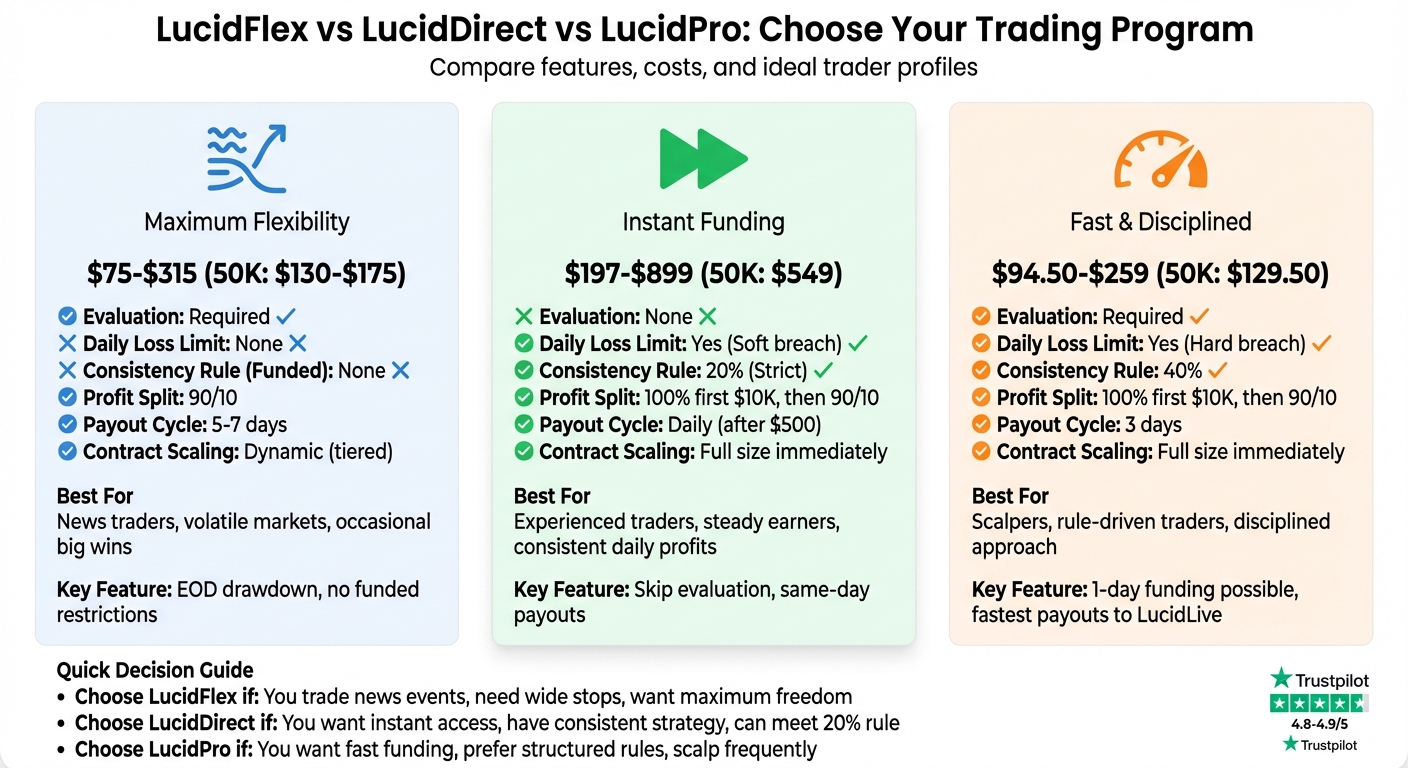
LucidFlex vs LucidDirect vs LucidPro Trading Programs Comparison
LucidFlex, LucidPro, LucidDaily or LucidDirect? Pick the right account
sbb-itb-46ae61d
LucidDaily Overview
LucidDaily (launched July 2026) is the daily-payout family. One-time fee from — (25K, cheapest config), no activation fee, and two checkout toggles that set your price and your risk: eval drawdown (Intraday cheaper, EOD pricier) and Daily Loss Limit (ON cheaper, OFF pricier). Config locks at purchase.
LucidDaily Key Features
- Daily payout requests, $500 minimum, no payout windows
- No consistency rule in funded (50% cushioned consistency in the eval)
- Funded drawdown is always intraday trailing, locks at initial balance + $100
- No per-request payout cap — Maximum Daily Profit of —–— by size, and hitting it moves you live ($15K flat cap on sim profits at that moment)
- Red-folder news in funded = hard breach
Who Should Use LucidDaily
Traders who want to get paid while they build, not after. If you’re consistent enough to pull profit most weeks and you actually WANT the live transition, LucidDaily gets you there faster than anything else Lucid offers. News traders and traders who want to stack unlimited sim profit should look at LucidFlex or Take Profit Trader instead.
LucidFlex Overview
LucidFlex operates on a two-stage model: you pay a one-time fee (ranging from $75 to $315), meet a profit target, and follow a 50% consistency rule during the evaluation phase. Once you pass, you’re upgraded to a funded account without any activation fees. The evaluation can be completed in as little as two trading days [2]. After funding, the consistency rule is dropped, and you keep 90% of all profits, with payouts typically approved within 1 to 15 minutes [2].
One of the standout features is the end-of-day (EOD) drawdown system. Instead of updating throughout the trading day, the Max Loss Limit adjusts at market close based on the closing balance. This prevents premature stop-outs caused by intraday volatility [2]. Additionally, once funded, there’s no daily loss limit, giving traders the freedom to recover from early-session losses without being restricted by arbitrary caps [2].
After six payouts, you transition to LucidLive, where you trade real capital. Up to $5,000 of simulated profits can be transferred, so it’s worth timing your payouts carefully [2].
LucidFlex Key Features
LucidFlex offers a 90/10 profit split and doesn’t require a payout buffer, meaning you’re not forced to keep large sums locked in your account [2]. Contract limits scale dynamically as your balance grows. For example, a $50,000 account starts with 2 mini contracts and increases to 3 once your balance reaches $1,000–$1,999, eventually capping at 4 minis above $2,000 [2].
News trading is fully allowed during high-impact events like NFP, FOMC, and CPI releases, with no blackout periods or restrictions [2]. These features are specifically designed to support traders who thrive in high-volatility environments and aim for rapid account growth. Lucid Trading currently boasts a 4.8/5 rating on Trustpilot, with users frequently praising the fast payouts and the absence of hidden rules [5].
| Account Size | Evaluation Fee | Profit Target | Max Loss Limit | Contract Limits (Funded) |
|---|---|---|---|---|
| $25,000 | $75–$100 | $1,250 | $1,000 | 2 minis / 20 micros |
| $50,000 | $130–$175 | $3,000 | $2,000 | 4 minis / 40 micros |
| $100,000 | $225–$295 | $6,000 | $3,000 | 6 minis / 60 micros |
| $150,000 | $315–$345 | $9,000 | $4,500 | 10 minis / 100 micros |
Who Should Use LucidFlex
LucidFlex is tailored for news traders and those who specialize in volatile markets. If your strategy involves trading during events like FOMC announcements or earnings reports, the EOD drawdown system helps protect your account from being liquidated prematurely during volatile price swings. It’s also a great fit for trend-following traders who rely on occasional large wins, as the removal of the funded consistency rule ensures that big winning days won’t count against you [2].
"LucidFlex is the forgiving option. No daily loss limit. No funded consistency rule… Most traders should start here." – Paul, Prop Trading Vibes [5]
Copy traders using top platforms will appreciate the simplified portfolio management enabled by the lack of a consistency requirement, while beginners can rest easy knowing that a single volatile candle won’t wipe out their account [5]. However, if you’re a steady daily earner who seldom encounters large swings, you might find LucidFlex’s flexibility unnecessary. In that case, LucidDirect’s instant funding option could be a better fit.
LucidDirect Overview
Building on the features of LucidFlex, LucidDirect offers a streamlined path to trading by skipping the evaluation phase entirely, granting instant trading access.
With LucidDirect, there’s no evaluation period. Traders pay a one-time fee – $197 for a $25,000 account or $899 for a $150,000 account – and immediately gain access to simulated capital with same-day payouts [6]. There are no activation fees, subscriptions, or waiting periods.
However, this convenience comes with stricter risk controls. LucidDirect enforces a Daily Loss Limit (DLL): if breached, all positions are closed, and the account is locked for the rest of the session. Trading resumes the next day. Additionally, the 20% consistency rule ensures steady performance – no single day’s profit can exceed 20% of the cycle’s total. For example, if your best trading day generates $1,000, you’ll need at least $5,000 in total profits before requesting a payout [9].
Payouts are processed quickly via Rise, with approvals in just 15 minutes. ACH transfers typically take a few hours to two business days. You keep 100% of your first $10,000 in profits, after which the profit split adjusts to 90/10 in your favor. After six payout cycles, traders can upgrade to LucidLive, which offers real capital, daily payouts, and overnight position holding [9].
LucidDirect also uses an End-of-Day trailing drawdown, with the Max Loss Limit recalculated at 4:45 PM EST. This system protects traders from being stopped out by intraday volatility as long as the account recovers by the session’s close. All positions must be closed by 4:45 PM EST, with no overnight or weekend holding allowed [4].
LucidDirect Key Features
LucidDirect’s pricing reflects the premium of bypassing the evaluation phase. For example, a $50,000 account costs $549 – significantly higher than LucidFlex’s $130–$175 range – but allows traders to start earning immediately without meeting profit targets first [6].
The 20% consistency rule remains a cornerstone of LucidDirect, ensuring profits are distributed steadily across trading days.
| Account Size | Max Loss Limit | Daily Loss Limit | First Payout Goal | Contract Limits |
|---|---|---|---|---|
| $25,000 | $1,500 | $600 | $3,000 | 2 minis / 20 micros |
| $50,000 | $2,000 | $1,200 | $3,000 | 4 minis / 40 micros |
| $100,000 | $3,000 | $2,000 | N/A | 6 minis / 60 micros |
| $150,000 | $4,500 | $3,000 | $9,000 | 10 minis / 100 micros |
As of early 2026, Lucid removed the mandatory 8-day minimum trading period for payouts. Traders can now request withdrawals as soon as they meet the profit and consistency targets, with a $500 minimum per payout cycle. News trading is fully allowed during high-impact events like FOMC and NFP, with no blackout periods [10].
"LucidDirect is built for traders who want immediate access, but you pay for that speed via tighter consistency and risk rules." – DamnPropFirms [4]
Who Should Use LucidDirect
LucidDirect is designed for traders who prioritize immediate access and are comfortable with strict risk and consistency requirements. It’s a great option for those who excel at producing steady, moderate gains and prefer to skip the evaluation process.
This program is especially appealing to experienced traders who value quick payouts and are confident in their ability to meet the 20% consistency rule. However, if your trading style relies on infrequent, high-volatility wins – like trading major economic events – the consistency rule may require you to continue trading beyond a big win to meet the withdrawal threshold. In such cases, LucidFlex, which doesn’t enforce a funded consistency rule, may be a better fit. Similarly, traders on a tighter budget might find LucidFlex’s lower upfront costs more attractive.
"The 50K is the sweet spot. The drawdown at $2,000 gives enough room to trade NQ and ES with reasonable position sizes without constantly worrying about a single bad candle killing your account." – Paul, PropTradingVibes [5]
LucidPro Overview
LucidPro offers traders a chance to secure funding quickly by meeting profit targets and adhering to risk limits. Skilled traders can even achieve a one-day funding pass, making it an appealing option for those confident in their abilities.
The pricing structure is straightforward: $129.50 for a $50,000 account, $199.50 for $100,000, and $259.00 for $150,000. Unlike LucidDirect, which provides instant access, or LucidFlex, known for its adaptable approach, LucidPro focuses on a fast-paced evaluation process aimed at disciplined, rule-based traders. Once funded, traders keep 100% of their first $10,000 in profits, after which a 90/10 profit split applies. Payouts are processed every three days, a quicker turnaround compared to LucidFlex’s 5–7 day cycle [1].
LucidPro employs an End-of-Day trailing drawdown and enforces a Daily Loss Limit (DLL) to guard against intraday losses. Additionally, a 40% consistency rule applies after funding – no single trading day can account for more than 40% of profits within a payout cycle. This rule is less restrictive than LucidDirect’s 20% cap but more structured than LucidFlex, which doesn’t impose this requirement.
Traders gain immediate access to full contract sizes once funded, with no scaling plans. For example, a $50,000 account allows up to 4 mini contracts or 40 micros right from the start. LucidPro supports a variety of professional trading platforms, including NinjaTrader, Tradovate, TradingView, MotiveWave, Quantower, and Sierra Chart. It’s also compatible with custom indicators and automated strategies using DLLs.
After completing five successful payouts, traders graduate to LucidLive, where they can access real capital trading, daily payouts, and hold overnight positions. News trading is fully permitted during major economic events like FOMC, NFP, and CPI releases, with no blackout periods [1]. Below, we’ll explore LucidPro’s features and the trading styles it supports best.
LucidPro Key Features
LucidPro strikes a balance between speed and discipline. With the potential for a one-day funding pass, skilled traders can reach funded status in a single session by meeting their profit target while staying within the DLL and Max Loss Limit. For instance, a $50,000 account requires $3,000 in profits, with a $2,000 Max Loss Limit and a $1,200 DLL [11].
| Account Size | Price | Profit Target | Max Loss Limit | Daily Loss Limit | Trading Limits |
|---|---|---|---|---|---|
| $25,000 | $94.50 | $1,250 | $1,000 | Varies | 2 minis / 20 micros |
| $50,000 | $129.50 | $3,000 | $2,000 | $1,200 | 4 minis / 40 micros |
| $100,000 | $199.50 | $6,000 | $3,000 | $1,800 | 6 minis / 60 micros |
| $150,000 | $259.00 | $9,000 | $4,500 | $2,700 | 10 minis / 100 micros |
To remain eligible for payouts, traders must maintain a $100 buffer above the Max Loss Limit. Payout approvals are fast, averaging under 15 minutes, with ACH transfers typically completed within a few hours to two business days.
LucidPro also incorporates features from the now-discontinued LucidBlack program, such as removing the five-day minimum profitable trading requirement and introducing a three-day payout cycle [1].
"Pro is actually an upgrade over Black because it removed the 5 minimum profitable days requirement." – Paul, PropTradingVibes [1]
Who Should Use LucidPro
LucidPro is best suited for experienced, rule-driven traders who excel at managing risk and adhering to structured limits. It’s particularly attractive to scalpers and news traders who value immediate access to full contract sizes and frequent payouts.
The three-day payout cycle rewards traders who can consistently generate $500–$800 in daily profits, allowing for multiple withdrawals every month. The 40% consistency rule ensures disciplined profit-taking without overly strict requirements, unlike LucidDirect’s 20% cap. Understanding prop firm consistency rules is essential for maintaining eligibility during the payout phase.
"The 3-day payout cycle means I don’t need huge daily wins. Consistent $500-$800 days compound fast when you’re withdrawing every 3 days." – Paul, PropTradingVibes
LucidPro also offers the quickest path to LucidLive, requiring just five payouts to graduate. Once there, traders receive a one-time bonus ranging from $1,000 to $4,500, depending on account size, and gain access to overnight and weekend position holding [1].
Feature Comparison Table
The table below outlines the key features and risk controls for each funding program:
| Row | LucidDaily value |
|---|---|
| Eval consistency | 50% (cushioned) |
| Funded consistency | None |
| Daily Loss Limit | Your choice at checkout (fixed if ON, soft breach) |
| Eval drawdown | Your choice: Intraday or EOD |
| Funded drawdown | Intraday trailing (always) |
| Payout frequency | Daily requests |
| Per-request cap | None (max daily sim profit —–— → auto move-live) |
| News trading (funded) | Hard breach — flat ±1 min around red folder |
| Feature | LucidFlex | LucidPro | LucidDirect |
|---|---|---|---|
| Account Type | Evaluation to Funded | Evaluation to Funded | Instant Funded (No Eval) |
| Daily Loss Limit | None | Yes (Hard breach) | Yes (Soft breach/Pause) |
| Drawdown Type | End-of-Day (EOD) | End-of-Day (EOD) | End-of-Day (EOD) |
| Funded Consistency | None | 40% | 20% (Strict) |
| Profit Split | 90/10 | 100% of first $10,000, then 90/10 | 100% of first $10,000, then 90/10 |
| Contract Scaling | Dynamic (Tiered) | Full size immediately | Full size immediately |
| Payout Requirement | 5 profitable days | 3-day payout cycles | Profit + 20% consistency |
| Ideal Profile | News/Volatility traders | Scalpers/Rule-driven traders | Experienced/Steady earners |
Each program is tailored to suit different trading styles, and the details above highlight how they vary in structure and requirements. For instance, LucidFlex is ideal for traders navigating volatile markets or employing wide stop-losses, thanks to its lack of daily loss limits and consistency rules once funded. This makes it a more forgiving option overall [2][7].
LucidPro, on the other hand, emphasizes speed and balance. It offers the fastest payout cycle at just three days and provides full contract size from the start. However, it enforces a 40% consistency rule to ensure profits are distributed evenly [1][5].
LucidDirect skips the evaluation phase entirely, making it a go-to choice for experienced traders ready to dive straight into live trading. It applies a strict 20% consistency rule, meaning outsized winning days can affect payout eligibility. Additionally, it pauses trading for the day after a soft breach of the daily loss limit, providing a layer of risk control without fully terminating accounts [1][3].
When it comes to contract scaling, LucidFlex uses a dynamic, tiered approach as profits grow. Meanwhile, both LucidPro and LucidDirect grant full contract sizes immediately, offering traders the maximum potential from day one [2][12].
Pricing reflects these differences. For a $50,000 account, LucidFlex costs about $175, LucidPro is priced at $129.50, and LucidDirect comes in at $250. All three programs maintain zero activation fees and boast fast payout processing – under 15 minutes – with same-day ACH deposits available through Plaid [1][5].
This breakdown helps pinpoint which program best aligns with your trading needs and preferences.
Rules and Risk Management Breakdown
Risk Management Rules Compared
LucidFlex, LucidPro, and LucidDirect each handle risk management differently, which is an important factor to weigh before choosing an account.
LucidFlex takes a unique approach by not imposing a daily loss limit during either the evaluation or funded phases. Instead, it uses an End-of-Day (EOD) trailing drawdown. This method recalculates the maximum loss based only on the closing balance, ignoring intraday price swings [2][5]. As Paul, a Professional Trader and Reviewer at Prop Trading Vibes, puts it:
"LucidFlex has zero daily loss limit AND zero funded consistency rule, the most forgiving combination among the best futures prop firms" [5].
Moving on to LucidPro, its risk measures are more structured.
LucidPro sets a 2.4% daily loss limit, which translates to about $1,200 on a $50,000 account. If this limit is hit, all open positions are closed at the current market price, and the account is locked until 6:00 PM ET. However, the account remains active. Two consecutive breaches of this limit often result in exceeding the overall Max Loss Limit, which could lead to account termination. High-impact news events can make this limit easier to trigger [13].
LucidDirect takes a slightly different approach. It enforces a daily loss limit that, when breached softly, pauses trading for the rest of the session without closing the account. However, it also applies the strictest consistency rule – a 20% cap. This means an unusually strong winning day could delay payouts until additional profitable days balance out the results [4].
Across all three programs, an EOD trailing drawdown is used to shield accounts from intraday volatility spikes. This ensures that the Max Loss Limit is only recalculated at market close [4][5].
For traders seeking flexibility, LucidFlex stands out as a solid option. Those who prefer a more structured system, like disciplined scalpers, might lean toward LucidPro with its 3-day payout cycle and 40% consistency rule. Meanwhile, traders with consistent returns who want to bypass the evaluation phase may find LucidDirect a better fit. These differences in risk management are essential for aligning with your trading style and goals.
Payouts and Account Scaling
Payout Schedules and Requirements
How quickly you can access your profits depends on the withdrawal method tied to each program.
LucidPro follows a 3-day payout schedule as of March 2026 [1][4]. Once your account is funded, you can request a withdrawal every three days. Initially, you keep 100% of the first $10,000 in payouts, after which the split shifts to 90/10 [1][5]. To qualify for a withdrawal, your account balance must stay above the Max Loss Limit plus a $100 buffer. Additionally, you can’t withdraw more than 40% of a single day’s profit [3][4].
LucidFlex has a different approach. You need five profitable trading days before requesting a payout [2][3]. Each day must meet a profit minimum: $150 for a $50,000 account, $200 for a $100,000 account, and $250 for a $150,000 account. From your first withdrawal, the profit split is set at 90/10, and there’s no consistency rule once funded [2]. Withdrawals are capped at 50% of your account balance, up to $2,000 on a $50,000 account, with a minimum withdrawal of $500 across all programs [2].
LucidDirect allows you to request payouts daily after reaching $500 in profit [1][4]. It uses the same profit-split structure as LucidPro [1][5]. However, it enforces a stricter consistency rule, limiting any single day’s profit to 20% of your total, which could delay a withdrawal if exceeded [1][4].
Payouts are processed quickly – approvals usually take less than 15 minutes, and US Plaid ACH transfers often hit your account the same day [5]. With payouts covered, let’s look at how account scaling can boost your trading potential.
How to Scale Your Account
Account scaling is a key feature for increasing trading flexibility as your profits grow.
LucidFlex uses a dynamic scaling model based on your end-of-day profits. For instance, with a $50,000 account, you start with 2 mini contracts. Once your profit exceeds $1,000, you can trade 3 minis, and at $2,000, you unlock 4 minis [2][14]. Scaling adjustments occur daily at market close, and if your profits dip below the threshold, your contract limits are reduced for the next session.
On the other hand, LucidPro and LucidDirect let you trade the full contract size right after funding [1][2].
All three programs eventually transition to LucidLive, where you trade with real capital. This happens after completing a specific number of payout cycles – six for LucidFlex and five for LucidPro and LucidDirect [1][2][5]. Upon graduation, you receive a one-time bonus between $1,000 and $4,500, depending on your account size, and the profit split adjusts to 80/20 in your favor [1][5]. Up to $5,000 of your simulated profits transfer to your live account, with any excess forfeited [2][5]. For LucidFlex traders nearing their sixth payout, it’s smart to withdraw the maximum allowable amount to avoid losing profits above the $5,000 cap [2].
Together, fast payouts and flexible scaling create a smooth path to LucidLive, giving you the tools to maximize your trading success.
Matching Programs to Trading Styles
Selecting Based on Your Trading Goals
Let’s break down how each funding option aligns with different trading objectives.
LucidFlex is a great fit for traders who thrive in high-volatility markets, especially during major news events or unpredictable market swings. It offers flexibility without penalizing you for inconsistent performance once funded [3][8]. On the other hand, LucidPro is tailored for traders who prefer a disciplined approach. It emphasizes structured risk controls, allows immediate access to maximum position sizing, and provides the quickest path to live funding [1][3][15]. For those with experience and a steady hand, LucidDirect allows you to skip the evaluation process entirely, making it ideal for generating consistent daily income [1][3].
The main difference lies in how these programs handle risk and profit patterns. If your strategy involves capitalizing on occasional big wins during volatile sessions, LucidFlex is a better choice since it avoids daily loss limits and funded consistency rules [1][8]. For traders who prefer hitting structured daily targets and enjoy rapid payouts, LucidPro supports controlled growth with its 3-day withdrawal cycles and a 40% consistency cap [1]. Meanwhile, LucidDirect works best for those who can maintain steady daily gains, but it’s less suitable for traders who rely on sporadic, outsized profits [1].
Example Trading Scenarios
Here are some real-world examples of how each program can cater to different trading styles:
- In January 2026, a LucidFlex trader entered an E-mini S&P (ES) trade that initially dropped by $1,300 – an amount that would have triggered liquidation in a LucidPro account with a $1,200 Daily Loss Limit. However, the LucidFlex trader was able to ride out the volatility and eventually closed the trade with a $1,150 profit [2].
- A LucidPro scalper took advantage of the program’s 3-day payout cycle and 100% profit split on the first $10,000 in withdrawals. By consistently earning daily profits between $500 and $800, the trader compounded their earnings faster than they could have with LucidFlex, which requires five profitable days and has a longer processing time [5].
- In early 2026, a trader using LucidDirect successfully withdrew funds from a $150,000 account. After building a track record of consistent gains across multiple accounts, they requested a $3,000 payout. Following the 90/10 profit split, they received $2,700 directly in their bank account – all without needing to complete a traditional evaluation [3].
Conclusion
Pick the futures prop firms and trading programs that match your style and risk tolerance, as each option caters to different trader needs.
LucidFlex is perfect if you thrive in volatile markets and need flexibility. With no daily loss limits and no consistency requirements after funding, it’s ideal for trading around major market events or using wider stop-loss strategies that might conflict with stricter rules [2]. On the other hand, LucidPro is designed for traders who value discipline and quick payouts. It offers a 3-day payout cycle and allows you to keep 100% of your first $10,000 in profits before switching to a 90/10 split [1]. If you’re an experienced trader who prefers to skip evaluations, LucidDirect provides instant funding. However, its 20% consistency rule means it’s best suited for those who can maintain steady daily performance [6].
If evaluations have been a stumbling block, LucidDirect might be worth considering despite its higher one-time fee ($197–$899), as it offers immediate access to funding. For traders looking for a more affordable entry point and willing to meet structured requirements, LucidPro starts at $94.50 for a $25,000 account [1]. For ultimate flexibility in trading rules, LucidFlex is the go-to choice [2].
No matter which program you choose, all three share key advantages. They feature Lucid Trading’s End-of-Day trailing drawdown, a competitive 90/10 profit split, and lightning-fast payout processing – many traders receive same-day ACH deposits through Plaid in under 15 minutes [5]. With Trustpilot ratings ranging from 4.8 to 4.9 out of 5, Lucid Trading has earned a strong reputation among its users.
Take a close look at your trading goals and performance to decide which program aligns best with your approach to the market.
FAQs
Which program fits my trading style best?
The best program for you depends on your trading style and goals:
- LucidDirect is perfect if you want to bypass evaluations and dive straight into trading.
- LucidFlex stands out with its flexibility, absence of daily loss limits during evaluations, and quick payouts.
- LucidPro caters to those who prefer a traditional evaluation process with structured rules and progression.
Your choice should align with your preferred evaluation method, trading rules, and funding requirements.
How do the consistency rules impact my payouts?
Consistency rules directly impact your payouts by setting specific performance standards during the evaluation phase. For LucidFlex traders, the rules require maintaining a maximum of 50% consistency during this stage. However, once you’re funded, this restriction is lifted, giving you greater freedom in your trading approach. These rules are designed to encourage disciplined trading during evaluations, which can affect both the timing of payouts and your eligibility, as they are closely tied to meeting the program’s standards.
When do I move to LucidLive, and what changes then?
When you progress to LucidLive, it means you’ve successfully completed the evaluation or funded account stage. This is where the real action begins – live trading with a funded account provided by Lucid.
At this stage, a few things change. The rules and payout processes are updated to align with live trading. For example, payouts are now processed in real time, risk management requirements are adjusted, and there may even be opportunities to scale your account. The emphasis moves away from meeting evaluation benchmarks and shifts toward navigating actual market conditions as a funded trader.