Looking to avoid scams when choosing a proprietary trading firm? Here’s what you need to know upfront:
- Scams Are Rising: Complaints about prop firm scams increased by 74% in 2024. Many fraudulent firms collect fees without paying traders.
- Key Verification Steps:
- Check business registration and regulatory licenses (e.g., NFA, FCA, CySEC).
- Confirm the firm’s operating history, leadership, and physical location.
- Evaluate Rules and Payouts:
- Review trading rules like drawdowns, profit targets, and payout policies.
- Verify proof of past payouts through third-party reviews and user feedback.
- Spot Red Flags:
- Hidden fees, vague rules, or unrealistic promises (e.g., 90%+ profit splits).
- Avoid firms with unverifiable leadership or domains registered recently.
Quick Tip: Use tools like DamnPropFirms for verified reviews, payout records, and comparisons of top firms like Apex Trader Funding and Take Profit Trader. Always research thoroughly before paying any fees.
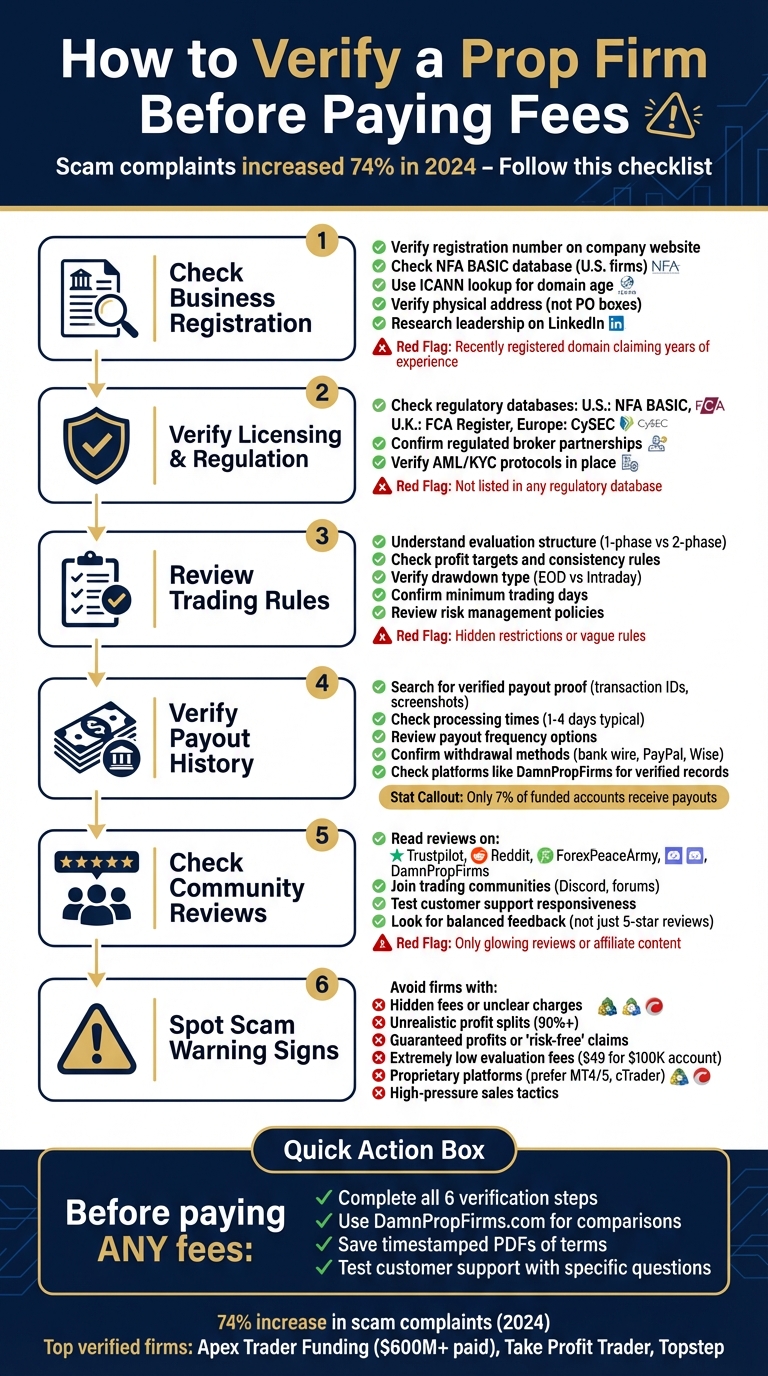
6-Step Checklist for Evaluating Prop Firm Legitimacy
Don’t Get Scammed: 8-Step Prop Firm Evaluation Guide (2026)
sbb-itb-46ae61d
1. Check Business Registration and Company Background
Before handing over any evaluation fees, it’s crucial to confirm that the firm is legally registered. This step ensures some level of accountability. Scammers often create professional-looking websites but operate without any formal registration.
Start by examining the firm’s website for key details like their registration number, physical address, and leadership team. Legitimate businesses prominently display this information. If you find a registration number, verify it through the official companies registrar in the country where the firm claims to operate. For U.S.-based firms, the NFA BASIC database at cftc.gov/check can confirm registration and reveal any disciplinary actions.
"While registration and a clean disciplinary record won’t protect you from fraud, most scams involve unregistered entities, people, and products." – Commodity Futures Trading Commission (CFTC) [5]
1.1 Look Up Corporate and Legal Records
To dig deeper, use lookup.icann.org to check when the firm’s domain was registered. A company claiming years of experience but using a recently registered domain is a red flag. This simple check can expose inconsistencies between their marketing claims and actual history.
If the firm operates in regulated markets, confirm their status through the relevant regulatory database. For instance:
- UK-based firms should appear in the Financial Conduct Authority (FCA) register.
- Cyprus-based firms need to be registered with CySEC.
- For firms dealing in digital currencies, use the Financial Crimes Enforcement Network (FinCEN) MSB Registrant Search to verify their registration as a Money Service Business.
| Verification Tool | Purpose | Where to Check |
|---|---|---|
| NFA BASIC | U.S. registration and disciplinary check | cftc.gov/check |
| ICANN Lookup | Domain registration and age verification | lookup.icann.org |
| FCA Register | UK financial service registration | Financial Conduct Authority |
| FinCEN MSB Search | Money service business status (crypto) | U.S. Treasury |
Additionally, verify the firm’s physical address using tools like Google Maps or Street View. Legitimate businesses operate from professional office locations, not PO boxes, residential apartments, or vacant lots.
"If you see a coffee shop, empty parking lot, or a residential apartment instead of an office, you have your answer." – Propvator
1.2 Review the Firm’s Operating History
Another important step is researching the firm’s leadership. Look up the founders and key executives on LinkedIn. A trustworthy firm will have a leadership team with verifiable professional experience in trading or finance. Be wary of companies that lack identifiable leaders or rely on AI-generated headshots or stock images for profiles.
"If you can’t find out who runs the company, who are you going to hold accountable when things go wrong?" – Prop Firm Store
Also, test the firm’s customer support before committing. Ask specific questions about payout policies or legal terms through their contact channels. If you encounter silence, vague answers, or communication limited to platforms like Telegram or WhatsApp, this could indicate a scam. Reputable firms typically offer multiple professional communication options, such as email, live chat, and phone support.
If a firm shows two or more of these warning signs – no identifiable leadership, unverifiable physical address, a recently registered website claiming years of experience, or refusal to use traditional bank transfers for payouts – it’s likely a scam designed to collect fees without any real intent to fund traders.
Once you’ve confirmed the firm’s background by comparing top futures prop firms, the next step is to verify its licensing and regulatory oversight.
2. Verify Licensing and Regulatory Status
Once you’ve confirmed a firm’s basic registration, the next step is to verify its licensing and regulatory compliance. This is a crucial step in ensuring the security of your trading partnership. Many retail prop firms sidestep traditional financial regulations by branding themselves as "educational services." However, reputable firms often voluntarily register with financial authorities or collaborate with regulated brokers to maintain credibility [11].
The rules and oversight vary depending on the region. For firms based in the U.S., you can check their status using the National Futures Association (NFA) BASIC system. In the U.K., firms should be listed in the Financial Conduct Authority (FCA) register, while European firms are typically regulated by the Cyprus Securities and Exchange Commission (CySEC) [1]. If a firm isn’t listed in these official databases, consider it a major warning sign. When searching for regulatory information, use the firm’s legal corporate name – often found in the website footer or Terms and Conditions – rather than its marketing name, as licenses are frequently held under the parent company.
"The retail prop trading industry generates over $400 million annually, yet operates largely outside traditional financial regulation because firms structure themselves as educational services rather than financial intermediaries." – Goat Funded Trader [11]
2.1 Check for Regulatory Oversight
Start by identifying the regulatory body responsible for overseeing the firm, based on its location and the services it provides. For example, U.S.-based firms involved in futures or derivatives trading should appear in the NFA BASIC database. Those acting as broker-dealers or handling client deposits may also need to be registered with FINRA (Financial Industry Regulatory Authority) [11].
Reputable firms often collaborate with regulated brokers for trade execution, allowing them to focus on evaluations while the broker ensures compliance with trading regulations [11]. You can verify such partnerships by checking if the firm uses established trading platforms like MetaTrader 4/5, cTrader, NinjaTrader, Rithmic, or Tradovate. These platforms require firms to meet specific technical and operational standards [4][8].
Another sign of a trustworthy firm is the implementation of strict Anti-Money Laundering (AML) and Know Your Customer (KYC) protocols. Firms that request detailed identity verification documents typically demonstrate a higher level of operational maturity and solid banking relationships [11][12]. Be cautious of firms that allow you to start trading without any form of identity verification, as this could indicate a lack of legitimacy.
"A 2023 ESMA report found that capital adequacy rules reduced firm failures by 40% compared to unregulated competitors, demonstrating how oversight protects traders from sudden shutdowns." – Goat Funded Trader [11]
If you have questions about a firm’s regulatory status, reach out to their customer support. Legitimate firms will provide clear and direct answers. On the other hand, evasive or unclear responses should raise immediate concerns [1].
Once you’ve confirmed regulatory oversight, the next step is to evaluate the firm’s industry credibility through memberships and certifications.
2.2 Check for Industry Memberships and Certifications
Although not required, professional memberships and certifications can indicate that a firm is committed to maintaining high industry standards [7]. These affiliations go beyond legal compliance and show a dedication to best practices.
For futures prop firms, check whether they are members of recognized financial exchanges. Membership is often necessary for direct access to trading platforms and tools [13]. For instance, Apex Trader Funding, which has reportedly paid out over $600,000,000 as of March 2026, holds multiple certifications and maintains transparent partnerships [8][10].
You should also look into the firm’s payout methods. Reputable firms typically use trusted third-party processors like Deel, Wise, or PayPal. These partnerships add an extra layer of financial security and oversight [4]. Be wary of firms that only offer cryptocurrency payouts or insist on unconventional payment methods, as this could be a red flag.
Additionally, review independent platforms for ratings and feedback. For example, Apex Trader Funding boasts a 4.8/5 rating on Trustpilot with over 1,200 reviews and an A+ rating from the Better Business Bureau (BBB) [10]. While ratings alone shouldn’t be the deciding factor, they provide valuable insights when combined with regulatory checks.
Before paying any evaluation fees, ensure the firm passes both regulatory and industry credibility checks. This two-step process greatly reduces the chances of falling victim to scams.
3. Review Trading Rules and Terms
Once you’ve confirmed a firm’s regulatory standing, it’s time to dive into their trading rules and risk management policies. Legitimate prop firms make these rules easy to find and understand. If you can’t locate basic trading criteria within a few minutes, that’s a warning sign [16].
The best firms explain their rules in straightforward language on their websites, often including examples or tools like calculators to clarify expectations. They avoid hiding critical details in fine print or using ambiguous terms.
"If you have to dig through pages of details or break down legalese just to figure out when you can take a payout, that’s a red flag." – Team Topstep [16]
Make sure to review these key areas to ensure the firm aligns with your trading style. Since evaluation structures and risk management rules can vary widely, understanding these differences is crucial.
3.1 Check Evaluation Requirements
The first step is to understand the evaluation structure. Some firms, like LucidFlex, use a single-phase process where you meet one set of criteria to access a funded account. Others, like LucidPro, use a two-phase system with separate requirements for each stage [14]. Profit targets are typically tied to account size, with mid-tier accounts often requiring profits in the thousands to qualify.
Pay attention to time limits and minimum trading days. For example, Lucid Trading offers flexible deadlines and even a "one-day pass" option for some structures [14]. On the other hand, Apex Trader Funding requires at least 8 trading days, with specific profit benchmarks over 5 of those days [15].
Consistency rules are another critical factor. These rules prevent traders from relying on a single lucky trade. For example, Apex enforces a 30% consistency rule, meaning if your largest winning day nets $1,500, you must achieve at least $5,000 in total profit before requesting a payout [15]. Lucid Trading adjusts these rules depending on the program, ranging from 20% for LucidDirect to 50% for LucidFlex evaluations [14].
The drawdown model is equally important. Some firms use an End-of-Day (EOD) drawdown, which only updates after the market closes, offering more flexibility during intraday volatility. Others use an intraday trailing drawdown that tracks session peaks, which can lead to violations even if your overall account is profitable [14]. Confirm the drawdown type before starting.
3.2 Review Risk Management Rules
After evaluation, you’ll need to understand the firm’s ongoing risk management policies. These rules determine whether you can maintain your funded account and access payouts. Transparency is key – watch out for hidden restrictions like bans on trading during news events, time-of-day limits, or sudden rule changes [14].
The type of drawdown remains important even after passing. EOD drawdowns tend to be more forgiving, especially for traders managing volatility. Some firms also implement a "buffer system", requiring your account balance to stay slightly above the maximum loss limit, often by a small margin like $100 [14].
Another factor to consider is the risk-to-reward ratio. Apex, for instance, enforces a maximum 5:1 ratio to prevent excessive risk for small gains [15]. This means risking $500 to earn $100 is fine, but risking the same amount to earn only $50 would violate their rules.
| Feature | LucidPro | LucidFlex | Apex Trader Funding |
|---|---|---|---|
| Evaluation Type | Two-phase | Single-phase | Standard Evaluation |
| Consistency Rule | 40% (Funded) | 50% (Eval only) | 30% (Payout cycle) |
| Daily Loss Limit | Yes | No | No (uses 30% Drawdown Rule) |
| Min. Trading Days | Low/Relaxed | ~2 Days | 8 Days |
| Drawdown Type | End-of-Day | End-of-Day | Choice of EOD or Intraday |
Finally, evaluate payout frequency and thresholds. Many firms have moved beyond monthly payouts. For example, LucidPro allows payouts as frequently as every 3 days once requirements are met [14]. Some firms also require a minimum profit or a specific number of "winning days" before withdrawals are allowed.
"If you’re a futures trader who hates surprise violations and ‘gotcha’ rules, Lucid’s rule set is one of the cleanest on the market right now." – DamnPropFirms [14]
Don’t forget to check whether the firm allows news trading during major economic events like NFP, FOMC, and CPI releases. Lucid explicitly permits trading during these events [14], while others may restrict or ban it. Always check that these policies are clearly outlined and not buried in fine print.
4. Check Payout History and Documentation
Once you’ve verified a firm’s trading rules, the next step is ensuring they handle withdrawals reliably. A firm’s payout history is a strong indicator of its integrity and dedication to supporting traders. With fraudulent operations still a concern, verifying payouts has become a critical step in protecting yourself.
Firms that are trustworthy provide clear evidence of payouts. Look for those that openly share their total historical payouts. For example, Apex Trader Funding has documented payouts exceeding $600 million [8], and Topstep recently processed over $23 million in payouts in a single month [17]. These aren’t just promotional figures – they’re backed by user feedback and third-party reviews.
"A firm’s reputation is built on how it treats its traders when the money’s on the line." – Topstep [16]
Interestingly, only about 7% of funded accounts ever receive a payout [17]. This makes it even more important to confirm that firms follow through when traders qualify. Before committing, take the time to research payout proof and review withdrawal terms.
4.1 Find Proof of Past Payouts
Don’t settle for vague claims. Look for concrete payout evidence such as transaction IDs, verified dashboard screenshots, or bank wire confirmations [1].
You can start by searching independent platforms using terms like "[firm name] payout Reddit" or "[firm name] scam" [1]. Websites like Reddit, Trustpilot, and ForexPeaceArmy often contain firsthand accounts from traders. For instance, Apex Trader Funding holds a 4.5/5 rating on Trustpilot from over 11,112 reviews as of late 2025 [17], with many users detailing payout amounts and processing times.
YouTube is another valuable resource. Look for videos showing withdrawal processes with visible account details [1]. In April 2025, a trader with Apex Trader Funding secured a single-day payout of $2,552,800.50, verified through bank wire documentation [17]. Similarly, in December 2024, trader Patrick Wieland received a $608,000 payout from the same firm, with bank records confirming the transaction [17]. These aren’t anonymous reviews – they’re well-documented cases.
You can also check platforms like DamnPropFirms, which compiles trader experiences and payout confirmations across firms. Cross-referencing information across multiple sources can help ensure consistency and accuracy.
Before signing up, test the firm’s customer support by asking direct questions about payout timelines and withdrawal methods. If their responses are evasive or unclear, it’s a major warning sign. Legitimate firms will provide straightforward answers and supporting documentation.
4.2 Review Payout Terms and Processing Times
Once you’ve confirmed the firm has a legitimate payout history, take a closer look at their terms. Payout frequency is a key factor. For example:
- Take Profit Trader offers daily withdrawals for Pro+ Live accounts [8].
- FundedNext processes payouts every 3–5 days [8].
- Apex Trader Funding allows withdrawals every 5 days with a 100% profit split on the first $100,000 [8].
Processing times are just as important. FundedNext guarantees payouts within 24 hours, offering a $1,000 bonus if they miss the deadline [8]. Topstep typically handles withdrawals within 24–48 hours [16], while Apex averages 1–4 days [17]. Be cautious if a firm can’t provide clear timelines or uses vague phrases like "within a few weeks."
| Prop Firm | Payout Frequency | Profit Split | Processing Time |
|---|---|---|---|
| Apex Trader Funding | Every 5 days | 100% (up to $100k) | 1–4 days |
| Take Profit Trader | Daily | 80–90% | From Day 1 (Pro+) |
| FundedNext | Every 3–5 days | 80% | Guaranteed 24 hours |
| Alpha Futures | Weekly | 70–90% | Not specified |
| Tradeify | Daily or 5 days | 90–100% | Not specified |
Watch for hidden restrictions. Some firms require a "safety net" – your account balance must stay above the maximum loss limit by a small margin, often around $100 [17][18]. Others may enforce prop firm consistency rules, blocking withdrawals if a single day accounts for a large portion of total profits [17].
Also, review the withdrawal methods available. Most firms offer bank wire transfers, but some charge fees – typically $10 for smaller amounts or $20 for ACH/wire transfers [16][17]. If you’re an international trader, confirm that the firm supports your local banking system and check for any currency conversion fees.
Lastly, don’t overlook tax obligations. U.S. traders are usually required to submit IRS Form W-9, while international traders need Form W-8BEN [17][19]. Since most prop firms don’t withhold taxes, it’s wise to set aside 30%–40% of each payout for tax purposes [19].
"Getting my first payout took less than a week from request to money in my bank account. Apex is the fastest prop firm payout I’ve seen." – Chris T., Funded Trader [17]
Before signing up, download and save a timestamped PDF of the payout policy [20]. This ensures you’re protected if the firm changes its rules later. Reputable firms apply changes only moving forward, not retroactively [20]. Always secure documented proof before committing to an evaluation.
5. Check Community Reviews and Reputation
When evaluating prop firms, trader feedback offers a crucial layer of insight that goes beyond official records and payout claims. Real-world experiences often highlight issues like sudden rule changes, withdrawal delays, or unresponsive customer support – problems that might not appear in a firm’s marketing materials. For example, the Commodity Futures Trading Commission (CFTC) reported a 74% increase in complaints about online prop firm scams in 2024 [1]. This underscores the importance of independent research and community input.
To get a clearer picture, explore reviews on platforms like Trustpilot, Reddit, and ForexPeaceArmy. These sources can reveal inconsistencies that curated testimonials on a firm’s website may hide. Be cautious if most of the content you find comes from affiliate blogs, as these may be biased toward promoting the firm. Legitimate companies typically have a mix of positive and negative feedback across multiple platforms.
Focus on verified reviews and evidence. A firm showcasing only glowing 5-star reviews might be cherry-picking feedback, while genuine reviews often include both praise and criticism.
5.1 Read Verified Reviews on DamnPropFirms

Platforms like DamnPropFirms provide a wealth of verified user reviews and payout proofs, giving traders another layer of validation. They rank firms using a scoring system that evaluates factors like payout speed, cost-to-payout value, and overall reputation [8]. The site also maintains a "Not Currently Recommended" list for firms flagged due to limited payout verification, disputes, or questionable practices. Always check this list before committing to a firm.
DamnPropFirms also documents verified payout records with screenshots and transaction IDs, ensuring that claims are backed by evidence [21][6]. Additionally, the platform offers detailed comparisons of account models, such as LucidPro versus LucidDirect, so you know exactly what you’re signing up for [21]. This level of transparency can help you avoid surprises after paying for an evaluation.
"Our rankings of the best futures prop firms are based on real trader feedback, verified payout records, and deep analysis of every rule structure. No paid placements. No hype. Just data." – DamnPropFirms [8]
Top firms like Apex Trader Funding and Take Profit Trader stand out for their strong track records. Apex has paid out over $600,000,000 to traders [8], while Take Profit Trader is known for its no activation fees and day-one payout options [8].
5.2 Join Trading Communities and Forums
Online trading forums can provide real-time feedback that traditional review sites might miss. Communities like the Damn Good Traders Discord allow you to monitor live trader performance and stay updated on issues like rule changes or withdrawal delays [8].
Before committing to a firm, test their customer support by asking detailed questions about payout timelines or contract specifics. Fast and clear responses are a good sign, while evasive answers should raise concerns.
Be wary of fake social proof. Scam firms often use stock photos for "funded traders" or fabricate glowing reviews to appear legitimate. Verify testimonials by cross-checking trader names and images on independent platforms.
| Indicator | Legitimate Firm | Scam Firm Red Flag |
|---|---|---|
| Payout Evidence | Public, verified receipts with transaction IDs | Only anonymous text or stock photos |
| Review Distribution | Balanced feedback on Reddit and Trustpilot | Exclusively 5-star reviews or affiliate blogs |
| Rule Enforcement | Clear, upfront rules with no hidden traps | Sudden changes or vague rules before payouts |
| Support Quality | Clear responses to tough questions | Ignores or blocks inquiries about payouts |
Keep in mind that only 5% to 10% of traders successfully pass prop firm evaluations [11]. This means many firms rely heavily on evaluation fees, which can sometimes incentivize them to complicate payout processes. By engaging with trading communities, you can identify firms genuinely invested in trader success versus those primarily focused on collecting fees. These insights can help you make smarter, more informed decisions.
6. Watch for Warning Signs of Scams
Even with careful checks like reading reviews and verifying payout records, some prop firms can still hide their true nature. These scams often operate behind polished websites and aggressive marketing, making them harder to detect. Complaints about online prop firm scams have been on the rise [1], so it’s crucial for traders to stay cautious when exploring new firms.
The most dangerous scams aren’t obvious. Instead, they use subtle tactics like vague contracts, high-pressure sales strategies, and promises that seem just believable enough. Being aware of these tricks can help you avoid falling into their traps.
6.1 Watch for Hidden Fees or Unclear Charges
Reputable prop firms are upfront about their fees. Costs like evaluation fees, reset charges, and platform fees should all be clearly disclosed before you make any payment. On the other hand, fraudulent firms often bury extra charges in fine print or spring them on you later. Common hidden fees include account activation costs, monthly platform charges, withdrawal processing fees, and penalties for inactivity [2].
Before signing up, ask the firm directly about all potential costs, including activation fees, withdrawal limits, and data charges. If their responses are vague or evasive, consider it a red flag [1]. Also, check whether the firm uses trusted third-party platforms like MetaTrader 4/5 or DXtrade. Proprietary platforms controlled entirely by the firm may be manipulated to create rule violations [4].
Be wary of pricing that seems suspiciously low. For example, if a firm offers a $100,000 challenge for just $49 when the industry average is closer to $500, there’s a good chance they’re just after your fees [23].
"If the price seems too good to be true, it probably is." – A1 Trading [23]
Besides hidden fees, keep an eye out for overly optimistic claims that distort realistic trading expectations.
6.2 Avoid Unrealistic Promises
Any firm that guarantees profits or advertises "risk-free trading" should raise immediate suspicion [1]. offers with best prop firms with instant funding often featuring profit splits exceeding 90% or unrealistically low profit targets (like 2–3%) often come with unsustainable conditions or sudden rule changes [2][23]. Legitimate firms usually set profit targets around 8–10% and enforce stricter risk management and consistency rules to encourage sustainable trading [23].
Marketing that features "overnight millionaire" stories or extreme success testimonials is another red flag [22]. These tactics are designed to create a sense of urgency and pressure traders into signing up without proper research. Similarly, countdown timers, "limited spots" warnings, or claims of payouts within minutes are signs of a scam [1].
Two notable examples highlight how these scams operate. In 2022, Fidelcrest Trading Company was exposed as a Ponzi scheme, using new registration fees to pay earlier participants, ultimately collecting nearly $8 billion from over 50,000 traders before collapsing [22]. In 2024, SurgeTrader was blacklisted after investigations revealed unauthorized withdrawals, market data manipulation, and a lack of proper oversight [22].
| Feature | Legitimate Prop Firm | Scam Prop Firm Tactic |
|---|---|---|
| Profit Targets | Realistic (8–10%) | Unrealistically low (2–3%) to attract sign-ups |
| Payouts | Verified, consistent, and public | Delayed, denied, or justified by vague "violations" |
| Rules | Transparent and stable | Hidden in fine print or changed retroactively |
| Funding | Real capital or clear demo-to-live process | "Fake live" accounts (perpetual demo) |
| Support | Responsive and professional | Avoids tough questions or ignores concerns |
Another useful step is checking the firm’s domain age with domain verification tools. If a company claims to have years of experience but only recently registered its domain, that’s a major warning sign [3]. Keep evaluating every aspect of a firm’s legitimacy to protect yourself from scams.
Conclusion
Selecting a trustworthy prop firm requires careful research. With a reported 74% increase in complaints about online forex prop firm scams as of 2024 [1], the importance of thorough verification cannot be overstated. This checklist – covering everything from confirming business registration and regulatory compliance to examining payout histories and spotting red flags – offers a solid approach to safeguarding your investment. Each step emphasizes the importance of transparency and meticulous vetting.
"Don’t trust hype – trust hard evidence. If a prop firm fails even one critical check, find another." – Funded Trading [1]
Once you’ve completed your due diligence, consider using trusted resources to finalize your decision. Platforms like DamnPropFirms evaluate firms for clarity, transparency, and consistent payouts. They also allow you to compare top-rated options, such as Apex Trader Funding, Take Profit Trader, and Topstep, so you can find the best fit for your trading style and risk preferences.
Another invaluable resource is the Damn Good Traders (DGT) Discord community, which boasts over 3,000 active traders [8][9]. Members share verified payout receipts, discuss rule updates, and highlight questionable practices – offering insights that go beyond polished reviews. This collective knowledge can be an essential tool, reinforcing the credibility of your research and helping you make informed decisions.
FAQs
What should I do if a prop firm isn’t listed in any regulator database?
If a proprietary trading firm isn’t listed in a regulatory database, there are still ways to assess its legitimacy. Start by looking for transparent payout proof – evidence that traders are actually receiving payments. Next, read reviews from credible sources to see what others are saying about their experiences. Finally, confirm that the firm operates on recognized trading platforms.
If, after thorough research, the firm still seems questionable or lacks verification, it’s wiser to approach with caution – or steer clear entirely.
How can I tell whether a “funded” account is real or just a perpetual demo?
To determine if a "funded" account is genuine, verify if it involves real trading with actual money. Authentic funded accounts provide traders with real capital and distribute actual profits. On the other hand, perpetual demo accounts operate entirely in simulated environments without any real financial backing.
Which payout terms matter most before I pay an evaluation fee?
When considering paying an evaluation fee, it’s crucial to understand key payout terms such as payout speed, profit split, payout caps, and withdrawal rules. These elements determine how fast you can access your earnings and influence the overall profitability of partnering with the firm.