Apex Trader Funding introduced major changes on March 1, 2026, making it easier and faster for traders to earn payouts. Here’s what you need to know:
- Two Account Types: Choose between End-of-Day (EOD) or Intraday Trailing Drawdown accounts, each with unique risk management features.
- Profit Targets: Fixed at 6% of the starting balance, with no minimum trading days required. Pass the evaluation in just one day if targets are met.
- Payouts: Weekly payouts with a six-step ladder system. Caps increase with each payout, and limits are removed after the sixth.
- Consistency Rule: A 50% rule applies to Performance Accounts, ensuring no single day contributes more than half your total profit.
- Safety Net: Limits withdrawals during the first three payouts to protect account balances.
- Multiple Accounts: Manage up to 20 Performance Accounts at once, significantly increasing earning potential.
Key Example: A $50,000 account allows a $3,000 cap by the sixth payout. With 20 accounts, this could mean $60,000 in earnings during the final payout cycle.
These updates streamline the funded trading process, offering flexibility and faster earning opportunities for disciplined traders.
Apex Trader Funding MASSIVE Update | Apex Trader Funding Review 2026

sbb-itb-46ae61d
Account Types and Profit Targets
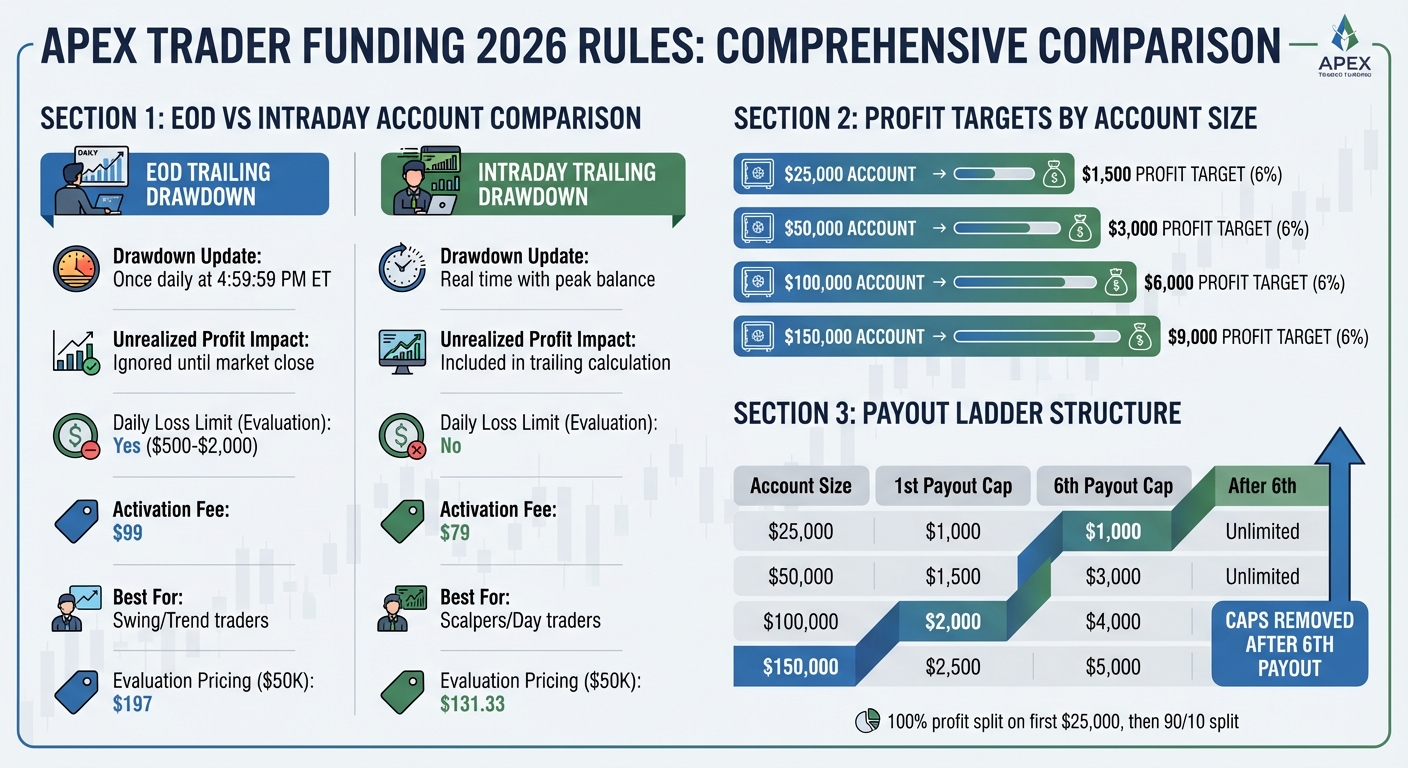
Apex Trader Funding Account Types and Payout Ladder Comparison 2026
EOD vs. Intraday Drawdown Accounts
Apex Trader Funding provides two account structures tailored to different trading strategies: EOD (End-of-Day) Trailing Drawdown and Intraday Trailing Drawdown. The key difference lies in how the drawdown threshold is calculated and applied.
EOD accounts update the drawdown limit once daily at 4:59:59 PM ET, based on your closing balance. This setup allows for intraday fluctuations without affecting your drawdown threshold until the end of the trading day. During the evaluation phase, these accounts include a Daily Loss Limit (DLL) – for instance, a $50,000 account has a $1,000 DLL. If breached, trading is paused for the day. The one-time activation fee for EOD accounts is $99.
Intraday accounts, on the other hand, continuously track your drawdown in real time. This means your threshold adjusts with your peak balance, including unrealized gains. For example, if your peak balance increases by $500, that amount is immediately locked into the trailing calculation, reducing your cushion even if you close positions. Unlike EOD accounts, Intraday accounts have no DLL during evaluation, offering more flexibility but requiring stricter risk management. The activation fee for Intraday accounts is $79.
"If you hate unrealized trailing moving while you are in a trade, Intraday will wreck you." – Mentor Note, DamnPropFirms [1]
For traders who hold positions through pullbacks or prefer a fixed daily threshold, EOD accounts are a better fit. Meanwhile, Intraday accounts suit scalpers or day traders who close positions quickly and avoid letting trades run for long.
Profit Targets for Each Account Size
While account types differ in structure, the profit targets remain the same across all account sizes. The formula is straightforward: 6% of the starting balance. Here’s the breakdown:
- $25,000 accounts: $1,500 profit target
- $50,000 accounts: $3,000 profit target
- $100,000 accounts: $6,000 profit target
- $150,000 accounts: $9,000 profit target
Traders have 30 calendar days to hit their profit target, with no minimum trading days required. If you can achieve the target without breaching drawdown limits, you could pass in just one trading day. The drawdown limits scale with account size: $1,000 for a $25K account, $2,000 for a $50K account, $3,000 for a $100K account, and $4,000 for a $150K account. Similarly, contract limits increase with the account size, allowing up to 4 mini contracts for a $25K account, 6 for $50K, 8 for $100K, and 12 for $150K.
Account Type Comparison Table
Here’s a quick side-by-side comparison of the two account types:
| Feature | EOD Trailing Drawdown | Intraday Trailing Drawdown |
|---|---|---|
| Drawdown Update | Once daily at 4:59:59 PM ET | Real time with peak balance |
| Unrealized Profit Impact | Ignored until market close | Included in trailing calculation |
| Daily Loss Limit (Evaluation) | Yes (ranges from $500 to $2,000) | No |
| Activation Fee | $99 | $79 |
| Best Trading Style | Swing/Trend traders | Scalpers/Day traders |
| Evaluation Pricing ($50K) | $197 | $131.33 |
Both account types allow traders to manage up to 20 active Performance Accounts simultaneously. Once funded, the drawdown threshold is fixed at the starting balance plus $100. Up next, we’ll examine how the evaluation phase rules further influence trading strategies.
Evaluation Phase Rules and Requirements
How Trailing Drawdown Works (EOD vs. Intraday)
The trailing drawdown is a key risk management feature during the evaluation phase. For End-of-Day (EOD) accounts, the trailing floor is recalculated only once daily, at 4:59 PM ET when the market closes. This setup means unrealized gains during the trading session won’t impact the drawdown floor until the day’s settled balance is finalized. This approach offers some flexibility during temporary pullbacks.
On the other hand, Intraday accounts operate differently. Here, the drawdown floor updates in real time, reflecting the peak intraday equity, including unrealized gains. For example, if a trade reaches a $1,000 profit before returning to breakeven, the drawdown floor adjusts upward by $1,000. It’s worth noting that only EOD accounts apply a Daily Loss Limit (DLL) during the evaluation phase. This distinction highlights the importance of choosing the right account type for your trading strategy [3].
Minimum Trading Days and 1-Day Pass Option
Starting in March 2026, Apex Trader Funding mandates a minimum of one trading day to complete the evaluation phase. If you hit your profit target without breaching drawdown limits, you can pass the evaluation in just one session. For a trading day to count, at least one full trade must be completed, and only closed trades are considered valid. Traders have up to 30 calendar days to achieve their profit target. Once the evaluation is passed, you must activate a Performance Account within 7 calendar days [4][1].
Consistency Rule (50% Threshold)
For accounts purchased after March 1, 2026, there’s no consistency rule during the evaluation phase. This means traders can reach their profit target in a single day, even if most of the profits come from one trade. However, once you transition to a Performance Account, a 50% consistency rule applies for payout eligibility. Under this rule, no single trading day can contribute 50% or more of your total net profit. If a windfall day exceeds this threshold, you’ll need to record additional smaller profits to balance your overall earnings [1].
Payout Structure and Eligibility Requirements
Understanding these payout rules is key to making the most of Apex Trader Funding’s updated 2026 system.
Requirements for Payout Eligibility
Before requesting your first payout, you need to meet these conditions: trade for at least 8 days and have at least 5 qualifying days where your net profits range from $100 to $300, depending on your account size [1][6].
Additionally, no single trading day can account for 50% or more of your total net profit. For your first three payouts, your account balance must remain above the Safety Net, which is the trailing drawdown threshold plus $100 [1][6]. Payouts start at $500 and can be requested weekly or twice a month, depending on your account type under the 2026 system [1][7].
Next, let’s look at how profit splits evolve once you surpass the $25,000 mark.
First $25,000 Payout Split and Subsequent Splits
Apex Trader Funding offers a beginner-friendly profit split structure. You keep 100% of the first $25,000 you earn. After that, profit splits adjust to 90% for you and 10% for Apex [6][7].
For example, if you earn $30,000, you’ll receive the full $25,000 from the first tier, plus $4,500 (90% of the remaining $5,000). This totals $29,500. Payout processing typically takes two business days for internal review, and funds are delivered via ACH or Plane within 3 to 4 additional business days [6].
Payout Ladder Caps and Structure
After the initial profit splits, payouts are capped for the first six withdrawals based on your account size. These caps gradually increase with each payout, rewarding consistent performance. Here’s how the tiered structure works:
| Account Size | Max 1st Payout | Max 6th Payout | Cap Status After 6th |
|---|---|---|---|
| $25,000 | $1,000 | $1,000 | Caps Removed |
| $50,000 | $1,500 | $3,000 | Caps Removed |
| $100,000 | $2,000 | $4,000 | Caps Removed |
| $150,000 | $2,500 | $5,000 | Caps Removed |
Starting with your 7th payout, all withdrawal caps are lifted, letting you request any amount above the $500 minimum [1][5][7]. This system is designed to encourage steady growth while protecting both traders and the firm during the initial payout period.
Tips for Maximizing Payouts
Here’s how you can work within Apex’s rules to improve your earnings potential.
Risk Management for Drawdown Limits
Protecting your account from breaching drawdown limits is critical. Treat the Safety Net as a firm boundary. Once you hit it (calculated as the starting balance + drawdown amount + $100), stop making aggressive trades[5].
For Intraday accounts, set alerts when you reach 25% of your daily profit to avoid violating the 30% Maximum Adverse Excursion (MAE) rule[5]. Remember, the intraday drawdown adjusts in real time based on your peak unrealized profit. If your trading style involves large intraday swings but you typically close positions profitably by the day’s end, consider choosing an End-of-Day (EOD) account instead.
For Performance Accounts, note that contract limits start at half of what was allowed during the evaluation phase. For example, a $50,000 Performance Account begins with a limit of 2 contracts. The full limit (4 contracts) becomes available only after your balance exceeds the Safety Net[2][5]. To ease the transition, practice trading within these reduced limits during your evaluation phase.
Maintaining Trading Consistency
Once your risk controls are solid, shift your focus to building consistent trading habits. The 50% consistency rule applies to Performance Accounts during payout requests – not during the evaluation phase[1][2]. If you have a single large winning day that accounts for more than 50% of your total profit, continue trading smaller positions on subsequent days to bring that percentage down[2]. Using micro contracts can help you gather profits without taking on unnecessary risk.
Ensure you meet the required qualifying days before requesting payouts. Depending on your account size, the minimum daily profit ranges from $100 for a $25,000 account to around $250–$300 for a $100,000 account[1][2]. Keep in mind that losing days aren’t factored into the consistency calculation.
By following these steps, you’ll align with the performance requirements and stay eligible for payouts.
Using Tools and Resources
Take advantage of tools designed to improve both risk management and consistency. For example, a Consistency Rule Calculator like FundedMath can help you confirm that your largest winning day doesn’t exceed the 50% threshold before submitting a withdrawal request[9]. This simple check can prevent payout delays or denials.
If you manage multiple accounts, trade copiers such as Replikanto or TradeSyncer allow you to execute trades across up to 20 Performance Accounts at once. This approach increases your overall payout potential without adding extra risk to individual accounts[1][8]. For traders who rely on visual data, Bookmap provides real-time insights into order flow and market liquidity, helping you fine-tune your entry and exit points[1].
Conclusion
Apex Trader Funding’s updates for 2026 bring a fresh approach to funded trading. With features like a one-time evaluation fee, automated payouts, and simplified rules, the platform has made the funding process more accessible for traders [1][10]. Having paid out over $378 million since its launch [10], Apex continues to show its dedication to supporting traders who follow the guidelines.
Grasping the difference between the End-of-Day (EOD) and Intraday drawdown models is an essential starting point. For many, the EOD model provides a steady drawdown threshold throughout trades, offering a sense of stability [1][10]. Once you complete the evaluation – sometimes achievable in just one day – your main goal becomes meeting the five qualifying trading days and adhering to the 50% consistency rule to access payouts [1][10]. This structure allows traders to quickly adjust their strategies after passing the evaluation phase, similar to the scaling plans at Earn2Trade.
The six-step payout ladder sets withdrawal limits at each stage, but the ability to manage up to 20 Performance Accounts simultaneously can significantly boost your earning potential. For instance, a $100,000 account caps at $4,000 on the sixth payout. Scaling this across 20 accounts could result in earnings of up to $80,000 [10]. Combined with a 100% profit split within the ladder framework, disciplined traders have the opportunity to achieve substantial gains [1][10].
To avoid delays in payouts, ensure your balance stays above the Safety Net and complete the evaluation within 30 days [1][10]. By aligning your trading strategy with the platform’s requirements and utilizing its tools effectively, you can maximize your withdrawal potential.
FAQs
Which account type is safer for my strategy: EOD or Intraday?
When deciding which account type is safer, it really comes down to how much risk you’re comfortable with. EOD (End-of-Day) accounts reset drawdown limits once a day, after the market closes. This setup helps shield you from the ups and downs of intraday volatility, making it a better fit for more cautious trading approaches. On the other hand, Intraday accounts monitor activity in real-time. While they offer greater flexibility, they also leave you more exposed to potential drawdowns during periods of high market volatility. Your choice should align with your risk tolerance and trading preferences.
How do I avoid breaking the 50% consistency rule when requesting payouts?
To stay within Apex Trader Funding’s 50% consistency rule, your daily profits during the payout period must not surpass 50% of your total earnings. You’ll also need to meet these key conditions: trade on at least 8 days, have 5 days with profits exceeding $50, and ensure no rules are broken. By managing your trades carefully and sticking to these requirements, you can secure your payout eligibility.
What’s the best way to scale payouts with multiple Performance Accounts?
To effectively manage payouts across multiple Performance Accounts at Apex Trader Funding, it’s crucial to stick to the scaling rules. Begin by operating with 50% of the maximum contract limit. As you meet the required thresholds, you’ll unlock access to the full contract allocation. Staying disciplined and adhering to these rules is key – violations can lead to losing profits or even account termination.