If a prop firm screws you over – denied payouts, shady rule changes, or worse – you’ve got two main places to report them in the U.S.: the CFTC (Commodity Futures Trading Commission) or the NFA (National Futures Association). But here’s the kicker: most futures prop firms aren’t even registered with the NFA. So, filing with the wrong agency wastes your time.
The CFTC handles fraud, market manipulation, and unregistered firms. The NFA? They only deal with their registered members, like Topstep. If you’re stuck with a non-member firm like Apex or Take Profit Trader, the NFA can’t touch them.
Here’s the breakdown of who to report to, how to file complaints, and what to expect. Let’s make sure you’re not left chasing your money in circles.
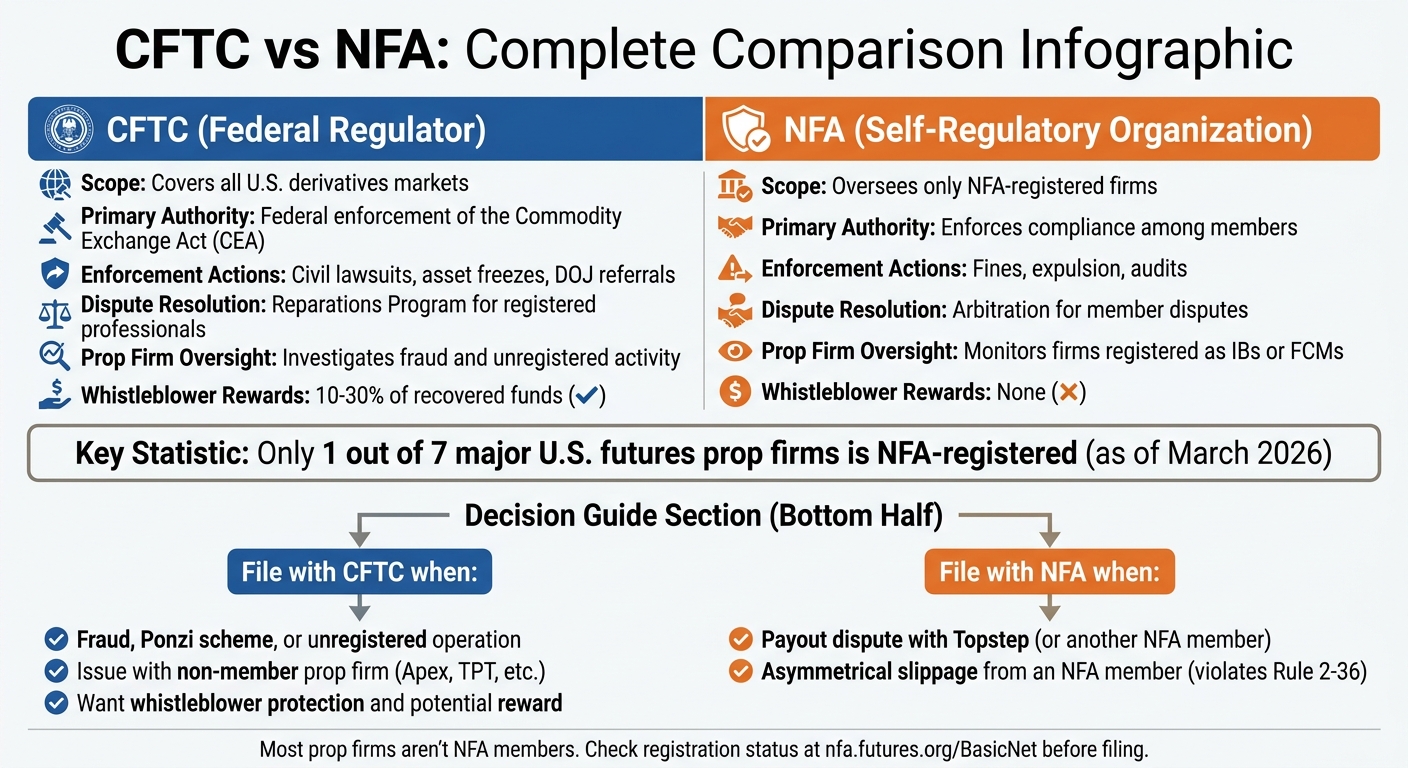
CFTC vs NFA Comparison: Jurisdiction, Authority, and When to File Complaints
CFTC vs NFA: Jurisdiction and Authority
The CFTC and NFA operate within different boundaries, though both are essential to regulating the futures industry. Knowing the role of each can help you decide where to file a complaint.
CFTC: Federal Enforcement Power
The CFTC is a federal agency with sweeping authority over U.S. derivatives markets. It handles violations of the Commodity Exchange Act (CEA), such as fraud, market manipulation, or unregistered activity[1][3]. The agency can file civil lawsuits, freeze assets, and refer cases for criminal prosecution[3].
For instance, in August 2023, the CFTC took action against MyForexFunds (MFF), accusing it of fraud. However, by March 2026, the case was dismissed with prejudice due to flawed evidence, and the court sanctioned the CFTC $3.1 million for bad faith conduct[2][5].
The CFTC also runs a whistleblower program. Reporting violations via Form TCR can lead to monetary rewards of up to 30% of the funds recovered[4].
NFA: Member Oversight and Arbitration
The NFA operates differently, focusing solely on its registered members. As a self-regulatory organization (SRO), it enforces compliance, conducts financial audits, and imposes capital requirements on its members[2]. It also offers arbitration for disputes between traders and its member firms.
Most futures prop firms aren’t NFA members. As of March 2026, only 1 out of 7 major U.S. futures prop firms was NFA-registered[2]. That firm is Topstep, which runs Topstep Brokerage LLC as a registered Introducing Broker (NFA ID #0567079). If you have a dispute with Topstep, you can use the NFA’s arbitration process. But for unregistered firms like Apex or TakeProfitTrader, the NFA has no authority.
Unlike the CFTC, the NFA can’t freeze assets or refer cases for criminal prosecution. Its enforcement powers are limited to fines, membership expulsions, and other disciplinary actions[2].
Side-by-Side Comparison: CFTC vs NFA
Here’s a quick breakdown of the differences between the two regulators:
| Feature | CFTC (Federal Regulator) | NFA (Self-Regulatory Org) |
|---|---|---|
| Scope | Covers all U.S. derivatives markets[1] | Oversees only NFA-registered firms[2] |
| Primary Authority | Federal enforcement of the CEA[3] | Enforces compliance among members[2] |
| Enforcement Actions | Civil lawsuits, asset freezes, DOJ referrals[3] | Fines, expulsion, audits[2] |
| Dispute Resolution | Reparations Program for registered professionals[1] | Arbitration for member disputes[2] |
| Prop Firm Oversight | Investigates fraud and unregistered activity[3] | Monitors firms registered as IBs or FCMs[2] |
Deciding between the CFTC and NFA depends on the firm’s registration status. If the firm is NFA-registered, arbitration is an option. For unregistered firms, your recourse is the CFTC, but only if you can prove fraud or manipulation. Most prop firms, however, execute trades through NFA-registered FCMs like NinjaTrader or Tradovate[2].
sbb-itb-46ae61d
When to File a Complaint with the CFTC
The CFTC (Commodity Futures Trading Commission) steps in when a prop firm’s actions go beyond shady practices and break federal laws. If you suspect fraud, market manipulation, or that a firm is operating without proper registration, the CFTC has the authority to act – even if the firm isn’t registered with the NFA (National Futures Association), which is common for a Forex prop firm.
Issues the CFTC Handles
The CFTC enforces the Commodity Exchange Act (CEA) and investigates cases involving fraud, deception, and other illegal schemes. This includes Ponzi schemes, false profit promises, and scams where firms demand extra payments to release funds[1]. They also crack down on market manipulation tactics like spoofing and unregistered operations where firms mishandle customer funds or improperly market commodity contracts.
The agency focuses on serious violations that cause significant financial losses or impact a large number of customers. Acting Chairman Caroline Pham summed it up well:
"enforcement actions for one-off, non-material operational or technical issues is shooting fish in a barrel"[6].
If you suspect a firm is crossing these lines, the next step is knowing how to report it.
How to File a CFTC Complaint
Filing your complaint with the right agency is key to getting results.
The CFTC offers three main ways to report misconduct:
- Whistleblower Program (Form TCR): Perfect if you want protection from retaliation and a shot at monetary awards (10% to 30% of recovered funds)[4]. To qualify, you must submit Form TCR voluntarily – before the CFTC or another authority requests the information[7].
- General Complaint Form: Use this for reporting suspicious activities when whistleblower protections aren’t needed.
- Reparations Program: This is for seeking damages from CFTC-registered professionals.
You can file online at whistleblower.gov (the easiest option), or through email, fax, or mail. Include your contact info and attach evidence like screenshots, emails, and account statements. While anonymous complaints are allowed, you’ll still need to provide a way for the Division of Enforcement to follow up. Don’t forget to save your confirmation number – it’ll come in handy if you gather more evidence later.
When to File a Complaint with the NFA
The NFA (National Futures Association) is the body to turn to if you’ve got an issue with a member firm – but here’s the catch: most prop firms aren’t NFA members. Among the top futures prop firms, Topstep is the only one currently registered with the NFA (NFA ID #0567079) as of March 2026[2]. If you’re dealing with an unregistered firm, the NFA won’t be able to help.
Issues the NFA Handles
For registered firms, the NFA steps in on specific issues. These include payout disputes where a firm refuses to honor profit-sharing agreements, misrepresentation (like falsely claiming NFA registration or misusing an FCM partner’s NFA ID), and compliance violations related to things like capital adequacy and record-keeping[2].
One particularly shady tactic the NFA cracks down on is asymmetrical slippage. This happens when a firm sticks you with losing slippage but keeps the profitable slippage for themselves. It’s a direct violation of NFA Compliance Rule 2-36, which bars members from cheating or deceiving customers[8]. Got proof? Screenshots are your best weapon – submit them with your complaint.
How to File an NFA Complaint
First, confirm the firm is an NFA member using the NFA BASIC tool at nfa.futures.org/BasicNet[2]. If they’re not registered, skip the NFA and go straight to the CFTC.
If you’re dealing with a monetary dispute – like Topstep withholding your payout – you’ll need to use the NFA Arbitration process[2]. This isn’t your standard complaint; it’s specifically for resolving financial disagreements. To prepare, gather all your evidence: account statements, email exchanges, screenshots of asymmetrical slippage, and any contracts. The NFA has real teeth – they can audit firms, issue fines, and even revoke memberships[2] – so solid documentation makes a difference.
CFTC or NFA? Decision Guide
Here’s a quick breakdown to help you figure out whether to report your issue to the CFTC or the NFA:
| Your Issue | File With | Why |
|---|---|---|
| Payout dispute with Topstep (or another NFA member) | NFA Arbitration | They oversee member firms[2] |
| Fraud, Ponzi scheme, or unregistered operation | CFTC | They have federal enforcement power[1] |
| Asymmetrical slippage from an NFA member | NFA Complaint | Violates Rule 2-36[8] |
| Issue with a non-member prop firm (Apex, TPT, etc.) | CFTC | The NFA has no authority over non-members[2] |
| Want whistleblower protection and a potential reward | CFTC Form TCR | You could earn 10-30% of recovered funds[4] |
If the firm isn’t NFA-registered but their clearing partner (FCM) is, you might still be able to report trade execution issues through the FCM’s NFA record[2]. But for payout or evaluation disputes, your best bet is the CFTC.
Checking Prop Firm Registration Status
Before you send any money or file a complaint, make sure to check if the firm is registered with the NFA. This step can clarify your options for resolving disputes and understanding what protections are available.
How to Use the NFA BASIC Tool
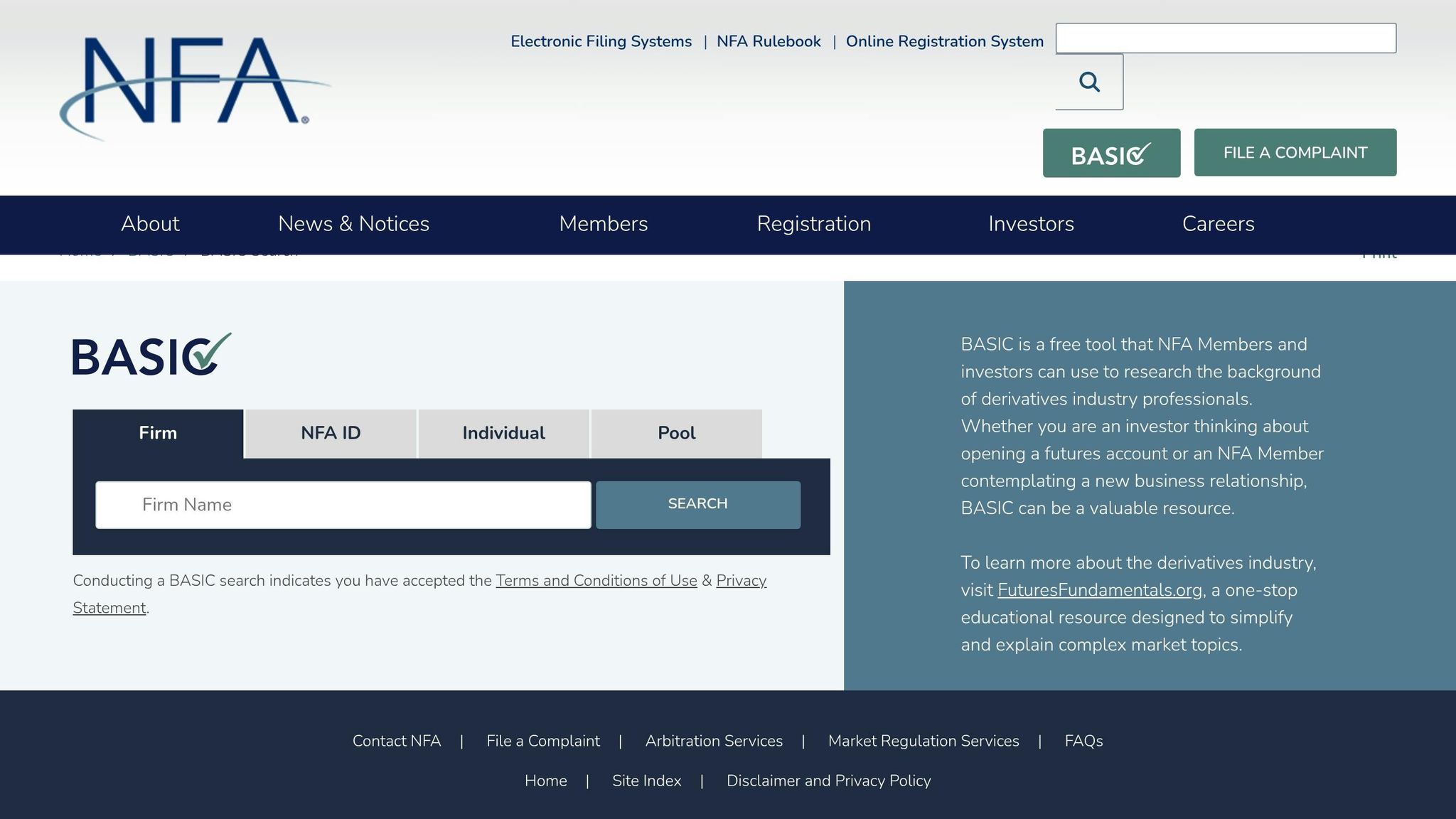
The BASIC (Background Affiliation Status Information Center) database from the NFA is your go-to resource for confirming a firm’s registration. Here’s how you can use it:
- Visit nfa.futures.org/BasicNet.
- Search using the firm’s brand name, legal entity name, or NFA ID number.
- Look for a status of "Approved". If the status says "Pending" or "Withdrawn", consider that a major warning sign.
- Check the "Regulatory Actions" and "NFA Arbitration Awards" sections for any past issues. A clean record is what you’re after – disciplinary actions or arbitration losses should make you think twice.
Here’s a key tip: some firms might try to pass off their partner FCM’s (Futures Commission Merchant) NFA ID as their own. If a firm claims to be registered, verify that the NFA ID provided actually belongs to them and not just their clearing partner, like NinjaTrader or Tradovate. This extra step ensures you’re not being misled.
The results from this tool give you a clear picture of a firm’s regulatory standing, as summarized in the table below.
NFA Registration Status of Major Futures Prop Firms
As of March 2026, the numbers tell a clear story: only 1 out of 7 major U.S. futures prop firms is registered with the NFA. Here’s the breakdown:
| Firm | NFA Registration Status | NFA ID | Trust Score |
|---|---|---|---|
| Topstep | Registered (Introducing Broker) | #0567079 | 95/100 |
| Apex Trader Funding | Not Registered | N/A | 80/100 |
| Take Profit Trader | Not Registered | N/A | 75/100 |
| Earn2Trade | Not Registered | N/A | 75/100 |
| Tradeify | Not Registered | N/A | 70/100 |
Topstep stands out as the only major firm registered with the NFA as an Introducing Broker. This means they undergo regular financial audits and must meet strict capital requirements. The others? They operate as unregistered evaluation services. While this isn’t illegal, it does mean the NFA won’t be able to help if you run into problems.
Using Damn Prop Firms for Research

After verifying a firm’s registration, head over to Damn Prop Firms for even more insights. Damn Prop Firms makes it easier to navigate the prop trading world. Every prop firm review on the site includes the latest NFA registration status, payout history, and a Trust Score (0–100) that factors in regulatory standing, company age, CFTC enforcement records, and feedback from the trading community. Reviews are updated every 3–6 months to reflect any changes in rules or registration status.
You can also use their comparison tools to see side-by-side details of firms, including which ones are registered, which have clean CFTC records, and which ones might be worth avoiding. Still unsure? Join their free DGT Discord with over 3,000 active futures traders who’ve been through this process and can share their experiences.
FAQs
How can I check if my prop firm is NFA-registered?
You can check if your prop firm is registered with the NFA by using the NFA’s online registry, NFA BASIC. This tool lists all registered firms. While most U.S. futures prop firms aren’t directly registered, some, like Topstep, are. Always verify this information through official sources.
What proof should I include when reporting a prop firm to the CFTC?
When you’re reporting a prop firm to the CFTC, make sure to include solid evidence. This could be records showing violations, examples of deceptive practices, manipulative schemes, or disruptive trading behavior. Your documentation should be detailed and backed up by investigations or other relevant records. The CFTC relies on information from public reports, industry authorities, or its own findings to kick off their investigations, so the stronger your evidence, the better.
Can I file a complaint against the prop firm’s FCM if the prop firm isn’t an NFA member?
You can report misconduct by a prop firm to the CFTC even if the firm isn’t an NFA member. However, you can’t file a complaint directly against the firm’s FCM unless it’s registered with the NFA or CFTC. Make sure to verify their registration and background details before taking any action.