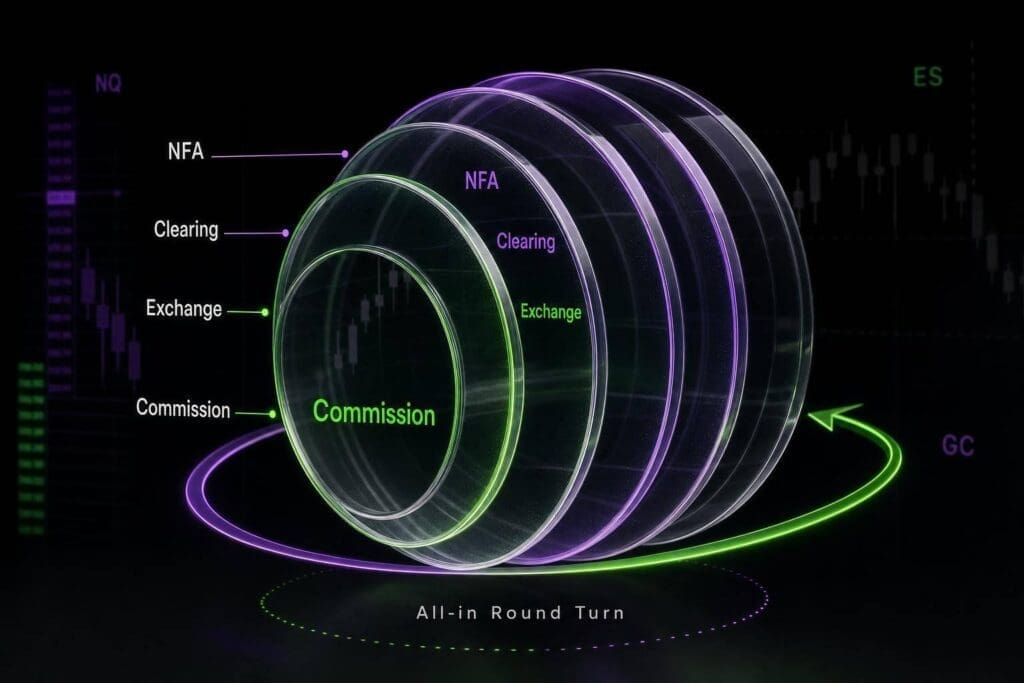
The short version: the commission on the ad is not your trade cost. What hits your P&L is the all-in round-turn after broker commission, exchange fees, clearing, and NFA charges get piled on. That’s why a rate that looks like pocket change can turn into a few bucks per trade fast.
If you trade futures often, this is the number that messes with your breakeven, your scalps, and your monthly cost. I’ll keep it simple: what you’re paying for, where brokers make the pricing page look prettier than the statement, and how to tell if your setup is cheap or just marketed to look cheap.
Introduction
The advertised commission is just one slice of the bill. What matters is your all-in round-turn cost. That’s the number that hits your breakeven, and it often ends up a lot higher once you add contract type, exchange fees, NFA fees, routing, and platform charges. In prop trading, those extra costs matter even more because small leaks add up fast.
The NFA fee is $0.02 per side, and ES round-turn costs can swing hard depending on your broker setup[1][3].
This article shows where each dollar goes. You’ll see the full fee stack for ES, MES, NQ, MNQ, CL, and MGC, how different setups change what you pay, and how monthly platform and data fees hit breakeven, especially in futures prop firms where even minor costs show up fast[1][3].
First, let’s look at why advertised commission rates throw traders off.
sbb-itb-46ae61d
Why the Advertised Commission Rate Misleads Traders
What Traders See First on Rate Cards
Rate cards usually lead with broker commission only. That’s the per-contract charge for one side of the trade. What they don’t put front and center is the rest of the bill: exchange fees, clearing fees, NFA fees, and sometimes platform or market data charges [1].
That headline number can look cheap and still cost more than you think. A $0.50 per-side commission turns into $1.74 round turn once you add exchange ($0.25), clearing ($0.10), and NFA ($0.02) fees [1]. That’s the number that hits your P&L, not the teaser rate on the card. Here’s what each fee actually covers.
Why Round-Turn Cost Is the Number That Matters
If you’re comparing brokers, use round-turn cost. Not the side rate. Round-turn cost tells you what the full trade costs from entry to exit [2][3].
A $0.99 per-side commission on Tradovate’s monthly plan is $1.98 round turn before exchange, clearing, and NFA fees even get added [6]. So if you stack brokers side by side using only the advertised per-side rate, you’re comparing the wrong number.
Why This Hits Prop Traders Harder
For prop traders, fees hurt more because they come straight out of your drawdown or daily loss limit in evals and funded accounts [6]. There’s no way around that.
It gets worse on micros. A small fee in dollar terms takes a bigger chunk out of the trade’s expected profit [3]. That’s why knowing the full fee stack matters. Your breakeven isn’t the clean number in your head. It’s the all-in cost after every fee gets piled on. Next, break the cost into its parts.
What Makes Up Your All-In Futures Trade Cost
Every futures trade has four execution-cost layers. The headline rate only shows one of them. If you want the actual cost of a trade, you need all four.
These are the base charges sitting behind the trade ticket.
Commission, Exchange, Clearing, and Regulatory Fees Defined
Broker commission is the only part your broker controls. That piece usually runs from $0.09 to $2.50 per side, and if you do enough volume, you can often negotiate it down [1].
Exchange fees go to the exchange listing the contract, like CME, ICE, or NYMEX. Your broker just collects that money and passes it through. You don’t get to negotiate this one [1][2].
Clearing fees pay for settlement through the clearinghouse. These are fixed pass-through charges. No wiggle room there either [1][2].
Regulatory fees are the smallest charge on the list, but you still pay them on every trade. The NFA fee is $0.02 per side, or $0.04 round-turn [1][2].
Here’s the stack, line by line:
| Fee Component | Set By | Negotiable? | Typical Range (Per Side) |
|---|---|---|---|
| Broker Commission | Broker (IB/FCM) | Yes, at volume | $0.09 – $2.50 [1] |
| Exchange Fee | Exchange (CME/ICE) | No | $0.25 – $1.60+ [1][4] |
| Clearing Fee | FCM | No | $0.05 – $0.20 [1] |
| NFA Fee | Regulator (NFA) | No | $0.02 [1][2] |
This is the breakdown you want when you’re reading a statement without getting blindsided by the fine print.
How These Fees Appear on Statements and Platform Pricing Pages
Brokers usually show these costs in one of two ways: itemized or bundled.
With itemized pricing, which is common on tiered and discount setups, your statement breaks out each charge on its own line. You’ll see broker commission separated from exchange, clearing, and NFA fees on each trade.
With bundled pricing, you get one all-in rate. The full cost is already baked into that number [5].
Round-Turn Cost by Contract: ES, MES, NQ, MNQ, CL, and MGC
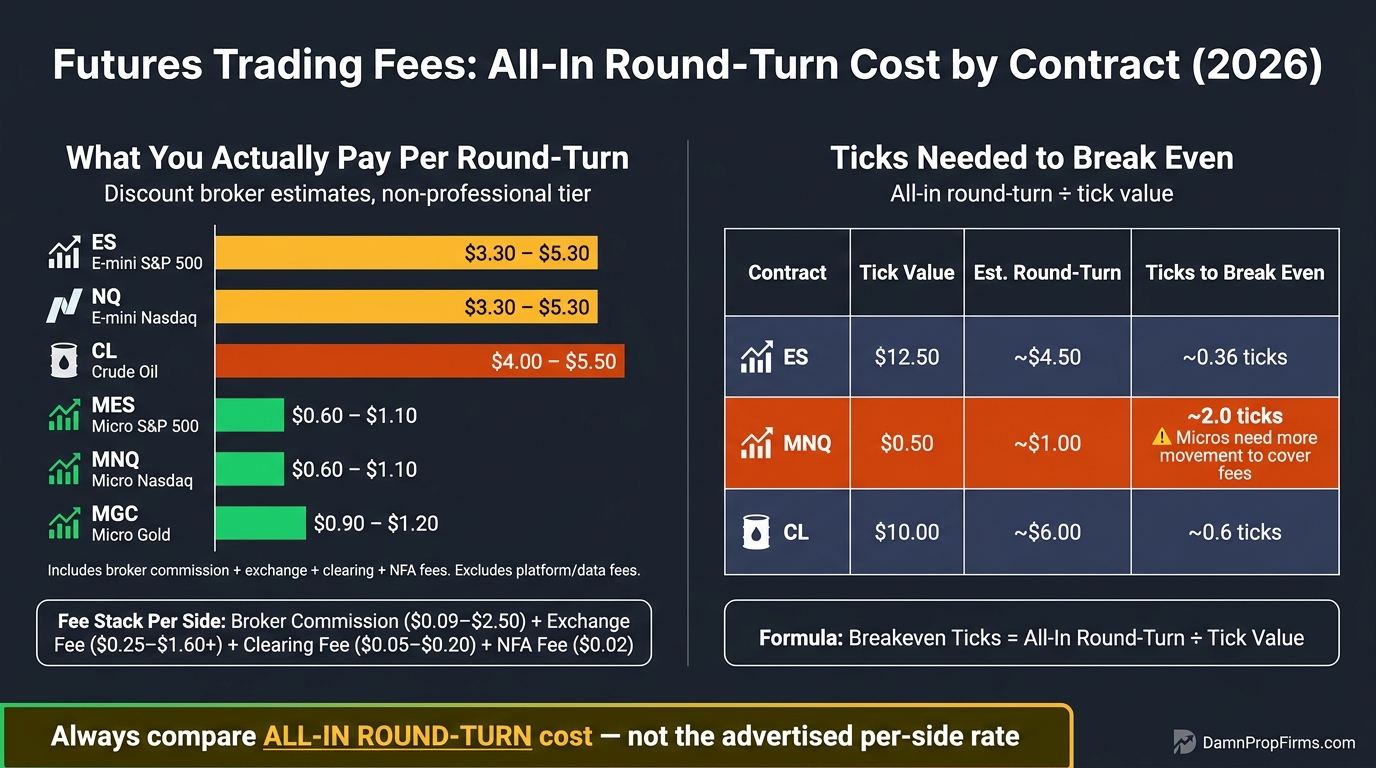
Futures Trading Fees: All-In Round-Turn Cost by Contract (2026)
Now that the fee stack is clear, here’s the part most traders care about: what these contracts usually cost all-in. The exact number still shifts by broker, platform, and routing, but the rough ranges are pretty consistent.
Next, it helps to look at the contracts traders hit most often.
Index Futures: ES, MES, NQ, and MNQ
For ES and NQ, a normal discount-broker round-turn usually lands around $3.30 to $5.30. Most of that isn’t your broker skimming extra. It’s the exchange, clearing, and NFA layer, which is about $2.80 round-turn by itself. The broker commission is the piece that moves the most based on your pricing plan or volume [1][3]. If you are trading through a funded account, you can often lower these costs by using futures prop firm discounts on evaluation fees.
MES and MNQ usually come in around $0.60 to $1.10 round-turn. Cheap per contract, sure. But that doesn’t always mean cheap for the position you’re trying to build.
Here’s the clean example. On Tradovate’s $99/month plan, 10 MES contracts cost $5.80 round-turn in commission alone. 1 ES costs $1.98 on the same basis [6]. So if you’re sizing up with micros, the “cheap” label can fall apart fast.
Energy and Metals: CL and MGC
Energy and metals work the same way, but CL is usually the pricier one.
Crude oil (CL) often runs about $4.00 to $5.50 round-turn at discount brokers [1][3].
Micro Gold (MGC) is usually around $0.90 to $1.20 round-turn. That looks light on paper, but if you stack contracts, the bill climbs fast [1][3].
Fee Comparison Table: Per-Side and Round-Turn Cost by Contract
The table below uses 2026 discount-broker estimates for non-professional traders [1][3][6].
| Contract | All-In Per Side | Total Round-Turn |
|---|---|---|
| ES / NQ | $1.65 – $2.65 | $3.30 – $5.30 |
| MES / MNQ | $0.30 – $0.55 | $0.60 – $1.10 |
| CL | Broker-dependent | $4.00 – $5.50 |
| MGC | $0.45 – $0.60 | $0.90 – $1.20 |
Estimates for non-professional discount-broker tiers; actual costs vary by broker, platform, and routing.
How Your Platform, Data Route, and Account Setup Affect the Price
Once exchange, clearing, and regulatory fees are fixed, the parts that still move your total cost are platform, routing, and data. That’s where your all-in price starts to drift.
The fixed stuff doesn’t change. The next swing comes from how your platform and market data are billed. Same contract. Same market. Different setup. Different cost.
Rithmic vs. Tradovate and Other Platform Workflows

A lot of prop setups run on Tradovate or Rithmic. The big difference is how the charges are packaged.
Tradovate keeps it pretty direct with Free, Monthly ($99/month), and Lifetime ($1,499) tiers. Those tiers cut the per-side commission from $1.29/$0.39 on micros down to $0.59/$0.09, before pass-through fees[6].
Rithmic-based setups often split things up more. You may see one charge for routing, another for the platform license, and another for market data. On paper, that rate card can look cheaper at first glance. Then you add every line item and the gap shrinks fast. Sometimes it even ends up higher than a bundled Tradovate setup.
That’s the part traders miss. Bundled pricing can look expensive until you do the full math. Itemized pricing can look cheap until the nickel-and-dime stuff shows up.
So yeah, two traders can trade the exact same contract and still have very different all-in costs.
Retail Broker Pricing vs. Prop-Firm Pricing Displays
This is where pricing gets messy. Some brokers show only the commission. Others show the full ticket cost. That means the exact same trade can look cheap on one screen and overpriced on another, even when the end cost is close.
At that point, the comparison isn’t just commission anymore. It’s routing, platform, and data.
If one trader is on a higher platform tier and another is using a different data route, their all-in cost on the same contract won’t match. That’s normal. It’s also why headline rates are a terrible shortcut.
Use the displayed all-in cost when you work out breakeven. Not the teaser number. Not the stripped-down commission line. The all-in number is the one that hits your trade.
How to Calculate Your Breakeven Cost Per Trade
Take your all-in dollar cost and convert it into ticks. That’s the number that matters when you’re judging whether a setup has enough room to pay for itself.
The Formula
Breakeven in ticks = all-in round-turn cost ÷ tick value
Use the all-in round-turn number from the fee breakdown above. A round-turn means the full trade: entry and exit. So if a fee is charged per side, you double it.
Here’s how that plays out on ES, MNQ, and CL.
Worked Examples for ES, MNQ, and CL
ES: one tick is worth $12.50 [2]. ES all-in round-turn is about $4.50 [4]. That’s $4.50 ÷ $12.50 = 0.36 ticks to break even. So yes, breakeven is under half a tick.
MNQ: one tick is worth $0.50 [6]. MNQ all-in round-turn is about $1.00 [3]. That’s $1.00 ÷ $0.50 = 2.0 ticks to break even. This is why micros can feel sneaky. The dollar cost looks small, but each tick pays so little that you need more movement just to get flat.
CL: one tick is worth $10.00 [2]. CL lands between ES and MNQ on breakeven pressure, with all-in round-turn costs usually around $4.00–$6.00 [3]. At $6.00, that’s 0.6 ticks to break even.
Use the table below for a fast side-by-side check.
| Contract | Tick Value | Est. All-In Round-Turn | Ticks to Break Even |
|---|---|---|---|
| ES (E-mini S&P 500) | $12.50 | ~$4.50 | ~0.36 |
| MNQ (Micro Nasdaq) | $0.50 | ~$1.00 | ~2.0 |
| CL (Crude Oil) | $10.00 | ~$6.00 | ~0.6 |
Breakeven ticks by contract. Estimates based on 2026 pricing. Exchange and clearing fees vary by broker and routing setup.
Why High-Frequency and Scalp Traders Need This Math
If you trade often, this number isn’t just nice to know. It’s the floor.
A setup that looks fine on paper can get chopped to pieces by fees if your average win is too tight. That’s even more true if you’re scalping for 1 to 3 ticks, trading micros, or hitting a lot of round-turns in a session. Two ticks of breakeven on MNQ is a very different deal than 0.36 on ES.
Use this as your breakeven baseline when you’re comparing contract size, trade frequency, and platform cost. Run the math before you size up. Run it before you switch platforms too.
How to Pick the Most Cost-Efficient Trading Workflow
Breakeven is only half of it. After that, you need the cheapest way to put on the same exposure. In practice, that usually comes down to two things: contract count and fixed platform fees.
When Minis Cost Less Than Micros for the Same Exposure
Micros look cheap at first glance. Per contract, they are. But that can fool you.
If you need the same exposure, one mini usually costs less than a stack of micros because fewer contracts means fewer fees. Simple as that.
Ten MES contracts give you the same exposure as one ES, but you still pay exchange and clearing fees on all 10. That fee stacking is why micros get expensive once size goes up. Use micros when you need tighter sizing, cleaner scale-ins and scale-outs, or when you need to keep dollar-per-tick risk inside your limits. Don’t use them by default when a mini does the same job for less.
Once you’ve nailed down contract count, the next thing hitting your cost is the fixed platform fee.
When a Higher Platform Fee Can Still Be Worth Paying
A lower advertised commission doesn’t mean your workflow is cheaper. What matters is the full monthly cost.
The math is straightforward: Monthly cost = (all-in round-turn × trades per month) + platform fee + data fee + routing fees [1].
On Tradovate’s Monthly plan, you pay $99/month to cut ES commissions from $1.29 per side to $0.99 per side. That only pays off at about 165 ES round-turns per month [6]. Under that line, the free tier is cheaper.
Fill quality matters too. Sometimes it matters more than shaving a few cents off commission. One tick of slippage on ES is $12.50 [3]. That wipes out a tiny commission cut fast. Before you pay for a tier, check how your fills hold up during the U.S. cash open.
Use the Position Size Calculator and contract specs on Damn Prop Firms to compare your full cost against how often you actually trade.
Then compare each workflow using your real monthly trade count, not the broker’s marketing math.
Bottom Line: Compare Futures Fees by All-In Round-Turn Cost, Not the Headline Rate
Once you know your breakeven, the next step is simple: figure out which setup is actually cheaper. The posted commission rate is only one piece of the bill. What matters is the all-in round-turn cost[1][4].
That number tells you what you pay on each full trade, in and out. And yeah, the gap can get ugly fast. On ES, a higher-cost broker can tack on several extra dollars per round-turn compared with a cheaper one[3]. Same contract. Different cost. That adds up fast if you trade a lot.
Platform pricing can swing the math just as much as the contract you pick. A good example is Tradovate. Its $99/month plan doesn’t save you money unless you’re doing more than about 165 ES round-turns per month[6]. If you’re under that line, the free tier is the cheaper move.
Don’t pick a tier based on the sales pitch. Run the numbers yourself. Use the Position Size Calculator and contract spec guides on Damn Prop Firms. Plug in your actual monthly trade count, the contract you trade, and your platform fee[1].
FAQs
How do I find my true all-in round-turn cost?
Add up every variable trade fee, then tack on your fixed monthly overhead. A round turn means the full in-and-out trade, so every per-side cost gets doubled: commission, exchange, clearing, and NFA.
Formula: (broker commission × 2) + (exchange fees × 2) + (clearing fees × 2) + (NFA fees × 2) + fixed monthly fees.
If you want the per-trade hit from fixed costs, divide your platform and data fees by your total monthly trade count.
Are micros ever more expensive than minis?
No. Micro contracts are not more expensive than their matching mini contracts.
Yes, commissions and fees are charged per contract. But micros are smaller, so the total round-turn cost is usually about one-tenth of an E-mini. That still holds after commission, plus exchange, clearing, and regulatory fees.
When does a paid platform tier save money?
A paid platform tier only makes sense if you trade enough for the lower per-contract commissions to cover the monthly fee.
With current standard commission setups, the break-even point on a $99/month plan is about 165 standard-contract round turns per month or 495 micro-contract round turns. Trade less than that, and the free plan usually costs less.