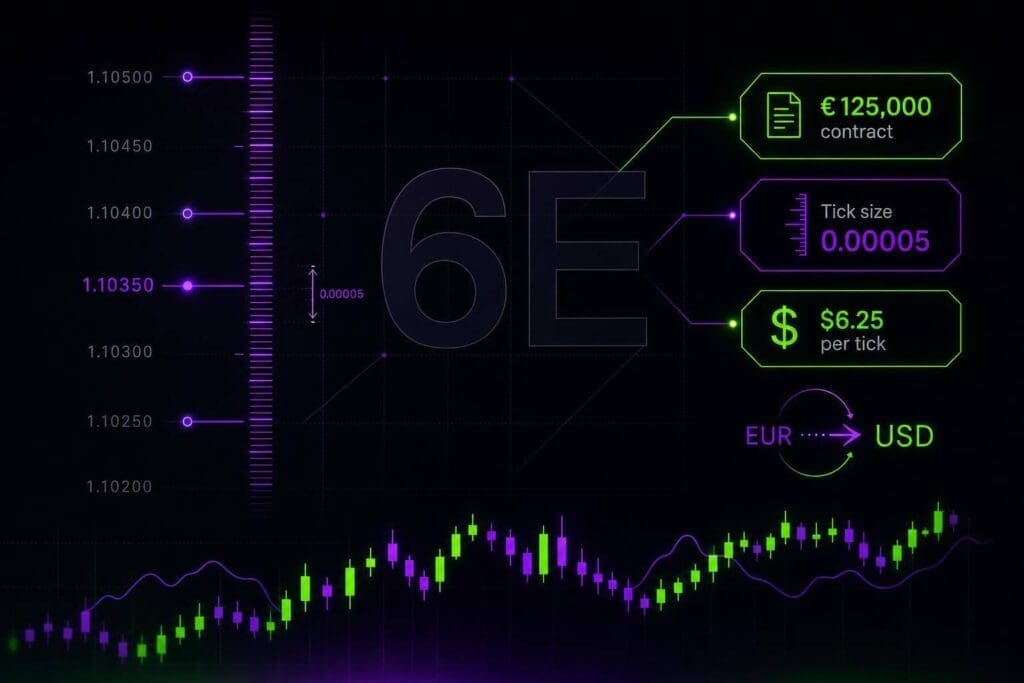
One 6E tick is worth $6.25. That’s the number you need before you size a trade, set a stop, or mess with more than one contract. The 6E controls 125,000 euros, trades in 0.00005 price increments, and every 0.00010 move is $12.50 per contract.
I’m keeping this tight. You’ll get the contract specs that matter, how to convert price moves into dollars, when 6E trades, and why M6E is often the smarter pick when your daily loss limit is tight. If your futures risk math is sloppy, 6E will punish it fast.
Product: Euro FX (6E)
sbb-itb-46ae61d
Quick Reference: Key 6E Numbers
| Specification | Detail |
|---|---|
| Exchange | CME Group (Globex) |
| Symbol | 6E |
| Underlying | EUR/USD exchange rate |
| Contract Size | 125,000 euros |
| Minimum Tick | 0.00005 |
| Tick Value | $6.25 per contract |
| Point Value (0.0001) | $12.50 per contract |
| 0.0050 Move | $625.00 per contract |
| Quote Format | USD per EUR (e.g., 1.08505) |
| Globex Hours | Nearly 24 hours a day, Sunday–Friday |
| Quarterly Months | March, June, September, December |
Next, break down what the 6E contract actually represents.
What Are Euro FX Futures (6E)?
Euro FX futures (6E) are CME’s EUR/USD futures contract. One standard contract equals 125,000 euros, and it’s quoted in U.S. dollars per euro. That quote setup is what determines the tick value and point value.
Exchange, Symbol, and Underlying Market
The 6E symbol is listed on the Chicago Mercantile Exchange (CME) and trades electronically on Globex[1]. Its price tracks the EUR/USD exchange rate, which is why the contract is quoted in U.S. dollars per euro.
Contract Size and Deliverable Structure
Each standard 6E contract represents 125,000 euros[1]. It’s also a physically deliverable contract at expiration, so most traders close the position or roll it before delivery[1].
That contract size is what gives each tick its dollar value.
How Much Is One 6E Tick Worth?
The 125,000 euro contract size is what sets every 6E dollar value.
Minimum Tick, Tick Value, and Point Value
The minimum tick in 6E is 0.00005 USD per euro, which is half a pip. That works out to $6.25 per contract for one tick. If 6E moves 0.0001, that move is worth $12.50 per contract.
The 6E Tick Value Formula
The math is simple:
Contract Size × Tick Size = Tick Value 125,000 × 0.00005 = $6.25
That same formula lets you map stop size and target size to dollars fast. No guesswork. Just contract size times price move.
Common 6E Move Conversions
| Move Size | Price Move (Decimal) | Dollar Value (1 Contract) |
|---|---|---|
| 1 tick | 0.00005 | $6.25 |
| 10 ticks | 0.00050 | $62.50 |
| 20 ticks | 0.00100 | $125.00 |
| 50 ticks | 0.00250 | $312.50 |
| 100 ticks | 0.00500 | $625.00 |
Memorize the table or at least the pattern. A 20-tick stop on one contract is $125.00. A 50-tick move is $312.50. That matters fast when you’re setting risk, especially when managing risk in a prop firm account.
Next, map those moves to actual 6E quote increments.
How to Read 6E Prices and Convert Moves to Dollars
6E Pricing Format
Here’s the part that trips people up: small-looking moves in 6E can still mean decent money.
Using the 0.00005 tick size, a move from 1.0800 to 1.0810 is 20 ticks, which comes out to $125.00 per contract. A move from 1.0800 to 1.0850 is 100 ticks, or $625.00 per contract.
That’s why you can’t just glance at the decimal places and guess. You need to know how many ticks are inside the move.
0.0001 vs. 0.00005 in 6E
This is where a lot of spot FX traders get crossed up.
In spot forex, 1 pip = 0.0001. In 6E futures, the minimum tick is 0.00005, which is half a pip. So when 6E moves 0.0001, that’s 2 minimum ticks, not 1.
That also means a one-pip move in euro spot equals $12.50 per contract in 6E, not $6.25.
Simple way to think about it:
- 0.00005 = 1 tick = $6.25
- 0.00010 = 2 ticks = 1 pip = $12.50
Price-to-Dollar Conversion Table
| Price Move | Ticks | Spot FX Pip Equivalents | Dollar Value (per 6E Contract) |
|---|---|---|---|
| 0.00005 | 1 | 0.5 | $6.25 |
| 0.00010 | 2 | 1 | $12.50 |
| 0.00050 | 10 | 5 | $62.50 |
| 0.00100 | 20 | 10 | $125.00 |
| 0.00500 | 100 | 50 | $625.00 |
Formula: price move × 125,000 = dollar value.
Example: 0.0050 × 125,000 = $625.00.
Once you can turn price movement into dollars, you’re in a much better spot to judge risk, stop size, and whether a trade even makes sense. The next piece is knowing when 6E trades and which contract months actually matter.
6E Trading Hours and Contract Months
Once you know the tick value, the next thing that matters is when that risk is live. A 10-tick move means one thing during calm hours and another when volume comes in hard.
CME Globex Trading Hours
6E trades almost 24 hours a day on CME Globex. The market opens Sunday at 6:00 PM ET and runs through Friday at 5:00 PM ET. There’s a daily maintenance halt from 5:00 PM to 6:00 PM ET. During that hour, trading is closed.
That schedule matters more than people think. If you hold positions into the halt, you’re stuck until the market reopens. No exits. No adjustments.
Quarterly Contract Months
6E uses a quarterly expiration cycle:
| Contract Month | Symbol Code |
|---|---|
| March | 6EH |
| June | 6EM |
| September | 6EU |
| December | 6EZ |
Nothing fancy here. Just know the codes so you don’t end up charting or trading the wrong month.
Expiration and Rollover Timing
Volume and open interest move to the next quarterly contract before expiration. That’s why active traders usually roll early. It keeps you in the contract with better liquidity and tighter action.
The last trading day can shift around holidays, so don’t guess. Check CME Group’s official contract specifications before you roll.
With the contract cycle sorted, the next step is comparing 6E vs. M6E for risk control.
6E vs. M6E: Which Contract Fits Your Risk?
6E vs M6E Euro FX Futures: Contract Specs & Tick Value Comparison
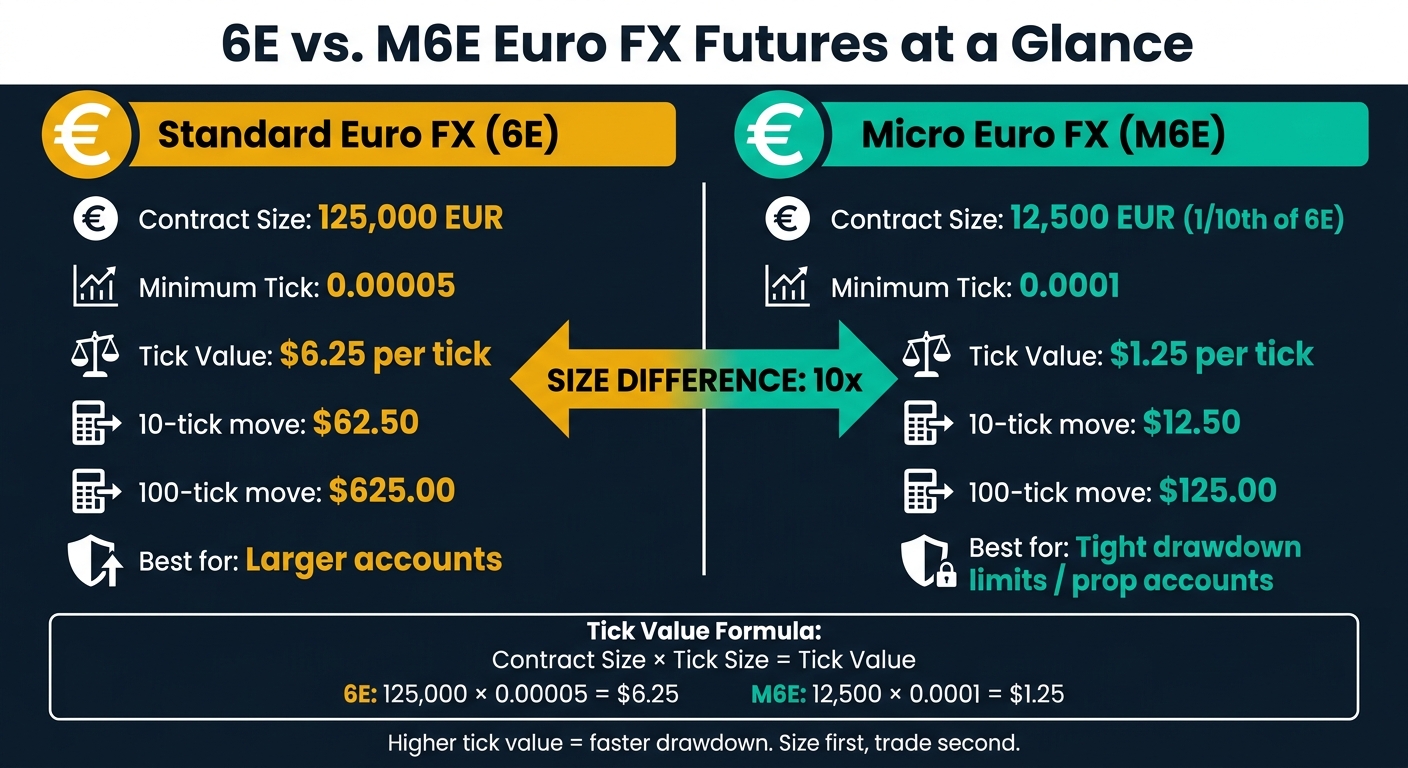
Once the dollar math is clear, this part gets simple: pick the contract size that matches your room for error. M6E is 1/10 the size of 6E, so the dollar hit per move is a lot smaller.
Contract Size and Tick Value Side by Side
| Feature | Standard Euro FX (6E) | Micro Euro FX (M6E) |
|---|---|---|
| Contract Size | 125,000 EUR | 12,500 EUR |
| Minimum Tick | 0.00005 | 0.0001 |
| Tick Value | $6.25 | $1.25 |
| Typical Use | Larger accounts | Tight drawdown limits |
That difference matters fast. On 6E, each tick is $6.25. On M6E, it’s $1.25. If you’re trading inside a firm account with a fixed daily loss cap, that gap isn’t small. It changes how much breathing room you get before the rules start choking the trade.
M6E keeps the per-trade dollar risk lower, which is usually the safer call when drawdown is tight. The catch is simple: commissions bite harder on smaller size. That’s the trade-off. You cut tick risk, but costs matter more.
Why Standard 6E Can Strain Tight Drawdown Limits
Standard 6E can chew through daily loss limits and trailing drawdowns a lot faster because the tick value is $6.25.[1] If the account uses a real-time trailing drawdown, smaller per-tick exposure matters even more.[1] That’s where micros help. They slow the damage when price chops around or when your entry is a little off.[1]
Still, don’t pretend micros are free. They reduce per-tick risk, but commissions stack up.[1]
Using 6E Tick Value for Position Sizing in Prop Accounts
Once you’ve got the 6E contract specs locked in, the next step is simple: turn your stop distance into actual dollar risk before you click buy or sell.
Planning Stops and Targets in Ticks
The formula is dead simple: stop size in ticks × $6.25 × number of contracts = dollar risk.
Here’s how that looks in practice:
| Trade Scenario | Stop Size (Ticks) | Target Size (Ticks) | Risk ($) | Reward ($) |
|---|---|---|---|---|
| 1 Contract 6E | 12 Ticks | 20 Ticks | $75.00 | $125.00 |
| 2 Contracts 6E | 12 Ticks | 20 Ticks | $150.00 | $250.00 |
| 1 Contract 6E | 20 Ticks | 40 Ticks | $125.00 | $250.00 |
| 3 Contracts 6E | 10 Ticks | 20 Ticks | $187.50 | $375.00 |
Every extra contract stacks more risk and more reward on top. That’s fine in theory. In a prop account, though, this is where traders get clipped. Size ramps up fast, and drawdown rules don’t care that the setup looked clean.
Tick Value and Daily Loss Limits
Prop firm drawdown limits make size control critical; an ordinary intraday swing can hit your daily loss buffer fast.[1]
Set size before entry. Use the Damn Prop Firms Position Size Calculator and P&L Calculator to turn stop distance and contract count into dollar risk before the trade is live.[1]
Tools and Related Contract Guides
Use the Position Size Calculator and P&L Calculator to check risk before entry.
Bottom Line
Once you strip it down, 6E comes back to three numbers: a 125,000-euro contract, a 0.00005 minimum tick, and $6.25 per tick. That’s the whole game. Those numbers shape every risk call you make.
A 10-tick stop puts $62.50 at risk per contract. A 100-tick move is $625.00 per contract. Simple math, but it hits hard. That’s why sizing matters so much when you’re trading 6E in funded accounts. This contract can move enough to smash daily loss limits in a hurry, so your size matters just as much as your setup.
Size first, trade second.
FAQs
How do I calculate 6E dollar risk from my stop size?
Multiply your stop-loss ticks by the $12.50 tick value and by your contract size. On 6E, the minimum tick is 0.0001, and each tick is worth $12.50 per contract.
Example: a 10-tick stop is $125.00 per contract (10 × $12.50).
If you’re trading more than one contract, scale it up:
- 1 contract = $125.00
- 2 contracts = $250.00
- 3 contracts = $375.00
Always check the current contract specs with the exchange before you place a trade.
When should I trade 6E for the best liquidity?
For the best liquidity in Euro FX futures (6E), trade during the main CME Globex session: Sunday 6:00 PM ET through Friday 5:00 PM ET. The busiest window is usually the London and New York overlap. That’s when order flow tends to be deepest.
Trade in those peak hours and you’ll usually get tighter bid-ask spreads and less slippage. That matters, especially if you’re taking short-term setups or trading size. For current session times and holiday schedules, check the official CME Group calendar.
Should I trade 6E or M6E in a prop account?
It comes down to your risk plan and your firm’s rules. 6E is the standard Euro FX contract. M6E is the micro version.
M6E gives you tighter position sizing, which matters if you’re trying to stay inside a drawdown cap without chopping your setup to pieces. That extra control can make trade management a lot cleaner.
Before you pick one, check the basics:
- Whether your firm supports both 6E and M6E
- Your account’s contract limits
- The margin needed for each symbol
- Your own risk tolerance
Don’t assume both contracts are available just because they’re common. Verify the symbols first, then size the trade around the rules you actually have.