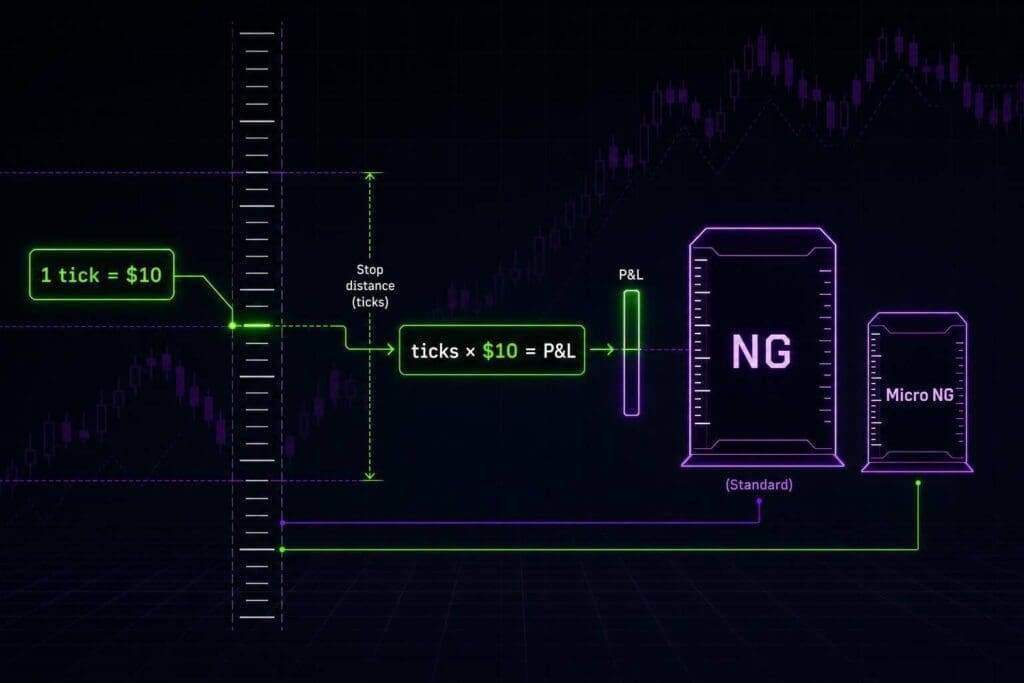
One NG tick is $10. That’s the only number I want burned into your head before you touch size on natural gas. NG moves in 0.001 per MMBtu, and on the standard 10,000 MMBtu contract, that tiny price change turns into $10 per contract. Stack a few ticks, and P&L starts moving fast.
I’m keeping this tight. You’ll get the contract math that matters, what a full point is worth, how to turn ticks into dollar risk, and when the smaller gas contract makes more sense. If you trade funded futures accounts or your own cash, the rule is the same: size off the stop, not off the margin screen.
NG Contract Specs in Plain English
Use these specs to turn NG price moves into actual dollars.
Underlying, Symbol, and Contract Size
Standard NG is the Henry Hub natural gas futures contract on NYMEX. The contract size is 10,000 MMBtu. That’s the piece that makes each tiny move in NG matter in dollar terms.
Price Quote, Minimum Tick, and Tick Value
NG’s minimum tick is 0.001, and each tick is worth $10.00 per contract. Simple math, but it matters. This is what sets your stop size, your per-trade risk, and how fast P&L moves when NG gets jumpy.
| Spec | Detail |
|---|---|
| Exchange | NYMEX (CME Group) |
| Ticker Symbol | NG |
| Contract Size | 10,000 MMBtu |
| Quote | $ per MMBtu |
| Minimum Tick | 0.001 |
| Tick Value | $10.00 per contract |
Trading Venue and Contract Months
NG trades electronically on CME Globex in ET, with a daily maintenance break from 5:00 PM–6:00 PM ET. The main session runs Sunday–Friday, 6:00 PM–5:00 PM ET. Contracts are listed for every calendar month.
With hours and expirations set, the next move is tracking P&L one tick at a time.
Next, turn those specs into dollar P&L.
sbb-itb-46ae61d
How NG Tick Size Converts to Dollar P&L
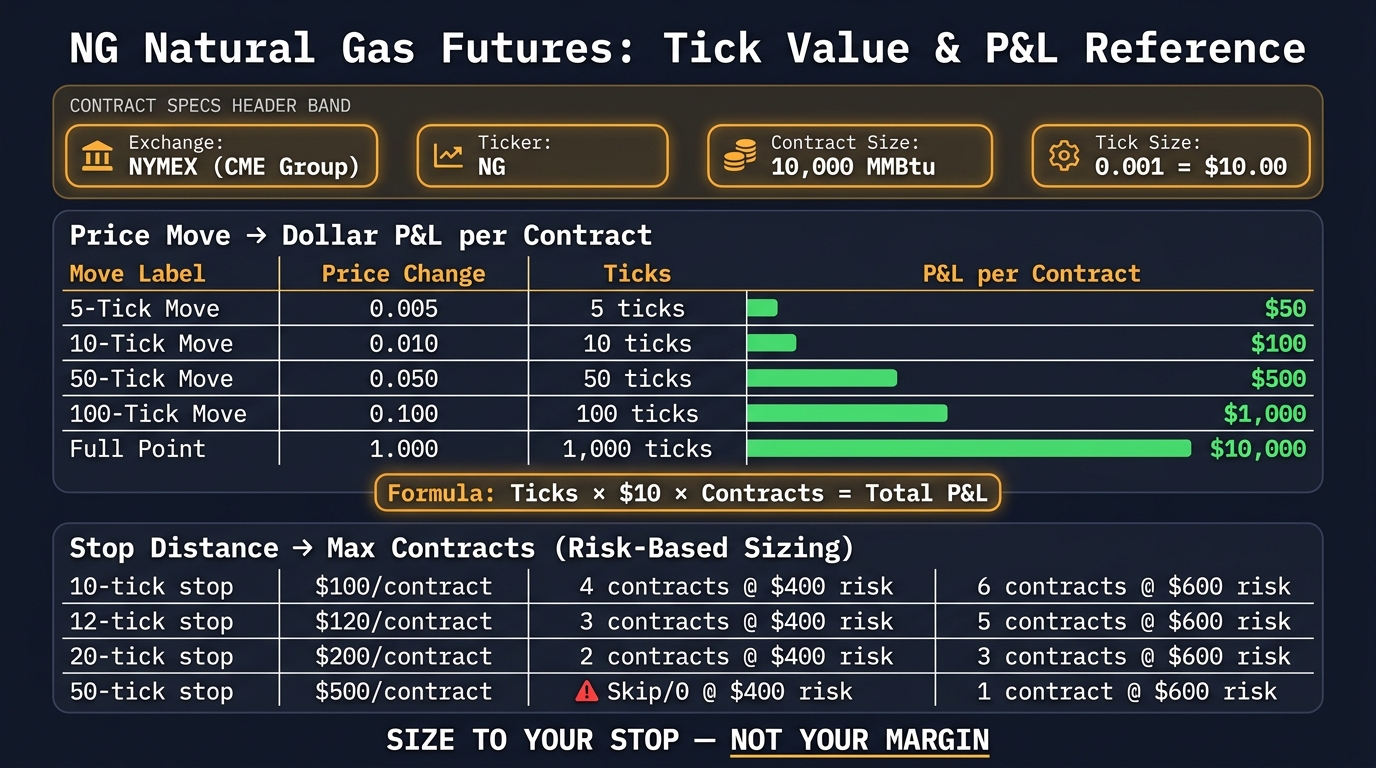
NG Futures Tick Value: Contract Specs & P&L at a Glance
What One Tick and One Full Point Are Worth
In NG, 1 tick = 0.001 = $10 per contract. Keep that number in your head before you enter any trade. It’s the base math for your stop, target, and size.
A 1.000 move – one full point – equals 1,000 ticks, which comes out to $10,000 per contract.
P&L Examples: 5-Tick, 10-Tick, and Larger Moves
The math stays simple, and you can use a futures trading profit calculator to automate these checks:
- A 5-tick move (0.005) = $50 per contract
- A 10-tick move (0.010) = $100 per contract
- A 0.100 move = 100 ticks = $1,000 per contract
| Move | Price Change | Ticks | P&L per Contract |
|---|---|---|---|
| 5-tick move | 0.005 | 5 | $50 |
| 10-tick move | 0.010 | 10 | $100 |
| 50-tick move | 0.050 | 50 | $500 |
| 100-tick move | 0.100 | 100 | $1,000 |
| Full point | 1.000 | 1,000 | $10,000 |
The Formula for Multi-Contract P&L
For more than one contract, use this:
Total P&L = Ticks Moved × $10 × Number of Contracts
Example: if NG moves 0.015 and you’re holding 3 contracts, that’s 15 ticks × $10 × 3 = $450 in total P&L.
That’s your dollar-risk side. Next step is using it to size the trade. This is a core component of scaling funded accounts safely.
How to Size NG Trades Without Overexposing Your Account
NG has a $10 tick value, so you should size risk before you enter. Set your max loss first. Then work backward from the stop distance to the number of contracts.
Start by Defining Your Stop Distance in Ticks
Before you even think about contract count, figure out where the trade is wrong. That’s where your stop goes. Once you have that level, count the ticks from entry to stop. That tick count is your risk unit.
For one contract, the math is simple:
Risk per contract = stop distance in ticks × $10 [1]
A 12-tick stop means $120 risk per contract.
A 20-tick stop means $200 risk per contract.
No fluff. Just math.
Calculate Contract Count from Your Max Dollar Risk
Once you know the risk per contract, sizing gets easy:
Contract Count = Max Dollar Risk ÷ Dollar Risk per Contract
Say your account rules let you risk $400 on one trade. If your stop is 20 ticks, that’s $200 risk per contract. So:
$400 ÷ $200 = 2 contracts
If that stop stretches to 50 ticks, now you’re at $500 per contract. With a $400 risk cap, that trade doesn’t fit. Skip it or cut size.
| Stop Distance | Risk per Contract | Max Contracts at $400 Risk | Max Contracts at $600 Risk |
|---|---|---|---|
| 10 ticks | $100 | 4 | 6 |
| 12 ticks | $120 | 3 | 5 |
| 20 ticks | $200 | 2 | 3 |
| 50 ticks | $500 | 0 (skip or reduce) | 1 |
This is the kind of position sizing strategy that kills guesswork. The same setup works for any stop size and any account risk cap.
Why NG Volatility Affects Sizing More Than You Might Expect
NG moves fast for a contract with a $10 tick, and that adds up in a hurry. A stop that looks small on the chart can turn into a big dollar hit once you do the math. As your stop gets wider, your per-contract risk climbs fast.
That’s also why low day-trade margins can mess with people. They make NG look cheap to hold, but that doesn’t mean the trade is cheap in risk terms. A small margin number can tempt you into taking more size than your plan allows [1]. Bad move.
Size to your stop, not your margin.
If standard NG still blows past your risk limit, look at the smaller contract.
Standard NG or a Smaller Natural Gas Contract: Which One Fits?
If your stop and risk budget don’t work with standard NG, don’t force it. Cut the contract size or pass on the trade.
Standard NG vs. Micro Natural Gas: Which Fits Your Risk?
Use standard NG when your stop fits your risk budget at $10 per tick. Use the smaller contract when standard NG makes you do one of two dumb things: push your stop farther than your plan allows, or size down so much the trade barely matters.
The whole thing comes down to dollar risk per tick. A smaller natural gas contract has a lower tick value, so the same stop distance in ticks costs less per contract. This logic applies across asset classes, including MNQ tick value calculations for equity traders. That lets you keep the setup the same without messing with stop placement.
Once you’ve picked the contract that fits your risk, use that contract’s tick value to map out your entry, stop, and target before you place the trade.
How to Use NG Specs to Plan a Trade Before You Enter
Once you’ve got contract size sorted, use the specs to build the trade before you hit buy or sell. Keep it simple. Run the same tick-based check every time, and map your risk and reward before the order goes live.
Pre-Trade Checklist for NG
Start with these inputs before you size anything.
| Checklist Item | What to Verify |
|---|---|
| Contract Month | You’re trading the front month or your intended expiry |
| Current Price | Note the live NG price to anchor your entry zone |
| Tick Value | Confirm the contract’s tick value before sizing |
| Stop Distance | Your stop distance in ticks |
| Profit Target | Your target in ticks |
| Risk Budget | Stop Ticks × Tick Value × Contracts must stay within your risk cap |
| Session Timing | You’re trading during active hours |
Once that’s locked in, turn ticks into dollar risk and dollar target.
Plan Entries, Stops, and Targets in Ticks Before You Click
Set your entry, stop, and target in ticks before placing the order. No winging it after you’re in.
A 20-tick stop risks $200 per standard contract. A 40-tick target pays $400. That gives you a 2:1 reward-to-risk ratio before entry. Clean math. No guessing.
If the numbers look bad on paper, pass on the trade.
Bottom Line
For standard NG, each tick is worth $10. Multiply your stop ticks by $10, then multiply that by your contract count to get total risk. If that fits your account rules, take the trade. If not, cut size or skip it.
FAQs
How many ticks does NG usually move in a day?
There’s no fixed daily tick range for NG. Some days it crawls. Other days it rips. That’s just Natural Gas.
The move you get in a session can swing hard with weather models, storage numbers, and production data. One headline can change the whole pace.
Don’t lean on some old “average day” number. Use the ATR on your platform and look at what volatility is doing right now. That gives you a much better read than a stale stat.
You should also confirm the contract’s minimum tick size and tick value on CME Group so your risk math is dead simple before you place anything.
When should I trade micro natural gas instead of standard NG?
Trade micro natural gas futures instead of standard NG when you need tighter risk control or smaller position sizing.
Standard NG moves in bigger dollar chunks per tick. That means it’s easier to oversize without meaning to. Micros give you more room to size the trade to your account and stick to your risk plan.
How do I calculate NG risk before entering a trade?
Multiply your contract count by the price move, then by the contract value. For standard Natural Gas (NG), the tick size is $0.001 per MMBtu, and the contract size is 10,000 MMBtu. That means 1 tick = $10.00 per contract.
Here’s the math in plain English:
- 5 ticks = $50.00 per contract
- 10 ticks = $100.00 per contract
If you’re trading more than one contract, just multiply from there. Two contracts on a 10-tick move? That’s $200.00.
Always check the current contract specs before you place a trade.