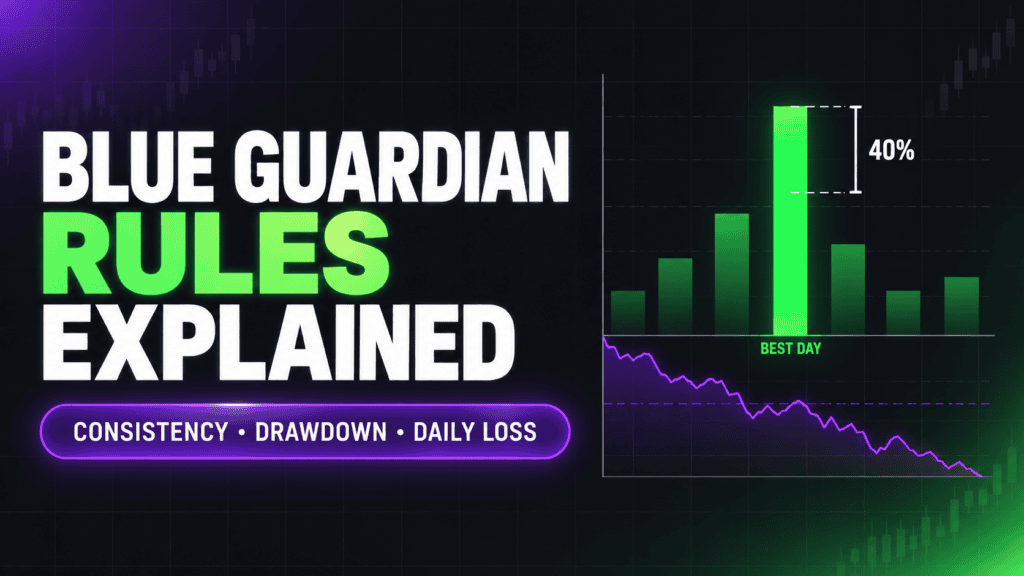
Quick answer: Blue Guardian’s instant funding for futures is the Direct account. The old Instant Standard model was retired on 6 July 2026 and Direct replaced it. You pay once, get a funded sim account the same day with no profit target and no evaluation, and trade under four rules that are tighter than the evaluation models: an end-of-day trailing drawdown, a soft daily loss limit from day one, a consistency rule that steps from 20% to 30% as you take payouts, and a payout goal you have to hit before each withdrawal. Everything below is the current Direct rulebook, with the math, followed by the honest comparison against just passing a Standard evaluation.
One naming note before the rules, because it’s the source of most confusion in this search: Instant Starter is a product on Blue Guardian’s CFD/forex side, not the futures program. If you were looking for Instant Starter rules, they live on the CFD help center and are not the rules on this page. This is the futures Direct account, the one we test and review on our Blue Guardian Futures review.
What the Direct account is
Direct is instant funding in the plain sense: a simulated funded account, live from the moment your payment clears, that pays real money when you hit its payout goal. There’s no evaluation phase, no profit target to pass and no “activation” step — the funded rules apply from your first trade. Sizes are $25K, $50K, $100K and $150K, the profit split is 90/10 like every other Blue Guardian model, and after your fifth payout a Direct account is eligible for the same earned Live Account (real CME execution, no caps, no consistency rule) as the evaluation models.
Blue Guardian Direct pricing by size
Direct is a one-time fee with no activation charge and no monthly cost. Prices below are pulled from our plan records, so they move when Blue Guardian moves them; code DGT applies the largest discount the firm offers on Direct.
| Direct account | List price | With code DGT | Max contracts |
|---|---|---|---|
| $25K | $307 | $230 | 1 mini / 10 micro |
| $50K | $494 | $371 | 4 mini / 40 micro |
| $100K | $659 | $494 | 8 mini / 80 micro |
| $150K | $824 | $618 | 12 mini / 120 micro |
Buying more than one account in the same order stacks the checkout ladder — 30% off the second, 35% off the third, 40% off the fourth and the fifth free — on top of the code. Direct accounts count toward the same five-funded-account maximum as every other model.
Drawdown: trailing end-of-day until it locks
Direct uses an end-of-day trailing drawdown, measured at the 4:10 PM ET close rather than tick by tick. The allowance by size, as of September 2026: $1,500 on $25K, $2,000 on $50K, $3,500 on $100K, $4,500 on $150K. It trails your end-of-day high-water mark upward until one of two things happens: the drawdown line reaches your starting balance (which takes a run-up equal to the full allowance), or you take your first payout — at which point it locks at your starting balance plus $100 and stops trailing for good (the same lock every Blue Guardian model applies after a payout). An intraday dip that recovers by the close never counts. If you’re new to how EOD trailing behaves, our end-of-day drawdown guide walks through it with examples.
Daily loss limit: soft, and on from day one
Unlike the Standard $25K or the no-DLL Reserve, every Direct size has a daily loss limit from the first session: $1,000 on $25K, $1,250 on $50K, $2,500 on $100K, $3,000 on $150K. It’s soft — hitting it flattens your open positions and locks you out for the rest of that trading day, and you come back tomorrow with the account intact. The maximum drawdown above is the rule that ends the account, not this one. The $50K figure is the one people search for most, so it’s worth repeating: on Direct it’s $1,250, which is also why “$1,250” keeps showing up in searches about Blue Guardian’s 50K daily loss limit — older Blue Guardian 50K accounts used the same figure. The full daily-loss table for every Blue Guardian model is on the review page.
The stepped consistency rule: 20% → 25% → 30%
This is the rule that decides whether Direct is for you. Your single best day can’t be more than a set share of the profit you’ve built since your last payout — 20% for your first payout, 25% for your second, 30% from your third onward. Blue Guardian shows this as a consistency score in your dashboard: best day divided by total profit. Loosening as you go is the right direction, but 20% on the first payout is strict, and it interacts with the payout goal in a way that catches people out.
Worked example, $50K Direct, first payout. The payout goal is $3,000 of profit. At 20%, your best day can be at most 20% of your total profit — so with exactly $3,000 banked, your biggest day has to be $600 or less. Have one $1,200 day in the mix and you’re not withdrawing at $3,000; you need $6,000 of total profit before that $1,200 day drops to 20% of the pile. The rule doesn’t breach your account, it just delays the payout until the ratio works. Traders who scalp for small, even days barely notice it; traders whose edge shows up in two or three big sessions a month feel it hard. Run your own numbers in the consistency calculator before you buy.
Payout goals and caps
Each payout unlocks at a profit goal. The first goal is 6% of the account — $1,500 / $3,000 / $6,000 / $9,000 by size. From the second payout on, the goal drops to $1,000 / $2,000 / $3,500 / $4,500. Once you’re over the goal with the consistency ratio satisfied, you can request a payout, and the amount is capped per request:
| Direct account | Payouts 1–3, max per request | Payouts 4+, max per request | Funded consistency |
|---|---|---|---|
| $25K | $1K | $1,000 | 20% → 25% → 30% |
| $50K | $2K | $2,500 | 20% → 25% → 30% |
| $100K | $2.5K | $3,000 | 20% → 25% → 30% |
| $150K | $3K | $3,500 | 20% → 25% → 30% |
The minimum withdrawal on Direct is $1,000 (higher than the $100 crypto / $500 Rise minimums on the evaluation models), the split is 90/10, and approved requests are processed within 24 business hours by Rise or crypto with a 3% processing fee. There’s no buffer on Direct: nothing has to stay in the account above your starting balance before you can withdraw. The per-request caps stop applying once you graduate to the Live Account after payout five.
What else applies on Direct
- Contracts: 1 / 4 / 8 / 12 minis by size (10 micros per mini), fixed — no scaling ladder.
- Hours: 6:00 PM to 4:10 PM ET; everything flattens automatically at 4:10 PM. No overnight, no weekend holds.
- News trading: allowed. The only place Blue Guardian bars it is the Live Account.
- No reset. A breached Direct account is finished — there’s no reset fee and no reactivation option, unlike the evaluation models. You buy a new one.
- 2% price-limit rule and the standard prohibited-strategies list (latency and HFT bots, arbitrage, hedging across accounts, copying other people’s trades, account sharing, VPN misuse) apply exactly as they do on every other model.
- Eligibility: the same 57-country restricted list as the rest of the futures program — see Blue Guardian’s restricted countries if you’re unsure.
Direct vs a Standard evaluation: the $50K math
The real question isn’t whether Direct’s rules are fair, it’s whether the price gap buys you anything. At $50K, Direct is $371 with the code; a Standard evaluation is $157. For the difference you get: no profit target to pass, no reset cycle if you fail, and a funded account today instead of after your first green day.
What you give up is bigger than it looks. Standard has no consistency rule in the evaluation, so one good day passes you, and once funded its rule is 40% — twice as loose as Direct’s 20% on the first payout. Standard’s first payout cap is $2.5K against Direct’s $2K. Standard’s $50K carries a soft $1,000 daily loss limit against Direct’s $1,250, and if you do blow the evaluation, a reset is $141 — so even a fail-then-pass path (evaluation with the code plus one reset) costs less than Direct. The one thing Standard has that Direct doesn’t is a $2,100 buffer that stays in the account; Direct has no buffer at all.
Verdict: if you’d expect to pass a one-day evaluation at least one try in two, Standard or Reserve is the cheaper route to the same 90% split, with looser payout rules. Direct earns its price for two kinds of trader: the one whose daily results are small and even, so the 20% rule costs nothing, and the one who has failed evaluations on emotional overtrading and wants the funded account’s tighter guardrails from day one. If that’s you, take it — with the code — at Blue Guardian Futures. If it isn’t, the Blue Guardian discount page shows every model’s price with DGT applied so you can pick the cheaper door. And if instant funding is the priority rather than Blue Guardian specifically, the best prop firms with instant funding page compares every instant product we track side by side.
Blue Guardian Direct account FAQ
Is there a profit target on a Blue Guardian Direct account?
No. Direct has no evaluation and no target to pass. What it has instead is a payout goal — 6% of the account for your first payout, then a smaller fixed amount for each later one — which you must reach, with the consistency ratio satisfied, before you can request a withdrawal.
Can I reset a Blue Guardian Direct account?
No. Direct accounts have no reset and no reactivation option. If you breach the drawdown, the account is closed and the only way back is a new purchase. The evaluation models (Standard, Reserve, Express) do offer resets and paid reactivation — one of the real trade-offs of instant funding.
What is the minimum withdrawal on Direct?
$1,000 per request, by Rise or crypto, with a 3% processing fee. That's higher than the $100 crypto and $500 Rise minimums on Blue Guardian's evaluation models. Requests are processed within 24 business hours.
Does the consistency rule apply to my first Direct payout?
Yes, and it's at its strictest there: 20% on the first payout, 25% on the second, 30% from the third. Your best day must be no more than that share of the profit you've made since your last payout. It never breaches the account — it only delays the payout until you've built enough total profit for the ratio to work.
Is news trading allowed on Blue Guardian instant funding?
Yes. News trading is permitted on Direct and on every evaluation and funded sim account at Blue Guardian since the July 2026 relaunch. It is not permitted on the Live Account you earn after your fifth payout.
How many Direct accounts can I run at once?
Up to five funded accounts in total across all Blue Guardian models, so five Direct accounts is possible. Buying them in one order stacks the multi-account discount ladder (30%, 35%, 40%, then a free fifth) on top of code DGT. Copying your own trades between your own accounts is allowed; copying anyone else's is not.
Is Blue Guardian Instant Starter still available?
Instant Starter is a product on Blue Guardian's CFD/forex program, and its rules are published on that program's help center — it isn't part of the futures lineup. On the futures side, the instant-funding model was Instant Standard, retired on 6 July 2026 and replaced by Direct. If you read "Instant Starter rules" in an older futures review, they're describing a product that no longer exists in this program.