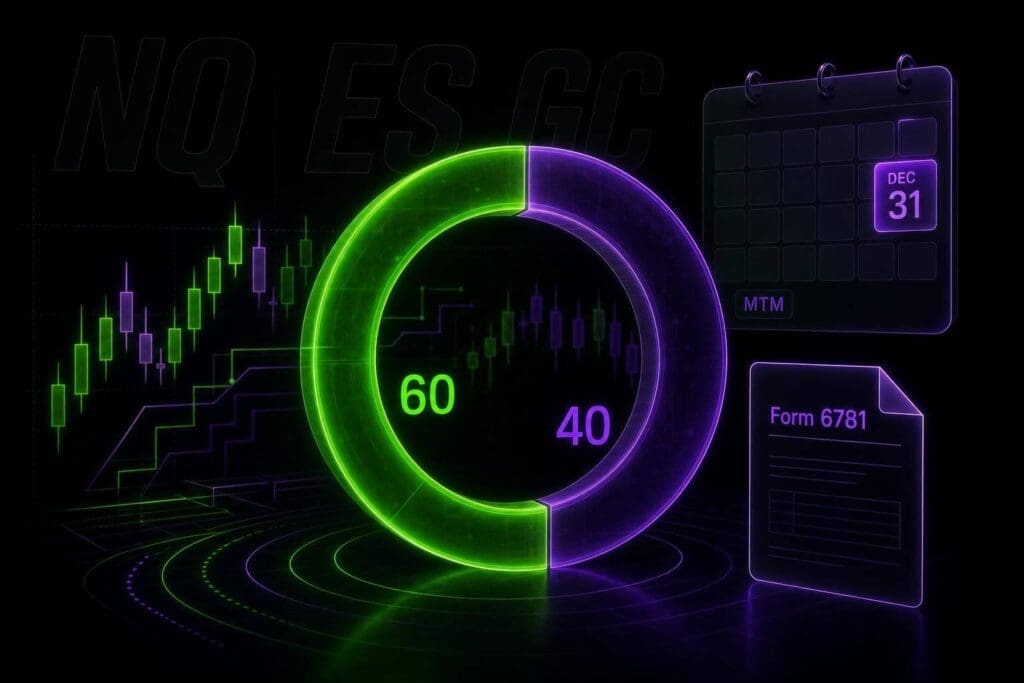
Section 1256 is the tax rule that gives many U.S. futures traders the 60/40 split and year-end mark-to-market. That means 60% of your net annual gain or loss gets long-term capital treatment, 40% gets short-term treatment, and open positions on the last business day of the year still count for taxes.
I’m keeping this tight. If you trade ES, NQ, CL, GC, or other U.S. exchange-traded futures, this is the part that matters: what usually qualifies, how the math works, why unrealized P&L can hit your return, and where it lands on Form 6781 and Schedule D. This is U.S. federal tax info only, not personal tax advice.
Introduction
If you trade U.S. exchange-traded futures, a lot of those contracts land under Section 1256 of the Internal Revenue Code.
That section does two big things. First, 60% of your net gain or loss gets taxed as long-term, and 40% gets taxed as short-term, no matter how long you held the trade. Second, any open position on the last business day of the year gets marked to market at fair value. In plain English, the IRS treats it like you closed it at year-end, even if you didn’t. That means you can owe tax on unrealized gains before the trade is actually closed.
You report Section 1256 gains and losses on Form 6781, then move the totals to Schedule D on Form 1040.
This article covers U.S. federal tax rules only. It is not personal tax advice.
Before getting into the tax math, it helps to pin down what counts as a Section 1256 contract.
sbb-itb-46ae61d
What Are Section 1256 Contracts?
Section 1256 applies to certain futures contracts, not all of them. The part that matters is the contract’s classification. That’s what decides whether the IRS gives it Section 1256 tax treatment.
Common Futures Contracts That Qualify
Common examples include E-mini S&P 500 (ES), E-mini Nasdaq-100 (NQ), Crude Oil (CL), and Gold (GC), which typically fall under Section 1256.[1] That classification is what drives how the IRS taxes the gain or loss.
Key Terms Defined
Section 1256 contracts get the 60/40 capital gains split and year-end mark-to-market treatment. We’ll get into how that works in the next section.
Why You Should Confirm Your Contract’s Classification
Not every futures-related product gets Section 1256 treatment. The safest first move is simple: check how your trades were labeled on your year-end tax form before you file.
Don’t assume every futures-related product falls into the same bucket. Confirm the classification on your tax form before filing.
Once the contract is classified, the next piece is the tax split it gets.
How the 60/40 Tax Split Works for Futures
Once a contract falls under Section 1256, the IRS applies the 60/40 split to your net result for the year.
The 60/40 Rule Explained
Here’s the plain-English version: the IRS treats 60% of your net Section 1256 gain or loss as long-term capital gain or loss, and 40% as short-term capital gain or loss. That split stays the same no matter how long you held the trade. A one-minute scalp and a swing held much longer get the same 60/40 treatment.[1]
This part trips people up a lot: the 60/40 rule applies to your net annual Section 1256 result, not to each trade on its own.[2] So the IRS isn’t looking at every ES or NQ trade and assigning 60/40 line by line. It looks at the combined net Section 1256 number for the year. The same split also applies when open positions are handled at year-end under mark-to-market.
Examples Using ES, NQ, CL, and GC
A few clean examples make this easier:
- A net ES gain gets split 60/40.
- A net NQ loss gets split 60/40 the same way.
- If you trade CL and GC in the same year, those Section 1256 results are netted together before the 60/40 split is applied.[2]
So if ES made money and NQ lost money, you don’t split each contract bucket on its own first. You net the full Section 1256 result, then apply the tax split.
That said, these examples still leave out year-end mark-to-market. And that matters, because open positions can change what ends up as taxable gain or loss for the year.
What the 60/40 Split Does Not Tell You
The 60/40 rule tells you the tax character of the gain or loss. It does not tell you your final tax bill.
Your actual tax bill depends on your full income picture and the federal tax brackets that apply to you.[2] So even if two traders have the same Section 1256 net gain, they can still owe different amounts. The main job of the 60/40 rule is to split the annual net amount into long-term and short-term treatment. You still need that net number reported the right way on your return.
What Happens to Open Futures Positions at Year-End?
If you’re holding futures into year-end, the IRS doesn’t let those trades just sit there untouched for tax purposes.
Section 1256 says open futures positions count toward that year’s gain or loss. So even if you haven’t closed the contract yet, the tax code acts like you did on the last business day of the year.
How Year-End Mark-to-Market Works
Here’s the rule in plain English: open Section 1256 contracts are treated as if they were sold at fair market value on the last business day of the tax year.
That means any unrealized gain or loss gets pulled into the current tax year. And yes, it still gets the same 60/40 tax split used for other Section 1256 gains and losses.
Year-End Open Position Examples for ES and CL
Say you’re sitting on an unrealized gain in ES at year-end. That gain becomes taxable for the current year, even though the position is still open.
Same deal with CL if you’re down. An unrealized loss at year-end becomes a current-year tax loss.
Those amounts then flow to Form 6781, which the next section covers.
Section 1256 Mark-to-Market vs. Section 475(f)
Don’t mix this up with Section 475(f). They’re not the same thing.
Section 1256 mark-to-market is automatic for futures. You don’t elect it. It just applies.
Section 475(f) is different. That’s a separate trader tax election and needs its own IRS filing.
| Section 1256 | Section 475(f) | |
|---|---|---|
| Nature of rule | Mandatory mark-to-market for futures contracts | Optional trader tax election |
| How it’s triggered | Automatic | Requires a separate IRS filing |
How to Report Section 1256 Futures Gains and Losses
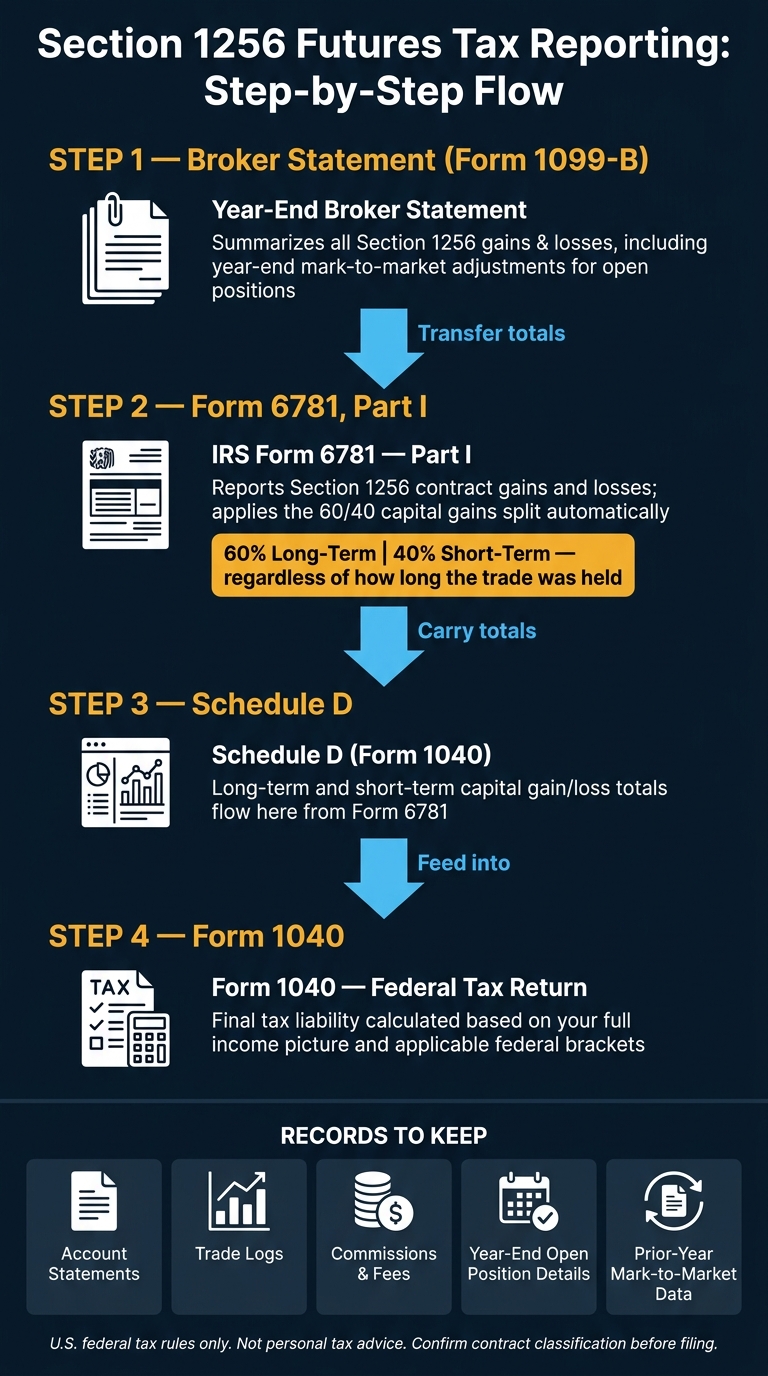
How Section 1256 Futures Gains Are Taxed: The Complete Reporting Flow
The 60/40 split and year-end mark-to-market flow through Form 6781. The path is pretty clean: broker statement → Form 6781 → Schedule D → Form 1040. No mystery. Just make sure the numbers tie out.
The Reporting Process Step by Step
Your broker will usually send a Form 1099-B after year-end. That form sums up your Section 1256 gains and losses, including any year-end mark-to-market adjustment for open positions. You then report those totals on IRS Form 6781, Part I, which is the IRS form for Section 1256 contracts. Form 6781 applies the 60/40 split and pushes the result to Schedule D and then Form 1040.
That’s the process on paper. In practice, your broker’s totals should line up with your own trade records. If they don’t, stop and sort it out before you file.
Records Futures Traders Should Keep
Your 1099-B is the starting point. It’s not your whole paper trail.
Keep these records:
- Account statements
- Trade logs
- Commissions and fees
- Year-end open position details and the prices used for the mark-to-market calculation
- Prior-year mark-to-market data for positions that carried from one tax year into the next
That last one matters more than some traders think. If a position rolled across tax years, you need the prior-year mark-to-market numbers so you can figure the gain or loss the right way when the trade finally closes.
Trade journal software can make this a lot less annoying. It helps track trade history and makes year-end reconciliation cleaner.
Use your records to check your broker’s totals before filing. Don’t just trust the PDF and move on.
When Broker Tax Forms Need a Second Look
Match the broker totals against your own logs. Some situations deserve a harder look than others.
Watch for:
- Multiple accounts
- Mid-year broker transfers
- Amended 1099s
- Open positions at year-end where the year-end values need a manual check
If any of those show up, go line by line. A bad carryover number or a missing adjustment can throw off the whole chain from Form 6781 to Schedule D to Form 1040. Reconcile the broker totals with your trade logs before you file.
Bottom Line for Futures Traders
Most U.S. exchange-traded futures, including ES, NQ, CL, and GC, fall under Section 1256. For tax purposes, that means your yearly gains and losses get the 60/40 capital gains split, and any open positions are marked to market at year-end.
For a clean filing, report the totals on Form 6781, then carry them over to Schedule D. Also keep your trade logs lined up with your broker statements. That part matters. If the numbers don’t match, fixing it later is a pain.
One last thing: confirm the contract’s tax classification before you file. Don’t assume every futures product gets the same treatment.
FAQs
How do I know if my contract is a Section 1256 contract?
The search results provided don’t say how to tell if a contract is a Section 1256 contract.
So, based on the information available here, this question can’t be answered.
Do I owe tax on futures positions I hold at year-end?
Yes. For U.S. futures taxed as Section 1256 contracts, gains and losses are usually recognized at year-end even if the position is still open.
That’s the mark-to-market rule. For tax reporting, unrealized P&L gets treated as realized at year-end, and those results are usually taxed under 60/40 capital gains treatment.
What happens if I have gains and losses across different futures contracts?
Under Section 1256, the 60/40 rule applies to your total net gain or loss for the tax year across all covered contracts. It does not apply contract by contract.
At year-end, the IRS looks at the mark-to-market total. Then it splits that number the same way every time: 60% long-term capital gain or loss and 40% short-term capital gain or loss, no matter how long you actually held any single position.