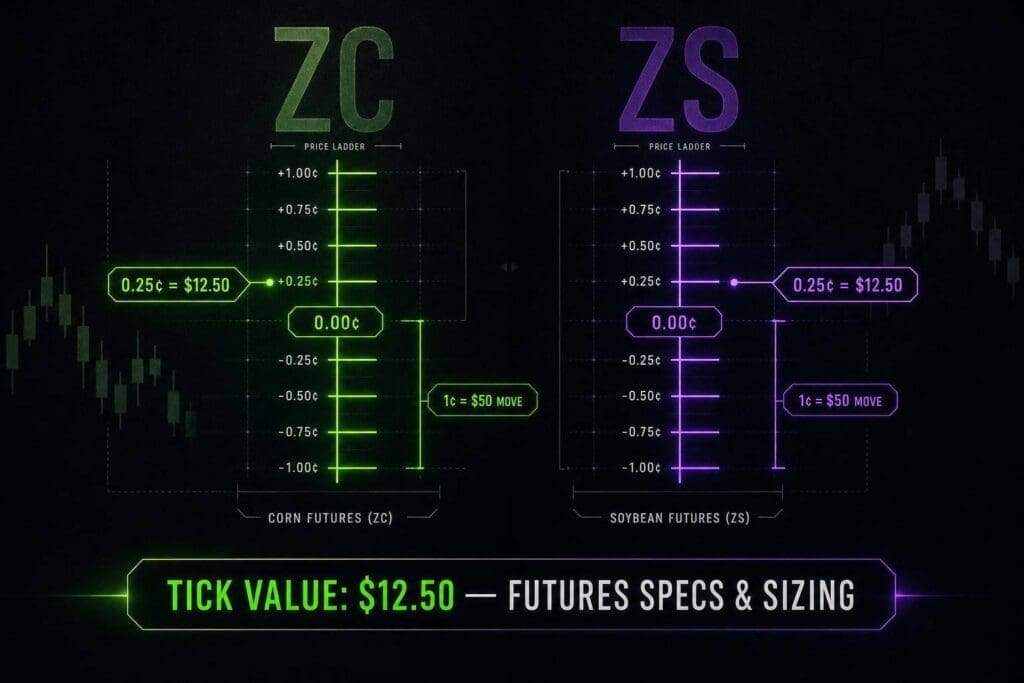
One tick in ZC or ZS is $12.50. That’s the number you need before you size anything. Corn and soybeans use the same tick math, so once you know one, you know both. I’ll keep this tight: how the quote works, what a 1-cent move pays, and how to turn your stop into straight dollar risk. If you trade grain futures, this is the part you don’t screw up. A small quote change can turn into a nasty hit fast when you stack contracts and ignore the math.
Short version: 4 ticks = 1 cent = $50 per contract. That’s the anchor for both markets.
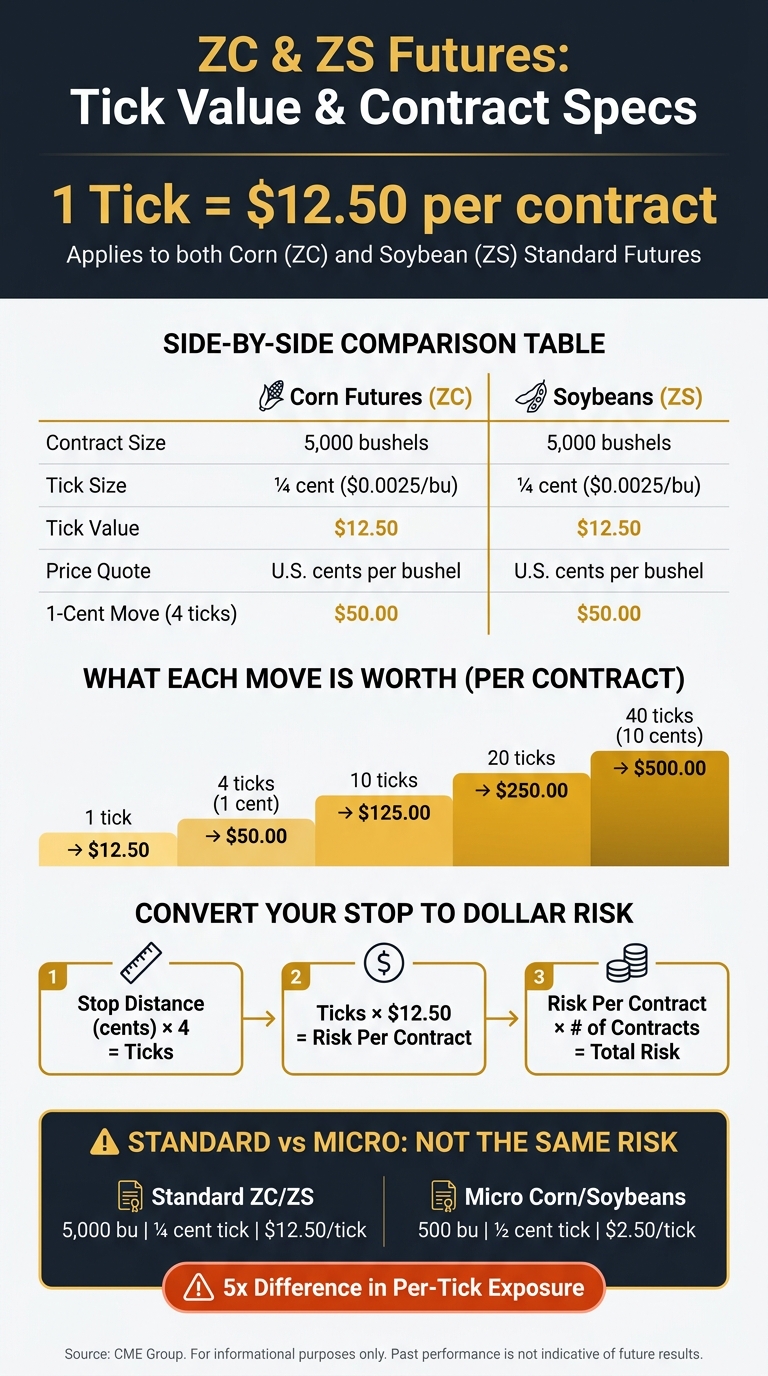
ZC vs ZS Futures: Tick Value & Contract Specs at a Glance
Introduction
Use this guide to turn ZC and ZS ticks into dollar risk before you place a trade. That’s the whole point. Contract specs tell you what a price move is worth, how far your stop sits in dollars, how many contracts you can take, and what your P&L will look like.
Get that math wrong and you can size too big fast. That’s how traders run into drawdown trouble or smash into account limits, especially in funded accounts.
Start with a position-size check so the numbers make sense. Then add commissions and fees, because those still hit your bottom line. Next, the ZC contract specs.
sbb-itb-46ae61d
What Tick Size, Tick Value, and Contract Size Mean for ZC and ZS
Here’s the math behind the $12.50 tick value. For both ZC and ZS, your P&L comes down to three contract specs: contract size, tick size, and quote format.
Tick Value = Contract Size × Tick Size
For ZC and ZS:
5,000 × $0.0025 = $12.50
So every 1-tick move adds or cuts $12.50 per contract.
| Specification | Corn (ZC) | Soybeans (ZS) |
|---|---|---|
| Contract Size | 5,000 bushels | 5,000 bushels |
| Tick Size | $0.0025 (¼ cent) | $0.0025 (¼ cent) |
| Tick Value | $12.50 | $12.50 |
| Price Quote Unit | U.S. cents per bushel | U.S. cents per bushel |
| Value of 1-Cent Move | $50.00 | $50.00 |
How Grain Futures Prices Are Quoted
ZC and ZS are quoted in cents per bushel. The minimum price move is 1/4 cent, which means:
- 4 ticks = 1 cent
- 1 cent = $50.00 per contract
That part trips some traders up at first, but the math is simple once you see it. A quarter-cent move sounds small. On a 5,000-bushel contract, it’s not small at all.
With the quote format locked in, the next step is the standard ZC contract specs.
Standard Corn Futures Specs for ZC
ZC uses the same 5,000-bushel contract size and quarter-cent tick setup covered above. That’s the math you use to calculate your dollar risk based on price moves.
| Specification | ZC (Corn Futures) |
|---|---|
| Symbol | ZC |
| Tick Value | $12.50 per contract |
| 1-Cent Move (4 ticks) | $50.00 per contract |
Source: CME Group – Corn Futures Contract Specs
How to Read a ZC Price Like 450’0
Once you know the tick value, you need to read the quote the right way.
A ZC price of 450’0 means 450 cents per bushel, or $4.50 per bushel. The number before the apostrophe is the full-cent value. The digit after the apostrophe shows the quarter-cent step.
Most platforms display quarter-cent steps like this:
- 450’0 = 450.00 cents
- 450’2 = 450.25 cents
- 450’4 = 450.50 cents
- 450’6 = 450.75 cents
That apostrophe digit is not a decimal place. It marks the quarter-cent steps: 0, 2, 4, 6, then the next full cent.
ZC Tick-to-Dollar Examples
Every tick in ZC is $12.50 per contract. Every full cent is $50.00 per contract.
| Move | Ticks | Dollar Value (1 Contract) |
|---|---|---|
| 1 tick | 1 | $12.50 |
| 4 ticks (1 cent) | 4 | $50.00 |
| 10 ticks | 10 | $125.00 |
| 20 ticks | 20 | $250.00 |
| 40 ticks (10 cents) | 40 | $500.00 |
A 10-cent move is $500.00 per contract. On five contracts, that’s $2,500.00.
ZS uses the same 5,000-bushel and quarter-cent setup, so the soybean math is almost the same.
Standard Soybean Futures Specs for ZS
ZS uses the same tick math as ZC. Same 5,000-bushel contract. Same 1/4-cent tick. So the dollar values line up too.
| Specification | ZS (Soybean Futures) |
|---|---|
| Symbol | ZS |
| Contract Size | 5,000 bushels |
| Price Quotation | Cents per bushel |
| Minimum Tick | 1/4 cent ($0.0025/bushel) |
| Tick Value | $12.50 per contract |
| 1-Cent Move (4 ticks) | $50.00 per contract |
Source: CME Group – Soybean Futures Contract Specs
These specs apply only to the standard ZS contract. Check the exact contract before you place an order. Micro contracts use different specs.
Why ZS Uses the Same Tick Value Math as ZC
ZS matches ZC on contract size and tick size, so each tick is worth $12.50. That’s the whole deal. These specs apply only to the standard ZS contract.
ZS Tick-to-Dollar Examples
| Move | Ticks | Dollar Value (1 Contract) |
|---|---|---|
| 1 tick | 1 | $12.50 |
| 4 ticks (1 cent) | 4 | $50.00 |
| 10 ticks | 10 | $125.00 |
| 20 ticks | 20 | $250.00 |
| 40 ticks (10 cents) | 40 | $500.00 |
A 10-cent stop costs $500 per contract, or $1,500 on three contracts.
Use these numbers to turn ZS stops into dollar risk in the next section.
How to Convert ZC and ZS Ticks Into Trade Risk
Using the $12.50 tick value above, turn your stop distance into dollar risk before you send the order. That’s how you keep size under control instead of guessing after you’re already in.
| Specification | ZC (Corn) | ZS (Soybeans) |
|---|---|---|
| Minimum Tick | 1/4 cent ($0.0025/bushel) | 1/4 cent ($0.0025/bushel) |
| Dollar Value per Tick | $12.50 | $12.50 |
| 1-Cent Move (4 ticks) | $50.00 | $50.00 |
| 10-Cent Move (40 ticks) | $500.00 | $500.00 |
Position Sizing Formula, Step by Step
Keep it simple. There are three parts:
- Ticks = Stop Distance (cents) × 4
- Risk per Contract = Ticks × $12.50
- Total Risk = Risk per Contract × Number of Contracts
Do this math before the trade goes in. Not after. A grain contract can get expensive fast if your stop is wider than you thought.
Example: ZC Stop Distance in Dollars
Say you buy ZC at 450’0 and put your stop at 447’0. That’s a 3-cent move against you.
Here’s the math:
- 3 cents × 4 = 12 ticks
- 12 ticks × $12.50 = $150 per contract
So your risk is $150 per contract. If you trade 2 contracts, that’s $300. If you trade 5 contracts, that’s $750.
Same contract, same setup, very different damage depending on size.
That same method applies to ZS.
Example: ZS Stop Distance in Dollars
Now use a ZS long at 1,200’0 with a stop at 1,190’0. The distance is 10 cents.
Math:
- 10 cents × 4 = 40 ticks
- 40 ticks × $12.50 = $500 per contract
That means $500 per contract. On 3 contracts, you’re carrying $1,500 of open risk below the market.
Next, verify the contract month and tick increment on the order ticket.
Order-Entry Mistakes to Avoid With ZC and ZS
Once you’ve converted ticks into dollars, the next way to get burned is simple: entering the wrong contract. Tick math means nothing if the order ticket doesn’t match what you meant to trade.
Check the Symbol, Contract Month, and Tick Increment First
Before you send the order, check the symbol, contract month, tick increment, and expiration date. Do it every time.
A clean setup can still turn into a bad trade if you click the wrong month or load the wrong contract spec. That kind of mistake isn’t about market direction. It’s just preventable slop. If you are trading through a firm like The Futures Desk, these errors can lead to unnecessary drawdown hits.
Do Not Mix Standard and Micro Grain Contract Specs
This is where sizing mistakes get expensive fast. Standard ZC and ZS contracts represent 5,000 bushels with a 1/4-cent tick worth $12.50, while Micro Corn and Micro Soybean contracts represent 500 bushels with a 1/2-cent tick worth $2.50 [1]. That’s a 5x gap in per-tick exposure.
| Feature | Standard ZC / ZS | Micro Corn / Micro Soybeans |
|---|---|---|
| Contract Size | 5,000 bushels | 500 bushels |
| Tick Increment | 1/4 cent | 1/2 cent |
| Tick Value | $12.50 | $2.50 |
Same stop distance, very different risk. If you use the same stop on a Micro contract, you’re risking one-fifth as much as you would on the standard contract. Size the trade from the contract you actually entered, not the one you had in your head.
Factor In Slippage, Commissions, and Fees
Tick value is just the clean, on-paper number. Your actual P&L gets hit by commissions, exchange fees, and slippage.
So don’t size off raw tick value alone. Use your all-in cost. That gives you the number that matters when the trade is live.
Bottom Line on ZC and ZS Tick Value
Standard Corn (ZC) and Soybean (ZS) futures both move in 1/4-cent increments, and each tick is worth $12.50 per contract. A full 1-cent move is worth $50.00 per contract. That’s the number that matters.
Before you size the trade, turn your stop into dollars. Take the stop distance in cents, convert it using the $12.50 tick value, then divide your risk budget by that dollar amount. Simple math. Less room for dumb mistakes.
Use a position calculator before you hit buy or sell. Also check your all-in costs, the exact symbol, and the contract month. Those small checks save you from avoidable entry errors.
FAQs
How do I calculate dollar risk from my stop in ZC or ZS?
Multiply the ticks between your entry and stop by the dollar value per tick, then multiply that by your contract size.
Formula: (Number of Ticks) × (Dollar Value per Tick) × (Number of Contracts) = Total Dollar Risk
Simple example: if your stop is 10 ticks away, the contract pays $12.50 per tick, and you’re trading 2 contracts, your total risk is $250.
Always check the current tick size and tick value for your exact contract with CME Group.
How do I read quotes like 450’0 or 1200’4?
Grain futures quotes use an apostrophe to split the whole number from the fraction. So 450’0 means 450 and 0/8 cents, while 1200’4 means 1200 and 4/8 cents.
The number before the apostrophe is the handle. The number after it tells you how many eighths get added, because these contracts trade in 1/8-cent increments.
What changes if I trade Micro Corn or Micro Soybeans instead?
Micro Corn and Micro Soybean futures are just smaller versions of standard ZC and ZS. That gives you tighter position sizing and a lower capital hurdle. The tick size and tick value are smaller too, so your P&L moves in smaller steps.
The good part is that the pricing format and P&L math work the same way as the standard contracts. If you already know how ZC or ZS move, you’re not learning a new system. You’re just trading a smaller piece of it.
For the exact contract size and tick value on the micro versions, check the official CME contract specs.