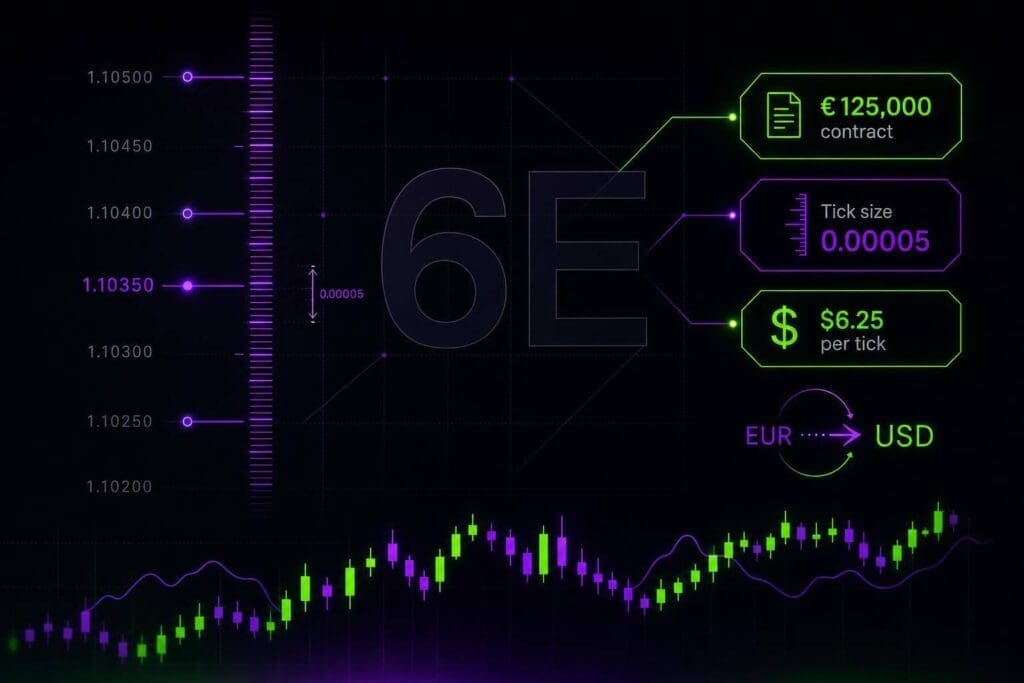
ZN pays $15.625 per tick, $1,000 per point, and that’s the only math most traders need before they size a position. If you trade Treasury futures, this is the part that keeps your stop, contract count, and daily loss limit from getting sloppy. I’m keeping it tight here: what ZN is, how the quote format works, what one move is worth in dollars, and how to turn ticks into hard risk before you click the order. If you trade funded accounts at futures prop firms, this stuff isn’t optional. Bad tick math is how a small-looking chart move turns into a dumb loss fast.
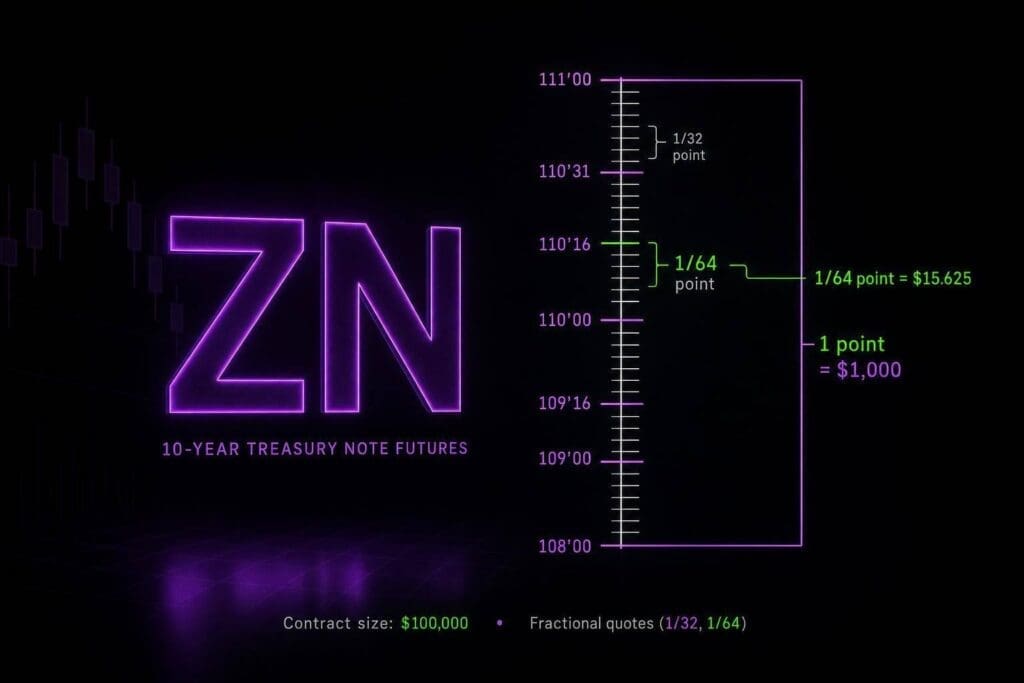
ZN is the 10-Year U.S. Treasury Note futures contract on CBOT via CME Globex. Contract size is $100,000 face value, and the price is quoted on a $100 par basis. So when you see a quote like 110’025, read it as 110 and 2.5/32, not a decimal. That quote format trips people up. Don’t let it.
The number that matters most is simple:
- 1 tick = 1/2 of 1/32
- 1 tick = $15.625 per contract
- 1 point = 64 ticks = $1,000
That means:
- 4 ticks = $62.50
- 8 ticks = $125.00
- 10 ticks = $156.25
That’s per contract. Stack size on top of that and the pain adds up fast.
If I’m sizing a trade, I use this every time:
ticks to stop × $15.625 × contracts = total risk
A few clean examples:
- 6-tick stop on 1 contract = $93.75
- 6-tick stop on 3 contracts = $281.25
- 10-tick stop on 5 contracts = $781.25
That’s the only part that matters before entry. Not margin. Not hope. Just dollar risk.
ZN trades the quarterly cycle:
- March
- June
- September
- December
Trading runs nearly 24 hours on Globex, from 6:00 PM ET Sunday to 5:00 PM ET Friday, with the daily halt from 5:00 PM ET to 6:00 PM ET. Most of the clean volume shows up during the U.S. session and around major data releases. That’s when fills tend to act less stupid.
One more thing. Don’t mix up ZN with ZF, TN, or ZB. They don’t share the same tick math. If you punch in the wrong symbol and size it like ZN, your risk is off before the trade even starts.
Bottom line: ZN is a clean contract once you know the numbers. Every tick is $15.625. Every point is $1,000. Use that math first, then build the trade around it. Not the other way around.
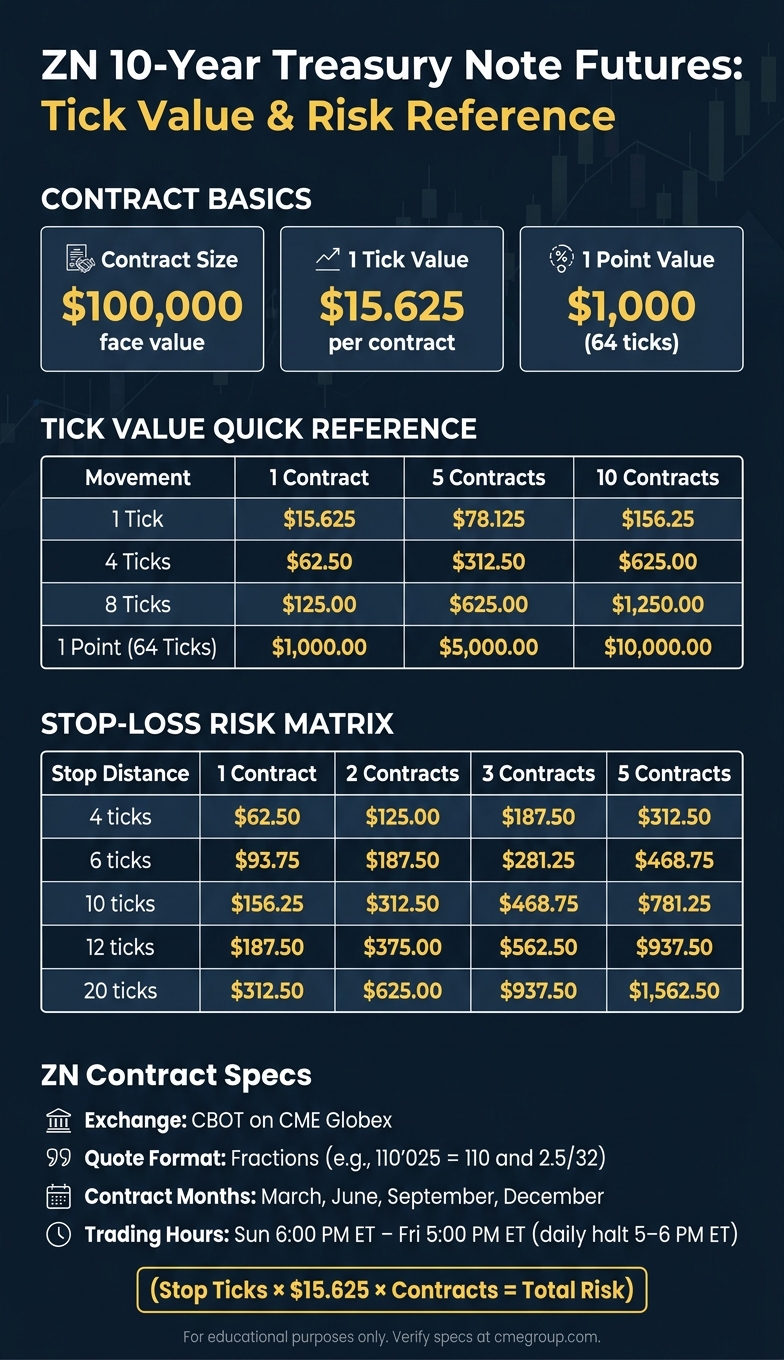
ZN Futures Tick Value & Risk Calculator at a Glance
How to Calculate Profit or Loss on Futures Contracts
sbb-itb-46ae61d
What Is ZN and Where Does It Trade?
Now that the dollar side is clear, here’s what ZN actually is and where those quotes come from.
ZN Contract Basics
ZN is the 10-Year U.S. Treasury Note futures contract. It’s quoted on a $100 par basis and reflects $100,000 face value. So if you see a quote of 110, that means 110% of par. [1]
That’s the part traders need to keep straight. The quote doesn’t mean the contract is worth $110. It’s tied to the par pricing format used for Treasury futures.
CME Globex and CBOT Venue Details
ZN is a CBOT Treasury futures contract that trades electronically on CME Globex. On some platforms, you’ll see it listed as CBOT ZN. That’s normal.
The CBOT/CME Globex listing is the source of ZN quotes. It’s also where the tick math behind your risk sizing, stop placement, and trade planning comes from. [1]
With the contract and venue nailed down, the next piece is the minimum price fluctuation and tick value.
ZN Tick Size and Tick Value
Now get to the part that hits your P&L: the smallest move ZN can make. This is the number that sets your stop distance, your target spacing, and how much a trade move is worth in dollars.
Minimum Price Fluctuation
ZN’s minimum price fluctuation is 1/2 of 1/32 of a point.[1] That sounds tiny, but on a $100,000 contract, tiny doesn’t mean cheap.
Dollar Value of One Tick
One minimum tick move equals $15.625 per contract.[1] That’s the number you use for P&L math and stop planning.
If you’re trading more than one contract, the math is simple:
- Ticks moved × $15.625 × number of contracts
So if ZN moves 4 ticks and you’re holding 3 contracts, that’s 4 × $15.625 × 3 = $187.50.
How ZN Quotes Look on Trading Platforms
This is also why ZN quotes look a little weird on most platforms. You’ll usually see prices in fractions, not decimals. For example, 110’025 means 110 and 2.5/32, not a decimal price.
Read that format wrong and your trade math gets sloppy fast. Read it right, and point value, tick value, and P&L start making a lot more sense.
How Much Is One Point in ZN Worth?
Point Value per Contract
Once you know the tick value, the next number that matters is the point value.
In ZN, one full point is worth $1,000.00 per contract. That equals 64 ticks.
P&L Examples
This is the number you use to turn chart movement into actual contract P&L.
| Movement | 1 Contract | 5 Contracts | 10 Contracts |
|---|---|---|---|
| 1 Tick | $15.625 | $78.125 | $156.25 |
| 4 Ticks | $62.50 | $312.50 | $625.00 |
| 8 Ticks | $125.00 | $625.00 | $1,250.00 |
| 1 Point (64 Ticks) | $1,000.00 | $5,000.00 | $10,000.00 |
A 4-tick stop costs $62.50 on 1 contract and $625.00 on 10 contracts.
That’s why size matters fast in ZN. A move that looks small on the chart can hit a lot harder once you scale up.
ZN Contract Specs at a Glance
Use this as the fast lookup for ZN order-entry specs and rollover months.
Quick-Reference Specs Table
| Spec | Detail |
|---|---|
| Symbol | ZN |
| Product Name | 10-Year Treasury Note Futures |
| Exchange/Venue | CBOT on CME Globex |
| Contract Size | $100,000 face value of eligible U.S. Treasury notes (6.5 to 10 years to maturity) |
| Contract Months | March, June, September, and December |
Quarterly Contract Cycle
ZN trades on the standard quarterly cycle: March, June, September, and December. Keep an eye on the roll as volume moves into the next front month. Once that shift starts, your next concern is trading hours, because that’s when liquidity gets more usable.
ZN Trading Hours
After contract size and tick value, trading hours tell you when ZN is actually sane to trade.
CME Globex Session Hours
ZN trades Sunday through Friday on CME Globex. The market opens at 6:00 PM ET on Sunday and runs until 5:00 PM ET on Friday, with a daily maintenance halt from 5:00 PM to 6:00 PM ET.
CME also changes hours around U.S. holidays. Check the holiday calendar on cmegroup.com before you trade a holiday week.
Why Session Timing Matters for Prop Traders
Those hours matter because ZN is usually most liquid during the U.S. cash session and around major U.S. economic releases. That’s when spreads are often tighter, volume is better, and your entries and exits tend to behave the way you expect. Risk management is cleaner too.
Set up a custom session template that matches ZN hours. If you don’t, your candle data and daily P&L can get messy fast. One more thing: if you enter a position before 5:00 PM ET, you can’t manage it during the halt. Trading doesn’t reopen until 6:00 PM ET.
How ZN Tick Movement Affects Risk and Position Sizing
Use the tick value to lock in your dollar risk before you enter. That’s the whole point. You’re turning chart distance into a hard number, so you know what the trade can cost before you click buy or sell.
Calculating Stop-Loss Risk in Ticks
(Stop Distance in Ticks) × $15.625 × (Number of Contracts) = Total Dollar Risk
A 6-tick stop on 1 contract puts $93.75 at risk. Push that stop out to 10 ticks, and you’re risking $156.25 per contract. Do the math first. Then size the trade.
Multi-Contract Sizing Examples
Risk by stop size and contract count:
| Stop Distance | 1 Contract | 2 Contracts | 3 Contracts | 5 Contracts |
|---|---|---|---|---|
| 4 ticks | $62.50 | $125.00 | $187.50 | $312.50 |
| 6 ticks | $93.75 | $187.50 | $281.25 | $468.75 |
| 10 ticks | $156.25 | $312.50 | $468.75 | $781.25 |
| 12 ticks | $187.50 | $375.00 | $562.50 | $937.50 |
| 20 ticks | $312.50 | $625.00 | $937.50 | $1,562.50 |
If you’re trading in a prop account, this part isn’t optional. Those numbers need to fit inside your daily drawdown limit.
Position Sizing Tools
A position-size calculator makes this easy. Plug in your max risk and stop distance, then convert that into contracts. After that, round down to the nearest whole contract. Not up.
The same math comes up when you stack ZN against ZF, TN, and ZB.
ZN vs. ZF, TN, and ZB: Spec Differences That Affect Your Math
If you trade more than one Treasury futures contract, the symbol changes the math. ZN, ZF, TN, and ZB do not use the same tick math. That’s where traders get clipped. Use the wrong symbol, assume the wrong tick value, and your risk per trade is off before the order even fills.
This isn’t a small detail. It changes stop size, target size, and contract count. Check the exact contract code on the order ticket before you enter. [1]
Common Order-Entry Mistakes
One of the easiest ways to screw up sizing is letting margin availability decide the trade. Low day-trade margins can make a position look cheap, but cheap margin is not the same as low risk. If your stop still costs too much, you’re oversized. Simple as that.
That’s why contract selection is part of risk management, not just order entry. You’re not just picking a symbol. You’re picking the tick value and the damage each bad trade can do to the account. [1]
Bottom Line on ZN Specs
Now that the specs are clear, this comes down to risk math.
Use $15.625 per tick and $1,000 per point to turn price movement into dollar risk. Take your stop size in ticks, multiply it by $15.625, then multiply that by your contract count. That gives you your total dollar exposure.
That’s the number that should decide your stop, target, and size before you click buy or sell.
In prop trading, that conversion is the line between a controlled trade and an oversized one.
FAQs
How do I read a ZN quote like 110’025?
ZN quotes use points and fractions of a point, not plain decimals. In 110'025, 110 is the full points.
After the apostrophe, 02 means 2/32nds, and 5 means 5/8 of a 32nd. So 110'025 means 110 and 2.625/32nds.
How many ZN contracts can I trade for my risk limit?
Your ZN contract size comes down to two things: your account tier and your funding firm’s risk rules. Most firms scale position limits with account balance, so the max size usually changes as the account size changes. Check your firm’s official help center for the exact contract cap tied to your account.
Even if the platform lets you trade more, don’t just max it out. Size your ZN positions around your risk plan, not the biggest number the rules allow.
What happens if I confuse ZN with ZF, TN, or ZB?
Mixing up ZN with Treasury contracts like ZF, TN, or ZB is how dumb order-entry mistakes happen. These are not interchangeable symbols. Each one has its own tick value, point value, and minimum price move.
Trade the wrong contract and your risk math gets thrown off fast. Your size might be off. Your stop-loss might be too tight or too loose. Your profit target might not line up with what you planned. That can leave you with exposure you never meant to take, and in some cases, margin issues too.
Check the ticker before you click buy or sell. Every time.