Trading with instant funding? Risk management is the key to success. Instant funding gives traders direct access to live capital without evaluation, but it comes with strict rules – like drawdown limits, daily loss caps, and consistency requirements. Breaking these rules can lead to immediate account termination. Here’s what you need to know:
- Drawdown Types: Understand End-of-Day (EOD) vs. Intraday Trailing drawdowns to avoid breaches.
- Position Sizing: Calculate trades based on loss limits, not total account balance, to manage risk effectively.
- Daily Loss Limits (DLL): Stop trading if losses hit a set threshold to protect your account.
- Consistency Rules: Firms enforce limits on single-day profits to ensure steady trading habits.
Tools like the Consistency Rule Calculator and platforms like TradeSyncer simplify compliance with these rules. Firms like Lucid Trading, Tradeify, Legends Trading, and Purdia Capital each offer unique risk structures, so choose one that aligns with your trading style.
Bottom line: Instant funding rewards disciplined, calculated trading. Follow strict risk management strategies to maintain your account and secure payouts. For detailed firm reviews and tools, visit DamnPropFirms.
Instant Funding Risk Management Strategy
sbb-itb-46ae61d
Core Risk Management Principles for Instant Funding
When it comes to instant funding programs, the rules are strict and immediate. Unlike evaluation accounts where you can afford some trial and error, instant funding puts you straight into live trading with no practice cushion. Breaking even a single rule – like exceeding a drawdown limit or daily loss cap – results in immediate account termination, regardless of how well you’ve performed before [1].
The foundation of these programs rests on three key safeguards: drawdown limits, position sizing, and daily loss limits. These rules are interconnected and designed to protect both the firm’s capital and your trading career. They dictate how much risk you can take on each trade, how to scale positions appropriately, and when it’s time to stop trading for the day. Mastering these principles is non-negotiable if you want to manage risk effectively.
"Effective risk management is survival-first, not performance-first." – Goat Funded Trader [2]
Data shows that over 90% of traders lose money in the markets, often due to poor risk management [2]. However, traders who adopt disciplined strategies can improve their success rates by about 30% [2]. In the context of instant funding, these numbers take on even greater importance since you’re trading with someone else’s money under tight conditions.
Drawdown Limits and Their Impact
Drawdown limits are the maximum amount of loss allowed before your account is terminated. They act as a safety net, ensuring you don’t spiral into unrecoverable losses. Two main types of drawdown rules exist: End-of-Day (EOD) drawdown and Intraday Trailing drawdown.
- End-of-Day (EOD) drawdown: Calculated at the close of each trading session, this type offers more flexibility during intraday volatility. Firms like Lucid Trading use this method, making it suitable for traders holding positions through market fluctuations.
- Intraday trailing drawdown: This rule monitors your account in real time, adjusting the loss threshold as your balance changes. It demands closer attention to intraday positions and provides tighter risk control.
For instance, Tradeify’s $150,000 instant funding account has a $6,000 maximum loss limit [1]. If your balance falls to $144,000 – depending on the drawdown type – your account is shut down immediately. Knowing how your firm’s drawdown is calculated is critical before you place a single trade.
Position Sizing and Managing Risk
Position sizing is another critical piece of the puzzle. In instant funding accounts, you need to calculate position sizes based on the Daily Loss Limit and Max Loss Limit, not the total account balance [1]. This approach prevents a single oversized trade from wiping out your account.
A general rule is to risk 0.5% to 1% of the account balance per trade [3]. However, instant funding programs often include consistency rules, which add another layer of discipline. These rules typically cap a single day’s profits at 20% to 30% of your total gains [1].
For example, if you’re trading a $50,000 account with a 20% consistency rule, your profits from one day cannot exceed 20% of your cumulative earnings. This ensures that success comes from steady, disciplined trading rather than a single oversized win. Firms like Lucid Trading and Tradeify enforce the 20% rule, while Legends Trading allows up to 30% [1].
To further protect your account, always use stop-loss orders to limit potential losses on individual trades [3].
Daily Loss Limits and Scaling Rules
Daily Loss Limits (DLL) are strict caps on how much you can lose in a single trading session. These limits are designed to prevent catastrophic losses in one day, preserving the progress you’ve made over time [1]. Once you hit your DLL, trading must stop immediately – no exceptions.
Some firms offer Scaling DLLs, which increase your loss allowance as your account grows [1]. This system rewards consistent profitability by giving successful traders more flexibility while protecting newer accounts from excessive risk. For example, Lucid Trading uses a scaling DLL system, letting traders take larger positions as their account balance rises.
To make the most of scaling rules, adjust your position sizes only after your account balance has increased safely [1]. Don’t assume you can take on more risk just because of a few winning days. Monitor your daily drawdown closely and use a pre-trade checklist that includes your stop price, position sizing based on volatility, and a clear exit strategy [2].
Risk Management Tools and Resources
Risk management tools help traders replace guesswork with precision. When dealing with instant funding programs, adhering to strict rules like drawdown limits, consistency requirements, and daily loss caps is mandatory. Relying solely on manual tracking doesn’t cut it. Experienced traders turn to calculators, volatility analyzers, and trade management platforms to stay compliant and avoid account issues.
Consistency Rule Calculator and Trade Management Tools
The Consistency Rule Calculator from DamnPropFirms simplifies tracking payout eligibility. It uses this formula:
Biggest End-of-Day Profit ÷ Consistency % = Total Balance Needed [4].
Most futures prop firms enforce a 20% consistency rule, meaning no single trading day can account for more than 20% of your total profit target [4]. If you go over this limit, your payout isn’t denied but delayed, as your profit target is adjusted upward.
Here’s an example: Suppose you’re trading a Tradeify $150,000 Lightning account with a $9,000 profit goal. If you earn $2,500 in one day, you’ve exceeded the $1,800 threshold (20% of $9,000). As a result, your profit target increases to $12,500 before you can request a payout.
On September 12, 2025, Tradeify introduced a tiered consistency model: 20% for the first tier, 25% for the second, and 30% for subsequent levels [4]. Growth Sim accounts, however, require a stricter 35% consistency rule. The calculator adapts to these variations, saving traders from the hassle of rejected payout requests.
"The Consistency Rule is a risk management tool used by proprietary trading firms to ensure traders don’t rely on just one or two lucky trades. Instead, they must show steady, controlled trading habits over time." – Tradeify [6]
In addition to calculators, platforms like TradeSyncer allow traders to monitor risk across multiple accounts simultaneously. These platforms include built-in compliance checks and analytics, making them invaluable for managing instant funding accounts from the best futures prop firms such as Lucid Trading, Tradeify, Legends Trading, and Purdia Capital. Tools like these ensure traders maintain position multipliers and compliance thresholds across their portfolios.
Volatility Analysis and Risk Assessment Tools
Evaluating market volatility is just as critical as tracking consistency. Futures Risk Calculators provide real-time data on popular contracts like the Nasdaq 100 and S&P 500. These tools often include ATR (Average True Range) settings, which support dynamic stop-loss adjustments based on market conditions [5]. For example, using ATR x2 is a common approach for setting adaptive stops on highly volatile instruments like the NQ [5].
Another essential tool is Bookmap, which offers real-time order flow and liquidity visualization through heatmaps. This tool helps traders identify market risks and avoid entering trades during periods of extreme volatility – situations that could lead to violations of consistency rules. Bookmap even offers a 20% discount with promo codes like "DGT" [4].
For those testing strategies, Monte Carlo analysis tools like the Challenge Simulator can be incredibly helpful. These tools simulate prop firm challenges and estimate success probabilities based on historical data [5].
Strategies for Better Risk Management
How to Build a Risk Management Plan
A strong risk management plan starts with setting clear, conservative trading parameters. Aim to risk only 0.5% to 1% of your account balance per trade, rather than the higher 2% or 3% some firms permit [7][8]. This approach gives you a buffer when trades don’t go as planned. For instance, if you have a $25,000 account, risking 1% means putting $250 on the line per trade. Even with five consecutive losses, your drawdown limit remains intact.
Next, assess risks specific to your trading style. Are you prone to trading during volatile news events or overtrading after losses? Document these tendencies and create rules to address them. Avoid strategies like Martingale or grid trading, which are often prohibited, and use a trading journal to identify recurring mistakes [7][8]. Many professional traders aim for a 2:1 risk-reward ratio, targeting $2 in profit for every $1 risked [8].
Keep your plan dynamic. Market conditions change, so review your trading journal weekly and adjust your risk profile accordingly. If your biggest winning day accounts for more than 20% of your total profits, it might indicate inconsistent trading habits, signaling a need to spread gains more evenly across sessions.
Once your plan is in place, focus on daily risk control methods to stick to these principles in real time.
Daily Risk Control Methods
Failing to respect daily loss limits can quickly drain an instant funding account. To stay safe, set a personal loss limit below the firm’s threshold – for example, stop at $700 if the allowed loss is $1,000. This extra margin keeps you from trading too close to the danger zone.
Adopt the 2-strike rule: stop trading after two consecutive losses [9]. In early 2026, trader Muhammad Ahsan from Funded Squad used this approach by cutting his risk per trade from 2% to 0.75% and focusing solely on GBPUSD. Within 30 days, he stayed within a 3% daily drawdown limit and earned consistent payouts through the firm’s 12-hour reward system [9].
"Protect the account first. Profits come second." – Muhammad Ahsan, Trader, Funded Squad [9]
Trade during peak hours – typically 9:30 AM to 11:30 AM ET for U.S. markets – to avoid erratic price movements that can lead to overtrading. Calculate your position size based on your stop-loss distance and risk percentage [8]. Most professional funded traders limit their margin exposure to 2–3% at any given time [9].
Diversification and Adjusting for Market Volatility
In addition to daily controls, adapting to market volatility strengthens your risk management. During highly volatile periods, lower your risk per trade to 0.5% to create a larger safety net. As mentioned earlier, disciplined risk management is key to maintaining consistency. For example, in March 2026, Muhammad Ahsan adjusted his strategy by focusing on a single currency pair during volatile conditions. This helped him avoid the risks of correlation stacking and maintain control [9].
Avoid holding simultaneous positions in correlated assets. For instance, trading EUR/USD, EUR/GBP, and EUR/JPY at the same time can amplify losses if one market move triggers multiple stop-losses. Instead, spread your risk across different asset classes like forex, commodities, indices, and crypto, but avoid stacking trades in correlated pairs [7][8]. Adjust your stop-loss distance based on current volatility while reducing your position size to keep your dollar risk constant.
Keep an eye on your real-time equity, not just your account balance. In trailing drawdown systems, your maximum loss limit adjusts as your account grows. This means a sudden market spike could breach your limit even if you think you have room. To stay safe, keep your floating drawdown below 50% of the maximum allowed loss and avoid trading within four minutes of major news events unless you’ve purchased a news trading add-on [7][9].
Instant Funding Prop Firms with Strong Risk Management Rules
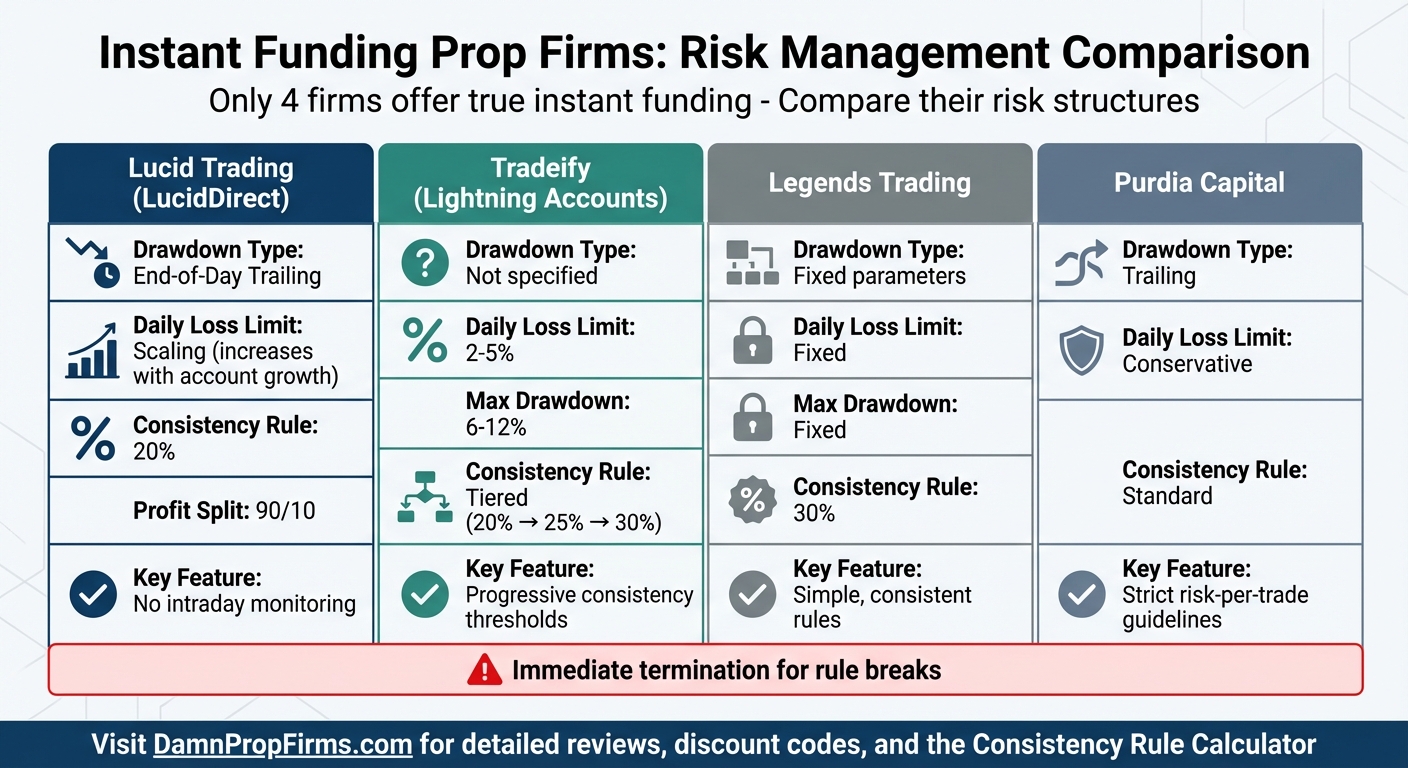
Instant Funding Prop Firms Risk Management Comparison Chart
When it comes to protecting your trading career, picking an instant funding firm with solid risk management practices is crucial. As of now, only four firms provide genuine instant funding: Lucid Trading, Tradeify, Legends Trading, and Purdia Capital.
Lucid Trading: Risk Management Overview
Lucid Trading’s LucidDirect program employs an end-of-day trailing max loss model, avoiding real-time intraday monitoring. This approach minimizes the risk of being stopped out during sudden market volatility. The firm also enforces a 20% consistency rule for payouts, ensuring steady performance. As your account grows, the Daily Loss Limit (DLL) increases proportionally, offering more flexibility. On top of that, Lucid Trading provides a generous 90/10 profit split, allowing traders to keep 90% of their profits [11].
For more details, check out the Lucid Trading review.
Tradeify: Risk Management Overview

Tradeify’s Lightning Accounts introduce a consistency rule that starts at 20% for the first payout and adjusts over time. The firm sets daily loss limits between 2–5% and drawdown limits ranging from 6–12%, making it easier for traders to manage their risk effectively [10].
To see their account options and promotions, visit the Tradeify review.
Legends Trading: Risk Management Overview

Legends Trading keeps things straightforward with fixed risk parameters. They maintain consistent daily loss limits and maximum drawdown thresholds, eliminating the need for complicated scaling rules. This simplicity helps traders plan their sessions and calculate position sizes with ease. The firm also provides clear position sizing guidelines tailored to account sizes.
For a detailed look at their account tiers and risk limits, explore the Legends Trading review.
Purdia Capital: Risk Management Overview

Purdia Capital takes a conservative approach, implementing strict risk-per-trade guidelines. They use a trailing drawdown model, which adjusts the maximum loss as your equity grows, offering a balance between flexibility and protection [10].
For more on their account structures and risk policies, see the Purdia Capital review.
Each of these firms offers a unique approach to risk management, allowing traders to select the one that aligns best with their strategies. To compare them side-by-side, use tools like the Consistency Rule Calculator available at DamnPropFirms.
Common Risk Management Mistakes to Avoid
Managing risk effectively in instant funding programs is a challenge even for experienced traders who understand how prop firms work. The statistics are stark – about 87% of traders fail within their first month[12], and only 10–20% typically pass funded challenges[14]. Recognizing and avoiding common pitfalls can make the difference between protecting your account and starting over. These mistakes highlight why careful risk management is so crucial.
Confusing drawdown types is a major issue. Many traders mix up daily drawdown (usually 3–5%) with overall drawdown (around 8–10%). Daily drawdown resets each day, meaning just one bad session can breach it. To complicate things, many firms use equity-based drawdown, which includes floating losses. This means your account could be disqualified if your equity dips below the threshold for even a second – even if the trade hasn’t closed yet[16][17].
Overleveraging is another frequent error. Emotional trading often leads to poor decisions. After a loss, it’s tempting to chase recovery trades – taking larger positions on lower-quality setups in an effort to "break even." This approach can quickly spiral out of control, breaching daily limits[16]. The solution? Stick to risking no more than 1% of your account per trade. For beginners, starting with 0.25% to 0.5% risk per trade is even safer while you build confidence and consistency[14][15].
Breaking "hard" rules is a fast track to disqualification. Trading during high-impact news events, holding positions over weekends, or using prohibited strategies will result in immediate account termination[13][14]. Another common misstep is violating consistency rules, such as ensuring no single day accounts for more than 20% of total profits. Ignoring these rules can delay withdrawals or prevent them entirely.
"Funded traders aren’t market wizards. They stick to their boring plans and stay out of their own way." – Blue Guardian[12]
Drifting from your strategy is equally problematic. Switching strategies mid-challenge or trading without a tested plan leads to erratic results[12]. To counter this, set a personal daily loss limit to act as a safety net. A 3-strike rule – stopping trading after three losses in a day – can help maintain discipline and protect your account[14][16].
Avoiding these mistakes requires as much discipline as following a well-structured risk management plan. Staying consistent and sticking to proven methods is key to long-term success.
Conclusion and Key Takeaways
Risk management is the backbone of successful instant funding. Without the safety net of an evaluation period, traders must rely on strict adherence to rules like drawdowns, position sizing, and daily loss limits. From the very first trade, disciplined strategies are non-negotiable.
Key principles to follow include limiting risk to 1–2% per trade, knowing whether your firm uses static or trailing drawdowns, and sticking to consistency rules. Tools like the Consistency Rule Calculator from DamnPropFirms can help you stay compliant and avoid costly errors. These strategies are essential for maintaining focus and ensuring long-term success in daily trading.
Currently, only four firms provide true instant funding: Lucid Trading, Tradeify, Legends Trading, and Purdia Capital. Each firm has its own risk management structure. For example, Lucid Trading combines an end-of-day trailing drawdown with a 20% consistency rule, while Tradeify uses tiered consistency thresholds ranging from 20% to 30%. Aligning a firm’s rules with your trading style is crucial to success.
Instant funding comes with upfront costs ranging from $300 to $2,000, making it an expensive but rewarding environment for learning. Treat your trading account like a business. Keep a detailed trading journal, set personal daily loss limits below the firm’s maximum, and avoid revenge trading at all costs. By maintaining disciplined risk management, traders can secure higher profit splits and achieve consistent results.
For verified reviews, discount codes, and additional risk management tools, visit the firm review pages at DamnPropFirms. Detailed breakdowns of firms like Lucid Trading, Tradeify, Legends Trading, and Purdia Capital are available to help you make informed decisions. You can also join the Damn Good Traders Discord community, where over 4,500 members share strategies and insights on navigating strict risk parameters. Combining disciplined risk management with shared knowledge ensures you’re well-prepared to protect and grow your instant funding account.
FAQs
How do I tell if my account uses EOD or intraday trailing drawdown?
When managing your prop firm account, it’s crucial to understand whether it operates with an EOD (End-of-Day) trailing drawdown or an intraday trailing drawdown.
- EOD trailing drawdown: This updates at the end of the trading day, reflecting changes based on the closing balance.
- Intraday trailing drawdown: This adjusts in real-time throughout the trading day, tracking your account’s performance moment by moment.
If you’re unsure which applies to your account, check your firm’s rules or dashboard for details. Still confused? Reach out to their support team or review the agreement for clarification.
What’s the safest way to size positions around the daily loss limit?
To keep your daily losses in check, make sure to size your positions so that no single trade or day’s activity surpasses a specific percentage of your account balance – usually about 20%. It’s also crucial to understand how your prop firm calculates daily losses, as some might factor in unrealized losses. Stick to conservative position sizing and closely track your real-time equity to manage risk effectively and steer clear of unexpected violations.
How can I avoid triggering a consistency rule without slowing growth?
Managing daily profit fluctuations is key to maintaining steady growth while adhering to consistency rules. Aim to keep these fluctuations within about 20% of your profit target. To help with this, use tools that track your highest profit days in relation to your account size and goals. Pay attention to position sizing and consider spreading profits over several days. This approach helps you stay consistent and make steady progress without breaking any rules.