Want to trade with someone else’s money and keep up to 95% of the profits? Proprietary trading firms (prop firms) let you do just that. Here’s how it works:
- Pay an Evaluation Fee: Typically $99–$700 to prove your skills in a simulated trading environment.
- Meet Profit Targets: Hit specific goals (e.g., 4–10% of the account size) while following strict risk rules.
- Get Funded: Trade with accounts ranging from $10,000 to $400,000. Keep most of the profits, while the firm covers losses.
But it’s not easy – 80–90% of traders fail these evaluations. Success depends on mastering risk management, understanding firm rules, and staying disciplined.
This guide breaks down:
- How to sharpen your trading skills
- Key risk management strategies
- Choosing the right prop firm
- Passing evaluations and scaling accounts
Whether you’re new or experienced, this step-by-step approach can help you navigate the challenges of prop trading and build a sustainable income.
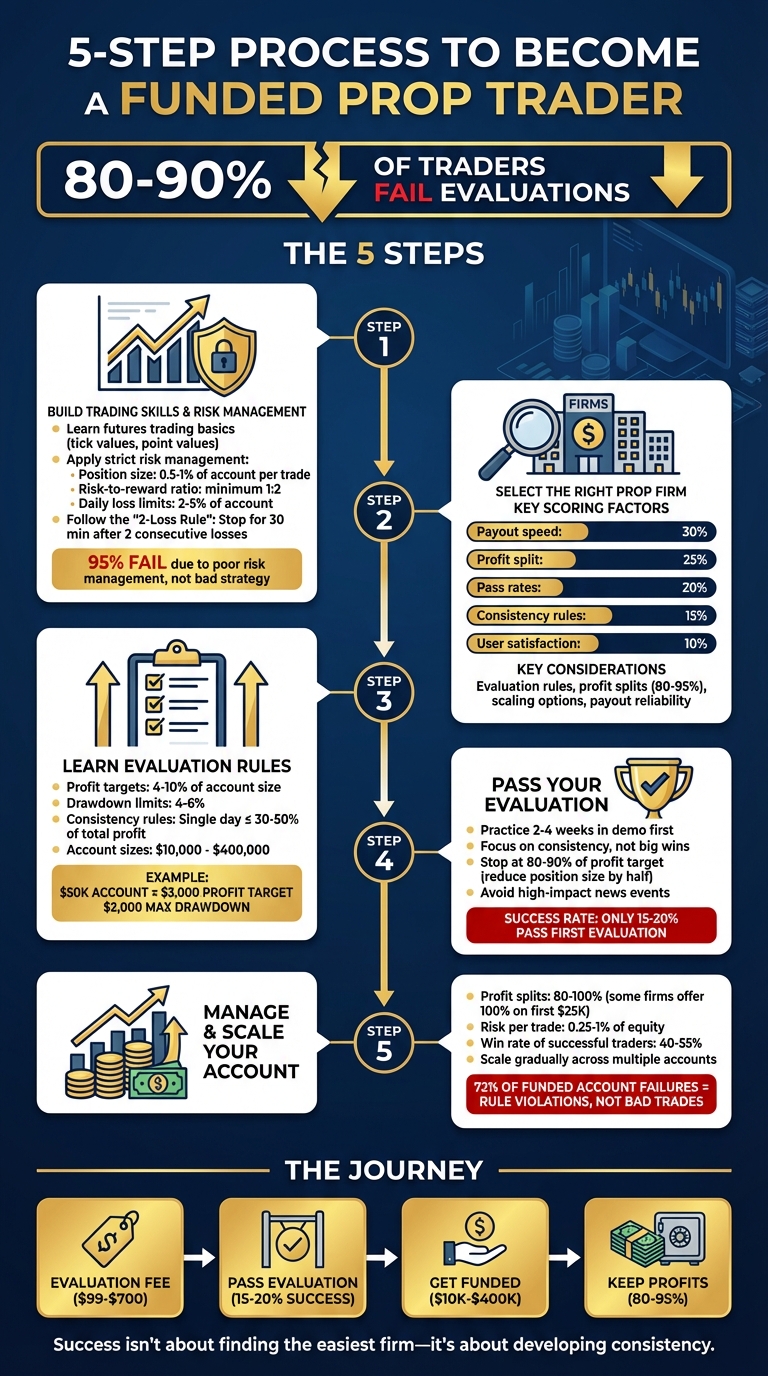
5-Step Process to Become a Funded Prop Trader
How to Get Funded as a Trader in 2026 | Full Strategy (1H+)
If you’re looking for a structured path to funding, Earn2Trade offers a clear roadmap for futures traders.
sbb-itb-46ae61d
Step 1: Build Your Trading Skills and Risk Management
If you want to secure a funded prop trading account, your first priority should be honing your trading skills and mastering risk management. These two areas are the backbone of success, especially when you consider that only 15% of traders pass evaluations, while the rest fall short [2].
Learn the Basics of Futures Trading
Futures contracts are traded on regulated exchanges like the Chicago Mercantile Exchange (CME) and come with standardized terms. Each contract’s movement is measured by a "tick", which determines your profit or loss for every minimum price change. For example, the E-mini S&P 500 (ES) has a tick value of $12.50, so a 10-tick stop loss equals $125 of risk per contract [6]. Meanwhile, the E-mini Nasdaq (NQ) moves $5.00 per tick.
Understanding point values is equally important. In the ES, one full point equals $50, while in the NQ, it equals $20 [3]. These figures are crucial for sizing your trades properly and staying within your drawdown limits.
Once you’ve got the basics down, the next step is to focus on strict risk management.
Apply Risk Management Strategies
A staggering 95% of traders fail prop firm evaluations due to poor risk management, not because their strategies are ineffective [3]. That’s why having a solid risk control plan is non-negotiable.
Here are five key risk management practices to follow:
- Limit position sizes to 0.5–1% of your account balance per trade.
- Always use hard stop losses that are executed on the server (mental stops won’t cut it).
- Maintain a minimum risk-to-reward ratio of 1:2.
- Monitor your drawdowns closely.
- Stick to daily loss limits [3].
To calculate your position size, use this formula:
Position Size = (Account Balance × Risk %) ÷ (Stop Loss Distance in Ticks × Tick Value) [3] [5].
For instance, if you’re trading with a $50,000 account and risking 1% ($500) with a 10-tick stop on the ES (risking $125 per contract), you would trade 4 contracts. Always round down to ensure you stay within your risk limit [4].
Most prop firms have strict daily loss limits, typically between 2–5% of your account value [3]. If you hit this limit, your account is terminated on the spot. To avoid this, many traders set their personal loss limits at 50–60% of the firm’s daily cap. This buffer helps reduce the impact of slippage and emotional trading. Another smart move is to follow the “2-Loss Rule”: if you lose two trades back-to-back, step away for at least 30 minutes to avoid revenge trading [2] [5].
It’s also important to understand the two types of drawdowns. Static drawdown measures losses from your starting balance, while trailing drawdown adjusts based on your account’s peak equity. Trailing drawdowns are particularly tricky because they rise as your profits grow, making recovery harder since your safety net doesn’t expand [3].
Finally, avoid trading during high-impact news events. Close your positions 10–30 minutes before these announcements to steer clear of slippage [3].
Step 2: Select a Prop Firm Using DamnPropFirms Resources
Once you’ve honed your trading skills and mastered risk management, the next crucial step is picking the right prop firm. With so many firms offering different rules, payout structures, and evaluation processes, choosing the wrong one can cost you both time and money. This is where DamnPropFirms steps in, helping you find a firm that fits your trading style perfectly.
How DamnPropFirms Makes Choosing Easier
DamnPropFirms provides verified reviews from traders with real, documented performance, cutting through the noise of fake testimonials. Their monthly rankings use a weighted scoring system to offer data-backed comparisons. Here’s how the scoring breaks down:
- Payout speed: 30%
- Profit split: 25%
- Evaluation pass rates: 20%
- Consistency rule leniency: 15%
- User satisfaction: 10%
[10][15]
One standout feature is the Consistency Rule Calculator, a free tool that helps you assess if you can meet a firm’s consistency requirements. For example, if you’re considering Apex Trader Funding, you can simulate your potential pass rate. Input a $50,000 account, a $3,000 profit target over 10 days, and a -4% loss on one of those days. The calculator might estimate a 92% pass rate, but if more than 40% of your profit came from a single day, it flags an issue. This allows you to adjust your strategy before risking failure [11][13]. Plus, exclusive discount codes like DGT can save you anywhere from 10% to 90% on evaluation fees [7].
Key Factors to Consider When Choosing a Prop Firm
When evaluating prop firms, focus on these five core factors:
- Evaluation Rules: Look at profit targets (usually 4–10% of account size), drawdown limits (4–6%), and consistency requirements. Some firms limit your largest winning day to 30–50% of total profits [12][14]. For instance, Apex Trader Funding offers no daily loss cap over $2,500 on $50,000 accounts, making it a good choice for trading volatile instruments like the E-mini S&P 500 (ES) or E-mini Nasdaq (NQ).
- Profit Splits: These typically range from 80–90%, but the fine print matters. Apex Trader Funding offers 100% of your first $25,000 in profits and 90% thereafter, with payouts processed in 2–3 days via ACH. This claim has been verified across over 500 cases [10][15]. On the other hand, FundedNext Futures provides 80–90% splits with bi-weekly payouts and a unique guarantee: if a payout is delayed beyond 24 hours, they’ll pay you an extra $1,000 [9].
- Scaling Options: This determines how quickly you can grow your account. Apex allows scaling every 4 months with no cap, potentially reaching $6 million, while some firms cap accounts at $150,000 [11][13].
- Payout Reliability: Apex has processed over $10 million in payouts with a 99% approval rate. Both Apex and FundedNext also provide IRS-compliant 1099 forms, simplifying tax reporting [14][16].
- Platform Compatibility: Ensure the firm’s platform aligns with your trading needs and preferred instruments.
Step 3: Learn Evaluation Rules and Account Options
Before diving into trading with a prop firm, it’s crucial to understand their evaluation rules. Each firm has its own set of criteria, and picking one that doesn’t align with your trading style can waste both time and money. Often, traders fail not because they lack skill but because they misunderstand the rules.
Types of Evaluation Programs
Most futures prop firms use a one-step evaluation process. To get funded, you need to hit a profit target without exceeding the drawdown limits. Firms like Apex Trader Funding and FundedNext Futures follow this model, meaning you could pass in just one session if you meet the target without breaking the drawdown rules.
One major difference between programs lies in how they handle drawdowns. There are two main types:
- End-of-Day (EOD) Trailing Drawdown: This is recalculated only at market close (usually 4:59 PM ET). It allows you to weather minor intraday pullbacks without impacting your drawdown limit.
- Intraday Trailing Drawdown: This adjusts in real time based on your peak balance. If your trade reverses after hitting a peak, the drawdown locks in at that higher level, reducing your profit buffer.
"Most futures traders blow accounts not because their setups are bad, but because they choose a drawdown model that punishes how they manage risk." – DamnPropFirms [8]
Consistency rules are another key factor. For example, FundedNext enforces a 40% rule – no single day’s profit can exceed 40% of your total profit. Apex, on the other hand, applies a 50% rule for payouts in their Performance Accounts. However, as of March 2026, Apex removed consistency rules during the evaluation phase, applying them only after funding. This means that while a single big win might help you pass the evaluation, it could limit your withdrawals later.
Now, let’s explore how account sizes impact your trading parameters.
Account Sizes and Their Rules
The size of your account plays a big role in setting profit targets, drawdown limits, and trading flexibility. Smaller accounts are cheaper to start but leave little room for error, while larger accounts offer more breathing space at the cost of higher targets.
Here’s a breakdown of common account sizes across top programs:
| Account Size | Firm | Profit Target | Max Drawdown | Min. Trading Days (Evaluation) | Max Contracts |
|---|---|---|---|---|---|
| $50,000 | Apex (EOD) | $3,000 | $2,000 | 0 Days | 6 |
| $50,000 | FundedNext (Legacy) | $2,500 | $2,000 | 0 Days | 3 Minis / 9 Micros |
| $100,000 | Apex (EOD) | $6,000 | $3,000 | 0 Days | 8 |
| $100,000 | FundedNext (Legacy) | $6,000 | $3,000 | 0 Days | 5 Minis / 50 Micros |
| $150,000 | Apex (EOD) | $9,000 | $4,000 | 0 Days | 12 |
Once you’re funded, some firms have additional requirements to keep your account active. For instance, Apex Performance Accounts require at least two trading days with a net profit of $50 or more within any rolling 30-day period to avoid deactivation.
It’s also important to note how breaches are handled. A "hard breach" happens when you hit the maximum loss limit, which leads to immediate account closure. A "soft breach", however, might only suspend trading for the day. For example, FundedNext Bolt accounts use a Daily Loss Limit (DLL) that halts trading until the next session without closing the account entirely.
For instruments like the E-mini S&P 500 (ES) or E-mini Nasdaq (NQ), EOD drawdown models offer more flexibility for swing traders, while scalpers might prefer the real-time adjustments of intraday trailing drawdowns.
Step 4: Pass Your Evaluation and Get Funded
Once you’ve got a solid grasp of risk management and evaluation criteria, it’s time to put your plan into action. Passing a prop firm evaluation isn’t about taking huge risks or chasing massive wins. It’s about staying disciplined and avoiding costly mistakes. The reality is sobering – industry data shows that 80% to 90% of traders fail their first evaluation [20]. Between January 2024 and July 2025, only 20.35% of evaluation accounts at MyFundedFutures met the objectives to advance [17]. The key to success often lies in preparation and emotional control rather than raw trading talent. Start by practicing your strategies in a simulated setting.
Practice with Demo Accounts First
Before spending $50–$500 on an evaluation fee [20], take 2–4 weeks to practice using a demo account that mirrors the evaluation rules [20][21]. Set the same profit targets, drawdown limits, and consistency requirements as the firm you’re targeting. For example, if you’re aiming for a $100,000 account with a $6,000 profit goal and a $3,000 maximum drawdown, configure your demo account to match those exact parameters.
Some prop firms even offer free 14-day trials with a 5% profit target and a 10% maximum loss. These trials let you test the firm’s platform without risking your money [21]. Use this opportunity to figure out which strategies hold up under pressure and which ones might lead you to break the rules.
Focus on Consistency, Not Big Wins
Once you’ve fine-tuned your approach in a demo environment, shift your focus to consistent and disciplined trading. One of the biggest pitfalls during evaluations is chasing the profit target with oversized positions. Keep in mind that consistent performance is the foundation of a successful evaluation. Many firms enforce rules to ensure profits aren’t the result of a single lucky day. For instance, some firms require that no single day accounts for more than 30% to 40% of your total profit [19]. If you hit your $6,000 profit target in one big trade, you might fail the consistency check or face restrictions on payouts later.
Thomas Vasilyev, an EA Developer, puts it perfectly:
"The consistency rule isn’t designed to punish good traders. It rewards disciplined ones." – Thomas Vasilyev [19]
To calculate a daily profit cap, multiply your total profit target by the firm’s consistency threshold. For a $6,000 target with a 40% rule, stop trading once you’ve earned $2,400 in a single day [19]. Stick to fixed lot sizes throughout the evaluation. Avoid increasing your position sizes to speed up the process, as this increases the risk of hitting drawdown limits. When you’re 80% to 90% of the way to your profit target, cut your position sizes in half to protect your gains [18]. This prevents emotional decision-making that could jeopardize your progress.
As one trader explains:
"The evaluation is a marathon packaged as a sprint. Run it like a marathon." – Spartora Trader [18]
Set a personal daily loss limit – typically 30% to 50% of the firm’s maximum drawdown – and stop trading for the day if you hit it [18]. Also, avoid trading during high-impact events like NFP or FOMC announcements, as the increased volatility can trigger stop losses or disrupt your consistency [19]. Above all, stick to your proven strategy during the evaluation. This phase is designed to test your discipline, not your ability to experiment with new approaches [18].
Step 5: Manage Your Funded Account and Scale Up
Reaching the point where you have a funded account is a big achievement, but the real challenge lies in managing it effectively and growing it over time. Passing the evaluation is just the beginning. Now, the focus shifts to disciplined trading to ensure your account thrives. The numbers speak for themselves: about 72% of funded account failures happen due to rule violations like position sizing mistakes, breaches of daily loss limits, or inconsistency, rather than unfavorable market conditions [22]. The key takeaway? Protect your capital by prioritizing survival over aggression. Funded accounts aren’t about hitting massive wins overnight; they’re about steady, repeatable results that safeguard your capital and lead to sustainable payouts.
Handle Payouts and Scale Your Position Sizes
Most proprietary trading firms offer profit splits ranging from 80% to 90% [25]. Some firms, such as Apex Trader Funding, even provide 100% profit splits on approved payouts [8][25]. To request a payout, you’ll typically need to meet a minimum number of trading days, close all positions, and maintain a balance above a required buffer [25][9]. First-time payouts also require KYC verification, with common payout methods including cryptocurrency and bank transfers [25].
Many firms enforce rules to ensure consistency, such as limiting any single trading day to 30%–40% of your total profit [25][9]. For example, if your total profit is $6,000 and the firm has a 40% rule, no single day’s profit can exceed $2,400. To stay within these limits, you can use tools like the Consistency Rule Calculator on DamnPropFirms [24]. As the ThinkCapital team explains:
"Understanding these payout structures is arguably more important than the trading strategy itself." – ThinkCapital Team [25]
When it comes to scaling your account, a sizing ladder can be a game-changer. This involves using different position sizes depending on market conditions: a baseline unit for standard trades, a half-unit for recovery, and micro-units during periods of high volatility or wide spreads [22]. As you scale up, adjust position sizes gradually, keeping the risk per trade between 0.25% and 1% of your equity. This approach helps maintain the longevity of your account [22]. Interestingly, many successful funded traders have win rates of only 40%–55%, but they rely on disciplined risk-to-reward ratios and always leave a safety buffer in their accounts after payouts to avoid breaching drawdown limits [22][25][8]. Advanced tools and a supportive community can make these processes more manageable while reinforcing good trading habits.
Use DamnPropFirms Tools and Community Support
Managing multiple funded accounts can be overwhelming, but tools like TradeSyncer simplify the process. This tool allows you to copy trades across multiple platforms, including Apex Trader Funding, Tradeify, and FundedNext Futures, with cloud syncing and built-in analytics [24]. By automating trade replication, TradeSyncer enables you to distribute risk and manage up to 20 active accounts simultaneously, as permitted by firms like Apex [8]. This saves time and minimizes errors, making account management much smoother.
In addition to automation, the Damn Good Traders (DGT) Discord community provides valuable support. With over 4,500 traders [24], this group shares trade setups, posts profit-and-loss screenshots, and even hosts daily giveaways to help traders improve. The community can assist with troubleshooting rule violations, refining risk management strategies, and offering accountability during tough times like drawdowns. Managing your mental energy is just as important as managing your trades. Implementing cooling-off strategies, such as mandatory breaks after losses, can help prevent revenge trading [22][23]. As Funded Trader Markets wisely puts it:
"Funded accounts are about survival first." – Funded Trader Markets [23]
Conclusion
The path to becoming a funded prop trader isn’t about luck – it’s about having a clear plan and the right tools. Start by developing strong trading skills and mastering risk management to stay in the game. Once you’re confident, pick a prop firm that aligns with your goals, study their evaluation rules thoroughly, and practice using demo accounts before committing to real fees. After securing funding, focus on disciplined account management, take strategic payouts, and scale up gradually while keeping drawdowns under control.
It’s worth noting that only a small percentage of traders successfully pass the evaluation [20]. As The Prop Firm Guide aptly states:
"The secret to long-term success isn’t in finding the easiest firm; it’s in developing consistency." – The Prop Firm Guide [1]
DamnPropFirms makes this journey easier by offering tools and resources tailored to traders’ needs. Use the Consistency Rule Calculator to avoid payout issues, and manage multiple accounts across firms like Apex Trader Funding, Tradeify, and FundedNext Futures with TradeSyncer. Plus, connect with over 4,500 traders in the Damn Good Traders Discord for real-time advice and support [7]. Take advantage of verified reviews, exclusive discount codes (like DGT for up to 85% off at Apex [7]), and other specialized tools to turn evaluation fees into consistent profits.
The road from novice to funded trader is tough but achievable. Stay consistent, trade with discipline, and lean on the resources available to help you succeed. Your journey begins with that first evaluation – make it count.
FAQs
Which prop firm rules matter most for my trading style?
To align your trading style with a prop firm’s expectations, it’s crucial to focus on rules around trade execution, risk management, and consistency. Some of the key guidelines you’ll encounter include:
- Trade duration limits: Certain firms may impose restrictions on how long trades can remain open, which can impact strategies like swing trading or scalping.
- Drawdown restrictions: These rules cap how much of your account you can lose, both daily and overall. Staying within these limits is essential to keep your account active.
- Profit targets: Firms often set specific profit goals that traders must achieve to qualify for payouts or funding.
- Payout conditions: These define when and how you can withdraw profits, such as meeting minimum trading days or reaching a profit threshold.
For instance, if you’re a micro-scalper, a firm with strict rules on minimum trade duration might fit your style better. By thoroughly understanding these requirements, you can ensure compliance and increase your likelihood of securing funding.
How do I avoid failing from trailing drawdown or daily loss limits?
To steer clear of failing due to trailing drawdown or daily loss limits, it’s crucial to grasp how these rules function and manage your trades with care. The trailing drawdown adjusts based on your account’s highest unrealized gains and never decreases. This means you need to keep an eye on your unrealized profits and avoid trades that could push your peak too high. Stick to consistent risk management strategies – like setting stop-losses and maintaining safe margins – to stay within limits and prevent violations.
When should I request a payout versus leaving a buffer to stay safe?
When you’re ready to request a payout, make sure you’ve met all the eligibility requirements. These typically include completing the minimum number of trading days, hitting your profit targets, and following any consistency guidelines.
It’s a smart move to leave a buffer in your account instead of withdrawing right after a small profit or when you’re close to drawdown limits. This helps you stay within risk management rules, keeps your account stable, and reduces the chances of breaking rules that could delay your payout or risk your funded status.