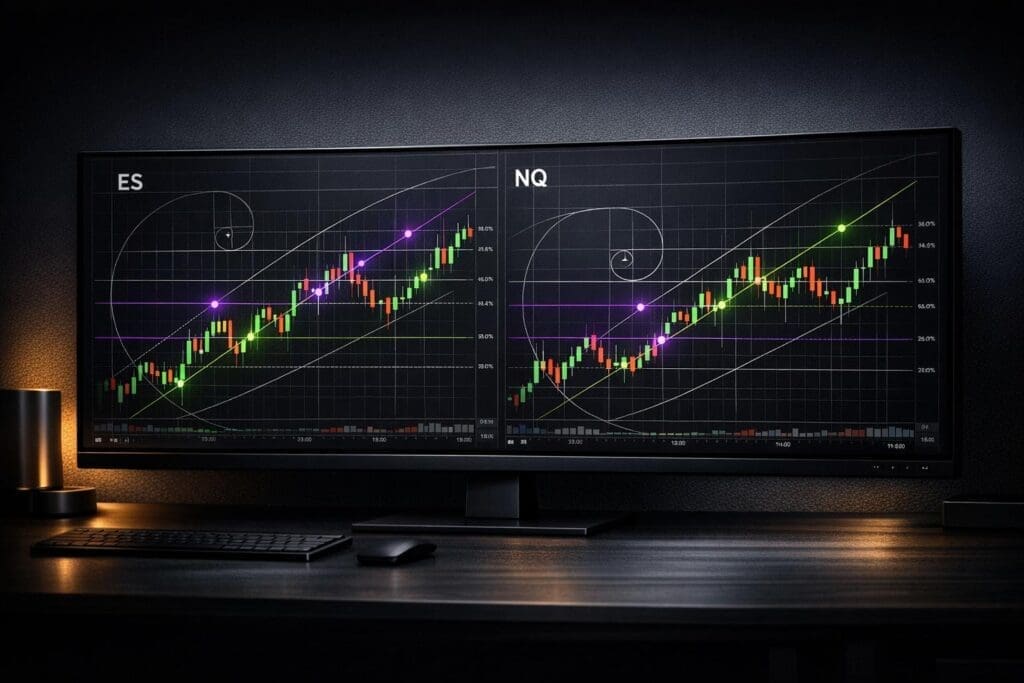
If you’re trading ES or NQ futures, Fibonacci tools are a must-have in your arsenal. They’re not just some fancy lines on a chart – they’re magnets for institutional order flow and algo trading, making them reliable for entries, exits, and risk management. Whether you’re timing pullbacks at the 61.8% level, scaling into trades, or targeting the 161.8% extension, these strategies give you clear price zones to work with. I’ll break down five practical ways to use Fibonacci levels to refine your setups and stick to tight risk controls using a futures risk management planner, especially if you’re trading a funded account. Let’s dive in.
5 Fibonacci Trading Strategies for ES and NQ Futures
1. Enter Pullbacks at the 61.8% Retracement Level on ES
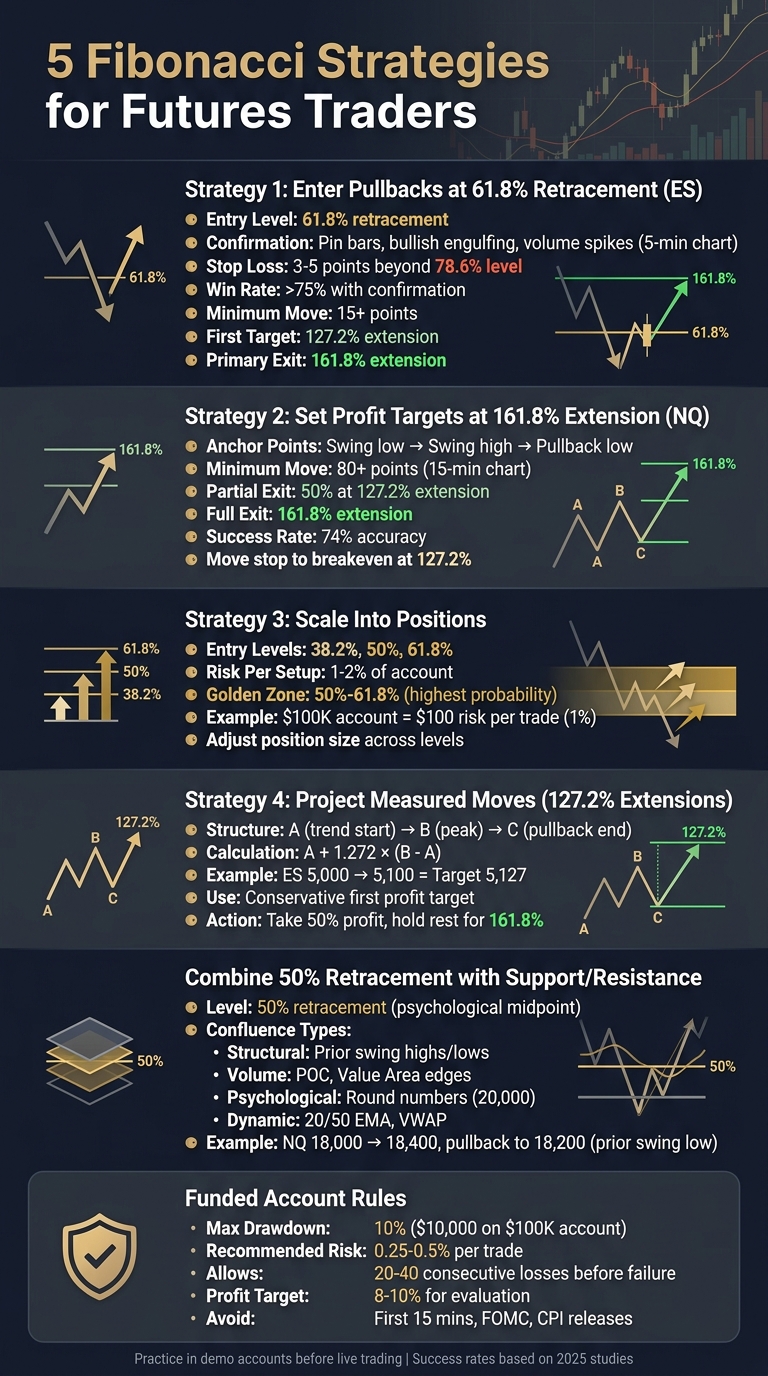
The 61.8% retracement level is a solid entry point when trading ES futures. This spot often lines up with institutional order flow, making it a high-probability area for the trend to continue. To draw your Fibonacci levels accurately, anchor the tool from swing low to swing high using candle bodies (not wicks) in an uptrend. ES futures often show wicks caused by liquidity grabs, so sticking to candle bodies helps keep your levels cleaner.
Only apply Fibonacci to clear impulse moves – think 15 points or more. Once you’ve identified the 61.8% retracement zone, don’t just blindly place orders. Wait for confirmation on lower timeframes. Look for signs of rejection like pin bars, bullish engulfing candles, or volume spikes on a 5-minute chart. As Jasper Osita from ACY Securities explains:
"The best pullbacks are not guesses – they’re planned reactions to known areas" [2].
Traders who combine Fibonacci levels with price action and volume confirmation often report win rates above 75% on pullback trades [1]. Once you’ve got confirmation, manage your risk with tight stops. If you are trading a funded account, ensure your position sizing aligns with your consistency rules.
Set your stop-loss 3–5 points beyond the 78.6% retracement level. If the price breaks through 78.6%, the pullback has failed, and the trend is likely compromised. For profit targets, aim for the 127.2% extension first – this is where you can move your stop to breakeven. Your primary exit should be at the 161.8% extension.
This strategy works best when the 61.8% retracement aligns with other technical factors, like prior swing highs/lows, Volume Profile nodes, or key psychological levels (e.g., 5000 on ES). The more confluence you have, the stronger the setup. Avoid using this approach during major news events like FOMC or CPI releases, or in the first 15 minutes of the session. These rules fit seamlessly with other Fibonacci-based strategies covered later.
sbb-itb-46ae61d
2. Set Profit Targets at 161.8% Extension for NQ Breakouts
The 161.8% Fibonacci extension is a solid profit target for NQ breakouts. It gives you a clear, calculated level for taking profits, cutting out the guesswork. Here’s how you can use it to manage your trades effectively.
To project the 161.8% extension, you’ll need three anchor points: the swing low, swing high, and pullback low. Tools like NinjaTrader and TradingView make this process simple by automatically plotting these levels. Stick to impulse moves of at least 80 points on the 15-minute chart to avoid getting thrown off by market noise.
For trade management, a common approach is to take 50% off at the 127.2% extension, move your stop to breakeven, and let the rest ride to the 161.8% level. According to a 2025 study, Fibonacci retracement levels were successful 74% of the time in pinpointing take-profit and stop-loss points [3].
The 161.8% target becomes even more reliable when it lines up with other technical factors. Look for alignment with a prior session high, round numbers like 20,000, or a high-volume node on the Volume Profile. This strategy works hand-in-hand with our entry technique at the 61.8% retracement, giving you a full plan from entry to exit. Use the 15-minute chart for projecting targets and the 5-minute chart for monitoring exit signals.
One thing to watch out for: avoid using this strategy during major news events like FOMC announcements or CPI releases. The volatility during these times can mess with swing points and throw off your Fibonacci projections.
3. Scale Into Positions Across Multiple Retracement Levels
Scaling into positions at the 38.2%, 50%, and 61.8% retracement levels allows you to gradually build exposure while keeping risk in check. This strategy works especially well with ES and NQ contracts when you’re confident about the overall trend but unsure where the pullback will bottom out. Many traders lean heavily on the 61.8% retracement level since it tends to hold more weight. As Stavros Tousios from ThinkMarkets explains:
"The golden zone (50%–61.8%) is a key ‘kill zone’ where Fibonacci traders cluster entries, stops, and targets." [3]
It’s crucial to adjust your risk for these staggered entries. Stick to risking no more than 1–2% of your account per Fibonacci setup [4]. For example, if you’re trading a $100,000 account with a 10% drawdown limit, risking 1% means you’re putting about $100 on the line for the whole trade. Use a futures trading profit calculator to determine your position sizes and always set stop losses.
When retracements get choppy, scaling in can help you secure partial fills and improve your average entry price. Just don’t force trades if the market doesn’t hit your planned levels. This approach works well alongside the entry and profit target strategies we’ve covered earlier. If you’re trading for a prop firm, keep their strict drawdown rules in mind – over-leveraging is a fast track to failing an evaluation [5].
4. Project Measured Moves Using 127.2% Extensions
The 127.2% extension is a handy tool for setting price targets in trending markets, especially when trading ES and NQ contracts. It’s great for identifying the first major price exhaustion zone beyond the previous swing high or low [6]. TrendSpider even refers to it as a "conservative profit target" [6].
Here’s how you use it: Start by identifying an ABC structure with three key swing points. Point A is where the trend begins, Point B is the peak of the initial move, and Point C is where the pullback ends, signaling the trend’s continuation [7]. To project the target, take 127.2% of the distance between Point A and Point B, then add that to Point A.
Let’s break it down with an example. Say ES rallies from 5,000 (Point A) to 5,100 (Point B) and then pulls back. You calculate the target as 5,000 + 1.272 × (5,100 – 5,000), which comes out to about 5,127. This method assumes the new impulse leg will be similar in size to the initial move but with a little extra momentum.
The FibAlgo Team calls the 1.272 extension a "conservative first target" [8]. It’s a great spot to lock in partial profits – maybe close out 50% of your position – while aiming for bigger targets like 161.8% or 200%. Keep in mind, extensions help you plan exits, while retracements are better for timing your entries [6]. If you’re trading on a funded account, hitting the 127.2% target early and banking profits can help you stay within consistency rules. This approach ties in perfectly with earlier strategies for entries and profit-taking.
5. Combine 50% Retracement with Prior Support or Resistance
The 50% retracement level isn’t technically part of the Fibonacci sequence, but it’s still a solid entry point when it lines up with prior support or resistance. This overlap is what traders call confluence – when multiple technical factors highlight the same price level. If a 50% retracement matches up with a previous swing high, swing low, or a Volume Profile vs Price Action Point of Control (POC), you’ve got yourself a setup worth paying attention to.
Big players tend to focus their order flow around these zones. When a Fibonacci level intersects with a key turning point or volume node, it creates a "combined effect" that draws in heavy trading activity. The 50% level also has a psychological pull – it’s the midpoint of a move and a spot where reversal traders often jump in.
Take this example: if the NQ rallies from 18,000 to 18,400 but then pulls back to 18,200 – which also happens to be a prior swing low or the day’s Value Area Low – this overlap strengthens the case for an entry.
You can layer different types of confluence to sharpen your edge:
- Structural confluence: Pair the 50% retracement with prior swing highs or lows.
- Volume-based confluence: Combine it with POC or Value Area edges where heavy trading occurred.
- Psychological confluence: Align the 50% level with round numbers like 20,000, which big institutions often respect.
- Dynamic confluence: Add moving averages like the 20 or 50 EMA or VWAP for extra confirmation.
For traders in funded accounts, using confluence to filter 50% retracements can help avoid overtrading and stick to consistency rules. It’s a method that not only boosts win rates but also aligns well with the discipline required for managing funded accounts. This approach builds on earlier Fibonacci strategies and keeps your trading focused and precise.
Applying Fibonacci Strategies in Funded Accounts
Using Fibonacci strategies effectively in funded accounts means navigating the strict rules set by prop firms. These firms, like Topstep and Apex Trader Funding, each have their own drawdown structures, daily loss limits, and consistency requirements (as of 2026). To succeed, you’ve got to tweak your Fibonacci approach to work within these constraints – otherwise, you risk failing your evaluation before you even get started.
Let’s say you have a $100,000 funded account with a 10% maximum drawdown. That gives you $10,000 of risk capital. If you’re risking 1% of the account balance per trade ($1,000), you’ve only got room for 10 losing trades before you’re out[5]. As derivatives analyst Isabella Torres puts it:
"If you treat a $100k prop account like a $100k personal account, you will blow it in a week"[5].
A smarter approach? Keep your risk per trade between 0.25% and 0.5% ($250–$500 on a $100k account). This way, you can handle 20 to 40 consecutive losses without blowing up your account[5]. Tight stops, placed just below key Fibonacci retracement levels like 61.8%, help limit risk, while aiming for extension targets at 127.2% or 161.8% provides clear profit zones.
This strategy becomes even more critical with firms like Apex, which use trailing drawdown rules. Since the drawdown floor moves up as your equity grows, locking in profits at Fibonacci extension levels can mean the difference between staying funded or restarting your evaluation. Timing exits before a retracement hits is essential for staying ahead of these evolving drawdown floors.
Damn Prop Firms keeps traders updated on the latest rules, drawdown types, and promo codes for firms like Apex Trader Funding, Topstep, and Bulenox. For instance, Apex holds a 4.9/5.0 rating as "Best for Futures Traders", and Bulenox offers discounts of up to 91% with specific promo codes[9]. Matching your Fibonacci strategy to a firm with rules that complement your trading style can make all the difference.
Most evaluations require an 8% to 10% profit target while staying within strict risk limits[5]. Combining Fibonacci targets with confluence from prior support, resistance, or volume nodes helps you build a consistent edge. This approach not only smooths out your profit curve but also aligns with the consistency rules prop firms love to see. By sticking to these precise entries and exits, you set yourself up for long-term success.
Conclusion
These five Fibonacci strategies – using the 61.8% retracement for pullback entries, aiming for 161.8% extensions, scaling trades across multiple retracement levels, projecting moves with 127.2% extensions, and pairing the 50% retracement with prior support or resistance – offer a solid framework for trading ES and NQ futures. Fibonacci levels often act as natural zones where price stalls, reverses, or picks up momentum. But let’s be real – none of this works unless you’ve put in the time to spot these setups in real-time conditions. Discipline and practice are non-negotiable.
Before throwing real money into the market, hammer out your approach in a demo account. RJO Futures, for example, provides free demo accounts loaded with $100,000 in simulated funds [10]. These are perfect for testing these Fibonacci setups in different market conditions – whether it’s a trending market, a range-bound one, or something choppier. Track every trade’s entry, stop, and target to figure out which levels consistently deliver results.
If you’re planning to trade with a prop firm, practice as if you’re under their rules. Set a strict 10% total drawdown and a 5% daily loss limit in your demo account, mirroring what firms like Topstep or Apex Trader Funding require [5]. This kind of structure is essential when every tick matters during evaluations, especially when navigating a prop firm consistency rule that can impact your payouts.
Also, don’t skip backtesting. For instance, analyzing NQ 1-minute data from 2013–2025 shows that certain retracement levels hit over 75% of the time during key sessions [11]. Identifying these zones in your own backtesting gives you a real edge – far beyond just memorizing Fibonacci setups. Once you’ve logged enough simulated trades and feel confident in your execution, you’ll be ready to take these strategies into a funded account. That’s where precision and discipline translate into actual profits.
FAQs
How do I pick the correct swing points for Fibonacci on ES and NQ?
To pick swing points for Fibonacci on ES and NQ, stick to the recent, major highs and lows that clearly define the trend. In a bullish trend, draw from the latest low to the high. For a bearish trend, connect the most recent high to the low. Focus on obvious reversal points rather than small, insignificant price moves. This helps you map out potential support and resistance levels more accurately.
How can I confirm a 61.8% pullback before entering a trade?
To be sure about a 61.8% pullback, you’ll want more than just the Fibonacci level itself. Look for things like candlestick patterns, sudden volume increases, or trendline touches that match up with the retracement. These extra signals can confirm whether the level is likely to hold as a reversal point or a support/resistance zone. Pairing Fibonacci with other technical tools gives you a better shot at making a solid entry decision.
How do I size risk for Fibonacci setups on a funded account?
To manage risk for Fibonacci setups, start by deciding how much you’re willing to risk per trade – typically 1-2% of your account. Pinpoint your entry at a Fibonacci retracement or extension level, then set your stop loss slightly beyond the next important Fibonacci level or a nearby support/resistance zone. To figure out your position size, divide your risk amount by the distance (in points or ticks) between your entry and stop loss. Make sure your approach aligns with your prop firm’s risk guidelines.