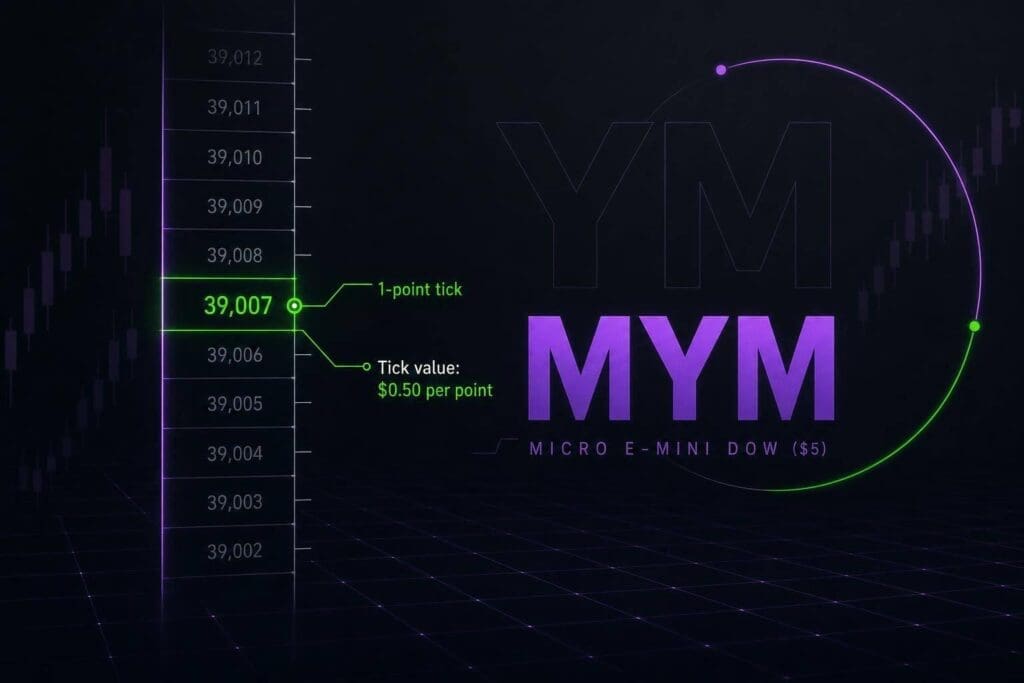
MYM ticks are simple: 1 point = 1 tick = $0.50 per contract. That’s the whole game. If you trade the Micro E-mini Dow, this is the number that controls your stop size, contract count, and how bad a dumb entry hurts.
I’m keeping this tight. You’ll get the contract math that matters, what a move is worth in dollars, when MYM trades, and how it stacks up against YM. (If you also trade tech, check the MNQ tick value for comparison.) No fluff. Just the numbers you need before you click buy or sell.
Micro E-mini Futures Products Overview
sbb-itb-46ae61d
Introduction
Before we get into the contract specs, here’s the part that matters fast: a 1-point move in MYM is worth $0.50 per contract. That comes from the $0.50 contract multiplier tied to the Dow. [1]
MYM is the micro version of the E-mini Dow (YM). It’s 1/10 the size of the standard contract, so the same index move hits your P&L a lot less in dollar terms with MYM. [1]
That smaller contract size makes position sizing easier and stop placement less of a pain. The next section breaks down the contract multiplier and point value in more detail.
Table of Contents
Use this guide to jump straight to the specs, tick math, trading hours, and the comparison section you need.
- Core Contract Specs
- Tick Size and Tick Value
- Price-to-P&L Conversion
- Trading Hours and Contract Months
- MYM vs. YM
- Verify Specs Before Trading
- Bottom Line
Core MYM Contract Specs Traders Need to Know
MYM is the smaller Dow futures contract, and the key specs boil down to three numbers: the multiplier, the point value, and the tick size. Here’s the part that matters on the screen: $0.50 per point, a 1.00-point minimum tick, and a $0.50 tick value. [1][5]
Contract Multiplier and Point Value
MYM is cash-settled at $0.50 per DJIA point. In plain English, that means 1 point = $0.50 per contract, and 100 points = $50 per contract. [1][5]
| Specification | MYM (Micro E-mini Dow) |
|---|---|
| Contract Multiplier | $0.50 × DJIA Index |
| Point Value | $0.50 |
| Minimum Tick Size | 1.00 index point |
| Tick Value | $0.50 |
Why MYM Is Called a Micro Contract
MYM is 1/10 the size of YM, which is the whole reason traders use it when they want smaller exposure. Each point is worth $0.50 instead of $5.00. [1][2][5] That makes position sizing a lot easier if you don’t want every move in the Dow hitting your P&L too hard. The next section breaks down how that value changes tick by tick. You can also use a futures trading profit calculator to model these moves automatically.
MYM Tick Size and Tick Value
MYM moves in 1.00-point steps, and each point is worth $0.50 per contract[1]. Nice and simple. On MYM, 1 point = 1 tick, so the math is dead easy when you’re turning chart movement into dollars.
Minimum Tick Size
The smallest move MYM can make is 1.00 index point[1].
Dollar Value Per Tick
Each 1.00-point move pays or costs $0.50 per contract[1]. So if MYM moves 10 points, that’s $5.00 per contract[9].
| Specification | MYM (Micro E-mini Dow) |
|---|---|
| Minimum Tick Size | 1.00 index point |
| Tick Value | $0.50 per contract |
| Point Value | $0.50 per contract |
That keeps stop and risk management math simple: ticks × $0.50 = dollar risk. Next, break that into single-contract and multi-contract P&L.
Converting MYM Price Movement Into Dollars
This is where MYM gets easy to work with. Once you know each tick is worth $0.50 per contract, you can turn price movement into P&L fast.
Single-Contract P&L Examples
Here’s what common MYM moves look like on 1 contract:
| Price Move | 1 Contract P&L |
|---|---|
| 5 ticks | $2.50 |
| 10 ticks | $5.00 |
| 50 ticks | $25.00 |
Small moves stay small on MYM. That’s part of the appeal. A 10-tick move is just $5.00 per contract, while a 50-tick move comes out to $25.00.
Multi-Contract P&L Examples
Add more contracts, and the math scales in a straight line. Just multiply the $0.50 per tick by your contract count.
| Price Move | 2 Contracts | 5 Contracts | 10 Contracts |
|---|---|---|---|
| 10 ticks | $10.00 | $25.00 | $50.00 |
| 25 ticks | $25.00 | $62.50 | $125.00 |
| 50 ticks | $50.00 | $125.00 | $250.00 |
| 100 ticks | $100.00 | $250.00 | $500.00 |
This is why contract count matters so much. A move that feels tiny on 1 contract starts hitting a lot harder at 10.
Stop-Loss and Position Sizing Use Cases
Once you know your dollar risk per tick, position sizing is just math.
A 30-tick stop on 1 contract risks $15.00. On 5 contracts, that same stop risks $75.00.
That’s the whole point of doing this math before you enter. You can match your size to your stop instead of winging it and finding out too late that the trade was bigger than it looked.
From here, the next question is when MYM trades and which contract month you’re using.
MYM Trading Hours and Contract Months
After the tick math, timing and contract month decide whether your MYM entries and exits feel smooth or sloppy.
CME Globex Trading Hours

MYM trades almost 24 hours a day on CME Globex, from Sunday 6:00 PM ET to Friday 5:00 PM ET, with a daily maintenance break from 5:00 PM to 6:00 PM ET Monday through Thursday [3][5].
Regular trading hours are usually 9:30 AM to 4:00 PM ET. That’s when liquidity is often best, especially near the open and the close.
U.S. holidays can shorten sessions or shut them down entirely, so check the CME holiday schedule before you trade.
Quarterly Contract Months
Contract month has a direct effect on liquidity, spreads, and fills. MYM uses the standard quarterly cycle: March (H), June (M), September (U), and December (Z) [3][4].
As expiration gets closer, spreads can widen and fills can get worse. If you hang around in the expiring contract too long, you can end up dealing with a wider bid-ask spread and less steady fills [1][5].
Expiration and Settlement Basics
MYM is cash-settled, so there’s no physical delivery. Final settlement is tied to the third Friday of the contract month [3][1].
Most traders roll before that third Friday because volume starts moving into the next contract. That rollover matters. It’s usually the point where the market shifts to the contract with better liquidity.
Next, compare MYM with YM to see how the micro contract changes risk and sizing.
MYM vs. YM: Specs Side by Side
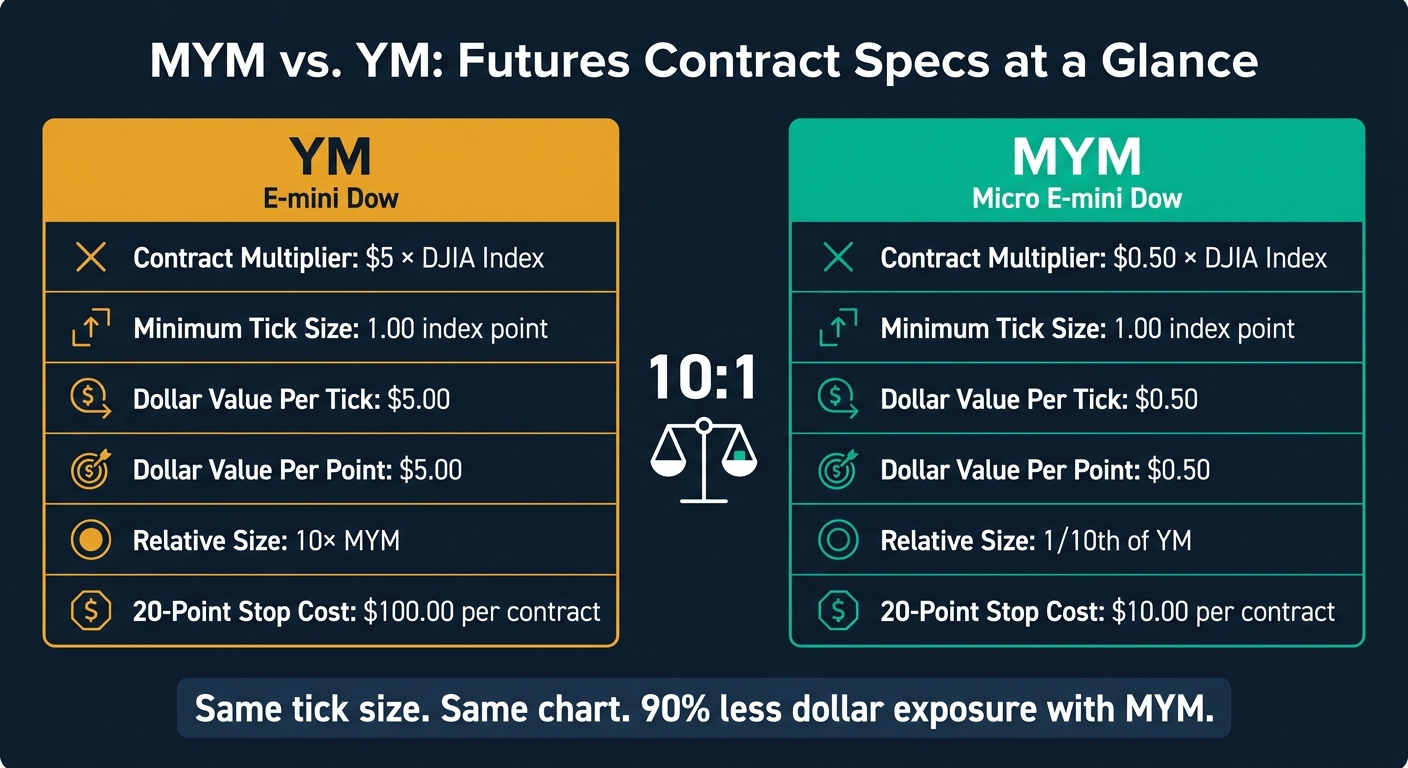
MYM vs YM Futures Contract Specs Compared
Using the tick math above, here’s the plain-English version: MYM and YM move the same way in index points, but not in dollars.
Tick Value, Point Value, and Multiplier Compared
YM pays $5.00 per point. MYM pays $0.50 per point. That’s a 10:1 size gap [1][5].
| Specification | E-mini Dow (YM) | Micro E-mini Dow (MYM) |
|---|---|---|
| Contract Multiplier | $5 × DJIA Index | $0.50 × DJIA Index |
| Minimum Tick Size | 1.00 index point | 1.00 index point |
| Dollar Value Per Tick | $5.00 | $0.50 |
| Dollar Value Per Point | $5.00 | $0.50 |
| Relative Size | 10× MYM | 1/10th of YM |
Same tick size. Very different dollar impact.
Before you trade either symbol, check the active contract month and contract specs on CME.
Why Traders Use MYM Instead of YM
This comes down to risk math. Nothing fancy.
With YM at $5.00 per tick, a 20-point stop costs $100 per contract. With MYM at $0.50 per tick, that same 20-point stop costs $10 per contract [1][5].
That changes a lot. You can use the same chart, the same stop distance, and the same Dow setup, but with far less dollar pressure. For traders dealing with tight drawdown rules, that’s the whole point.
MYM gives you the same Dow index exposure in terms of price movement, while cutting the dollar movement by 90%. That’s why it’s easier to size. It’s also why stops feel less brutal on small accounts or drawdown-sensitive accounts like Phidias.
Where to Verify MYM Specs Before You Trade
Once you know the tick math, the next move is simple: make sure you’re trading the right live contract. Before you place a MYM trade, check the active contract, session, and tick specs for the current market date.
CME Group as the Source of Truth

CME Group is the official source for MYM specs [7]. Use CME Group to confirm the active contract, tick size, trading hours, and expiration date before each trade. That quick check helps you avoid bad sizing, sloppy stop placement, and the wrong contract month. Roll to the next contract before expiration, when volume shifts.
Platform Checks Before You Enter a Trade
Your platform might show MYM as MYM, /MYM, or a month code like MYMU6 [5][10]. If your platform is pointed at the wrong contract month, your P&L math will be off. Before you enter a trade, verify:
- The active symbol and contract month
- The session template
- Whether your data feed is live or delayed
Match the platform symbol to the CME contract month before you enter. If the symbol, session, or contract month is wrong, your tick value and P&L math will be wrong too.
Bottom Line on MYM Tick Value
The key number is simple: MYM pays $0.50 per point, and its minimum move is 1.00 point.[1][5][6] Since MYM is one-tenth the size of YM, it keeps risk tighter.[1][6]
That makes trade planning dead simple. A 20-point stop = $10.00 per contract because the math is just stop distance × $0.50.[1]
This matters most when you’re trading the active front month. Stick to the front month during the New York open, when liquidity is usually strongest.[1][8] MYM expires in March, June, September, and December, and most traders roll before the third Friday.[1][5]
The dollar math stays clean:
- 50 ticks = $25.00
- 100 ticks = $50.00
Start with the tick value. Then use position sizing strategies to manage your risk.
FAQs
How much margin do I need to trade MYM?
In a personal futures account, MYM margin depends on your broker. There’s no single number that applies everywhere. Brokers set their own margin for day trading and overnight holds, and you usually only need a small slice of the contract’s full notional value to get into a trade. If you want the current rate, check your broker’s platform or support docs. That’s the number that matters.
With a prop firm, margin usually doesn’t work like normal retail brokerage margin. Most firms don’t handle risk through margin calls the same way your personal broker does. They set contract limits instead, and your risk is boxed in by the account’s drawdown rules. So in practice, what stops you isn’t margin. It’s the max size you’re allowed to trade and how close you are to your drawdown line.
When should I roll to the next MYM contract?
MYM rolls every quarter: March, June, September, and December.
A common rule of thumb is to roll on the Monday before the third Friday of the contract month.
If you care about fills, trade the front-month contract. That’s usually where the most volume sits, and it’s where liquidity is best.
Still, don’t wing it. Always confirm the exact rollover date with CME Group.
Is MYM better than YM for small accounts?
Yes. MYM is usually the better pick for small accounts because the tick value is much lower: $0.50 per tick vs. $5.00 on YM.
That matters a lot. A smaller tick value gives you more room to size trades without blowing through your risk on one sloppy entry. If you’re working with a small account, risk control comes first, and MYM makes that part much easier.
You still get live market movement and the same basic Dow price action. You’re just doing it with less money on the line per tick. That’s a big deal when you’re practicing execution, dialing in stops, or trying to stay inside a tight daily loss limit.
The trade-off is simple: commissions can take a bigger bite on the smaller contract. But for most small-account traders, that’s worth it. Better control beats bigger exposure.