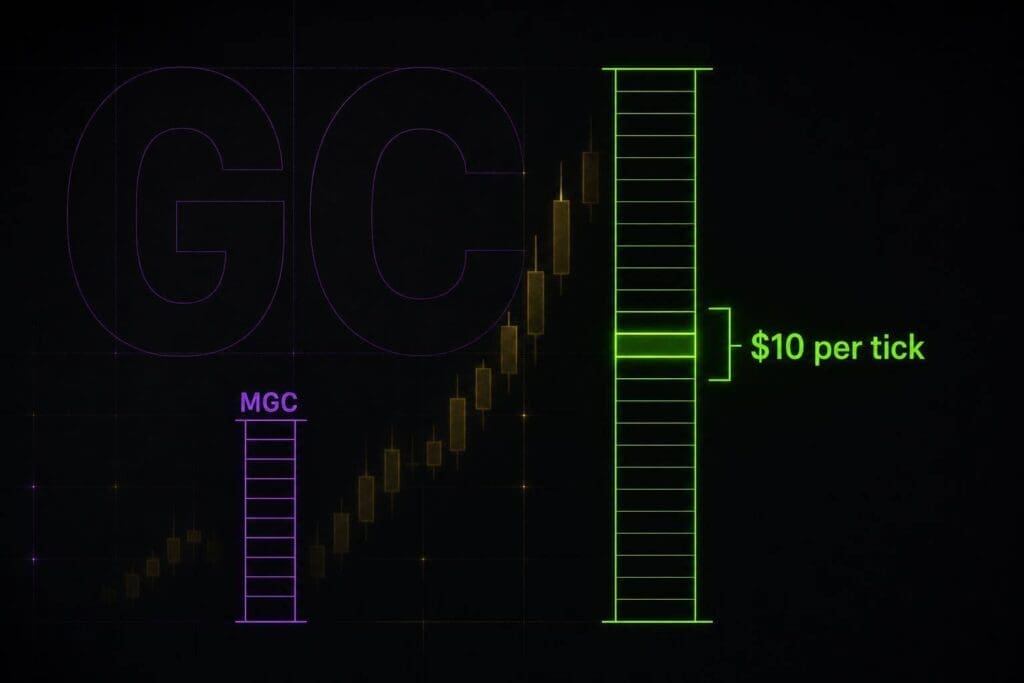
One GC tick is $10 per contract. That’s the number that matters first. If you trade gold futures, that tick math sets your stop size, contract count, and how fast you can smack into a daily loss limit.
I’ll keep this tight: GC is the full-size COMEX gold contract, it controls 100 troy ounces, and it moves in $0.10 increments per ounce. That means 10 ticks = $100 and 20 ticks = $200 on one contract. If that feels too hot for your account, MGC is the smaller way to trade the same market. Below is the stripped-down version you need to size gold without doing dumb math mid-trade.
What Is GC and Why Does Tick Value Matter?
GC in One Line
GC is the standard gold futures contract traded on CME Globex [1]. It’s quoted in U.S. dollars per troy ounce and each contract represents 100 troy ounces of gold [1]. That’s the part you can’t gloss over. One GC contract controls 100 ounces, so a small move on the chart can turn into a big dollar swing fast. That’s why tick value is one of the first numbers you need burned into your brain.
Why Prop Traders Need to Know Tick Math
GC can move hard and fast. If your tick math is off, your stop placement, size, and daily loss math are off too.
The minimum price fluctuation in GC is $0.10 per ounce. That works out to $10 per contract per tick, or $100 per full point [1]. Miss that by a factor of 10 and you can blow through a daily loss limit before you even realize what happened. In a prop eval, that kind of mistake ends the session in a hurry. This is why mastering prop firm challenge strategies is critical for long-term success.
If your account is on the smaller side, MGC makes a lot more sense. Same gold market. Less heat per tick.
GC vs MGC at a Glance
Micro Gold (MGC) tracks the same market at one-tenth the size, with a contract size of 10 troy ounces and a tick value of $1.00 [1]. The tick size stays the same at $0.10 per troy ounce, but the dollar hit per tick is 10x smaller. That’s the whole appeal. You get the same market structure without taking full-size GC damage on every little wiggle.
| Feature | GC (Standard Gold) | MGC (Micro Gold) |
|---|---|---|
| Contract Size | 100 troy ounces | 10 troy ounces |
| Tick Size | $0.10 | $0.10 |
| Tick Value | $10.00 | $1.00 |
| Point Value | $100.00 | $10.00 |
Next, break down the full GC contract specs.
sbb-itb-46ae61d
Core GC Contract Specifications
Exchange, Symbol, and Contract Size
GC trades on COMEX, which sits under CME Group, and the ticker is GC. One standard GC contract controls 100 troy ounces of gold [1].
That contract size matters more than a lot of newer traders think. Gold can look calm on the chart, then the dollar swings add up fast because each contract has decent weight behind it.
Tick Size, Tick Value, and Point Value
GC moves in $0.10 increments. That works out to $10 per tick and $100 per point [1].
Here’s the cheat sheet:
| Specification | Detail |
|---|---|
| Exchange | COMEX (CME Group) |
| Ticker Symbol | GC |
| Contract Size | 100 troy ounces |
| Tick Size | $0.10 per troy ounce |
| Tick Value | $10.00 per contract |
| Point Value | $100.00 per point |
| Trading Hours | Sun 6:00 PM – Fri 5:00 PM ET |
| Daily Maintenance Break | 5:00 PM – 6:00 PM ET |
Use these numbers to size your stops, contract count, and daily risk. If your stop is 5 points, that’s $500 per contract. Simple math, but it keeps you out of dumb mistakes. Check current specs on CME Group before you trade.
Trading Hours and Session Structure
Trading hours aren’t just trivia. They change how GC moves and how clean your fills are.
GC trades from Sunday 6:00 PM to Friday 5:00 PM ET, with a daily maintenance break from 5:00 PM to 6:00 PM ET [1]. U.S. morning hours usually have the best liquidity. Overnight can get thinner, and that often means rougher spreads and sloppier movement.
That matters for stop placement. A stop that makes sense during the New York session can get clipped much easier in thinner hours. Same chart. Different tape.
Next, turn these specs into dollar risk. For more strategy on managing funded accounts, see our futures prop firm guides.
How to Calculate GC Profit, Loss, and Risk
Formula: Ticks to Dollars
Use the GC specs above to turn price moves into dollar risk.
GC P&L = ticks × GC P&L = ticks × $10 × contracts0 × contracts
That’s the whole math. No fluff.
If GC moves 1 tick, that’s $10 per contract. If you’re holding more than one contract, multiply it out.
Example: What a 10-Tick Move Is Worth
A 10-tick move equals $100 per contract.
- 1 contract = $100
- 2 contracts = $200
- 3 contracts = $300
This is why GC can get away from you fast. A move that looks small on the chart can hit your P&L hard if your size is too big. Use a futures risk management planner to determine your maximum position size before entering a trade.
Using Point Moves for Faster P&L Estimates
For faster math during the session, think in points instead of ticks.
The shortcut is simple: Points × $100 × contracts = P&L
| Move | Ticks | GC Value (1 Contract) |
|---|---|---|
| $0.10 | 1 | $10.00 |
| $0.50 | 5 | $50.00 |
| $1.00 (1 point) | 10 | $100.00 |
| $10.00 (10 points) | 100 | $1,000.00 |
Use these conversions when you set stops, targets, and daily loss limits. If your stop is $2.00 on 2 contracts, that’s 20 ticks = $200 per contract = $400 total. That kind of math should be automatic before you click in.
GC vs Micro Gold (MGC): Which Contract Fits Your Account?
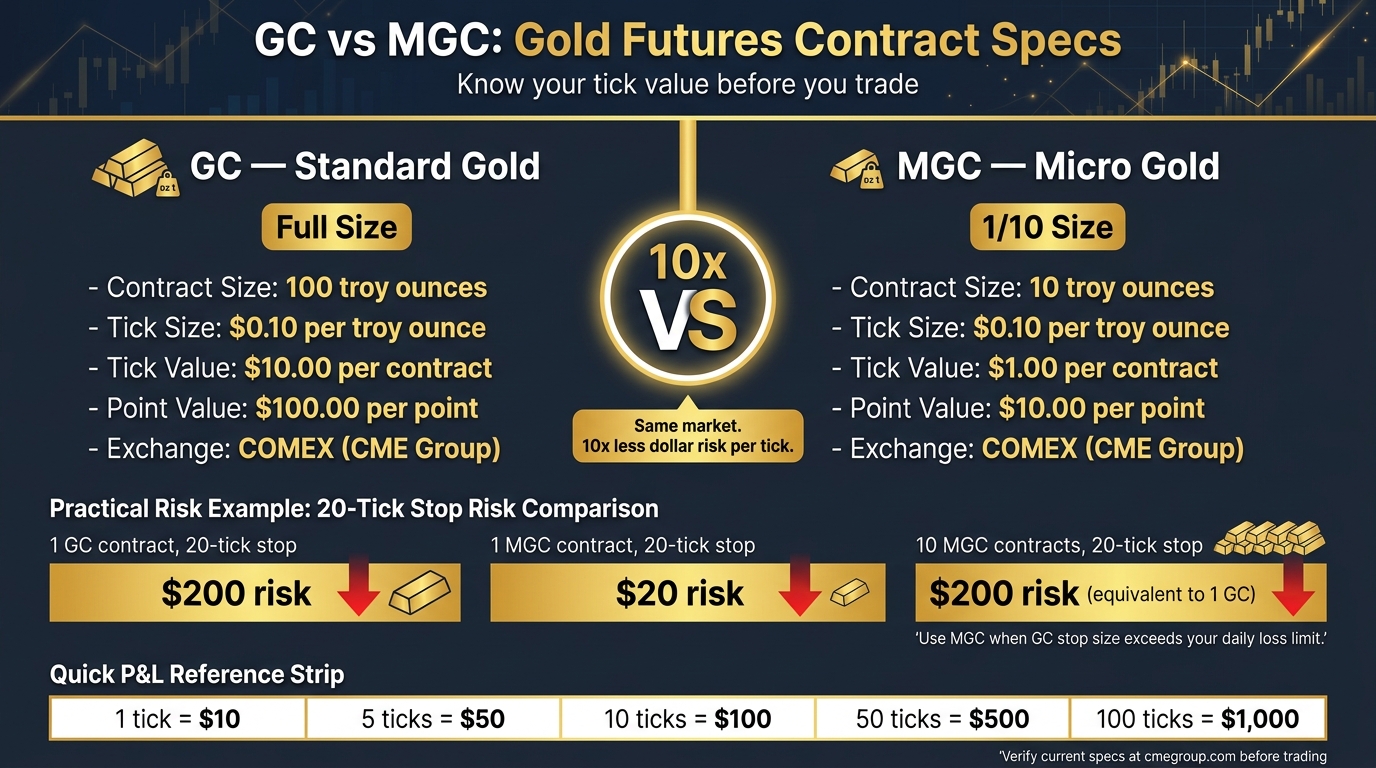
GC vs MGC Gold Futures: Contract Specs & Tick Value Comparison
MGC Contract Specs That Matter
MGC is the micro gold contract. It’s 1/10 the size of GC, but it tracks the same gold market. The big deal is simple: you get 1/10 the dollar risk per tick.
GC vs MGC Tick Value Comparison
| Feature | GC (Standard Gold) | MGC (Micro Gold) |
|---|---|---|
| Contract Size | 100 troy ounces | 10 troy ounces |
| Tick Size | $0.10 | $0.10 |
| Tick Value | $10.00 | $1.00 |
| Point Value | $100.00 | $10.00 |
That 10-to-1 gap carries across contract size, tick value, and point value. You can use a futures contract size converter to quickly toggle between these units.
When to Use MGC Instead of GC
This is where MGC makes life easier.
If your prop firm evaluation account has a $2,000 trailing drawdown, a 20-tick stop on 1 GC contract puts $200 at risk. That same 20-tick stop on 1 MGC puts just $20 at risk. So if you want the same total risk, you can trade 10 MGC contracts and still stay at $200 total risk [2].
That matters when you need tighter control over position size. GC is fine for charting and reading the market. But if the account is tight, execute on MGC so your dollar risk stays under control. It gives you more room to size in, scale out, or trim risk without getting pushed around by a contract that’s too big.
Use that contract-size gap to convert stops into dollar risk in the next section.
Applying GC Contract Specs in a Futures Prop Firm Account
Convert Your Stop Into Dollar Risk
Once you know GC pays $10.00 per tick, the next job is simple: turn that into dollar risk before you hit buy or sell.
You need one number upfront: how much money are you risking on this trade? Take your stop distance in ticks and multiply it by the tick value.
A 30-tick stop on 1 GC contract = $300 in risk ($10.00 × 30 ticks).
| Stop Distance | Contracts | Total Dollar Risk |
|---|---|---|
| 10 ticks | 1 GC | $100.00 |
| 20 ticks | 1 GC | $200.00 |
| 30 ticks | 1 GC | $300.00 |
| 50 ticks (5 points) | 1 GC | $500.00 |
That’s the raw trade risk. Then fees chip away at the result. At $3–$5 round trip per contract, a 10-tick winner on 1 GC leaves about $95–$97 before slippage. Small move, small margin for error.
That’s why this matters in a prop account. Your risk per trade has to fit inside the firm’s daily loss limit before you enter. Not after the fact. Not once the trade starts moving against you.
Work Backward From Daily Loss Limits
The clean way to size GC in a prop account is to work backward from the firm’s limit.
Start with the daily loss limit or trailing drawdown. Then set your stop. Then decide contract count. In plain English:
- Firm limit first
- Stop size second
- Contract count last
That order matters. If you flip it around, you end up forcing trades into risk limits that don’t fit.
If GC feels too big, don’t force it. Use MGC instead. It gives you more control when the stop you need on GC would eat too much of your allowed drawdown.
Trailing drawdowns make this even tighter. They follow your highest balance, which means your room can shrink after you make new highs. A setup that fit yesterday might be too big today. You want that mapped out before the first trade, not while you’re trying to manage heat.
Tools for Position Sizing and Account Planning
Once the math looks right, run it through a calculator and confirm the size.
Use the Damn Prop Firms Position Size Calculator to turn stop distance and drawdown into contract count. Then use the Futures Profit Split Converter to estimate net payout.
Other Things to Know Before Trading GC
Notional Value and Volatility Context
Once you get the tick math down, the next step is seeing the actual exposure sitting behind one GC contract. A $10 tick looks tame on paper. In live markets, it doesn’t stay tame for long.
A CPI print can move GC $30 in minutes. That’s a $3,000 swing on one contract [1]. Weekend gaps or geopolitical headlines can move gold $20 to $50 per ounce, which means $2,000 to $5,000 of risk before the market even reopens [1]. The tick math is easy. The contract exposure is where traders get punched in the face.
That’s why front-month timing matters.
Delivery and Front-Month Awareness
If you’re holding GC past the intraday session, delivery dates stop being background noise. They matter.
The big issue is staying long into FND, the first day a long can get assigned delivery. Most active traders should roll into the next front month 2–3 weeks before FND to stay in the liquid contract and avoid delivery risk [1]. GC trades on the February, April, June, August, October, and December cycle.
Always Verify Specs on CME Group

Before you put on a swing trade, check CME Group for the contract details that matter: last trading day, FND, holiday hours, and margin at cmegroup.com [1].
Bottom Line on GC Tick Value
Use GC tick math before you enter the trade. Set your stop, target, and size first. If the stop blows past your drawdown, cut size or move to MGC. Simple as that. Gold can move hard and fast.
If GC swings too much in dollar terms for your stop or account heat, use MGC instead. It gives you more room to stay sane without getting chopped up by oversized risk. Check the current contract specs on CME Group before you trade.
FAQs
How many ticks are in a 1-point move in GC?
There are 10 ticks in a 1-point move in Gold futures (GC).
GC’s minimum price fluctuation is 0.10, so a full $1.00 move equals 10 ticks. Each tick is worth $10.00, which means a 1-point move is $100.00 in profit or loss per contract.
When should I trade MGC instead of GC?
Trade MGC instead of GC if you need smaller size to keep risk under control, especially on choppy days or when your account isn’t that big.
MGC is 10 troy ounces. GC is 100. So the tick value on MGC is $1.00, while GC is $10.00.
That matters fast.
Your stops are easier to place. Your targets don’t need to be huge. And your daily risk limit is a lot easier to respect when each tick isn’t hitting you for $10.
How do I calculate GC risk before entering a trade?
Work out your risk the simple way: stop size in ticks × tick value.
For GC, one $0.10 tick equals $10.00 per contract. For MGC, one $0.10 tick equals $1.00 per contract.
So if your stop is 10 ticks:
- 1 GC = $100.00 at risk
- 1 MGC = $10.00 at risk
That gap matters. A stop that feels fine on MGC can get expensive fast on GC. Always check the CME Group contract specs before you place a trade.