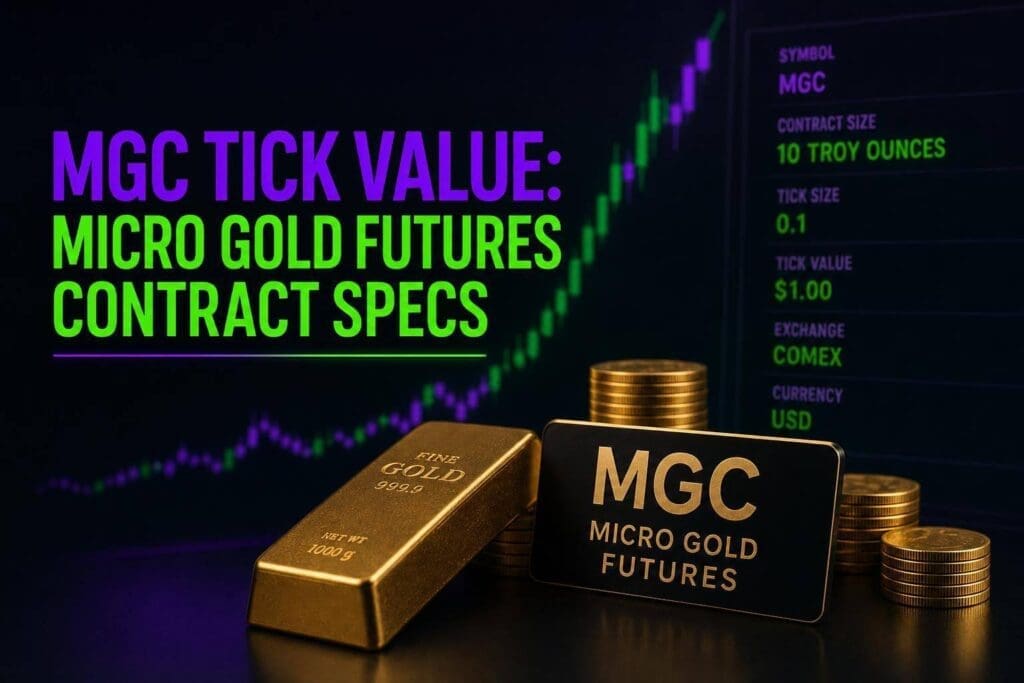
One MGC tick is worth $1.00. That means every $0.10 move in gold equals $1.00 per contract, and every $1.00 move equals $10.00. That’s the whole game with Micro Gold: same gold market, way less size than GC.
If you’re trading MGC, you don’t need a wall of spec-sheet fluff. You need the math, the contract size, and how that turns into risk on your account. I’ll keep it tight and stick to what matters: tick value, point value, contract size, GC comparison, and trading hours.
E-Micro Gold Futures and Silver 1000oz Futures
sbb-itb-46ae61d
Introduction
MGC is the Micro Gold futures contract on the COMEX division of CME Group. It’s sized at 10 troy ounces and quoted in U.S. dollars per troy ounce.[1] That small line in the spec sheet matters, because it tells you how every move in price turns into actual dollars on your P&L using a futures trading profit calculator.
MGC is financially settled, so you don’t have to deal with physical delivery risk or First Notice Day management.[1] That makes it a cleaner contract for traders who want gold exposure without the extra admin headache.
Those specs are what you use to turn chart movement into dollar risk, set position size, and stack MGC up against GC without guessing. Next up: contract specs, tick math, GC comparison, and trading hours.
Table of Contents
- What Is MGC Micro Gold?
- MGC Contract Specs
- How Much Is One MGC Tick Worth?
- MGC vs. GC Tick Value: Key Differences
- MGC Trading Hours
- Using MGC Tick Value for Position Sizing
- Bottom Line on MGC Contract Specs
What Is MGC Micro Gold?
MGC is COMEX Micro Gold. One contract represents 10 troy ounces, which is one-tenth the size of GC, and it’s cash-settled.[1] That smaller contract size matters. It makes tick-based risk a lot easier to manage without taking on the same chunk of exposure you’d get with full-size gold.
At a gold price of $3,000 per ounce, one MGC contract has a notional value of $30,000. A standard GC contract at that same price comes in at $300,000.[1] That’s a huge gap. If your account size is smaller, or you just want tighter control over position sizing, MGC gives you a cleaner way to do it.
How MGC Fits Into the Gold Futures Lineup
A lot of traders read GC for the bigger picture and trade MGC for the smaller size, especially when gold gets jumpy.[1] Same market. Less size. That’s the appeal.
How MGC Prices Are Quoted
MGC is quoted in U.S. dollars per troy ounce.[1] So if gold is trading at $3,250.40 per ounce, one MGC contract controls $32,504 worth of gold. That quote format is also why every $0.10 move turns into a fixed dollar tick value.
MGC Contract Specs
Here’s the quick version: MGC is 10 troy ounces of gold, the minimum tick is $0.10, the tick value is $1.00, and the point value is $10.00.
Contract Size, Symbol, and Exchange
The root symbol is MGC, and it trades electronically on the COMEX division of CME Group through CME Globex.[1] Each contract represents 10 troy ounces of gold. MGC is cash-settled.[1]
Tick Size, Tick Value, and Point Value
The minimum price move is $0.10 per troy ounce. Because one MGC contract covers 10 ounces, that move works out to $1.00 per contract. That’s the tick value.[1]
A $1.00 move in gold equals $10.00 on one MGC contract. Nice and clean. If gold moves from $2,450.00 to $2,451.00, one contract gains or loses $10.00.
| Specification | Detail |
|---|---|
| Root Symbol | MGC |
| Exchange | COMEX (CME Group) |
| Contract Unit | 10 troy ounces |
| Price Quotation | U.S. dollars and cents per troy ounce |
| Minimum Tick Size | $0.10 per troy ounce |
| Tick Value | $1.00 per contract |
| Point Value | $10.00 per $1.00 move |
| Settlement | Cash-settled |
| Initial Margin | About $1,100 |
Contract Months and Expiration
MGC trades the February, April, June, August, October, and December contract months.[1] The contract code uses the root symbol, month code, and year, so MGCZ26 means December 2026.[2]
Most of the volume sits in the front month. That’s the one most traders watch. A lot of traders roll into the next front month about 2 to 3 weeks before expiration to stay where the action is.[1]
Those specs matter because they drive all the tick-value math in the next section.
How Much Is One MGC Tick Worth?
One MGC tick is worth $1.00 per contract. MGC moves in $0.10 increments, and each contract controls 10 troy ounces. So a $1.00 move equals 10 ticks, or $10.00 per contract.[1]
The MGC Tick Value Formula
Tick Value = Tick Size × Contract Size
For MGC, the math is simple: $0.10 × 10 troy ounces = $1.00 per tick.[1]
MGC P&L Examples by Tick Move
Here’s how those tick moves turn into dollar P&L at different size:
| Price Move | Ticks | P&L (1 Contract) | P&L (5 Contracts) |
|---|---|---|---|
| $0.10 | 1 | $1.00 | $5.00 |
| $0.50 | 5 | $5.00 | $25.00 |
| $1.00 | 10 | $10.00 | $50.00 |
| $2.00 | 20 | $20.00 | $100.00 |
| $5.00 | 50 | $50.00 | $250.00 |
| $10.00 | 100 | $100.00 | $500.00 |
Why Tick Value Matters for Stops and Targets
This is where the math stops being trivia and starts helping. If you want to risk $30.00 on a trade, that’s a 30-tick stop on one contract. If you’re aiming for 2:1 reward-to-risk, your target needs to be 60 ticks away.
That gives you a clean way to size trades without guessing using a futures risk management planner. Stop distance turns into dollar risk. Target distance turns into dollar reward. Simple.
That tick math matters even more once you put MGC next to GC.
MGC vs. GC Tick Value: Key Differences
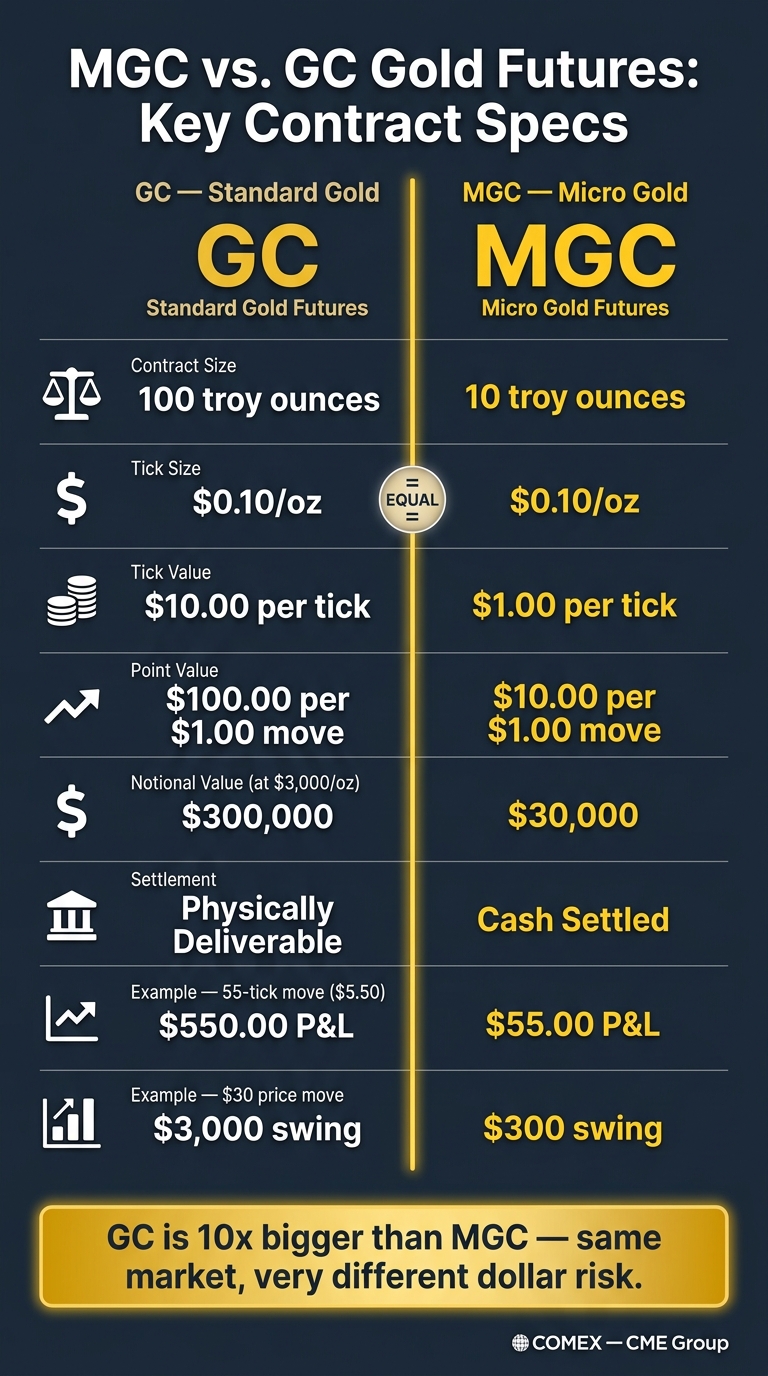
MGC vs. GC Gold Futures: Contract Specs Compared
GC is 10x bigger than MGC. That one gap changes your tick value, point value, and total exposure fast. Same market. Very different dollar swings.
Tick Value and Point Value Side by Side
Both contracts move in $0.10 per ounce increments, so the tick size is the same.[1] The part that changes is what that move is worth in dollars.
| Feature | GC (Standard Gold) | MGC (Micro Gold) |
|---|---|---|
| Contract Size | 100 troy ounces | 10 troy ounces |
| Tick Size | $0.10/oz | $0.10/oz |
| Tick Value | $10.00 | $1.00 |
| Point Value | $100.00 | $10.00 |
| Settlement | Physically deliverable | Financially settled |
| Notional Value (at $3,000/oz) | $300,000 | $30,000 |
A 55-tick move in gold, from $2,000.00 to $2,005.50, pays or loses $550.00 per GC contract and $55.00 per MGC contract.[1]
That 10x gap hits hardest when you’re sizing risk.
Position Sizing and Notional Exposure
A $30 move in gold means a $3,000 swing on one GC contract and $300 on one MGC contract.[1] That’s the whole point of Micro contracts. You get more control.
MGC lets you scale in and out without boxing yourself in. GC doesn’t. If you want to trim about 30% of a position, you can sell 3 MGC contracts. You can’t do that with a single GC contract.[1]
That’s why MGC is easier to work with when you’re managing risk trade by trade.
Which Contract Fits Prop Traders Better
For most prop firm evals, MGC fits better because the lower tick value gives you more room inside tight drawdown rules.[1] An 8-tick move against you is $80 on GC and $8 on MGC.
A lot of traders chart and read flow on GC, then execute on MGC to keep dollar risk under control.[1]
Execution matters most when liquidity is at its best.
MGC Trading Hours
The tick value stays the same. Fill quality does not.
MGC trades almost 23 hours a day, five days a week. The daily maintenance break is 5:00 p.m. to 6:00 p.m. ET. CME lists the official schedule for this contract in Eastern Time (ET).[1]
CME Globex Hours for MGC

MGC trades on CME Globex from Sunday through Friday. The market opens at 6:00 p.m. ET on Sunday and closes at 5:00 p.m. ET on Friday.[1]
When Liquidity Is Strongest
The best liquidity usually shows up during the London-New York overlap, around 8:00 a.m. to 11:30 a.m. ET. The COMEX open at 8:20 a.m. ET is often the wildest part of the day, with heavier movement for the next 30 to 60 minutes.[1]
For most intraday traders, that U.S. morning window gives you the best mix of volume and cleaner fills.
Match your stop size and order type to the session you’re trading.
| Session | Time (ET) | Liquidity | What to Expect |
|---|---|---|---|
| Asian | 6:00 p.m. – 3:00 a.m. | Lowest | Wider spreads, thin depth, elevated gap risk |
| London | 3:00 a.m. – 11:30 a.m. | Moderate to High | Volume builds; London AM Fix at 5:30 a.m. ET |
| U.S./COMEX | 8:20 a.m. – 1:30 p.m. | Peak | Tightest spreads, highest volume |
| Midday lull | 12:00 p.m. – 2:00 p.m. | Low | Volume drops 60%–70%; choppy price action [3] |
| Maintenance | 5:00 p.m. – 6:00 p.m. | None | Market closed; no execution possible |
Two parts of the day need more respect than people give them.
The Asian session from 6:00 p.m. to 3:00 a.m. ET is usually the thinnest stretch. MGC spreads can widen to 2 to 3 ticks, compared with the usual 1-tick spread during peak U.S. hours.[1] That matters more than it sounds. A fixed $1.00 tick doesn’t mean your trade behaves the same in every session. Thin overnight depth can turn a one-tick idea into a worse fill fast.
The midday lull from 12:00 p.m. to 2:00 p.m. ET is another soft patch. Volume drops by 60% to 70%, and price action often gets choppy.[3] That’s a bad time to lean on market orders.
Stops that make sense during COMEX hours can get clipped overnight just because the book thins out. Same contract. Same tick value. Different trading conditions.
Using MGC Tick Value for Position Sizing
MGC tick value is what turns a stop from a chart idea into a hard dollar number. That’s the part that matters. Once you know each tick is $1.00 per contract, position sizing gets dead simple.
Dollar Risk by Stop Size
The formula stays the same every time: Stop Size (ticks) × $1.00 × Number of Contracts = Total Dollar Risk.
A 15-tick stop on one MGC contract risks $15.00. A 30-tick stop risks $30.00. Bump that up to five contracts, and those same stops turn into $75.00 and $150.00.
This is how you turn ticks into exact dollar risk instead of guessing.
| Stop Size | 1 Contract | 2 Contracts | 5 Contracts |
|---|---|---|---|
| 15 Ticks | $15.00 | $30.00 | $75.00 |
| 30 Ticks | $30.00 | $60.00 | $150.00 |
| 50 Ticks | $50.00 | $100.00 | $250.00 |
| 100 Ticks (10 pts) | $100.00 | $200.00 | $500.00 |
Setting Targets Using Tick Value
The same setup works for targets. A 50-tick target on three contracts pays $150.00 before commissions. A 100-tick target – a 10-point move – pays $100.00 per contract.[1]
If you’re trading under a daily loss limit, use that same math to cap your size. Say your daily loss limit is $100.00 (a common threshold at The Futures Desk) and your stop is 25 ticks. That’s $25.00 of risk per contract, which means your max size is 4 contracts before commissions.
Tools to Help With the Math
The Position Size Calculator on Damn Prop Firms does the math fast. That’s one reason MGC is nice for sizing: each contract moves in clean $1.00 ticks.
Use the same tick math for stops, targets, and contract count.
Bottom Line on MGC Contract Specs
After the tick math and the GC comparison, the takeaway is simple: MGC is the 10-troy-ounce micro gold futures contract on COMEX. Each contract represents 10 troy ounces, and the minimum tick is $0.10 per ounce, which comes out to $1.00 per contract[1].
That keeps stop and target planning simple. A $1.00 move in gold = $10.00 per MGC contract[1]. Clean math. No mental gymnastics.
For smaller accounts and prop-style risk management, MGC gives you gold exposure with tighter control over dollar risk. If you need smaller swings and more precise position sizing, MGC is the cleaner fit.
FAQs
How many MGC contracts should I trade?
Size your MGC position off three things: your account balance, your drawdown rules, and how much pain you’re willing to take on one trade. MGC keeps things lighter than standard GC because it tracks 10 troy ounces of gold and has a $1.00 tick value.
The math is simple. Take your max dollar risk for the trade and divide it by your stop size in ticks. That gives you your contract count.
Formula:
Contracts = max dollar loss per trade ÷ stop-loss distance in ticks
Then do one more check before you hit buy or sell:
- Stay under your firm’s max position size
- Keep the trade far enough from your drawdown line that one loss won’t put you in a hole
That’s the whole game. If your stop is wide, your size needs to shrink. If your drawdown is tight, size down again. MGC makes that easier to manage than full-size GC.
Is MGC better than GC for small accounts?
Yes. MGC is usually the better fit for small accounts because the margin is lower and the contract size gives you tighter risk control than full-size GC.
GC is 100 troy ounces and has a $10.00 tick value. MGC is 10 troy ounces and has a $1.00 tick value. That difference matters fast when gold starts moving.
A lot of traders chart and read order flow on GC, then place the trade on MGC. Same market. Smaller punch. You get finer position sizing and more room to manage risk without taking the full hit of a GC contract in a volatile session.
When is the best time to trade MGC?
The best time to trade Micro Gold (MGC) is usually the U.S./COMEX session, mainly from 8:20 AM to 1:30 PM ET. That’s when liquidity is at its best and the market tends to move cleanly.
The busiest stretch is the London-New York overlap, roughly 8:00 AM to 11:30 AM ET. If you want tighter action and more participation, that’s the window most traders care about.
A lot of traders stay away from the 12:00 PM to 2:00 PM ET dead zone. Volume often drops off there, and price action can get thin and annoying.