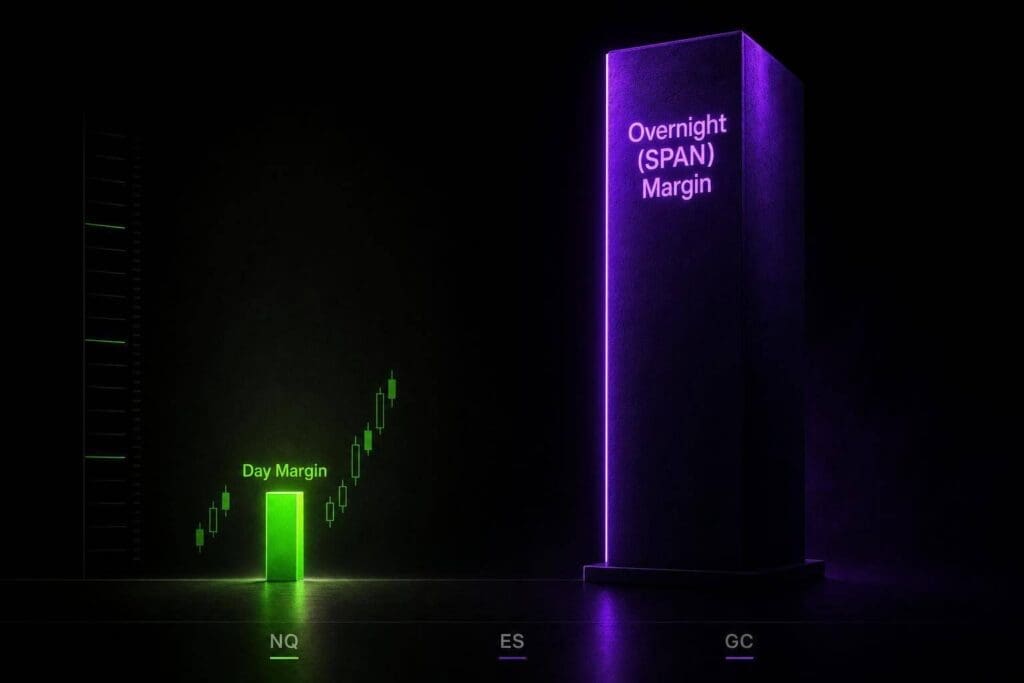
Short version: day margin gets you into the trade, overnight margin decides if you can keep it. That’s the whole game. A contract that only needs $50, $500, or something close during the session can need 10x to 25x more at the cutoff. Miss that switch and your broker can flatten you fast.
I’d treat intraday margin like a temporary discount, not your true position size limit. If you hold futures into the close, the only number that matters is the overnight requirement plus a buffer. Below, I’ll break down the split in plain English, point out where traders get clipped, and show what that means for ES, NQ, CL, and micros.
Margin
What Is The Difference Between Day Trading Margin And Overnight Margin?
Day margin is a broker-set intraday discount. Overnight margin is the exchange minimum you need if you want to hold past the close. The gap exists because futures margin is marked to market, so P&L hits your account equity right away.[7][1]
How Futures Margin Works
Futures margin is a performance bond, not a loan and not a down payment. It’s the collateral behind the contract if price moves against you. Since futures accounts are marked to market each day, wins and losses flow into your equity immediately. That means the bond has to stay funded for as long as the trade is open.
Day Margin vs Overnight Margin: The Short Version
Brokers offer reduced intraday rates to pull in active traders who flatten before settlement. In many cases, day margin is only 10% to 25% of the exchange-required overnight margin. That’s your day trading margin.
Overnight margin is different. It’s the exchange minimum required to carry the position past the session close, and brokers can’t set it lower for overnight holds.[7][1]
Next, look at how that gap shows up on ES, NQ, CL, and micros.
What Is Day Trading Margin On ES, NQ, CL, And Micros?
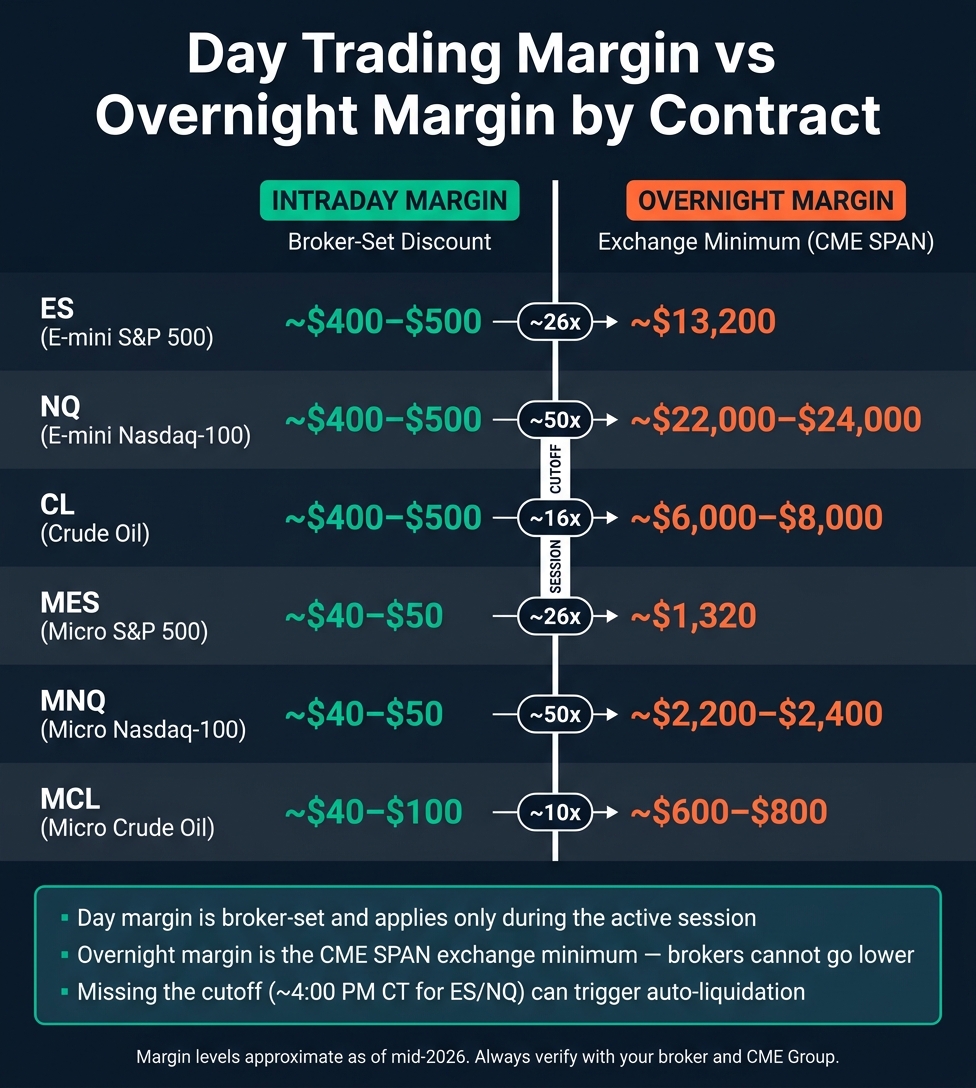
Day Trading Margin vs Overnight Margin: Key Contracts at a Glance
Day trading margin is the intraday equity your broker wants in the account to hold a futures position during market hours. The part that matters is simple: you need to be flat before the cutoff if you want the lower day margin.
Who Sets Day Trading Margin
CME sets the exchange minimum for overnight margin through SPAN, while brokers set intraday margin.[1][2] That means your broker controls the day rate, not CME. It also means the broker can bump that rate with no notice.[2][3]
That’s where traders get smoked. Lower intraday margin gives you more leverage, but it also leaves less room for error if you’re trading with a thin buffer.[2][3]
Typical Day Trading Margin Ranges In U.S. Dollars
Here’s the range most traders see on common U.S. futures contracts.
| Contract | Typical Intraday Margin | Typical Overnight Margin (SPAN) |
|---|---|---|
| ES (E-mini S&P 500) | $400–$500 [1][3] | ~$13,200 [7] |
| NQ (E-mini Nasdaq-100) | $400–$500 [3] | Broker/exchange dependent |
| CL (Crude Oil) | Broker/exchange dependent [1][3] | $6,000–$8,000 [7] |
| MES (Micro S&P 500) | $40–$50 [3][7] | ~$1,320 [7] |
| MNQ (Micro Nasdaq-100) | $40–$50 [3] | Broker/exchange dependent |
| MCL (Micro Crude Oil) | $40–$100 [3][5][7] | Broker/exchange dependent |
MES, MNQ, and MCL are one-tenth the size of the full-size contracts, so the intraday margin is a lot lower.[3][7] That sounds nice on paper. It does not mean the trade is safe.
Low day margin just means you can control the contract with less cash up front. Risk is still risk.
These lower intraday rates only matter if the position is closed before the broker’s overnight cutoff.
Brokers can also jack up intraday margin with no warning, especially around major news. If your account buffer is thin, that can lead to a margin call or straight liquidation.[2][3]
When Day Margin Applies
Intraday margin only applies before the broker’s cutoff. For CME equity index futures, that cutoff usually lands around 4:00 PM CT (5:00 PM ET), right before the daily maintenance break.[5][7]
If you’re still holding the position then, the broker reprices it to overnight margin. If the account can’t support that higher amount, the position can be auto-liquidated. At the cutoff, the broker flips the trade from day margin to overnight margin.
What Is Overnight Margin In Futures?
Overnight margin is the exchange-set minimum you need to hold a futures position past the cutoff. It’s set through SPAN, short for Standard Portfolio Analysis of Risk.[7][2] Your broker can ask for more. They can’t go below the exchange floor.
That sets up the next part: initial margin vs. maintenance margin.
Initial Margin vs Maintenance Margin
Initial margin is what you need to open a position or keep it into the next session. Maintenance margin is the minimum account equity you need to stay above if you want to avoid a margin call or forced liquidation.[7]
Those numbers change by contract.
Typical Overnight Margin For ES, NQ, CL, MES, MNQ, And MCL
As of mid-2026, common CME overnight initial margin levels are about this:[7]
| Contract | Symbol | Est. Overnight Initial Margin |
|---|---|---|
| E-mini S&P 500 | ES | ~$13,200 [7] |
| Micro E-mini S&P 500 | MES | ~$1,320 [7] |
| E-mini Nasdaq-100 | NQ | ~$22,000–$24,000 [7] |
| Micro E-mini Nasdaq-100 | MNQ | ~$2,200–$2,400 [7] |
| Crude Oil | CL | ~$6,000–$8,000 [7] |
| Micro Crude Oil | MCL | ~$600–$800 [7] |
Micro contracts are one-tenth the size of the full-size version, so the overnight margin is also about one-tenth as much.[7] That’s why they make sense for smaller accounts. You still get the same market, just with less size and less capital tied up.
Why Overnight Margin Is Higher
Overnight margin is higher because of gap risk. The market can move hard between one session close and the next open, especially when liquidity thins out or news hits after the day session ends.[7][5]
That’s the whole reason exchanges keep the overnight number well above intraday margin. Brokers offer lower day rates because they expect you to flatten before settlement. In many cases, those reduced intraday rates are only 10% to 25% of the full overnight requirement.[7]
So if you’re used to tiny day margin on ES or NQ, the overnight number can feel like a slap in the face. It is. But that’s the cost of holding risk when the market is closed and price can jump without giving you a clean exit.
Here’s how day margin and overnight margin compare side by side.
Day Trading Margin vs Overnight Margin: Side-By-Side Comparison
Put these side by side and the cutoff issue gets obvious fast. A trade that looks fine on day margin can still blow up at the overnight check.
Comparison Table: Day Margin vs Overnight Margin
| Feature | Day Trading Margin | Overnight Margin |
|---|---|---|
| Who Sets It | Your broker [1][2] | The exchange (CME Group) [1][2] |
| When It Applies | During the active session [2] | After the session cutoff [2] |
| Capital Required | Low [3] | Much higher [1][3] |
| Forced Exit Risk | Rises if equity drops intraday [1] | Rises if equity is below the cutoff requirement [1][4] |
That’s the whole split: broker discount vs exchange minimum. Intraday, the gap can look harmless. After the cutoff, it can be big enough to get you liquidated.
How Large The Margin Gap Can Be
This gap is a lot bigger than most newer traders think. A broker might let you trade one ES contract intraday for $500, while the exchange-set overnight margin for that same contract is over $12,000.[1] Same contract. Totally different capital check.
That’s why traders get caught. They size the trade off the day rate, then the close hits and the math changes.
Don’t use intraday margin to size an overnight hold.
Use the overnight number. Not the day rate.
sbb-itb-46ae61d
When Does Margin Change At The Close Or Into A New Session?
The part that trips traders up is timing. At the broker cutoff, intraday margin ends. Overnight margin starts right then and there.[7]
Common Cutoff Windows For U.S. Futures
For CME equity index futures like ES, NQ, MES, and MNQ, the cutoff is usually 4:00 PM CT / 5:00 PM ET.[7] But don’t assume the exchange time is the one that matters. Brokers and platforms can flip you earlier than CME does. Check your broker’s margin page or contract specs page and get the exact time from them.
Once that cutoff hits, the requirement jumps from the intraday rate to the full SPAN overnight margin.[7] If your account equity doesn’t cover it, the broker can liquidate the position.[7] Simple as that. The exact minute matters more than the session date.
Why A Position Can Be Fine At 3:30 PM ET But Not At 3:59 PM ET
This is where people get clipped.
At 3:30 PM ET, one ES contract might need only about $500 in intraday margin. By 3:59 PM ET, if you’re holding it into the 4:00 PM close, you may need around $13,200 available.[7] That’s not a small jump. That’s a brick wall.
If your equity is short, the broker can liquidate the trade, and that often happens at a worse price after the close.[7] That’s how traders end up with accidental overnight holds. Not because the trade changed, but because the margin rule did.
What Happens If You Don’t Meet Overnight Margin?
When intraday margin switches to overnight margin at the cutoff, your cheap daytime hold disappears fast. If your account equity doesn’t cover the higher requirement, the broker will usually flatten the position for you.[1][8] No warning. No grace period. In some cases, you also get hit with a liquidation fee. For prop traders, it can get worse: forced exit plus a rule breach.
If equity falls under maintenance margin, you’re in margin-call territory. Some brokers don’t wait around. They flip the account to liquidation-only mode until you add funds or cut risk.[8]
Auto-Liquidation And Forced Exit Risk
A lot of brokers run automated risk controls. That’s the whole point. If you don’t meet the overnight requirement at the cutoff, the system can force-close the trade at market.[1][8] That means you don’t get to pick the exit price. The market does.
This matters most near the close, when things can get jumpy and fills can get ugly. If you’re oversized, or your account is already beat up, that auto-liquidation can turn a bad trade into a much worse one.
The Accidental Overnight Hold
Most accidental overnight holds come from boring stuff, not some big plan gone wrong:
- You miss the exit
- Your platform disconnects or your internet dies
- You assume micros are always cheap enough to hold past the close[1][4]
That last one trips up a lot of traders. An MES or MNQ trade might only need $50 to $100 intraday, but overnight margin is often about 10x higher.[5][3] So a position that looked harmless at 3:55 PM can become a problem five minutes later.
Another classic mistake is dragging a losing trade into the close and hoping the overnight session bails you out. That’s where people get smoked. The danger isn’t just the bad entry. It’s the margin switch and the gap risk. The market can reopen at a very different price, and losses can go past the account balance.[4][5]
Set up a backup way to flatten. Keep the broker desk number handy. Make sure the mobile app works before you need it.[4] That’s also why contract size matters in the examples below.
Practical Examples: ES, NQ, CL, MES, MNQ, And MCL
This is where traders get clipped. A position looks cheap all day, then the session rolls over and the margin check changes fast. What looked fine at $500 intraday can suddenly need $12,000+ to stay open.
The problem isn’t the entry. It’s the handoff from intraday margin to overnight margin. Miss that switch by a few minutes and the platform can flatten you.
Full-Size Contracts: ES, NQ, And CL
With full-size contracts, the gap is big enough to hurt.
A single ES contract will often cost about $500 intraday, but holding it overnight usually takes more than $12,000 in exchange-set initial margin [1][3]. NQ and CL work the same way. The intraday number gets you into the trade. The overnight number decides whether you keep it.
| Contract | Typical Intraday Margin | Overnight Margin |
|---|---|---|
| ES | ~$500 [3] | $12,000+ [1] |
| NQ | ~$400–$500 [3] | $10,000+ [3] |
| CL | ~$400–$500 [3] | $6,000–$8,000 [7] |
That means a trader can hold 1 ES all afternoon with no issue, then get rejected at the close because the account doesn’t have five figures sitting there. Same contract. Same position. Different margin regime.
Micro Contracts: MES, MNQ, And MCL
Micros make the dollar hit smaller, but they don’t fix the margin switch.
They’re 1/10th the size of the standard contracts, so the per-contract risk drops [5][6]. That’s why they’re popular. You can size down and stay a lot more precise. But once the market heads into the close, the same rule kicks in: intraday margin goes away, and overnight margin takes over.
Typical intraday margin on micros is only $40 to $50 per contract [3][6]. Sounds cheap. Then the overnight number shows up.
| Contract | Typical Intraday Margin | Overnight Margin |
|---|---|---|
| MES | $40–$50 [3] | ~$1,320 [7] |
| MNQ | $40–$50 [3] | ~$2,200–$2,400 [7] |
| MCL | $40–$100 [3] | ~$600–$800 [7] |
So yes, MES is easier to carry than ES in raw dollars. But if you’re treating micros like some free pass into the close, that’s how you get smoked. An MES position that needed just $40–$50 intraday can still need about $1,320 or more once the overnight check hits [1][7].
If the account doesn’t meet that number, forced liquidation can kick in [1][8]. For prop traders, that’s where firm rules and platform settings start to matter, because the cutoff isn’t just about exchange margin on paper.
Why This Matters For Prop Firm Futures Traders
That margin gap gets a lot nastier inside a funded account.
If you’re trading retail and you miss overnight margin, you usually get a margin call or the broker liquidates you. Bad, but familiar. In a prop setup, the hit is different. Missing overnight margin can turn into an instant rule violation. You’re not just dealing with margin anymore. You’re dealing with a breach that can kill the eval or the funded account fast. A lot of firms will flatten you the second you break the rule.
So yes, session timing is part of position sizing. Treat the last hour like its own risk window. That’s not optional.
A lot of prop firms want you flat before the exchange close, not at the close. If the rule says flat by 3:50 PM ET, then 3:59 PM ET is already too late. No gray area there. Cut size earlier or get flat early. And don’t trust your memory on this stuff. Check the firm’s help center and read the current rule.
The exact cutoff still changes by firm and platform. Margin schedules differ. Auto-liquidation rules differ too. Some platforms bump margin before major news, which can squeeze a position even if price barely moves.
For rule checks, use the firm’s help center for the current cutoff and liquidation rules.
Bottom Line: Which Margin Should You Focus On?
After the ES, NQ, and micro examples above, the rule is simple: both margins matter, but overnight margin is the one that can hurt you.
Day trading margin tells you how many contracts you can carry during regular hours with the money in your account. Overnight margin tells you if you can still hold that same position past the session cutoff. Miss that number, and you can get flattened fast if you’re not watching the clock.
The gap isn’t small. On ES, overnight margin sits around $13,200, while intraday margin can be just $400–$500. So yes, a trade that looks fine during the day can blow up at the cutoff [7][3].
Before the cutoff, do three things:
- Check your broker’s exact liquidation time
- Look up the current CME SPAN margin at cmegroup.com
- Make sure your account equity, not just your cash balance, clears the overnight requirement with some room left
If you’re in a funded or eval account, this matters even more. That’s where a normal hold turns into a rule breach. A solid rule is keeping a 25%–30% buffer above the minimum margin requirement so you’ve got room for a SPAN jump or a late-session drawdown before the close [7].
In funded or evaluation accounts, size down before the cutoff.
Day margin gets you in. Overnight margin keeps you in. Know both before you click buy or sell.
FAQs
How much buffer should I keep above overnight margin?
Keep a buffer based on your total account equity and your own risk tolerance, not just the bare minimum overnight margin. Overnight margin is simply the cash you need to carry a position past the close. Get too close to that line, and you’re asking for a margin call or a forced liquidation if the market moves against you.
The sane move is to size positions so your account stays well above both day margin and overnight margin, with extra room for gap risk. Overnight moves don’t care where your stop was. If you keep finding yourself needing a tight buffer just to hold, cut size or skip the overnight hold.
Can brokers raise intraday margin without warning?
Yes. Brokers can bump up intraday margin with no warning.
That usually happens when volatility spikes, right before major economic news, or around other big market events. Intraday margin is set by the broker, not the exchange, so it can change in the middle of the session based on market conditions, your open positions, and your account equity.
The practical takeaway is simple: don’t run your account right on the edge. Keep extra cash above the minimum so you don’t get caught flat-footed if margin jumps mid-session.
What if I get stuck in a trade near the cutoff?
If you’re still in a trade near the session cutoff, get flat fast. That’s the cleanest way to avoid higher overnight margin hitting your account.
If you don’t have enough margin to hold the position overnight, your broker can auto-liquidate it for you. And yeah, that often comes with extra fees. Since overnight margin is a lot higher than intraday margin, even a small move against you can trigger a margin call.